


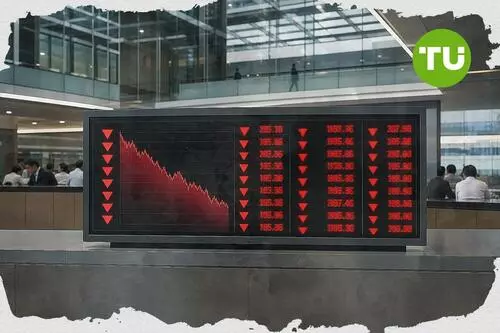
South Korea's benchmark KOSPI index suffered another sharp decline on Tuesday, triggering its eighth circuit breaker of 2026 as investors continued to retreat from semiconductor and artificial intelligence-related stocks. The latest selloff underscores growing concerns over lofty AI valuations and rising leverage across one of Asia's most technology-focused equity markets.
Highlights
- KOSPI triggered its eighth circuit breaker of 2026.
- The index closed 10.84% lower at 6,023.67.
- More than $360 billion in market value was erased.
- Semiconductor stocks led the market decline.
The KOSPI index fell another 10.84%, closing at 6,023.67 after losing 732.09 points, extending its decline to more than 28% over the past month. The latest market rout wiped out an estimated 520 trillion Korean won (approximately $360 billion) in market value and triggered a temporary trading halt under South Korea's circuit breaker rules, according to Cryptopolitan.
Semiconductor weakness drives market lower
The latest decline was led by heavy selling in semiconductor stocks, which remain the backbone of the South Korean equity market. Investors continued to reduce exposure after weakness spread across global AI-related companies, following losses in major U.S. chipmakers.
Memory chip producers came under additional pressure after the initial public offering of Changxin Memory Technology (CXMT) intensified competition concerns across the sector. At the same time, Nvidia shares fell 4.4%, while Micron and SanDisk also posted significant declines, adding to negative sentiment throughout Asian markets.
Samsung Electronics, which represents roughly half of the KOSPI's weighting, amplified the downturn as its decline accelerated index-wide losses. The broader retreat also affected SK Hynix, whose shares have fallen roughly 50% from their June peak, reflecting continued weakness across memory chip manufacturers.
AI valuation concerns spread across markets
Investor sentiment has also been affected by questions surrounding the pace of AI infrastructure spending. Recent financing announcements tied to large-scale AI data center investments have renewed debate about the industry's growing capital requirements and the sustainability of increasingly expensive expansion plans.
Higher borrowing costs and rising debt issuance have prompted investors to reassess valuations across AI-related companies, contributing to broader market volatility. The weakness was not confined to South Korea, with Japan's Nikkei 225 also posting steep losses as technology shares came under pressure.
Some leveraged positions in South Korean equities were reportedly backed by stock collateral, increasing the risk of forced liquidations as prices continued to decline.
Technology markets face a new reality
The latest selloff highlights how closely South Korea's stock market is tied to the global semiconductor industry. As one of the world's largest producers of memory chips, the country's equity market has become a key indicator of investor confidence in artificial intelligence spending and technology demand.
With the KOSPI now down more than 28% in a month, investors are increasingly watching whether the decline represents a temporary repricing of AI-related assets or signals a broader slowdown in technology investment. The performance of semiconductor leaders such as Samsung and SK Hynix is likely to remain central to that outlook in the months ahead.
We also reported SK Hynix shares tumble as global chip selloff deepens.





Latest SK Hynix News





-
 Afghanistan
-
 Albania
-
 Algeria
-
 Angola
-
 Argentina
-
 Armenia
-
 Australia
-
 Austria
-
 Azerbaijan
-
 Bahamas
-
 Bahrain
-
 Bangladesh
-
 Belarus
-
 Belgium
-
 Bolivia
-
 Botswana
-
 Brazil
-
 Brunei
-
 Bulgaria
-
 Cambodia
-
 Cameroon
-
 Canada
-
 Chile
Chile
-
 China
China
-
 Colombia
-
 Congo
Congo
-
 Costa Rica
-
 Cote d'Ivoire
-
 Croatia
-
 Cuba
Cuba
-
 Cyprus
-
 Czechia
-
 DR Congo
-
 Denmark
-
 Dominican Republic
-
 Ecuador
-
 Egypt
Egypt
-
 El Salvador
-
 Estonia
-
 Eswatini
-
 Ethiopia
-
 Finland
-
 France
-
 Georgia
-
 Germany
-
 Ghana
Ghana
-
 Greece
-
 Haiti
Haiti
-
 Hong Kong
-
 Hungary
-
 India
India
-
 Indonesia
-
 Iran, Islamic republic
-
 Iraq
Iraq
-
 Ireland
-
 Israel
-
 Italy
Italy
-
 Jamaica
-
 Japan
Japan
-
 Jordan
-
 Kazakhstan
-
 Kenya
Kenya
-
 Korea
Korea
-
 Kuwait
-
 Kyrgyzstan
-
 Laos
Laos
-
 Latvia
-
 Lebanon
-
 Lesotho
-
 Libya
Libya
-
 Lithuania
-
 Luxembourg
-
 Madagascar
-
 Malaysia
-
 Malta
Malta
-
 Mauritius
-
 Mexico
-
 Moldova
-
 Mongolia
-
 Montenegro
-
 Morocco
-
 Mozambique
-
 Myanmar
-
 Namibia
-
 Nepal
Nepal
-
 Netherlands
-
 New Zealand
-
 Nigeria
-
 North Macedonia
-
 Norway
-
 Oman
Oman
-
 Pakistan
-
 Palestine
-
 Panama
-
 Papua New Guinea
-
 Paraguay
-
 Peru
Peru
-
 Philippines
-
 Poland
-
 Portugal
-
 Puerto Rico
-
 Qatar
Qatar
-
 Reunion
-
 Romania
-
 Rwanda
-
 Saudi Arabia
-
 Serbia
-
 Singapore
-
 Slovakia
-
 Slovenia
-
 Somalia
-
 South Africa
-
 Spain
Spain
-
 Sri Lanka
-
 Sweden
-
 Switzerland
-
 Syria
Syria
-
 Taiwan
-
 Tajikistan
-
 Tanzania
-
 Thailand
-
 Trinidad and Tobago
-
 Tunisia
-
 Turkey
-
 UAE
UAE
-
 Uganda
-
 Ukraine
-
 United Kingdom
-
United States
-
 Uruguay
-
 Uzbekistan
-
 Venezuela
-
 Vietnam
-
 Yemen
Yemen
-
 Zambia
-
 Zimbabwe
- Forex
- Crypto












