
Do Most Binary Options Traders Lose Money?


Editorial Note: While we adhere to strict Editorial Integrity, this post may contain references to products from our partners. Here's an explanation for How We Make Money. None of the data and information on this webpage constitutes investment advice according to our Disclaimer.
Yes. Most available research from regulators and financial watchdogs indicates that the majority of retail binary options traders lose money. Depending on the market and study, around 70-90% of retail accounts end with losses. One of the main reasons is the payout structure, which often requires traders to win more than half of their trades just to break even. Short-term contracts, poor risk management, and unregulated offshore platforms further reduce the chances of long-term success.
Multiple regulatory studies have found that most retail traders lose money when trading high-risk derivatives, including binary options. Available binary options success rate statistics consistently show that profitable traders represent only a small minority.
European regulators have reviewed retail derivatives markets and reported persistent losses among individual investors. According to analyses referenced by the European Securities and Markets Authority (ESMA), a large majority of retail accounts trading high-risk derivative products end up losing money.
These findings help explain why binary options retail trader loss rate statistics are consistently high, especially on offshore platforms offering very short expiration times and limited investor protections.
Risk warning: Binary options trading is highly risky and may result in a total loss of funds. These speculative instruments often lack strong regulation, with over 80% of traders losing their capital. Invest only what you can afford to lose and seek professional advice.
How binary options really work
Binary options are financial contracts with two possible outcomes. If the trader's prediction is correct at expiration, the contract pays a predetermined amount. If the prediction is incorrect, the investment is lost.
Unlike traditional options or Forex trades, binary options generally do not allow traders to adjust positions, scale in or out, or exit a trade before expiration. The outcome depends entirely on whether the asset's price finishes above or below the strike price at the predetermined expiration time.
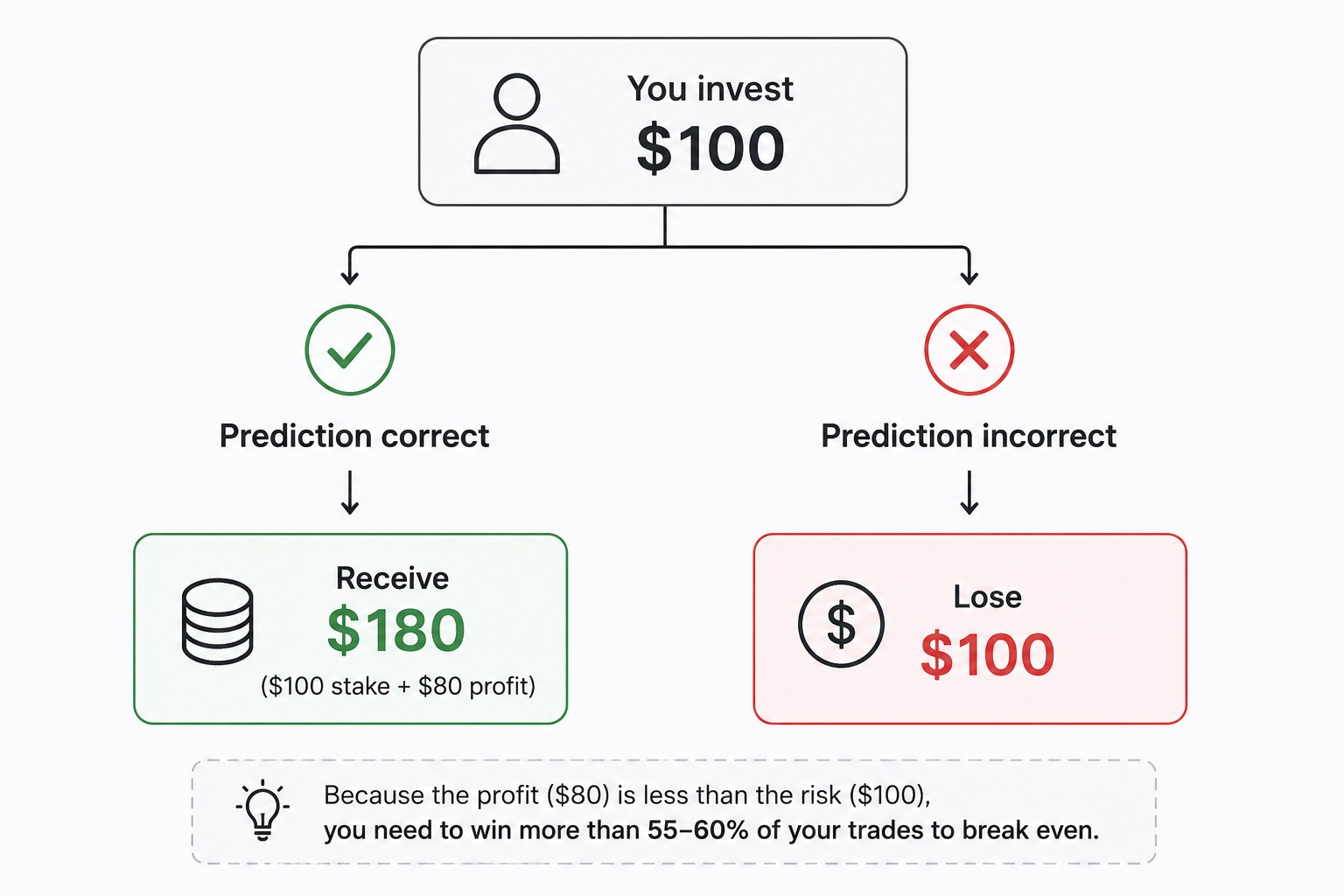
For example, if a trader invests $100 in a contract that offers an 80% payout, a successful trade returns $180, including the original investment, while an unsuccessful trade results in the loss of the full $100. Because the potential profit ($80) is smaller than the amount at risk ($100), traders must win more than half of their trades just to break even. Lower payout ratios require an even higher win rate.
This built-in imbalance is one of the main reasons why most retail binary options traders lose money over time, even if they correctly predict market direction on many trades.
Binary options success rate statistics
Several studies have examined the binary trading success rate by analyzing retail trading accounts. Although the exact figures vary across markets and research methods, the overall conclusion is consistent: most retail traders lose money over time.
| Metric | Typical estimate |
|---|---|
| Binary options success rate | 10-30% profitable accounts |
| Retail traders' loss rate | 70-90% losing accounts |
| Percentage of profitable traders | Often below 20% |
| Overall account performance | Majority of accounts end with losses |
These estimates are consistent with findings from regulators and market researchers across different jurisdictions. In some studies of offshore trading environments, where investor protections are weaker and payout ratios are less favorable, reported loss rates are even higher, with some estimates suggesting that up to 95% of traders lose money. However, these figures should be viewed as market-specific estimates rather than universal statistics.
Why short-expiry trading increases losses
Binary options often have expiration times ranging from 30 seconds to just a few minutes. This fast-paced format can appeal to beginners because trades seem simple and offer quick results. However, very short expiries leave little room for market trends to develop.
Instead, random price fluctuations and short-term volatility play a much larger role in determining the outcome of a trade. As a result, even well-researched predictions can be affected by normal market noise, making consistent profitability more difficult.
Japan’s Financial Services Agency (FSA) has warned that accurately predicting an asset's price at a specific moment requires considerable market knowledge, experience, and risk management. These challenges help explain why the success rate of binary options traders tends to remain low, particularly when trading very short-term contracts.
Platform risks and broker fraud
Trading losses are not the only risk associated with binary options. In some cases, traders also face problems related to unregulated or fraudulent platforms. Investigations by financial regulators have identified practices such as:
manipulated pricing feeds;
delayed order execution;
withdrawal restrictions;
misleading advertising that promises easy or guaranteed profits.
The U.S. Commodity Futures Trading Commission (CFTC) has repeatedly warned that fraudulent binary options platforms often use these tactics to attract investors. In 2025, the agency announced a federal court order requiring more than $451 million in restitution and penalties in connection with a major global binary options fraud scheme.
These enforcement actions highlight that retail trader losses are not always the result of poor trading decisions. In some cases, they are also linked to deceptive business practices and the use of unregulated trading platforms.
Structural disadvantages of binary options
Several features of binary options make consistent profitability more difficult than in many other financial markets. Unlike Forex or traditional options, binary contracts offer limited flexibility once a trade has been opened, leaving traders with fewer opportunities to manage risk or respond to changing market conditions.
| Feature | Binary options | Forex or traditional options |
|---|---|---|
| Trade outcome | Fixed win or total loss | Flexible profit or loss |
| Trade management | No adjustment after entry | Position can be modified |
| Risk control | Limited tools | Stop-loss orders, scaling, and other risk management techniques |
| Market duration | Often seconds or minutes | Flexible holding periods |
These structural limitations help explain why many retail traders struggle to achieve consistent results. Even when market direction is predicted correctly, unfavorable payout ratios, limited trade management, and short expiration times can reduce long-term profitability.
Can anyone make money in binary options?
Profitable binary options traders do exist, but they represent a small minority. Available research and regulatory findings consistently show that most retail traders lose money over time, despite the relatively simple structure of binary options.
Long-term trading results are influenced by several factors, including:
payout ratios;
trading strategy;
platform transparency;
risk management.
Beginners often struggle because of unrealistic profit expectations, poor risk management, emotional decision-making, and choosing unreliable brokers. Even experienced traders face challenges, including unfavorable payout ratios, strict timing requirements, and limited opportunities to manage positions once a trade has been opened.
While regulated trading environments may provide better pricing transparency and stronger investor protections, available binary options success rate statistics still indicate that the majority of retail traders do not achieve long-term profitability.
Better alternatives for most traders
Binary options are not the only way to participate in financial markets. Many financial educators recommend starting with instruments that offer greater flexibility, longer trading horizons, and more comprehensive risk management tools.
Unlike binary options, where trade outcomes are fixed once a position is opened, the markets below allow traders to adjust positions, use stop-loss orders, and manage risk as market conditions change.
| Alternative | Advantage |
|---|---|
| Forex trading | Adjustable positions and stop-loss orders |
| Stock investing | Longer investment horizon |
| Futures trading | Transparent exchange pricing |
| Options strategies | Flexible payoff structures |
Top brokers for binary options trading
If you decide to trade binary options despite the risks involved, choosing a reputable broker is one of the most important decisions you can make. Look for platforms that provide transparent trading conditions, clear fee structures, reliable payment methods, and appropriate regulatory oversight where available.
The table below compares leading binary options brokers based on key trading conditions, including minimum deposit, payout range, available instruments, and regulatory status.
| CloseOption | Capitalcore | Nadex | Pocket Option | QUOTEX | |
|---|---|---|---|---|---|
|
Foundation year |
2013 | 2019 | 2009 | 2017 | 2019 |
|
Min. deposit |
5 | 10 | 250 | 5 | 10 |
|
Min. Payout (%) |
17 | 60 | No | 50 | 20 |
|
Max. Payout (%) |
95 | 90 | 100 | 128 | 98 |
|
Withdrawal fee |
0-100 | Different | 0-25 USD | 0-0,5 | No |
|
Demo |
Yes | Yes | Yes | Yes | Yes |
|
Regulation |
No | IFSA | No | MISA | No |
|
Instruments |
Currency pairs, commodities, cryptocurrency, OTC (currency, commodities, stocks) | Currencies, assets of stock and commodity markets | Currency pairs, commodities, cryptocurrencies, indices | Binary options (currency pairs, pairs of fiat and cryptocurrencies) | Binary options on currencies, cryptocurrencies, and metals, Forex, and CFDs on metals, futures indices, cryptocurrencies, and stocks |
|
Open an account |
Go to broker Your capital is at risk. |
Go to broker Your capital is at risk.
|
Study review | Go to broker Your capital is at risk. |
Go to broker Your capital is at risk. |
Don't judge your strategy by a few trades

Many new traders assume that a few successful trades are enough to prove a strategy works, while a short losing streak means it has failed. In reality, binary options are probability-based instruments, and even a well-designed strategy will experience both winning and losing periods. Evaluating performance over a large number of trades provides a much more accurate picture than focusing on individual outcomes.
Another common mistake is chasing higher payouts without considering the probability of success. A contract offering a larger return is often less likely to finish in the money. Before opening a position, consider whether the potential reward justifies the additional risk rather than making decisions based solely on the advertised payout.
Successful traders focus on consistency instead of trying to win every trade. Clear rules, realistic expectations, and disciplined risk management are far more important than finding a strategy that promises quick profits.
Conclusion
The majority of retail binary options traders lose money, a reality confirmed by regulators and starkly illustrated by loss rates ranging from 70% to 90%. This is largely due to unfavorable payout structures and the inflexible, high-risk nature of binary contracts, especially on short-term trades where random market noise often trumps strategy. Even when using a solid approach, traders face structural disadvantages—like the inability to adjust positions or manage risk as they can in Forex or traditional options. Rather than chasing the illusion of easy profits, most should consider more flexible and transparent alternatives that allow for real risk management. Ultimately, consistent success in financial markets hinges not on luck or deceptive simplicity, but on discipline, realistic expectations, and choosing platforms that protect rather than exploit their users.
FAQs
What factors most influence the loss rates among binary options traders?
How do fixed payouts in binary options affect a trader's break-even win rate?
Are certain types of binary options contracts riskier than others?
Why is risk management challenging in binary options trading?
Editors' Top Picks and Insights






Related Articles
Team that worked on the article
Aleksandra Chaikina has been a contributor to Traders Union since 2021. With over 15 years of experience in copywriting and more than 5 years focused on financial content, she specializes in producing detailed guides, analytics, and comparative reviews across various sectors, including cryptocurrencies, Forex, investment strategies, and financial technologies.
Dan Blystone began his trading career in 1998 as an arbitrage clerk on the floor of the Chicago Mercantile Exchange (CME). He later traded bond and Eurex futures at proprietary firms such as Altea Trading, gaining valuable experience in high-frequency trading and risk management.
Chinmay Soni is a financial analyst with more than 5 years of experience in working with stocks, Forex, derivatives, and other assets. As a founder of a boutique research firm and an active researcher, he covers various industries and fields, providing insights backed by statistical data.
Risk management is a risk management model that involves controlling potential losses while maximizing profits. The main risk management tools are stop loss, take profit, calculation of position volume taking into account leverage and pip value.
CFD is a contract between an investor/trader and seller that demonstrates that the trader will need to pay the price difference between the current value of the asset and its value at the time of contract to the seller.
The CFTC protects the public from fraud, manipulation, and abusive practices related to the sale of commodity and financial futures and options, and to fosters open, competitive, and financially sound futures and option markets.
Forex trading, short for foreign exchange trading, is the practice of buying and selling currencies in the global foreign exchange market with the aim of profiting from fluctuations in exchange rates. Traders speculate on whether one currency will rise or fall in value relative to another currency and make trading decisions accordingly. However, beware that trading carries risks, and you can lose your whole capital.
Binary options trading is a financial trading method where traders speculate on the price movement of various assets, such as stocks, currencies, or commodities, by predicting whether the price will rise or fall within a specified time frame, often as short as a few minutes. Unlike traditional trading, binary options have only two possible outcomes: a fixed payout if the trader's prediction is correct or a loss of the invested amount if the prediction is wrong.

-
 Afghanistan
-
 Albania
-
 Algeria
-
 Angola
-
 Argentina
-
 Armenia
-
 Australia
-
 Austria
-
 Azerbaijan
-
 Bahamas
-
 Bahrain
-
 Bangladesh
-
 Belarus
-
 Belgium
-
 Bolivia
-
 Botswana
-
 Brazil
-
 Brunei
-
 Bulgaria
-
 Cambodia
-
 Cameroon
-
 Canada
-
 Chile
Chile
-
 China
China
-
 Colombia
-
 Congo
Congo
-
 Costa Rica
-
 Cote d'Ivoire
-
 Croatia
-
 Cuba
Cuba
-
 Cyprus
-
 Czechia
-
 DR Congo
-
 Denmark
-
 Dominican Republic
-
 Ecuador
-
 Egypt
Egypt
-
 El Salvador
-
 Estonia
-
 Eswatini
-
 Ethiopia
-
 Finland
-
 France
-
 Georgia
-
 Germany
-
 Ghana
Ghana
-
 Greece
-
 Haiti
Haiti
-
 Hong Kong
-
 Hungary
-
 India
India
-
 Indonesia
-
 Iran, Islamic republic
-
 Iraq
Iraq
-
 Ireland
-
 Israel
-
 Italy
Italy
-
 Jamaica
-
 Japan
Japan
-
 Jordan
-
 Kazakhstan
-
 Kenya
Kenya
-
 Korea
Korea
-
 Kuwait
-
 Kyrgyzstan
-
 Laos
Laos
-
 Latvia
-
 Lebanon
-
 Lesotho
-
 Libya
Libya
-
 Lithuania
-
 Luxembourg
-
 Madagascar
-
 Malaysia
-
 Malta
Malta
-
 Mauritius
-
 Mexico
-
 Moldova
-
 Mongolia
-
 Montenegro
-
 Morocco
-
 Mozambique
-
 Myanmar
-
 Namibia
-
 Nepal
Nepal
-
 Netherlands
-
 New Zealand
-
 Nigeria
-
 North Macedonia
-
 Norway
-
 Oman
Oman
-
 Pakistan
-
 Palestine
-
 Panama
-
 Papua New Guinea
-
 Paraguay
-
 Peru
Peru
-
 Philippines
-
 Poland
-
 Portugal
-
 Puerto Rico
-
 Qatar
Qatar
-
 Reunion
-
 Romania
-
 Rwanda
-
 Saudi Arabia
-
 Serbia
-
 Singapore
-
 Slovakia
-
 Slovenia
-
 Somalia
-
 South Africa
-
 Spain
Spain
-
 Sri Lanka
-
 Sweden
-
 Switzerland
-
 Syria
Syria
-
 Taiwan
-
 Tajikistan
-
 Tanzania
-
 Thailand
-
 Trinidad and Tobago
-
 Tunisia
-
 Turkey
-
 UAE
UAE
-
 Uganda
-
 Ukraine
-
 United Kingdom
-
United States
-
 Uruguay
-
 Uzbekistan
-
 Venezuela
-
 Vietnam
-
 Yemen
Yemen
-
 Zambia
-
 Zimbabwe
- Forex
- Crypto










- How binary options really work
- Binary options success rate statistics
- Why short-expiry trading increases losses
- Platform risks and broker fraud
- Structural disadvantages of binary options
- Can anyone make money in binary options?
- Better alternatives for most traders
- Top brokers for binary options trading
- Expert opinion
- Conclusion
- FAQs


