
Farcaster Review: Unlocking The Potential Of Web3 Social Networking


Editorial Note: While we adhere to strict Editorial Integrity, this post may contain references to products from our partners. Here's an explanation for How We Make Money. None of the data and information on this webpage constitutes investment advice according to our Disclaimer.
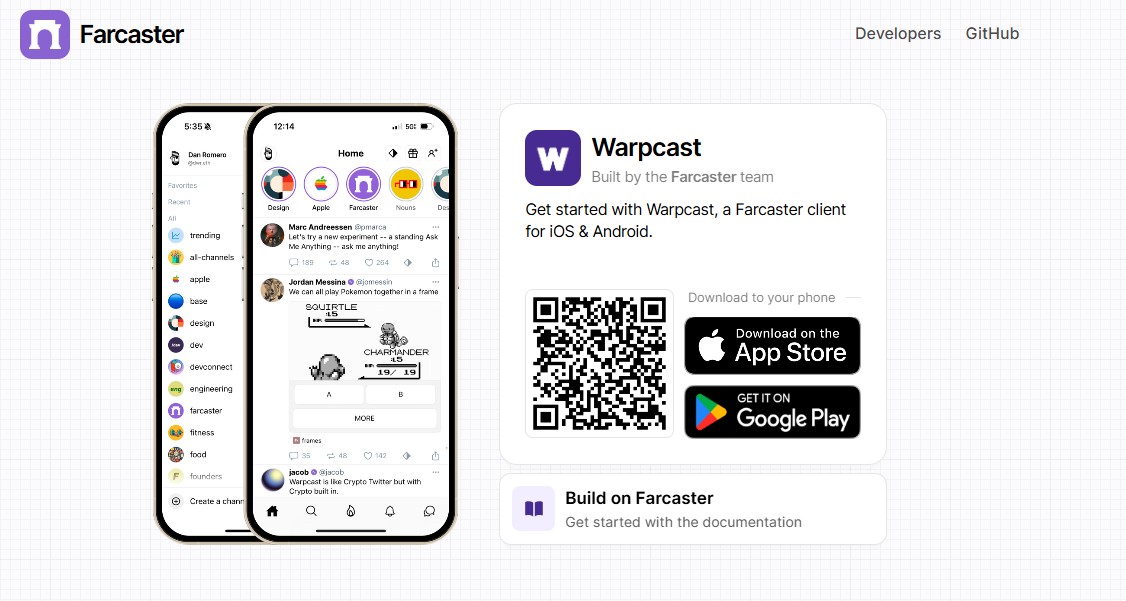
Farcaster is a decentralized social network designed to empower users by giving them greater control over their data and online identity. Built on Web3 principles, it aims to address the limitations of traditional social platforms, such as centralized control and data privacy concerns.
Farcaster is more than just a social network—it’s a blockchain-powered platform designed to transform the way we communicate online. With growing concerns over digital privacy, Farcaster offers a solution that lets users control their own data while enjoying effortless connections across its ecosystem. The platform integrates token rewards, opening up new opportunities for both engagement and investment. In this Farcaster review, we will discuss how the platform brings a fresh take on how digital communication and decentralized finance can come together.
What is Farcaster?
Farcaster offers a fresh approach to social media, giving users complete control over their own data and interactions. Unlike platforms like Facebook or Twitter, it’s not controlled by one company, but instead operates on decentralized technology, allowing users to own their profiles and content. This model aligns with the growing interest in privacy, protecting your data and ensuring freedom of expression. Built on Ethereum’s blockchain, like Mirror, Farcaster works seamlessly with Web3 tools, enabling easy use of decentralized apps. Its focus on open collaboration allows anyone to build on Farcaster, driving growth and innovation in the space.
Why decentralization matters
Traditional platforms are often accused of misusing data and censoring content. Farcaster tackles these problems head-on by giving people control over their data, allowing a shift from corporate influence to a platform focused on community values.
Who is it for?
Farcaster appeals to Web3 enthusiasts, developers, and privacy-conscious individuals who value autonomy over their digital footprint. It’s also a promising space for investors seeking exposure to decentralised technologies.
Key features and innovations
Farcaster’s features are designed to set it apart from conventional social networks. Here’s a breakdown.
Decentralized identity
Users retain complete ownership of their profiles, stored on Ethereum’s blockchain. This means profiles are not tied to any central authority, ensuring true portability.
Composable architecture
Farcaster’s open protocol allows developers to create custom applications and features. This composable design promotes creativity and adaptability.
Ethereum integration
By leveraging Ethereum, Farcaster enables easy interaction with crypto wallets and dApps, allowing users to send tokens, mint NFTs, and more within the ecosystem.
Community moderation
Instead of relying on platform-imposed rules, Farcaster helps communities to establish their own moderation policies, aligning with decentralized governance principles.
Farcaster token
Farcaster is developing a tokenomics system to incentivize participation and reward user contributions, potentially paving the way for an airdrop.
Pros and cons of Farcaster
- Pros
- Cons
Complete control over your data. Farcaster gives you ownership of your data, meaning you’re not dependent on companies using it for their own gain. This is crucial for anyone who values privacy and autonomy.
Open to new ideas. Farcaster is built on open principles, which means developers can bring fresh, creative ideas to the platform, allowing it to evolve rapidly.
No single controlling body. The decentralized nature means fewer restrictions and no arbitrary bans, so you can share freely without fear of censorship.
Works well with decentralized tools. Thanks to its Ethereum foundation, Farcaster integrates easily with decentralized apps, creating a more flexible and expansive online experience.
Might be confusing at first. For newcomers, understanding how Farcaster works within the decentralized space might take some time, especially if you're not familiar with blockchain.
Still building a community. The user base is still growing, meaning there’s less engagement and content compared to more established platforms.
Experience can differ. Since the platform is decentralized, how you experience Farcaster might depend on the tools and apps you use to interact with it.
Growing pains as it scales. As Farcaster attracts more users, it may face challenges in maintaining its decentralized nature, which could affect performance or cause bugs.
Performance and growth metrics
Since its inception, Farcaster has shown promising growth in adoption and activity. According to recent metrics:
How users are interacting. Farcaster has seen a big increase in user activity, reaching 73,700 unique casters in just one week.
How active the network is. The platform now has 62.58 million casts, 280,120 users, and 3,050 hubs, showing it's growing and active.
How the platform is doing financially. In 2023, Farcaster made $194,110, and by July 2024, that number jumped to $1.91 million, a huge increase in just six months.
How much money they've raised and their worth. In May 2024, Farcaster raised $150 million, valuing the company at $1 billion, showing strong trust from investors.
Who the users are. Most Farcaster users are between 18 and 34 years old, with 37% aged 18-24 and 40% aged 25-34, indicating a youthful and energetic user base.
With Farcaster’s rising popularity, traders often search for the best exchanges to access associated tokens and Web3 markets. To help you choose a safe and efficient platform, here’s a quick comparison of the leading crypto exchanges for Farcaster-related assets.
| Coinbase | OKX | BTCC | Cryptohopper | Crypto.com | |
|---|---|---|---|---|---|
|
Foundation year |
2012 | 2017 | 2011 | 2018 | 2016 |
|
Min. Deposit, $ |
10 | 10 | 10 | No | 1 |
|
Coins Supported |
400+ | 600+ | 399 | 1000 | 400+ |
|
Spot Taker fee, % |
0.5 | 0.1 | 0.3 | 0 | 0.5 |
|
Spot Maker Fee, % |
0.5 | 0.08 | 0.2 | 0 | 0.25 |
|
Tier-1 regulation |
Yes | No | Yes | No | Yes |
|
TU overall score |
8.5 | 8.46 | 8.08 | 7.8 | 7.76 |
|
Open an account |
Go to broker Your capital is at risk. |
Go to broker Your capital is at risk. |
Go to broker Your capital is at risk.
|
Go to broker Your capital is at risk. |
Go to broker Your capital is at risk. |
How much does Farcaster cost?
Farcaster is free to use, but users may incur Ethereum gas fees for certain actions, such as profile registration or token interactions.
The platform’s core functionalities, like posting and interacting, don’t require payment. However, users integrating wallets or engaging with on-chain activities should budget for variable transaction costs.
What are some social applications built on Farcaster?
Farcaster is a decentralized protocol that enables the development of various social applications, providing users with control over their data and interactions. Notable applications built on Farcaster include:
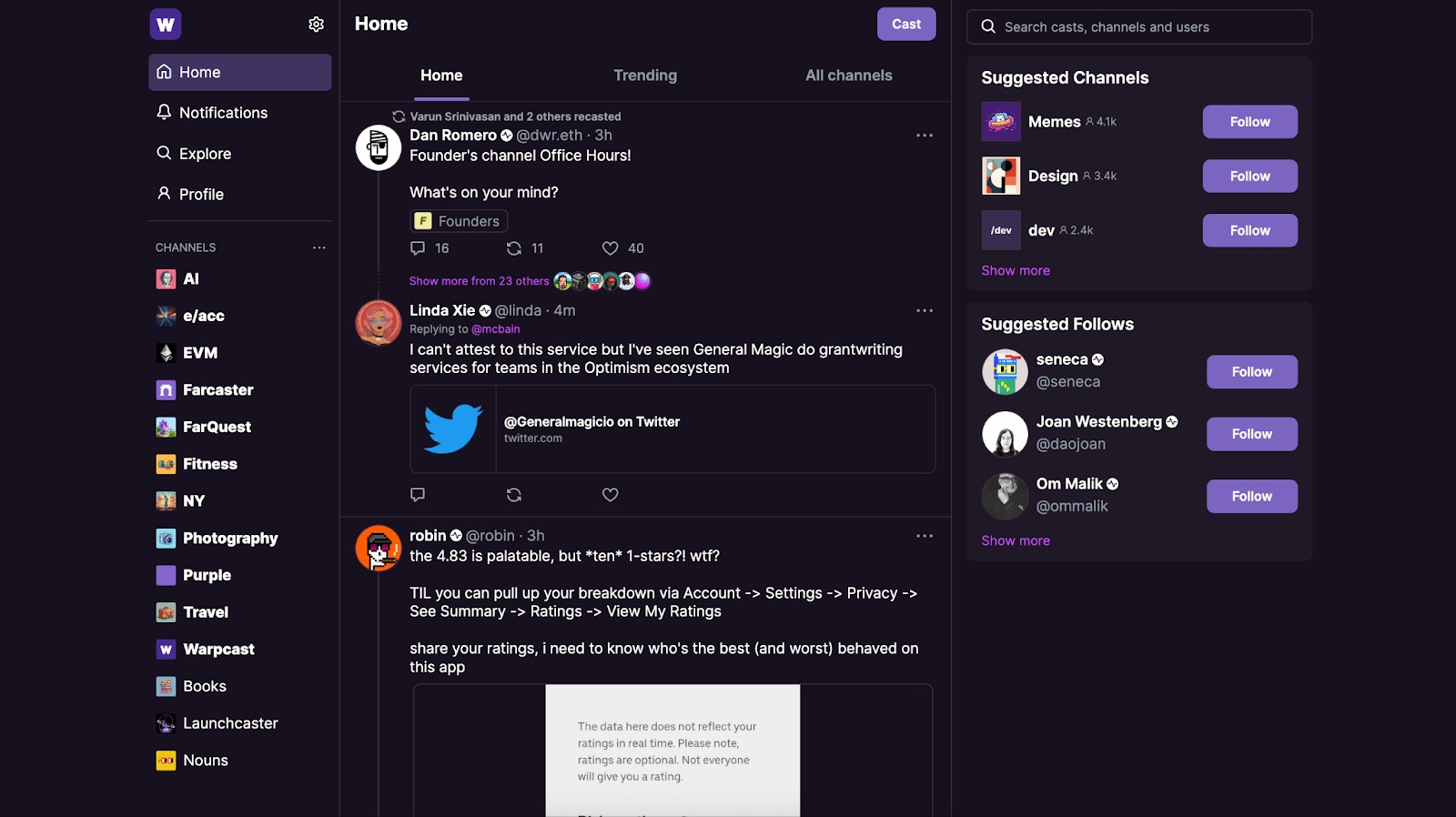
Warpcast: a primary client developed by the Farcaster team, offering a user experience similar to traditional social media platforms. Available on iOS and Android, Warpcast allows users to create profiles, post messages (casts), and follow others within the decentralized network.
Paragraph: a decentralized newsletter publishing platform akin to Substack, offering features like NFT memberships, token-gating, and direct integration with the Farcaster social graph. This enables new content monetization opportunities for creators and broader reach to their audience.
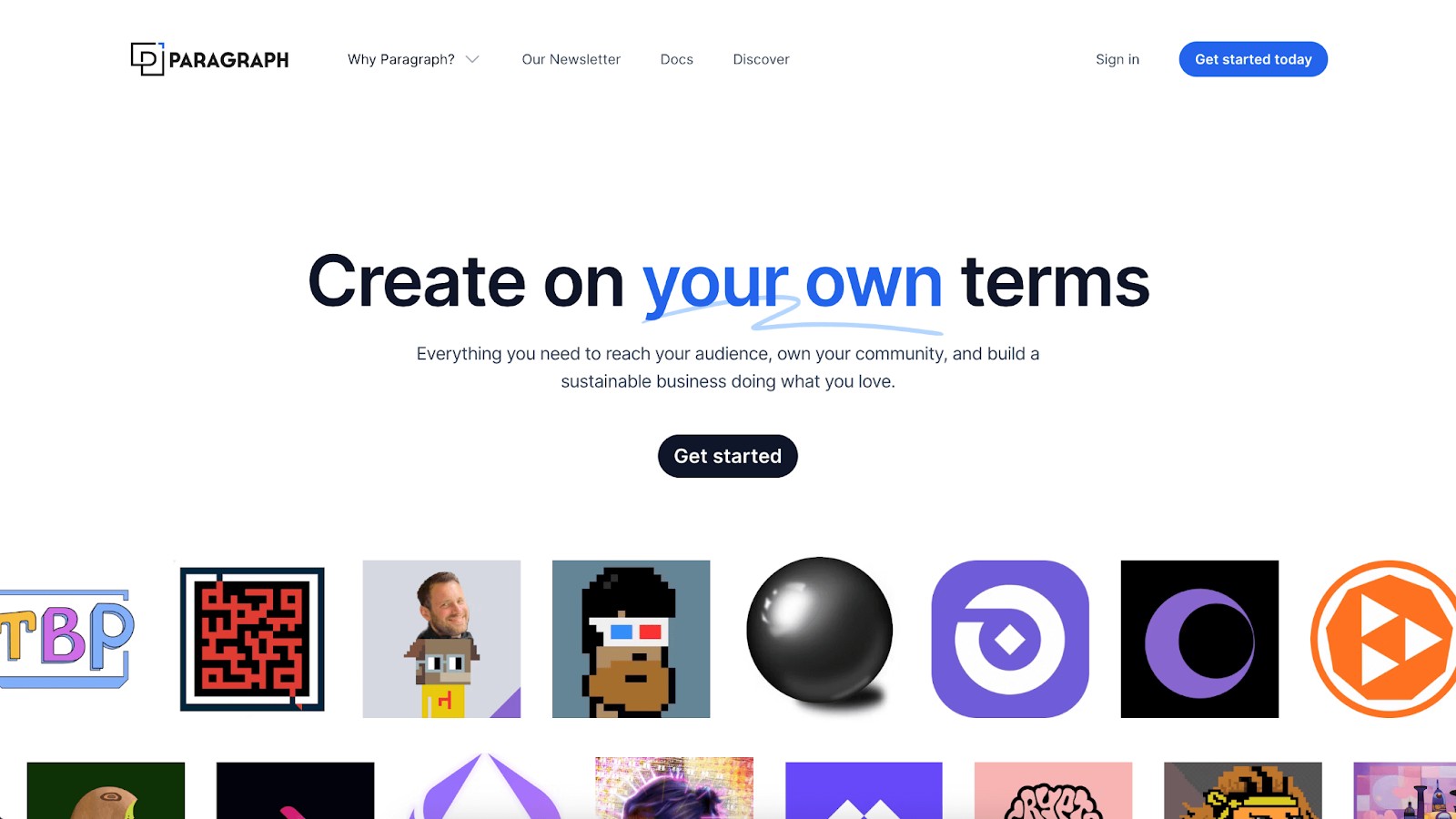
These applications showcase the versatility of the Farcaster protocol in supporting diverse social experiences within a decentralized framework.
Supercast: an application that enhances the social networking experience by integrating additional features and functionalities, providing users with more ways to interact and engage within the Farcaster ecosystem.
Yup: a platform that enables users to curate and share content, rewarding them for their contributions and interactions. Yup integrates with Farcaster to provide a decentralized social experience focused on content discovery and curation.
Farcord: an application that brings community and communication features to Farcaster, allowing users to create and join groups, participate in discussions, and collaborate within a decentralized environment.
Building trust and gaining early insights

Farcaster’s real strength lies in how flexible and interactive it is, something beginners often miss. Instead of just following posts and sharing updates, focus on building meaningful connections with creators and early users. This means joining discussions about niche topics like Web3 governance or crypto startups. The goal isn’t just to follow trends—it’s to help create them. When you’re part of these small but powerful groups, you’ll often hear about projects and trends early enough to act before they go viral.
Another overlooked tactic is to use Farcaster’s decentralized identity system to boost your credibility across platforms. Instead of treating it like a standalone profile, sync it with your Ethereum Name Service (ENS) and connect with communities like DAOs. This builds trust across networks and helps you stand out as someone others can rely on for good insights. Over time, this strategy can lead to invites for exclusive crypto deals, early access to investment opportunities, and connections that are worth their weight in gold.
Conclusion
Farcaster is redefining social networking by placing true ownership and control of data back in the hands of users, championing privacy and freedom within a rapidly evolving Web3 landscape. Its decentralized design and open protocol empower both individuals and developers to innovate, as seen with applications like Warpcast and Paragraph that offer new ways to connect and monetize content. With a soaring user base and robust financial backing, Farcaster’s model demonstrates that decentralized platforms can win both strong community trust and investor confidence. In a digital world hungry for authenticity and autonomy, Farcaster stands out as a beacon for those seeking to shape the future of online interaction.
FAQs
How does Farcaster protect user privacy compared to traditional social networks?
What role does Ethereum integration play in Farcaster’s functionality?
Who is the primary audience for Farcaster, and what makes it appealing to them?
Are there any costs associated with using Farcaster, and what should users expect regarding fees?
Editors' Top Picks and Insights




Related Articles
Team that worked on the article
Alamin Morshed is a contributor at Traders Union. He specializes in writing articles for businesses that want to improve their Google search rankings to compete with their competition.
Chinmay Soni is a financial analyst with more than 5 years of experience in working with stocks, Forex, derivatives, and other assets. As a founder of a boutique research firm and an active researcher, he covers various industries and fields, providing insights backed by statistical data.
Mirjan Hipolito is a journalist and news editor at Traders Union. She is an expert crypto writer with five years of experience in the financial markets.
Ethereum is a decentralized blockchain platform and cryptocurrency that was proposed by Vitalik Buterin in late 2013 and development began in early 2014. It was designed as a versatile platform for creating decentralized applications (DApps) and smart contracts.
CFD is a contract between an investor/trader and seller that demonstrates that the trader will need to pay the price difference between the current value of the asset and its value at the time of contract to the seller.
Cryptocurrency is a type of digital or virtual currency that relies on cryptography for security. Unlike traditional currencies issued by governments (fiat currencies), cryptocurrencies operate on decentralized networks, typically based on blockchain technology.
An investor is an individual, who invests money in an asset with the expectation that its value would appreciate in the future. The asset can be anything, including a bond, debenture, mutual fund, equity, gold, silver, exchange-traded funds (ETFs), and real-estate property.
Index in trading is the measure of the performance of a group of stocks, which can include the assets and securities in it.

-
 Afghanistan
-
 Albania
-
 Algeria
-
 Angola
-
 Argentina
-
 Armenia
-
 Australia
-
 Austria
-
 Azerbaijan
-
 Bahamas
-
 Bahrain
-
 Bangladesh
-
 Belarus
-
 Belgium
-
 Bolivia
-
 Botswana
-
 Brazil
-
 Brunei
-
 Bulgaria
-
 Cambodia
-
 Cameroon
-
 Canada
-
 Chile
Chile
-
 China
China
-
 Colombia
-
 Congo
Congo
-
 Costa Rica
-
 Cote d'Ivoire
-
 Croatia
-
 Cuba
Cuba
-
 Cyprus
-
 Czechia
-
 DR Congo
-
 Denmark
-
 Dominican Republic
-
 Ecuador
-
 Egypt
Egypt
-
 El Salvador
-
 Estonia
-
 Eswatini
-
 Ethiopia
-
 Finland
-
 France
-
 Georgia
-
 Germany
-
 Ghana
Ghana
-
 Greece
-
 Haiti
Haiti
-
 Hong Kong
-
 Hungary
-
 India
India
-
 Indonesia
-
 Iran, Islamic republic
-
 Iraq
Iraq
-
 Ireland
-
 Israel
-
 Italy
Italy
-
 Jamaica
-
 Japan
Japan
-
 Jordan
-
 Kazakhstan
-
 Kenya
Kenya
-
 Korea
Korea
-
 Kuwait
-
 Kyrgyzstan
-
 Laos
Laos
-
 Latvia
-
 Lebanon
-
 Lesotho
-
 Libya
Libya
-
 Lithuania
-
 Luxembourg
-
 Madagascar
-
 Malaysia
-
 Malta
Malta
-
 Mauritius
-
 Mexico
-
 Moldova
-
 Mongolia
-
 Montenegro
-
 Morocco
-
 Mozambique
-
 Myanmar
-
 Namibia
-
 Nepal
Nepal
-
 Netherlands
-
 New Zealand
-
 Nigeria
-
 North Macedonia
-
 Norway
-
 Oman
Oman
-
 Pakistan
-
 Palestine
-
 Panama
-
 Papua New Guinea
-
 Paraguay
-
 Peru
Peru
-
 Philippines
-
 Poland
-
 Portugal
-
 Puerto Rico
-
 Qatar
Qatar
-
 Reunion
-
 Romania
-
 Rwanda
-
 Saudi Arabia
-
 Serbia
-
 Singapore
-
 Slovakia
-
 Slovenia
-
 Somalia
-
 South Africa
-
 Spain
Spain
-
 Sri Lanka
-
 Sweden
-
 Switzerland
-
 Syria
Syria
-
 Taiwan
-
 Tajikistan
-
 Tanzania
-
 Thailand
-
 Trinidad and Tobago
-
 Tunisia
-
 Turkey
-
 UAE
UAE
-
 Uganda
-
 Ukraine
-
 United Kingdom
-
United States
-
 Uruguay
-
 Uzbekistan
-
 Venezuela
-
 Vietnam
-
 Yemen
Yemen
-
 Zambia
-
 Zimbabwe
- Forex
- Crypto












