
The 1% Daily Profit Myth In Forex



Editorial Note: While we adhere to strict Editorial Integrity, this post may contain references to products from our partners. Here's an explanation for How We Make Money. None of the data and information on this webpage constitutes investment advice according to our Disclaimer.
Forex trading can yield 1% daily profits, but it’s challenging and depends on skill, strategy, and market conditions. Consistent success requires risk management, discipline, and a deep understanding of trading dynamics.
Forex trading often promises lucrative returns, but chasing a consistent 1% daily profit is far more complex than it seems. This article dives into the reality of daily profit targets, exploring what it takes to achieve sustainable growth in the Forex market. We’ll break down expert-backed strategies, dispel profit myths, and reveal what truly separates successful traders from those chasing unrealistic goals.
Is it possible to make 1% a day in Forex?
Achieving a consistent 1% daily profit in Forex trading is highly challenging due to market unpredictability. While some traders might hit this target occasionally through expert strategies, expecting such returns every day is unrealistic and risky.
To put this into context, starting with $1,000 and earning 1% daily would result in $1,010 on day one, and $1,020.10 after day two. While compounding can be powerful, consistent daily gains require exceptional skills, risk management, and patience. Focus on realistic monthly goals and long-term profitability for sustained success.
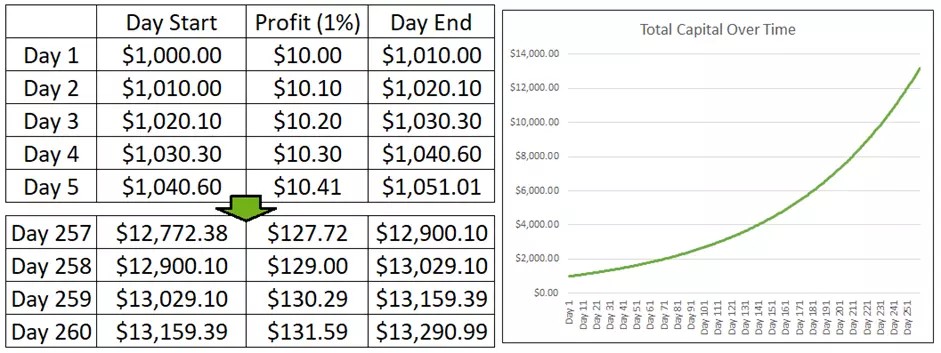
If this trend continued and you consistently saw a 1% increase in capital for a whole year, or 260 trading days, you’d have $13,290.99 in your account, with $131.59 profit being added on day 260 alone. That’s an increase of 1229.099% in one year. You can probably see why this is highly unrealistic.
Even if a trader set out to make 1% of their initial $1000.00 investment every day and not compound their returns, that would still require a consistent $10.00 increase daily. By day 260 they would have $3,590.00 in capital, an increase of 259% compared to day 1. This is also quite unrealistic.
Impact of market conditions
Market conditions significantly influence the difficulty of achieving consistent daily returns in Forex trading. Profits are more attainable during periods of strong trending price action compared to times of consolidation or ranging markets.
In strongly trending markets, the clear directional bias allows traders to enter positions with probabilities tilted in their favor. With the right strategy and execution, daily returns of 1% or more are possible in these environments.
However, markets don't trend indefinitely; periods of ranging or sideways movement are inevitable. During such times, achieving a 1% daily profit becomes more challenging due to the lack of clear direction, increasing reliance on short-term technical patterns.
Historical data indicates that during low volatility periods, consistent daily profits above 0.1% are impressive. The risks of unpredictable price movements rise, making substantial daily returns more a matter of luck than skill.
Therefore, traders aiming for a 1% daily target should consider prevailing market conditions. Strong trends offer better opportunities, while consolidations warrant more modest return expectations to maintain risk control. Flexibility and patience are essential in adapting to shifting market regimes.
Which are the best brokers for day trading?
The best day-trading brokers meet the following criteria:
High trading volumes and liquidity. This ensures that traders can enter and exit positions quickly without experiencing significant price slippage. It’s essential for day traders focused on short-term market movements.
ECN accounts with tight spreads. ECN (electronic communication network) accounts provide direct access to the interbank market, ensuring tighter spreads and lower trading costs, which are critical for frequent trades.
Trade automation features. Platforms like MT5 and cTrader support algorithmic trading and expert advisors (EAs), enabling traders to automate strategies for faster decision-making and execution.
VPS services. A virtual private server (VPS) provides a stable, high-speed internet connection, reducing latency and ensuring that automated trades are executed promptly, even during internet disruptions.
Selecting a reliable broker is crucial for day traders aiming for consistent profits and smooth trading experiences. After thorough research and evaluation, we have compiled a list of top brokers that meet essential criteria such as high liquidity, tight spreads, advanced trading platforms, and robust VPS support. These brokers are equipped with features like algorithmic trading capabilities, MetaTrader signals, and copy trading options to enhance your trading performance. Explore the table below to find the best fit for your day trading needs.
| Day trading | Min. deposit, $ | ECN | TradingView | Copy trading | Trading Central | Signals (alerts) | Free VPS | Open an account | |
|---|---|---|---|---|---|---|---|---|---|
| Yes | 10 | Yes | No | Yes | No | Yes | Yes | Go to broker Your capital is at risk.
|
|
| Yes | No | Yes | Yes | Yes | No | Yes | Yes | Go to broker Your capital is at risk. |
|
| Yes | 100 | Yes | Yes | Yes | No | Yes | Yes | Study review | |
| Yes | 5000 | Yes | No | No | No | No | Yes | Study review | |
| Yes | 1 | Yes | Yes | Yes | Yes | Yes | Yes | Study review |
Realistic profit expectations in Forex
Achieving consistent profits in Forex trading requires setting realistic expectations, which depend on factors like trading strategy, risk tolerance, account size, and experience. Here's a breakdown of potential profit ranges.
Conservative expectations (low risk)
Monthly profit. Aiming for 1% to 3% of trading capital.
Annual return. Approximately 12% to 36%.
Approach. Engaging in low-risk trading during less volatile market periods and focusing on long-term strategies.
Moderate expectations (moderate risk)
Monthly profit. Targeting 3% to 5% of capital.
Annual return. Around 36% to 60%.
Approach. Balancing risk and reward, employing well-tested trading strategies, and maintaining disciplined risk management.
Aggressive expectations (high risk)
Monthly profit. Seeking over 5% returns.
Annual return. Exceeding 60%.
Approach. Involving higher-risk trading, which can lead to significant returns but also increases the potential for substantial losses.
Key considerations
Risk management. Implementing effective risk management is crucial. It's generally recommended to risk only a small percentage of your trading capital on each trade, typically 1-2%.
Realistic goals. Setting achievable profit targets helps in maintaining discipline and avoiding the pitfalls of overtrading or excessive risk-taking. Unrealistic expectations can lead to disappointment and financial losses.
Continuous learning. Investing time in education and skill development enhances trading performance. Understanding market analysis, developing a solid trading strategy, and practicing effective risk management are essential components of successful trading.
Market conditions. Being aware of market volatility and global events is essential, as they can significantly impact trading outcomes. Staying informed about economic indicators and geopolitical developments can help in making informed trading decisions.
Leveraging compounding for consistent growth
Leveraging compounding for consistent growth in Forex is a powerful strategy that can help your trading account grow over time. Compounding involves reinvesting your profits to generate earnings on both your initial capital and the profits you've already earned.
To ensure steady growth and compounding profits, traders should follow some crucial steps.
Prudent risk management. Implement strict risk management practices, including setting stop-loss orders and risking only a small percentage of your trading capital on each trade. This protects your account from significant losses.
Consistent profitability. Focus on consistent profitability by developing a trading strategy with a positive expectancy. This means generating more profitable trades than losing ones over the long term.
Reinvest profits. Instead of withdrawing profits, reinvest them into your trading account. This increases your trading capital and allows you to trade large positions over time.
Gradually increase position size. As your account grows due to compounding, you can gradually increase your position size while maintaining prudent risk management practices. Avoid over-leveraging and ensure that you still risk only a small percentage of your account on each trade, typically limiting yourself to 1% to 2% of total capital per trade.
Be patient and disciplined. Compounding takes time and requires patience and discipline. Avoid the temptation to deviate from your trading plan or withdraw profits too early.
Balancing risk and reward in daily trading goals
The most effective way to balance risk and reward when working towards your daily trading goals is to implement a stringent trading strategy and to regulate your emotions. It’s often too easy to let our emotions get the better of us, we’re only human after all. Feelings of greed, anxiety, or fear can lead to more risky trades. The desire to reach unattainable daily profits can influence our decision-making skills.
Map out your strategy before starting to trade and regularly consult your strategy blueprint to help you stick to it. Set stop-loss and take-profit orders and stick to them to avoid your emotions dictating when to close a trade. Patience and discipline are key if you want to be consistently profitable and see long-term compounding gains.
Finding the right broker can significantly impact your trading journey. We have evaluated key features such as account types, minimum deposits, maximum leverage, spreads, and investor protection to help you choose a broker that aligns with your trading goals. The table below highlights essential broker comparisons, enabling you to make an informed decision for your Forex trading success.






Managing losses is just as crucial as securing wins

Success in Forex trading isn’t about winning every trade — it’s about mastering risk asymmetry. Many beginners focus solely on being right, but seasoned traders know that profitability comes from a well-structured risk-to-reward ratio. Even if you win only 40% of your trades, a 1:3 risk-to-reward setup can still make you consistently profitable. For instance, risking $100 with a potential profit of $300 means that just four winning trades out of ten can put you ahead. This mindset transforms trading from a guessing game into a calculated strategy, where managing losses is just as crucial as securing wins.
Equally important is adopting a business-like approach to trading. Keep a detailed trading journal documenting each trade, the reasons behind it, the outcome, and the lessons learned. Review this journal regularly to spot patterns, correct mistakes, and refine strategies. This habit forces you to stay accountable and shifts your focus from chasing daily profits to building a sustainable trading system. Trading isn’t about being perfect — it’s about being consistently better through continuous learning and adaptation.
Conclusion
While the idea of making 1% profit per day in Forex trading is alluring, the reality demands a more measured perspective. Sustainable success in the Forex market hinges on risk management, emotional discipline, and setting realistic expectations—traits that top traders consistently exhibit. For example, many professionals achieve steady annual gains rather than daily compounding miracles, focusing on protecting capital over chasing daily quotas. Ultimately, mastering Forex isn’t about quick riches, but about building long-term wealth through patience, strategy, and continual learning. In the world of trading, slow and steady truly does win the race.
FAQs
What factors make earning 1% a day in Forex trading so difficult?
How does compounding influence long-term Forex account growth?
What role do market conditions play in achieving daily Forex profit targets?
Why is balancing risk and reward important for Forex traders who set aggressive profit goals?
Editors' Top Picks and Insights

Hunting crypto owners: Why criminals have gone offline

BitMEX is shutting down: Why Trump could not save the exchange

Do governments need crypto workers?

Brent nears $100: Why oil prices are rising

Gram Wallet launch: Can Telegram bring crypto to the masses?

AI without limits: How dangerous are neural networks?
Related Articles
Team that worked on the article
Rinat Gismatullin is an entrepreneur and a business expert with 9 years of experience in trading. He focuses on long-term investing, but also uses intraday trading.
Dan Blystone began his trading career in 1998 as an arbitrage clerk on the floor of the Chicago Mercantile Exchange (CME). He later traded bond and Eurex futures at proprietary firms such as Altea Trading, gaining valuable experience in high-frequency trading and risk management.
Chinmay Soni is a financial analyst with more than 5 years of experience in working with stocks, Forex, derivatives, and other assets. As a founder of a boutique research firm and an active researcher, he covers various industries and fields, providing insights backed by statistical data.
Overtrading is a phenomenon where a trader executes too many transactions in the market, surpassing their strategy and trading more frequently than planned. It's a common mistake that can lead to financial losses.
A margin call is a demand made by a broker or a financial institution to a trader or investor who is using margin (borrowed funds) to cover potential losses in a trading account. It occurs when the value of the securities or assets held in the account falls below a certain threshold, known as the maintenance margin or margin requirement, as specified by the broker.
Cryptocurrency is a type of digital or virtual currency that relies on cryptography for security. Unlike traditional currencies issued by governments (fiat currencies), cryptocurrencies operate on decentralized networks, typically based on blockchain technology.
Day trading involves buying and selling financial assets within the same trading day, with the goal of profiting from short-term price fluctuations, and positions are typically not held overnight.
Ranging markets are a type of market characterized by short-term movement between apparent asset price highs and lows.

-
 Afghanistan
-
 Albania
-
 Algeria
-
 Angola
-
 Argentina
-
 Armenia
-
 Australia
-
 Austria
-
 Azerbaijan
-
 Bahamas
-
 Bahrain
-
 Bangladesh
-
 Belarus
-
 Belgium
-
 Bolivia
-
 Botswana
-
 Brazil
-
 Brunei
-
 Bulgaria
-
 Cambodia
-
 Cameroon
-
 Canada
-
 Chile
Chile
-
 China
China
-
 Colombia
-
 Congo
Congo
-
 Costa Rica
-
 Cote d'Ivoire
-
 Croatia
-
 Cuba
Cuba
-
 Cyprus
-
 Czechia
-
 DR Congo
-
 Denmark
-
 Dominican Republic
-
 Ecuador
-
 Egypt
Egypt
-
 El Salvador
-
 Estonia
-
 Eswatini
-
 Ethiopia
-
 Finland
-
 France
-
 Georgia
-
 Germany
-
 Ghana
Ghana
-
 Greece
-
 Haiti
Haiti
-
 Hong Kong
-
 Hungary
-
 India
India
-
 Indonesia
-
 Iran, Islamic republic
-
 Iraq
Iraq
-
 Ireland
-
 Israel
-
 Italy
Italy
-
 Jamaica
-
 Japan
Japan
-
 Jordan
-
 Kazakhstan
-
 Kenya
Kenya
-
 Korea
Korea
-
 Kuwait
-
 Kyrgyzstan
-
 Laos
Laos
-
 Latvia
-
 Lebanon
-
 Lesotho
-
 Libya
Libya
-
 Lithuania
-
 Luxembourg
-
 Madagascar
-
 Malaysia
-
 Malta
Malta
-
 Mauritius
-
 Mexico
-
 Moldova
-
 Mongolia
-
 Montenegro
-
 Morocco
-
 Mozambique
-
 Myanmar
-
 Namibia
-
 Nepal
Nepal
-
 Netherlands
-
 New Zealand
-
 Nigeria
-
 North Macedonia
-
 Norway
-
 Oman
Oman
-
 Pakistan
-
 Palestine
-
 Panama
-
 Papua New Guinea
-
 Paraguay
-
 Peru
Peru
-
 Philippines
-
 Poland
-
 Portugal
-
 Puerto Rico
-
 Qatar
Qatar
-
 Reunion
-
 Romania
-
 Rwanda
-
 Saudi Arabia
-
 Serbia
-
 Singapore
-
 Slovakia
-
 Slovenia
-
 Somalia
-
 South Africa
-
 Spain
Spain
-
 Sri Lanka
-
 Sweden
-
 Switzerland
-
 Syria
Syria
-
 Taiwan
-
 Tajikistan
-
 Tanzania
-
 Thailand
-
 Trinidad and Tobago
-
 Tunisia
-
 Turkey
-
 UAE
UAE
-
 Uganda
-
 Ukraine
-
 United Kingdom
-
United States
-
 Uruguay
-
 Uzbekistan
-
 Venezuela
-
 Vietnam
-
 Yemen
Yemen
-
 Zambia
-
 Zimbabwe
- Forex
- Crypto







