
Should I Own Gold Or Gold Stocks?


Editorial Note: While we adhere to strict Editorial Integrity, this post may contain references to products from our partners. Here's an explanation for How We Make Money. None of the data and information on this webpage constitutes investment advice according to our Disclaimer.
Gold or gold stocks? Both – but for different goals. Physical gold (and ETFs) offers stability, inflation protection and crisis insurance, while gold miners amplify gains through operating leverage and dividends but add company, operational and policy risk. In 2025 miners have outpaced the metal, so a blended allocation – cash/wealth in bullion + growth exposure via selected miners – suits most investors.
One of the biggest investment stories of 2025 is gold’s return to glory as it struck $4,000 an ounce in October, breaking more than 50 new highs in the course of the year.
The 52% gain in the metal price is the strongest since the 1970s, the result of a perfect storm of economic and geopolitical pressures. Baked into the current gold price are expectations of severe economic disruptions resulting from potential military conflicts involving Israel, the U.S. and Iran, and a possible widening of the war between Ukraine and Russia. There’s also the economic uncertainties triggered by US President Donald Trump’s tariff wars against China, India and others, spreading fears of supply chain disruptions.
Gold’s vaunted status as a safe haven in times of crisis has again been vindicated. The weaker U.S. dollar, down 10% so far this year, has been a gift to countries like China and India, which have been aggressively accumulating gold with cheaper U.S. dollars, while Western ETF holdings have surged to nearly 3,900 tonnes, nearing 2020 peaks. Further buttressing demand are new Basel III rules treating gold as a Tier 1 asset equivalent to cash. That’s unlocked a new wave of institutional buying.
Speculative positioning has also ramped up, adding fuel to the fire.
Gold or gold stocks?
The table below shows the year-to-date performance of the 10 largest gold mining companies in the world. They all handily beat gold’s 52.2%, impressive as this is.
| Rank | Company | YTD appreciation (%) |
|---|---|---|
| 1 | Newmont (NEM) | 122 |
| 2 | Agnico Eagle Mines (AEM) | 100 |
| 3 | Barrick Gold (GOLD) | 105 |
| 4 | Franco-Nevada (FNV) | 65 |
| 5 | Wheaton Precious Metals (WPM) | 82 |
| 6 | Kinross Gold (KGC) | 145 |
| 7 | Gold Fields (GFI) | 165 |
| 8 | AngloGold Ashanti (AU) | 199 |
| 9 | Northern Star Resources (NST.AX) | 75 |
| 10 | Evolution Mining (EVN.AX) | 125 |
These are extraordinary returns by any measure and explains why gold has such a powerful following among certain investors. The outstanding performers were AngloGold Ashanti and Gold Fields, both nominally South Africa, though AngloGold no longer has any mines in SA. Gold Fields has one, at South Deep to the south of Johannesburg.
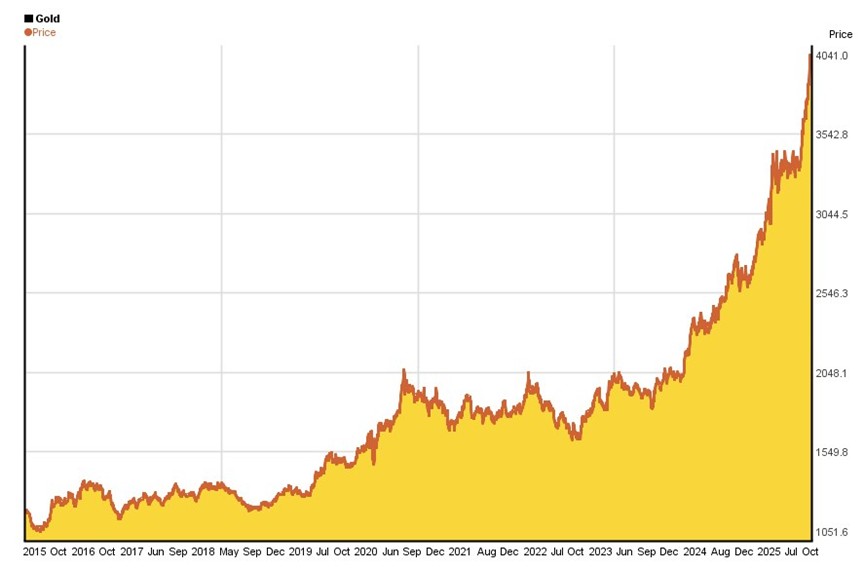
Gold miners have learned the hard way that it is best to assume disaster is just around the corner, allowing them to stack cash while the going is good. This protects them against any price shocks down the line, They, and the analysts that follow them, tend to be woefully conservative in their gold price estimates. At the recent 2025 Mining Forum Americas get-together, the world’s largest miners outlined their all-in sustaining cost (AISC) targets of between $1,460-$1,700/oz. With spot gold now around $4,000, this gives some idea of the margins they are minting.
What are they doing with all this new cash? Fattening their balance sheets and hunting for acquisitions (in the case of those with depleting gold reserves) and paying shareholders for the most part.
JPMorgan expects gold prices to average $3 675/oz by the fourth quarter of 2025 and climb toward $4 000 by mid-2026. Those forecasts have already been superseded, though some profit taking and consolidation may now be in order.
When you add price appreciation to dividends, the rating looks as follows:
| Rank | Company | YTD appreciation (%) |
|---|---|---|
| 1 | Gold Fields (GFI) | 225 |
| 2 | AngloGold Ashanti (AU) | 230 |
| 3 | Ora Banda Mining (ESGFF) | 705 |
| 4 | Kinross Gold (KGC) | 143 |
| 5 | Orla Mining (ORLA) | 100 |
| 6 | Harmony Gold (HMY) | 68 |
| 7 | SSR Mining (SSRM) | 90 |
| 8 | Newmont (NEM) | 65 |
| 9 | Agnico Eagle Mines (AEM) | 97 |
| 10 | Wheaton Precious Metals (WPM) | 89 |
| Gold | 52.2 |
Kea Nonyana, VIP client manager at PrimeXBT in Johannesburg, points out that gold stocks have an advantage over other types of companies in the form of operating leverage, which means higher gold prices translate immediately to the bottom line. Given the government shutdown in the U.S. and ramped-up war fever, Nonyana argues that rather than being at the tail end of a bull run, gold stocks are just getting started.
David Shapiro, chief global equity strategist at Sasfin Securities, argues that the easy money has now been made on gold. “Gold has run on the weak dollar and the wish of certain countries to spread their reserves beyond the dollar.”
Shapiro cautions against getting hyped up on gold. It could go higher for a short while, especially if the Fed further cuts interest rates, but he expects the U.S. dollar’s current weakness to reverse. “As the US economy picks up, the massive speculative positions in gold – and subsequently platinum – will unravel,” he says.
For gold miners with cash on hand, this is a perfect time to go shopping for opportunities. Newmont is by far the world’s largest gold mining house with annual production in excess of 6.7 million ounces from operations in North America, Ghana, Argentina, Peru and Suriname. It is sitting on a cash pile of more than $6 billion, boosted by free cash flows from record gold prices and divesting itself of non-core assets worth $2.5 billion.
Barrick Gold is the world’s second largest producer with operations in close to 20 countries from which it produced 3.91 million ounces in 2024, though it’s costs (AISC) at around $1,520/oz is at the higher end of the range. This compares with Newmont’s AISC of $1,450/oz, AngloGold Ashanti ($1,380/oz), Gold Fields ($1,320) and Kinross Gold (1,350/oz).
You will notice that those companies with the lower all-in sustaining costs have performed better on the stock market this year, the stand-outs being AngloGold Ashanti, Gold Fields and Kinross Gold.
A rising gold price can hide all manner of sins which become apparent later, when gold prices come under pressure. Gold Fields managed to trim its AISC by 6.5% over the year to date, while Agnico Eagle leads at an AISC of $1,285/oz, thanks to high-grade Canadian assets and operational discipline.
Smaller gold projects worth keeping an eye on are Australia’s Sunstone Metals (ASX:STM), which has two gold-copper projects in Ecuador; Titan Metals, another copper-gold miner operating in Ecuador’s southern Andean copper-gold belt; and Minerals 260 (ASX:MI6), an emerging mid-tier gold producer in Australia.
Minerals 260 is up 166% this year on the stock exchange so far this year. Titan Metals is more risky given its developmental path and high cash burn rate, but if it can keep the cash spigot open, analysts forecast earnings growth of about 15% a year. Sunstone is illiquid and therefore may be difficult to exit.
Physical gold or digital?
For the gold enthusiasts, there’s nothing wrong with holding some physical gold and some gold stocks.
The problem with physical gold is the costs of storage and insurance. Now there’s a solution to that too: Mesh.Trade is a blockchain based platform that allows investors to acquire digital gold (and silver) backed by real gold and silver, with all the insurance and storage costs taken care of. Another way to gain exposure to digital gold is through Pax Gold, which offers an asset-backed token where one token represents one fine troy ounce of gold.
You can also buy gold and borrow against it through Troygold. SA Mint, a wholly-owned subsidiary of the South African Reserve Bank, allows online purchasing of Krugerrands and bullion bars, with the insurance costs and storage taken care of by the company.
For investors who prefer trading gold price movements rather than holding physical bullion, online brokers provide direct access to gold markets through spot trading, CFDs, ETFs, and gold mining stocks. Choosing a reliable platform with competitive spreads, strong liquidity, and robust execution can significantly affect trading results. The comparison below highlights several brokers that offer access to gold trading instruments and suitable conditions for both short-term traders and long-term investors.
| Plus500 | OANDA | FOREX.com | IG Markets | Interactive Brokers | |
|---|---|---|---|---|---|
|
Min. deposit, $ |
100 | No | 100 | 1 | No |
|
Tradable assets |
2800 | 129 | 5500 | 20000 | 30000 |
|
XAU/USD spread, pips |
45 | 30 | 35 | 30 | 15 |
|
XAU/USD commission, $ |
3 | 3 | 2.5 | No | 2 |
|
Max. Regulation Level |
Tier-1 | Tier-1 | Tier-1 | Tier-1 | Tier-1 |
|
TU overall score |
7.7 | 6.63 | 6.47 | 6.38 | 6.37 |
|
Open an account |
Go to broker 81% of retail CFD accounts lose money. |
Go to broker Your capital is at risk. |
Study review | Study review | Study review |
Protection first, selective growth second, and disciplined risk controls throughout

I favour a simple, blended approach: keep a defensive core in allocated bullion or a high-quality physical ETF (for crisis protection and low counterparty friction) and add a smaller, actively managed sleeve of low-cost, well-capitalised miners or royalty firms for leveraged upside. Focus on companies with low all-in sustaining costs, clean balance sheets and predictable production, and prefer royalty/streaming names if you want exposure with lower operational risk.
Manage position size via dollar-cost averaging, rebalance when allocations drift, and use covered calls or collars sparingly to generate yield or cap downside. Custody matters – choose audited storage or transparent ETFs for bullion, and always factor in taxes and liquidity before scaling exposure. In short: protection first, selective growth second, and disciplined risk controls throughout.
Conclusion
The clear takeaway is that a blended approach offers the best of both worlds when it comes to gold investing. Physical gold remains unrivaled for crisis protection and wealth preservation, while gold stocks and royalty firms can significantly outperform in bull markets, as shown by AngloGold Ashanti's and Gold Fields' impressive 2026 returns. Selecting miners with low all-in sustaining costs and healthy balance sheets is essential for capturing upside while minimizing risks. Ultimately, achieving both stability and growth means anchoring your portfolio in real gold and selectively adding growth-focused mining equities, always with disciplined risk controls in place.
FAQs
What types of risks are unique to investing in gold mining stocks compared to physical gold?
How does inflation impact the appeal of gold versus gold stocks?
What is a blended approach to allocating between gold and gold stocks, and why is it recommended?
How does liquidity differ between physical gold, gold ETFs, and gold mining stocks?
Editors' Top Picks and Insights






Related Articles
Team that worked on the article
Ciaran Ryan is a veteran financial journalist based in South Africa, where he covers cryptocurrency, mining, stock markets, and governance for Moneyweb. He also hosts the weekly Moneyweb Crypto Podcast.
Dan Blystone began his trading career in 1998 as an arbitrage clerk on the floor of the Chicago Mercantile Exchange (CME). He later traded bond and Eurex futures at proprietary firms such as Altea Trading, gaining valuable experience in high-frequency trading and risk management.
Chinmay Soni is a financial analyst with more than 5 years of experience in working with stocks, Forex, derivatives, and other assets. As a founder of a boutique research firm and an active researcher, he covers various industries and fields, providing insights backed by statistical data.
Xetra is a German Stock Exchange trading system that the Frankfurt Stock Exchange operates. Deutsche Börse is the parent company of the Frankfurt Stock Exchange.
Yield refers to the earnings or income derived from an investment. It mirrors the returns generated by owning assets such as stocks, bonds, or other financial instruments.
Forex leverage is a tool enabling traders to control larger positions with a relatively small amount of capital, amplifying potential profits and losses based on the chosen leverage ratio.
Risk management is a risk management model that involves controlling potential losses while maximizing profits. The main risk management tools are stop loss, take profit, calculation of position volume taking into account leverage and pip value.
Bitcoin is a decentralized digital cryptocurrency that was created in 2009 by an anonymous individual or group using the pseudonym Satoshi Nakamoto. It operates on a technology called blockchain, which is a distributed ledger that records all transactions across a network of computers.

-
 Afghanistan
-
 Albania
-
 Algeria
-
 Angola
-
 Argentina
-
 Armenia
-
 Australia
-
 Austria
-
 Azerbaijan
-
 Bahamas
-
 Bahrain
-
 Bangladesh
-
 Belarus
-
 Belgium
-
 Bolivia
-
 Botswana
-
 Brazil
-
 Brunei
-
 Bulgaria
-
 Cambodia
-
 Cameroon
-
 Canada
-
 Chile
Chile
-
 China
China
-
 Colombia
-
 Congo
Congo
-
 Costa Rica
-
 Cote d'Ivoire
-
 Croatia
-
 Cuba
Cuba
-
 Cyprus
-
 Czechia
-
 DR Congo
-
 Denmark
-
 Dominican Republic
-
 Ecuador
-
 Egypt
Egypt
-
 El Salvador
-
 Estonia
-
 Eswatini
-
 Ethiopia
-
 Finland
-
 France
-
 Georgia
-
 Germany
-
 Ghana
Ghana
-
 Greece
-
 Haiti
Haiti
-
 Hong Kong
-
 Hungary
-
 India
India
-
 Indonesia
-
 Iran, Islamic republic
-
 Iraq
Iraq
-
 Ireland
-
 Israel
-
 Italy
Italy
-
 Jamaica
-
 Japan
Japan
-
 Jordan
-
 Kazakhstan
-
 Kenya
Kenya
-
 Korea
Korea
-
 Kuwait
-
 Kyrgyzstan
-
 Laos
Laos
-
 Latvia
-
 Lebanon
-
 Lesotho
-
 Libya
Libya
-
 Lithuania
-
 Luxembourg
-
 Madagascar
-
 Malaysia
-
 Malta
Malta
-
 Mauritius
-
 Mexico
-
 Moldova
-
 Mongolia
-
 Montenegro
-
 Morocco
-
 Mozambique
-
 Myanmar
-
 Namibia
-
 Nepal
Nepal
-
 Netherlands
-
 New Zealand
-
 Nigeria
-
 North Macedonia
-
 Norway
-
 Oman
Oman
-
 Pakistan
-
 Palestine
-
 Panama
-
 Papua New Guinea
-
 Paraguay
-
 Peru
Peru
-
 Philippines
-
 Poland
-
 Portugal
-
 Puerto Rico
-
 Qatar
Qatar
-
 Reunion
-
 Romania
-
 Rwanda
-
 Saudi Arabia
-
 Serbia
-
 Singapore
-
 Slovakia
-
 Slovenia
-
 Somalia
-
 South Africa
-
 Spain
Spain
-
 Sri Lanka
-
 Sweden
-
 Switzerland
-
 Syria
Syria
-
 Taiwan
-
 Tajikistan
-
 Tanzania
-
 Thailand
-
 Trinidad and Tobago
-
 Tunisia
-
 Turkey
-
 UAE
UAE
-
 Uganda
-
 Ukraine
-
 United Kingdom
-
United States
-
 Uruguay
-
 Uzbekistan
-
 Venezuela
-
 Vietnam
-
 Yemen
Yemen
-
 Zambia
-
 Zimbabwe
- Forex
- Crypto












