
Why This Is The Time To Accumulate Indonesian Bank Stocks


Editorial Note: While we adhere to strict Editorial Integrity, this post may contain references to products from our partners. Here's an explanation for How We Make Money. None of the data and information on this webpage constitutes investment advice according to our Disclaimer.
Foreign investors have yanked USD3.75bn out of Indonesian equities so far in 1H25, the largest net-sell in the region, knocking the Jakarta Composite Index 2% lower in USD terms and dragging bank valuations back to multi-year lows.
For global traders hunting durable yield and EM rebound plays, that capitulation is creating a rare entry point. Indonesia’s leading lenders now combine dividend yields that reach 8%, surpassing the 10-year Indonesian Government bond yield of 6.5%, with system-wide NPLs below 2%, and they just received an additional tail-wind from Bank Indonesia’s fresh 25bp rate cut to 5.25%. Past easing cycles in 2016-17, 2019 and 2020 preceded double-digit rallies in bank shares – trends this article will revisit in detail. We’ll show why beaten-down valuations, policy support and improving trade sentiment make it time to buy Indonesian bank stocks and how you can position for the next leg higher.
Risk warning: All investments carry risk, including potential capital loss. Economic fluctuations and market changes affect returns, and 40-50% of investors underperform benchmarks. Diversification helps but does not eliminate risks. Invest wisely and consult professional financial advisors.
Foreign investors flee, creating value gaps
International investors have been pulling money out of Indonesian equities, which drove down prices of bank stocks to compelling levels. In late 2024 and early 2025, foreigners were net sellers for six consecutive months – an unusually prolonged exodus not seen since 2017. They offloaded approximately USD3.85bn worth of Indonesian stocks from October 2024 through March 2025. Such massive outflows were driven by global risk aversion – concerns about Indonesia’s fiscal policy shifts, prolonged high interest rates, and political uncertainty.
Sentiment swung to an extreme of pessimism, but this wave of selling appears overdone relative to fundamentals. Once the panic subsided, foreign inflows returned: during the five weeks from mid‑April to the end of May 2025, foreign investors posted a net buy of USD320mn, and the JCI rallied from its trough of roughly 6,400 to a peak of around 7,200. The rebound highlights how quickly flows can reverse when valuations and macro conditions turn more attractive. Meanwhile, foreigners reported net sales of USD950mn and USD3.75bn in June-mid July 2025, and YTD, reflecting a huge impact when the trend will reverse. Learn how Indonesia’s Nutritious Free Meal program helps eliminate poultry oversupply, drives stronger demand for feed and chicken products, and improves profit margins for CPIN, JPFA, and MAIN.
Valuations at multi-year lows for major and mid-tier banks
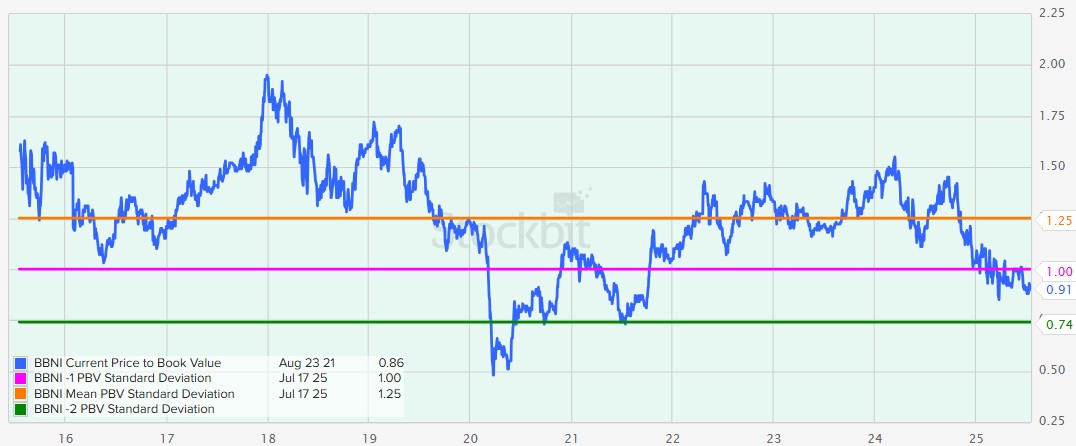
Thanks to the sell-off, valuations of Indonesian banks are now cheap relative to their own history. Price-to-book ratios (P/B) and price-to-earnings ratios (P/E) have compressed to levels not seen in years. For instance, Bank Negara Indonesia (BBNI) – one of the big-four state-owned lenders – trades around 0.9× P/B, which is 1.5 standard deviation (S.D.) below its 10-year mean. This comes even as BBNI’s profitability is improving (return on equity is consistently higher than the pre-pandemic’s level), suggesting a disconnect where price has fallen more than fundamentals.
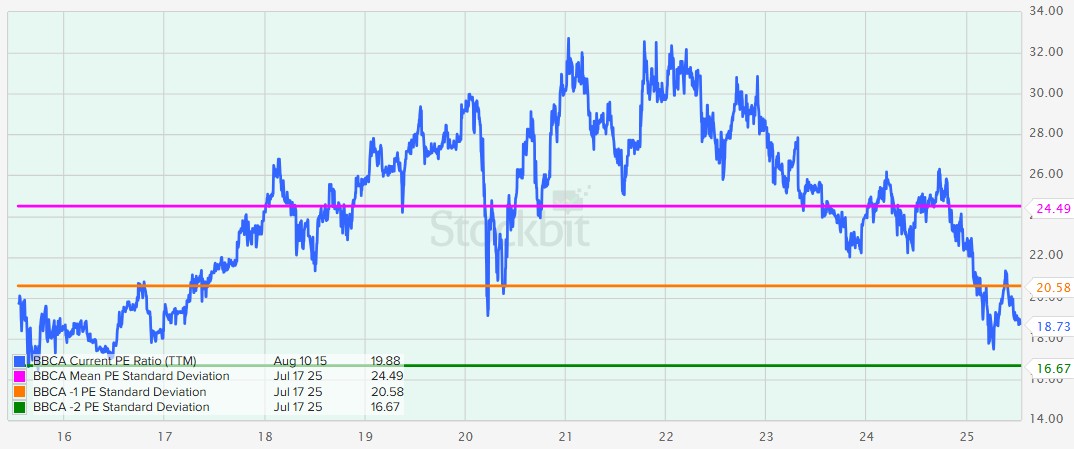
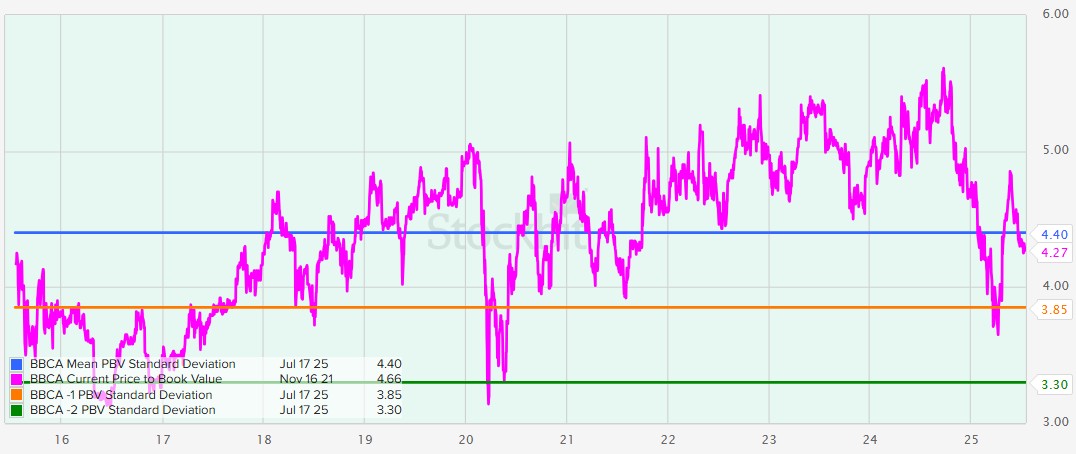
Even market leader Bank Central Asia (BBCA), long esteemed for its premium valuation, has seen its P/E multiple compress. BBCA’s stock underperformed peers over 2021–2023, and now trades at 4.27× P/B, slightly below its 10-year mean of 4.4×, with its trailing twelve months (TTM) P/E around 18.7× which is about 1.5 S.D. below its 10-year historical mean. In other words, BBCA is no longer priced at an excessive premium; after the pullback it “is no longer fully valued” and offers upside despite short-term rate headwinds.
Crucially, mid-tier and specialized lenders are even more deeply discounted. For example, Bank Tabungan Negara (BBTN) – a mid-sized bank focusing on mortgages – currently trades at only 0.5× P/B. Such a P/B well below 1 indicates investors are pricing in substantial pessimism about future growth or asset quality, yet BBTN’s niche (government-backed housing loans) and potential benefit from lower rates suggest the pessimism may be overdone.
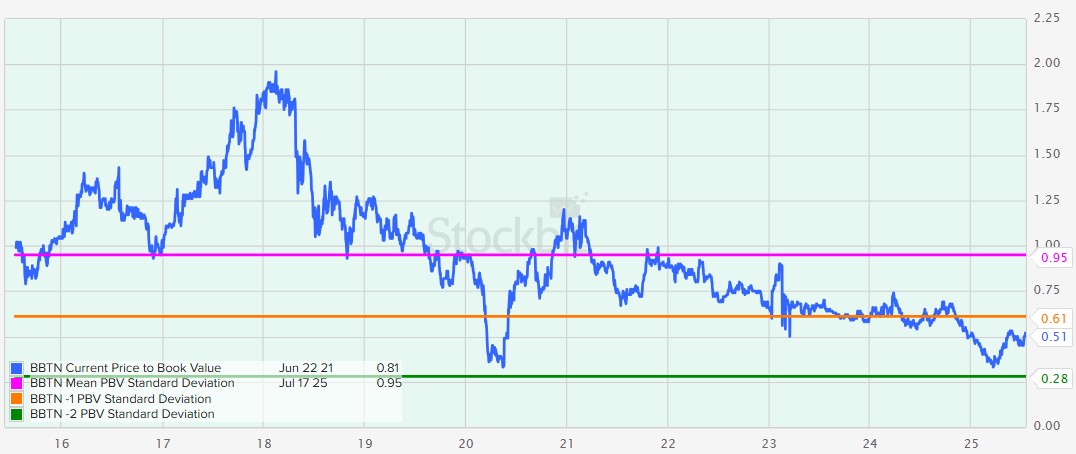
Industry-wide ROEs are trending upward post-pandemic, yet many bank stocks are priced for very low growth. The valuation case is clear: prices have fallen while earnings have remained solid, leaving many bank stocks at undemanding multiples. This offers a significant upside if sentiment and liquidity normalize.
Attractive dividend yields vs history and government bonds
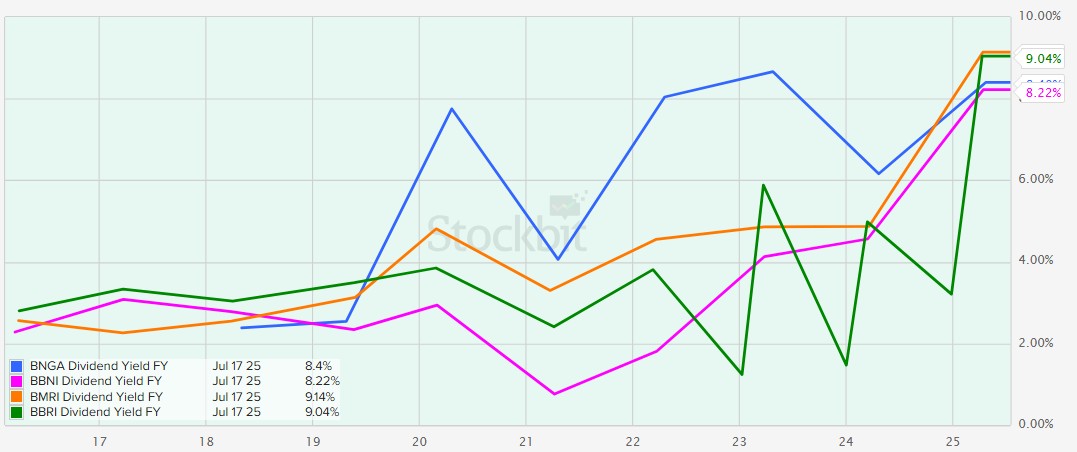
One immediate benefit of lower prices is higher dividend yields. Indonesian banks have a long track record of robust payouts, and with share prices depressed, those yields have climbed to attractive levels – in some cases now exceeding government bond yields or historical norms. For example, Bank CIMB Niaga (BNGA), noted above, has maintained a dividend payout over 50%, resulting in a high single-digit dividend yield for investors at the current stock price. A yield in the ~7–9% range (IDR terms) is extremely enticing, effectively rivaling the Indonesian 10-year government bond yield, which is currently at around 6.5%, while still offering equity upside. Indeed, BNGA’s generous payout and strong earnings have led analysts to call its dividend “highly attractive”, expecting this to help catalyze a re-rating of the stock.
Large banks are also boosting returns to shareholders. BBNI, for instance, is increasing its dividend payout ratio to 50% (up from a historical 20–30%). With capital levels strong (CAR ~19%), BBNI has room to nearly double its payout, which will significantly raise its yield going forward. Even Bank Rakyat Indonesia (BBRI) – the country’s biggest microfinance lender – has been paying out higher dividends; in 2023 it distributed 85% of earnings as dividends, an unusually high payout that pushed its yield into the mid-single digits. For context, BBRI’s yield had historically been in the 2–3% range, but after the recent price drop and payout boost, investors can get around 5% or more yield from BBRI stock.
Likewise, Bank Mandiri (BMRI) often yields ~6% at recent prices due to a combination of price weakness and a ~60% payout ratio. These yields are high relative to the past – just a few years ago, most Indonesian banks yielded only low-single-digit percentages because valuations were richer.
Several bank stocks that can match or beat the Indonesia 10-year government yield are BNGA and BBNI (~8%), BMRI and BBRI (~9%). This makes bank equities attractive not just to equity investors but also to income-focused investors who might see them as bond proxies with growth potential. As a result, once confidence returns, yield-hungry funds could rotate into these stocks, supporting their prices.
In short, Indonesian banks offer a rare combination of high dividend income and low valuations. The dividend yields are at multi-year highs, providing a cushion and incentive for investors to hold the stocks while waiting for price recovery. This yield support limits downside and is a strong catalyst for renewed interest – especially as local rates fall (driving bond yields down and making equity yields even more attractive by comparison).
Rate cuts: Easing cycle bodes well for bank stocks
After a period of monetary tightening, Bank Indonesia (BI) has begun cutting interest rates – a trend that historically boosts banking sector performance. The central bank hiked its benchmark rate aggressively in 2022–2023 (from a pandemic low of 3.5% up to 6.25% by Aug 2024) to combat inflation. But by late 2024, inflation was subdued and the tide turned: BI kicked off a new easing cycle in September 2024 with a surprise 25 bps rate cut to 6.00%, its first cut in over three years. This marked a policy shift from a “pro-stability” stance to a more growth-supportive stance.
Further cuts followed – BI has since trimmed the benchmark rate four times (as of July 2025) down to 5.25%. The central bank signaled room for more easing, citing low inflation and a stable IDR outlook. Lower interest rates are generally positive for banks and the broader market. They reduce funding costs, stimulate loan demand, and improve borrowers’ ability to repay loans (lower credit costs).
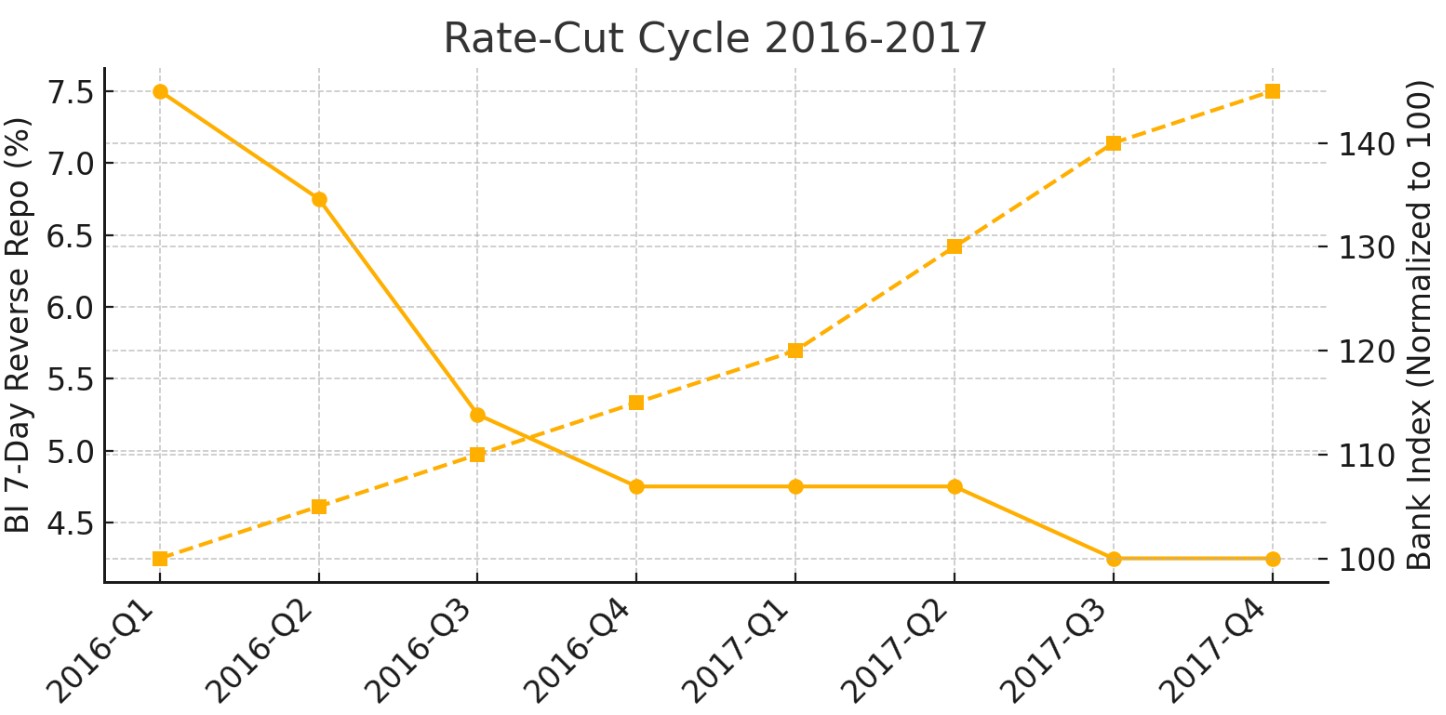
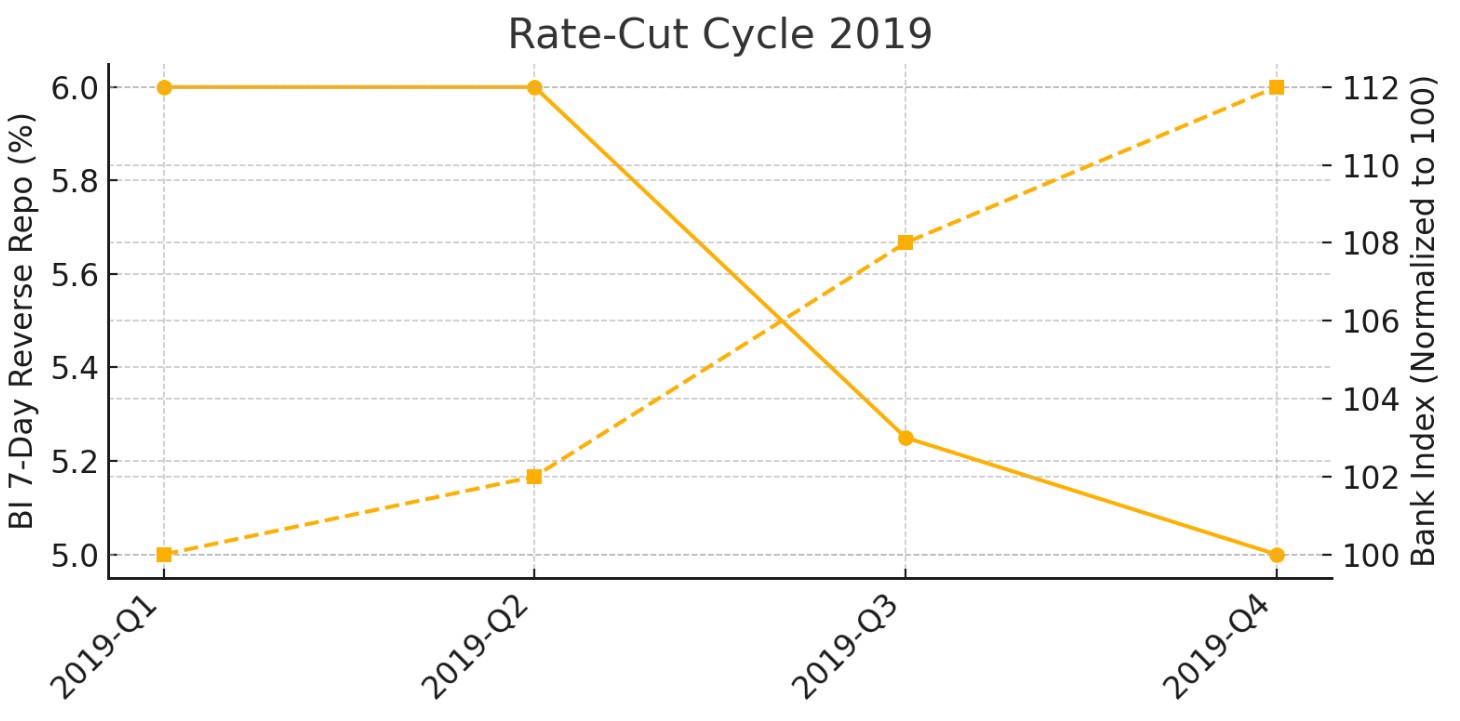
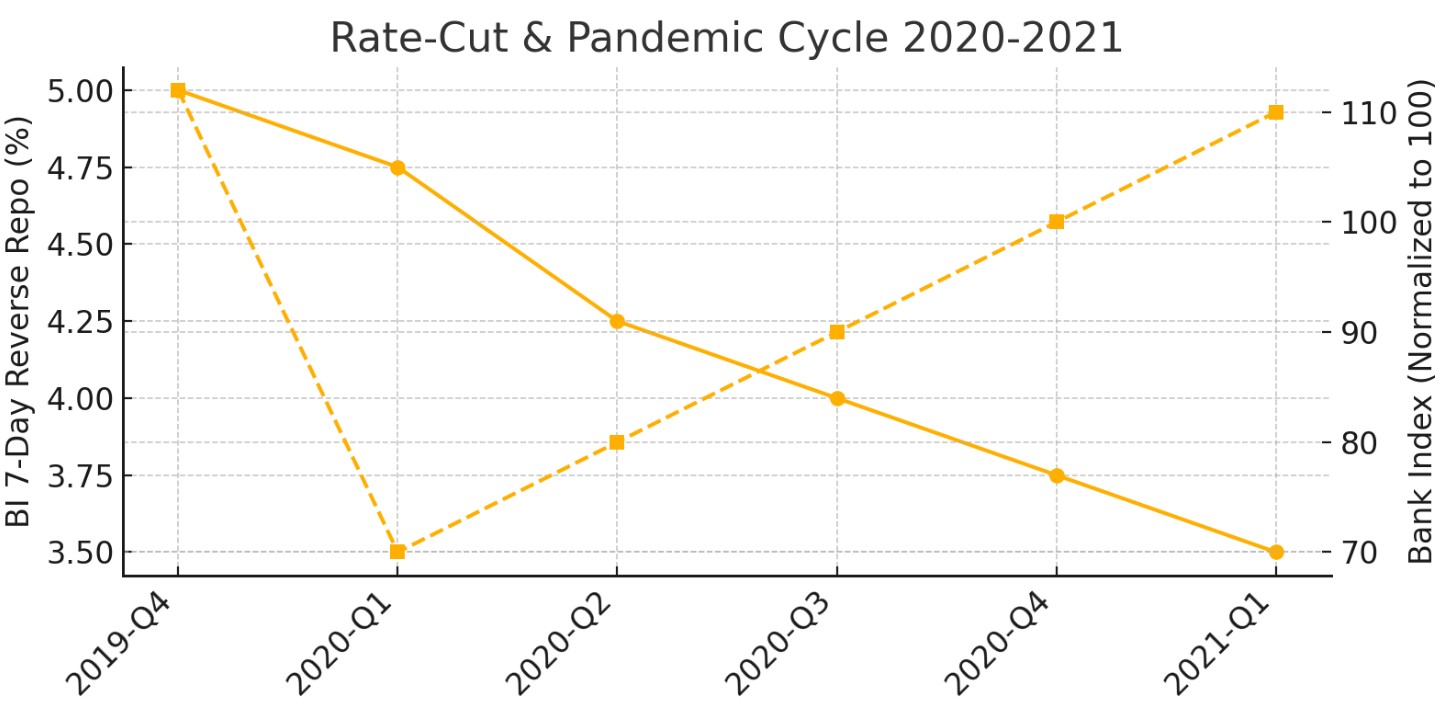
Historically, rate-cut cycles have aligned with strong bank stock performance (barring external shocks). For example, in the last major easing phase (2016–2017), BI slashed rates by 200+ bps and banks enjoyed a robust rally as economic growth picked up. Again in 2019, BI cuts helped lift bank shares (until the unforeseen COVID shock intervened). During the pandemic in 2020, BI’s rapid cuts to record-low rates initially coincided with market turmoil, but critically laid the groundwork for the sharp rebound in bank stocks in 2021 as recovery took hold. Now, with the 2024–2025 easing cycle underway, bank stocks are expected to repeat history.
2016-2017 rate cut cycle and bank share price index:
2019 rate cut cycle and bank share price index:
2020-2021 rate cut and pandemic cycle, and bank share price index:
For international investors who want to take advantage of these discounted valuations and high dividend yields, access to the Indonesian equity market usually comes through global stock brokers that provide trading on Asian exchanges or ADR instruments. Choosing a platform with reliable market access, competitive fees, and strong investor protection is an important step before building exposure to Indonesian bank stocks. The comparison below highlights several brokers that offer access to Indonesian equities and other global markets.
| SpeedTrader | EXANTE | CapTrader | Plus500 | TradeZero International | Freedom24 | UTEX | Easy Equities | Revolut | |
|---|---|---|---|---|---|---|---|---|---|
|
Foundation year |
1999 | 2011 | 2001 | 2008 | 2008 | 2013 | 2020 | 1998 | 2015 |
|
Account min. |
2,500 | EUR10,000 | 2,000 | 500 | 500 | 1 | 10 | No | No |
|
Interest rate |
No | Varies | 1% | No | 9% | 7,08 | No | 3.50% | 0%-4% |
|
Basic stock/ETF fee |
$0.0025/$0,0009 | From $0.02 | $0.01 | $0.006 | $0,005 | 0,02$/€+2 EUR / 0,25%+10HK$ | 0,02-0,04% | 0.25% | 0.12%-0.25% |
|
Min. stock/ETF fee |
$0 | $1 | $2 | Not specified | $0.99 | 0,25% | 0,02% | R0.01 | £1.00/€1.00 |
|
Basic futures fee |
Not specified | From $1.5 | €1 | Not specified | Not specified | Varies | Not provided | Not specified | No |
|
Min. futures fee |
Not specified | Not specified | €1 | Not specified | Not specified | Varies | Not provided | Not specified | No |
|
Open an account |
Go to broker |
Go to broker Your capital is at risk. |
Go to broker Your capital is at risk.
|
Go to broker 81% of retail CFD accounts lose money. |
Go to broker Your capital is at risk. |
Go to broker Your capital is at risk.
|
Go to broker Your capital is at risk.
|
Study review | Study review |
Indonesian bank stocks are undervalued

Accounting for the beginning of interest rate cut cycle (3x25bps rate cuts so far) and dividend yields exceeding the 10-year Indonesian Government Bond (INDOGB) yield, I recommend gradually accumulating positions in the sector. Indonesian bank shares now look mis‑priced, and the risk‑reward profile has become favourable for long‑term investors.
Indonesia’s major bank stocks appear to be undervalued: they are roughly 15% lower year‑over‑year, whereas the Jakarta Composite Index (JCI) is already up by almost 3%, driven mainly by conglomerates and the Prajogo Pangestu group stocks. Tight liquidity, decelerating loan growth, and massive net foreign outflow have all contributed to the correction.
However, the share price is expected to go north in the near future, supported by the cessation of foreign selling, attractive dividend yield – higher than both historical averages and long‑term government bond yields – and the dovish stance by the central bank.
Conclusion
Now is a compelling time to accumulate Indonesian bank stocks, as beaten-down valuations, robust dividend yields that outpace government bonds, and a fresh central bank easing cycle align to create a rare buying opportunity. Major lenders like BBNI and BBCA are trading at multi-year valuation lows, while dividend yields for banks such as BNGA and BBNI reach the 7–9% range. With the normalization of sentiment and resumption of foreign inflows already sparking a market rebound, the stage is set for outsized returns as macro conditions improve. Investors who act decisively today could capture both high income and capital upside, making Indonesian banks one of the region’s most attractive equity prospects.
FAQs
How do dividend yields of Indonesian bank stocks compare to government bond yields?
What are the implications of the current valuation gap among major and mid-tier Indonesian banks?
Why might Indonesian bank stocks benefit from the recent interest rate cuts?
How has foreign investor behavior affected Indonesian bank stock prices in recent months?
Editors' Top Picks and Insights






Related Articles
Team that worked on the article
Andreas Kristo Saragih is a seasoned equity research analyst with over a decade of experience across both buy-side and sell-side roles, focused on the Indonesian capital market. He has extensive sector coverage, including banking, consumer goods, retail, real estate, healthcare, transportation, poultry, cement, pharmaceuticals, construction, and infrastructure.
Dan Blystone began his trading career in 1998 as an arbitrage clerk on the floor of the Chicago Mercantile Exchange (CME). He later traded bond and Eurex futures at proprietary firms such as Altea Trading, gaining valuable experience in high-frequency trading and risk management.
Chinmay Soni is a financial analyst with more than 5 years of experience in working with stocks, Forex, derivatives, and other assets. As a founder of a boutique research firm and an active researcher, he covers various industries and fields, providing insights backed by statistical data.
The deviation is a statistical measure of how much a set of data varies from the mean or average value. In forex trading, this measure is often calculated using standard deviation that helps traders in assessing the degree of variability or volatility in currency price movements.
Index in trading is the measure of the performance of a group of stocks, which can include the assets and securities in it.
An investor is an individual, who invests money in an asset with the expectation that its value would appreciate in the future. The asset can be anything, including a bond, debenture, mutual fund, equity, gold, silver, exchange-traded funds (ETFs), and real-estate property.
A bear market is a period of time in which an investment asset, such as stocks, bonds, or commodities, experiences a decline in price for an extended period of time.
Risk management is a risk management model that involves controlling potential losses while maximizing profits. The main risk management tools are stop loss, take profit, calculation of position volume taking into account leverage and pip value.

-
 Afghanistan
-
 Albania
-
 Algeria
-
 Angola
-
 Argentina
-
 Armenia
-
 Australia
-
 Austria
-
 Azerbaijan
-
 Bahamas
-
 Bahrain
-
 Bangladesh
-
 Belarus
-
 Belgium
-
 Bolivia
-
 Botswana
-
 Brazil
-
 Brunei
-
 Bulgaria
-
 Cambodia
-
 Cameroon
-
 Canada
-
 Chile
Chile
-
 China
China
-
 Colombia
-
 Congo
Congo
-
 Costa Rica
-
 Cote d'Ivoire
-
 Croatia
-
 Cuba
Cuba
-
 Cyprus
-
 Czechia
-
 DR Congo
-
 Denmark
-
 Dominican Republic
-
 Ecuador
-
 Egypt
Egypt
-
 El Salvador
-
 Estonia
-
 Eswatini
-
 Ethiopia
-
 Finland
-
 France
-
 Georgia
-
 Germany
-
 Ghana
Ghana
-
 Greece
-
 Haiti
Haiti
-
 Hong Kong
-
 Hungary
-
 India
India
-
 Indonesia
-
 Iran, Islamic republic
-
 Iraq
Iraq
-
 Ireland
-
 Israel
-
 Italy
Italy
-
 Jamaica
-
 Japan
Japan
-
 Jordan
-
 Kazakhstan
-
 Kenya
Kenya
-
 Korea
Korea
-
 Kuwait
-
 Kyrgyzstan
-
 Laos
Laos
-
 Latvia
-
 Lebanon
-
 Lesotho
-
 Libya
Libya
-
 Lithuania
-
 Luxembourg
-
 Madagascar
-
 Malaysia
-
 Malta
Malta
-
 Mauritius
-
 Mexico
-
 Moldova
-
 Mongolia
-
 Montenegro
-
 Morocco
-
 Mozambique
-
 Myanmar
-
 Namibia
-
 Nepal
Nepal
-
 Netherlands
-
 New Zealand
-
 Nigeria
-
 North Macedonia
-
 Norway
-
 Oman
Oman
-
 Pakistan
-
 Palestine
-
 Panama
-
 Papua New Guinea
-
 Paraguay
-
 Peru
Peru
-
 Philippines
-
 Poland
-
 Portugal
-
 Puerto Rico
-
 Qatar
Qatar
-
 Reunion
-
 Romania
-
 Rwanda
-
 Saudi Arabia
-
 Serbia
-
 Singapore
-
 Slovakia
-
 Slovenia
-
 Somalia
-
 South Africa
-
 Spain
Spain
-
 Sri Lanka
-
 Sweden
-
 Switzerland
-
 Syria
Syria
-
 Taiwan
-
 Tajikistan
-
 Tanzania
-
 Thailand
-
 Trinidad and Tobago
-
 Tunisia
-
 Turkey
-
 UAE
UAE
-
 Uganda
-
 Ukraine
-
 United Kingdom
-
United States
-
 Uruguay
-
 Uzbekistan
-
 Venezuela
-
 Vietnam
-
 Yemen
Yemen
-
 Zambia
-
 Zimbabwe
- Forex
- Crypto












