
Indonesia’s Nutritious Free Meal Program: A Game-Changer For Poultry Profits



Editorial Note: While we adhere to strict Editorial Integrity, this post may contain references to products from our partners. Here's an explanation for How We Make Money. None of the data and information on this webpage constitutes investment advice according to our Disclaimer.
The Indonesia’s Nutritious Free Meal (Makan Bergizi Gratis/MBG) program, which was launched in January 2025, is one of the region’s largest social-nutrition initiatives. The program is expected to deliver daily nutritious meals to school-age children, pregnant and breastfeeding women, and toddlers at national scale. The government’s 2025 allocation began at IDR71tr and has since been lifted to a headline IDR171tr as the program widened its reach. During 2025 alone, the rollout seeks to reach tens of millions of beneficiaries, with an ambitious year-end target of roughly 83mn people.
The nutritious free meal comprises a carbohydrate source, a protein portion, vegetables and milk, all financed within a strict IDR10,000-per-person budget. Recognizing Indonesia’s diverse geography and the budget constraint, policymakers opted for locally sourced staples – rice, corn or potatoes for carbohydrates, and regionally abundant proteins such as shrimp and fish for coastal areas, with poultry and beef serving as readily available alternatives elsewhere.
How, therefore, might investors tap into this opportunity? We recommend concentrating on listed poultry integrators that possess end-to-end control and nationwide distribution networks, most notably CPIN, JPFA and MAIN. These companies are ideally positioned to capture government and institutional orders, lock in utilization gains across feed, DOC, broiler and processed-food segments, and ultimately transform policy-driven volume into operating leverage. We prefer scale and cold-chain leadership (CPIN), processing leverage (JPFA), and utilization torque (MAIN).
MBG program – all you need to know
The MBG is a flagship initiative launched in January 2025 with an initial budget of IDR71tr to serve 17.9mn recipients (about 15.5mn students and 2.4mn pregnant or breastfeeding mothers and toddlers). Following a presidential directive, the target was raised to 82.9 mn people – nearly one-third of Indonesia’s population – bringing the total FY25 budget to IDR171tr. For FY26, the government has nearly doubled funding to IDR335tr to sustain and broaden the program. This hefty allocation is intended to maintain coverage of roughly 82.9 mn beneficiaries.
Distribution of the meals is handled through a vast network of community kitchens and service units. By mid-2025, the National Nutrition Agency (Badan Gizi Nasional, BGN) had set up over 1,800 Nutrition Fulfillment Service Units (SPPG) across all 38 provinces. These facilities prepare and deliver meals to schools and community centers.
The cost per meal in the program is IDR10,000 which includes ingredients (food supplies), preparation and delivery overheads (workers’ wages, kitchen utilities, transport, etc.). A typical meal portion includes a carbohydrate staple (such as rice, fortified noodles, potato and corn), a protein source (chicken, eggs, fish, tofu, shrimp, beef or tempeh), vegetables, and fruit. Milk is provided to boost calcium and protein intake, though not every day. Menus are rotated frequently to avoid monotony and can be adjusted by on-site nutritionists based on regional food availability.
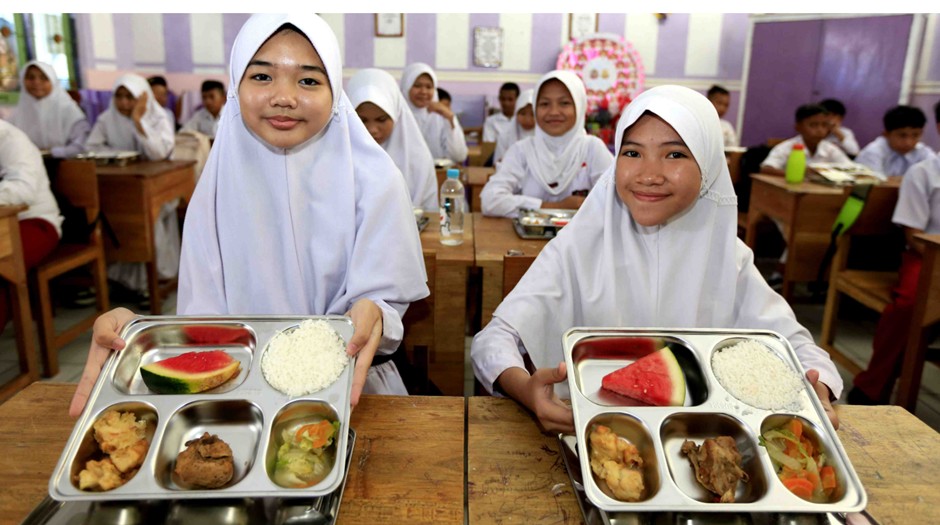
MBG to support sustainable demand and pricing
Government calculations imply that the program alone will require about 400,000 tonnes of eggs per year, while industry analysts estimate that total MBG demand will absorb roughly 8% of Indonesia’s current poultry output. This comes against a backdrop of very low poultry intake per capita in Indonesia. The recent publication by the Indonesian Statistic Bureau (BPS) shows the poultry consumption per capita stood at 8.3kg, far below peers in ASEAN (Malaysia ~30kg, Philippines and Vietnam above 10kg).
| Description | Value | UoM |
|---|---|---|
| MBG recipients | 82.9 | mm |
| Recipient who consume poultry | 41.5 | mm |
| Poultry portion/pax | 50.0 | gr |
| Poultry consumption/day | 2.1 | ktonnes |
| Poultry menu/year | 156.0 | x |
| Poultry consumption/year | 323.3 | ktonnes |
| Poultry production/year | 3,836.0 | ktonnes |
| Poultry absorption from MBG | 8.4 | % |

Crucially, the additional demand from MBG will soak up long-standing surpluses. Government officials note that oversupply – especially of chicken meat – has plagued the industry for decades amid weak purchasing power. Prior production ran about 340,000 tonnes/year above domestic demand. On the egg front, Indonesia typically has a 200,000-tonne surplus, however, the MBG program’s requirements would effectively eliminate that buffer and could even create shortages unless fresh capacity is added.
Greater demand should translate into firmer prices. After years of depressed poultry prices, broiler prices have begun to recover. In mid-2025 livebird was averaging only IDR15–17k/kg (below production cost of around IDR18k), but by late 2025 prices were around IDR20–21k/kg. DOC prices have similarly rebounded to roughly IDR6.5k each versus government floor levels of IDR5.5k. In essence, MBG-driven offtake supports revenue by lifting the live-bird population, stimulating consumption and easing structural oversupply, thereby exerting upward pressure on both broiler and DOC prices.
Profitability Tailwind from Indonesia’s free meal program
Given the egg and poultry meat requirements outlined above, poultry integrators are expected to expand their breeding flocks and DOC output, translating into a much larger livebird population. Because feed constitutes roughly 60% of broiler production costs, a bigger herd directly lifts feed volumes, benefiting feed-mill operators. Notably, the feed division already accounts for about half of segmental operating profit and enjoys the highest margins among integrators’ business lines.
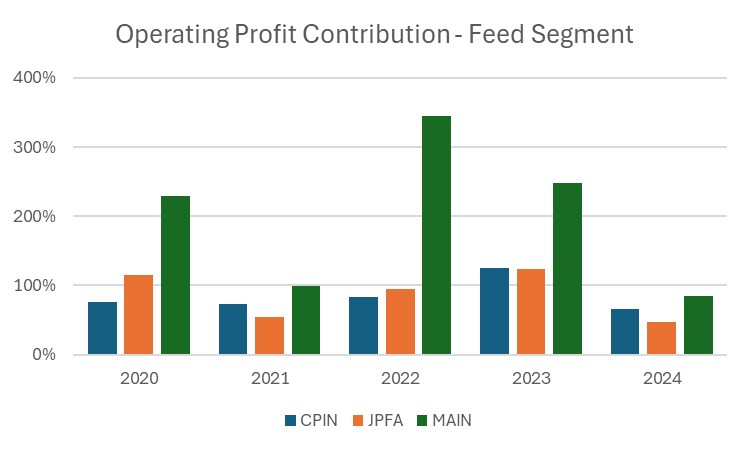
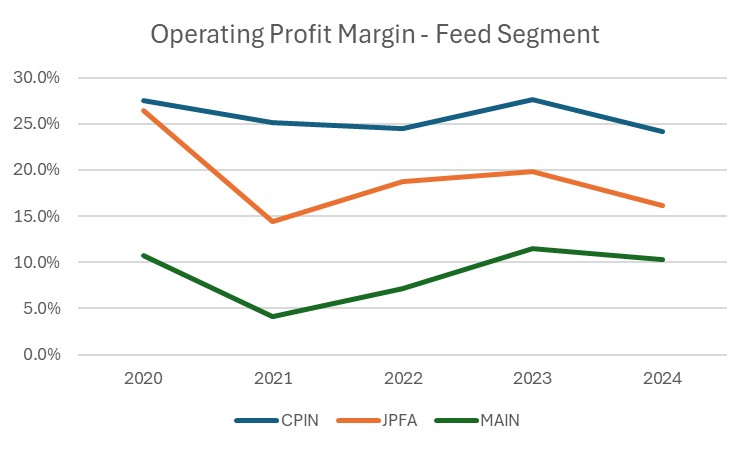
On the cost side, MBG’s guaranteed offtake will dramatically reduce expensive culling costs. It is worth noting that authorities conducted multiple culling mandates in FY23 to shore up prices, but at the expense of producers. Each forced cull wasted feed, chick inventory and labor, squeezing integrator margins. With less idle oversupply, the need to cull is dramatically reduced, sparing companies those avoidable costs. In practical terms, producers can focus on selling more livebird into MBG-supported channels rather than euthanizing flocks. This structural support also stabilizes prices with industry analysts now see broiler and DOC pricing less volatile, supported by tighter supply and steady demand. In sum, integrators should see steadier, healthier profit margins on each chicken sold once feed prices stabilize, and supply shocks diminish.
MBG creates sustained state-backed offtake, lifting volumes, capacity use and margins for integrators

I expect the MBG program represents a sustainable demand for listed poultry integrators. Its sheer scale and predictability of government-backed offtake should lift volumes across the chain – feed, DOC, broiler, and processing food – supporting both revenue growth and operating leverage. In practical terms, more institutional meals mean steadier day-to-day drawdowns of livebird and processed chicken, higher plant utilization, and better inventory turns. The largest listed players are best positioned to capture this because they already control the cold chain, distribution, and farmer networks at national scale.
Profitability should improve as well. A tighter supply–demand balance for live birds will reduce the boom-bust pricing that historically forced costly culling. In addition, integrators will be able to plan chick placements more rationally and run closer to optimal capacity thanks to a reliable buyer. As a result, I believe it will stabilize DOC and live bird prices, widens processing spreads, and helps feed margins via more predictable procurement and throughput.
Conclusion
Indonesia’s Nutritious Free Meal program stands out as a strategic catalyst for the nation’s poultry industry, directly tackling the persistent challenge of oversupply. By substantially increasing the demand for feed and poultry meat, this initiative has notably improved financial margins for major players like CPIN, JPFA, and MAIN. For example, elevated sales volumes and stabilized pricing have reversed margin pressures that once threatened profitability. Ultimately, the program not only addresses key nutritional needs among Indonesians but also reaffirms how well-crafted policy can empower entire sectors and sustain growth. The lesson is clear: targeted public interventions can invigorate industries and create lasting economic impact.
FAQs
How does the Nutritious Free Meal Program contribute to improved nutrition among children and vulnerable groups?
What measures ensure meal quality and safety within the Nutritious Free Meal Program?
What economic effects does the program have on local farmers and food producers?
How does the program’s scale impact logistics and distribution across Indonesia’s diverse regions?
Editors' Top Picks and Insights

Bitcoin price prediction and Bollinger Bands: Can BTC recover after falling to $63,000?

FIFA World Cup on blockchain: Where football meets crypto

Aliens, Satoshi, and Bitcoin: How the extraterrestrial theory emerged

Blockchain nation in crisis: How a power struggle split Liberland

Shifting priorities: Governments back mining as businesses turn to AI
Intel's comeback: Apple, Trump and the AI bet
Related Articles
Team that worked on the article
Andreas Kristo Saragih is a seasoned equity research analyst with over a decade of experience across both buy-side and sell-side roles, focused on the Indonesian capital market. He has extensive sector coverage, including banking, consumer goods, retail, real estate, healthcare, transportation, poultry, cement, pharmaceuticals, construction, and infrastructure.
Dan Blystone began his trading career in 1998 as an arbitrage clerk on the floor of the Chicago Mercantile Exchange (CME). He later traded bond and Eurex futures at proprietary firms such as Altea Trading, gaining valuable experience in high-frequency trading and risk management.
Chinmay Soni is a financial analyst with more than 5 years of experience in working with stocks, Forex, derivatives, and other assets. As a founder of a boutique research firm and an active researcher, he covers various industries and fields, providing insights backed by statistical data.

-
 Afghanistan
-
 Albania
-
 Algeria
-
 Angola
-
 Argentina
-
 Armenia
-
 Australia
-
 Austria
-
 Azerbaijan
-
 Bahamas
-
 Bahrain
-
 Bangladesh
-
 Belarus
-
 Belgium
-
 Bolivia
-
 Botswana
-
 Brazil
-
 Brunei
-
 Bulgaria
-
 Cambodia
-
 Cameroon
-
 Canada
-
 Chile
Chile
-
 China
China
-
 Colombia
-
 Congo
Congo
-
 Costa Rica
-
 Cote d'Ivoire
-
 Croatia
-
 Cuba
Cuba
-
 Cyprus
-
 Czechia
-
 DR Congo
-
 Denmark
-
 Dominican Republic
-
 Ecuador
-
 Egypt
Egypt
-
 El Salvador
-
 Estonia
-
 Eswatini
-
 Ethiopia
-
 Finland
-
 France
-
 Georgia
-
 Germany
-
 Ghana
Ghana
-
 Greece
-
 Haiti
Haiti
-
 Hong Kong
-
 Hungary
-
 India
India
-
 Indonesia
-
 Iran, Islamic republic
-
 Iraq
Iraq
-
 Ireland
-
 Israel
-
 Italy
Italy
-
 Jamaica
-
 Japan
Japan
-
 Jordan
-
 Kazakhstan
-
 Kenya
Kenya
-
 Korea
Korea
-
 Kuwait
-
 Kyrgyzstan
-
 Laos
Laos
-
 Latvia
-
 Lebanon
-
 Lesotho
-
 Libya
Libya
-
 Lithuania
-
 Luxembourg
-
 Madagascar
-
 Malaysia
-
 Malta
Malta
-
 Mauritius
-
 Mexico
-
 Moldova
-
 Mongolia
-
 Montenegro
-
 Morocco
-
 Mozambique
-
 Myanmar
-
 Namibia
-
 Nepal
Nepal
-
 Netherlands
-
 New Zealand
-
 Nigeria
-
 North Macedonia
-
 Norway
-
 Oman
Oman
-
 Pakistan
-
 Palestine
-
 Panama
-
 Papua New Guinea
-
 Paraguay
-
 Peru
Peru
-
 Philippines
-
 Poland
-
 Portugal
-
 Puerto Rico
-
 Qatar
Qatar
-
 Reunion
-
 Romania
-
 Rwanda
-
 Saudi Arabia
-
 Serbia
-
 Singapore
-
 Slovakia
-
 Slovenia
-
 Somalia
-
 South Africa
-
 Spain
Spain
-
 Sri Lanka
-
 Sweden
-
 Switzerland
-
 Syria
Syria
-
 Taiwan
-
 Tajikistan
-
 Tanzania
-
 Thailand
-
 Trinidad and Tobago
-
 Tunisia
-
 Turkey
-
 UAE
UAE
-
 Uganda
-
 Ukraine
-
 United Kingdom
-
United States
-
 Uruguay
-
 Uzbekistan
-
 Venezuela
-
 Vietnam
-
 Yemen
Yemen
-
 Zambia
-
 Zimbabwe
- Forex
- Crypto











