
The Rise And Evolution Of Initial Coin Offerings In Crypto Fundraising


Editorial Note: While we adhere to strict Editorial Integrity, this post may contain references to products from our partners. Here's an explanation for How We Make Money. None of the data and information on this webpage constitutes investment advice according to our Disclaimer.
Initial Coin Offerings (ICOs) revolutionized fundraising by allowing global access to early-stage crypto projects through token sales. While fast and inclusive, ICOs also introduced new risks tied to regulation, speculation, and project transparency.
Initial Coin Offerings were never just a fundraising gimmick. They rewrote the script on how capital forms in internet-native ecosystems. Instead of relying on banks or venture funds ICOs let projects reach a global pool of believers willing to fund ideas at the speed of code. But that openness also blurred the line between innovation and speculation. The real story is not just about coins sold but about how value moves when trust is programmed not negotiated. ICOs and their descendants are more than funding tools. They are tests of how markets behave when anyone can be an investor and every token has a narrative.
Risk warning: Cryptocurrency markets are highly volatile, with sharp price swings and regulatory uncertainties. Research indicates that 75-90% of traders face losses. Only invest discretionary funds and consult an experienced financial advisor.
Understanding crypto fundraising
Crypto fundraising has transformed how startups raise capital. Instead of depending solely on traditional investors and lengthy funding cycles, blockchain projects can now access global capital through token-based models. These new methods allow broader participation, enable faster capital movement, and introduce unique risks. Gaining a clear understanding of how these mechanisms work, and how they compare to venture capital, can help both investors and founders navigate the changing landscape of the crypto economy.
The rise of token-based capital raising
Token sales have reshaped startup fundraising by cutting out middlemen and creating new ways to build communities around projects. Projects issue tokens in exchange for crypto, usually before the platform is fully launched. These tokens can represent access, utility, or governance within the project’s ecosystem. Depending on the model, tokens may be sold publicly (ICO, IDO) or privately (pre-sale rounds with VCs)
| Key Format | Description |
|---|---|
| ICO (Initial Coin Offering) | The first and most popular method during 2017. Often public, with low entry barriers |
| IEO (Initial Exchange Offering) | Launched via crypto exchanges, which vet the projects and manage the sale |
| IDO (Initial DEX Offering) | Token sales on decentralized exchanges, with quicker access but often less due diligence |
Why it grew fast
Global accessibility: anyone with crypto could participate.
Speed: projects could raise millions in minutes without going through banks or legal paperwork.
Community building: early backers often became project evangelists.

Comparing traditional venture capital with crypto models
Crypto fundraising flips many traditional rules, creating both new opportunities and major tradeoffs. Startups pitch to VC firms in exchange for equity, mentorship, and staged funding. VCs often take board seats and guide the company’s growth over several years. Funding rounds are formal, legally structured, and involve long-term commitments
How crypto models differ
Projects raise funds quickly from the public, often before there’s a working product.
Investors get tokens, not equity, which may or may not offer real ownership or rights.
There’s usually no board or oversight, just smart contracts and tokenomics.
| Feature | Venture Capital | Crypto Fundraising |
|---|---|---|
| Access | Limited to accredited investors | Open to global retail participants |
| Speed | Months of due diligence and negotiation | Can close in days or minutes |
| Investor involvement | Active, hands-on guidance | Passive or community-driven |
| Risk level | Lower due to regulation and vetting | Higher due to fast-moving, open market |
Why this matters
Venture capital offers structure and support but limits access.
Crypto models offer speed and openness but need stronger safeguards.
A hybrid approach is emerging, where trusted VCs join early token rounds to provide credibility.
The ICO boom of 2017
In 2017, crypto fundraising took off like never before. Startups around the world raised huge sums of money by selling digital tokens directly to the public. It was fast, open, and mostly unregulated and it changed the game. While some projects thrived, others burned through cash or vanished completely. This was the year the crypto world realized how powerful and risky token fundraising could be.
Origins and explosive growth
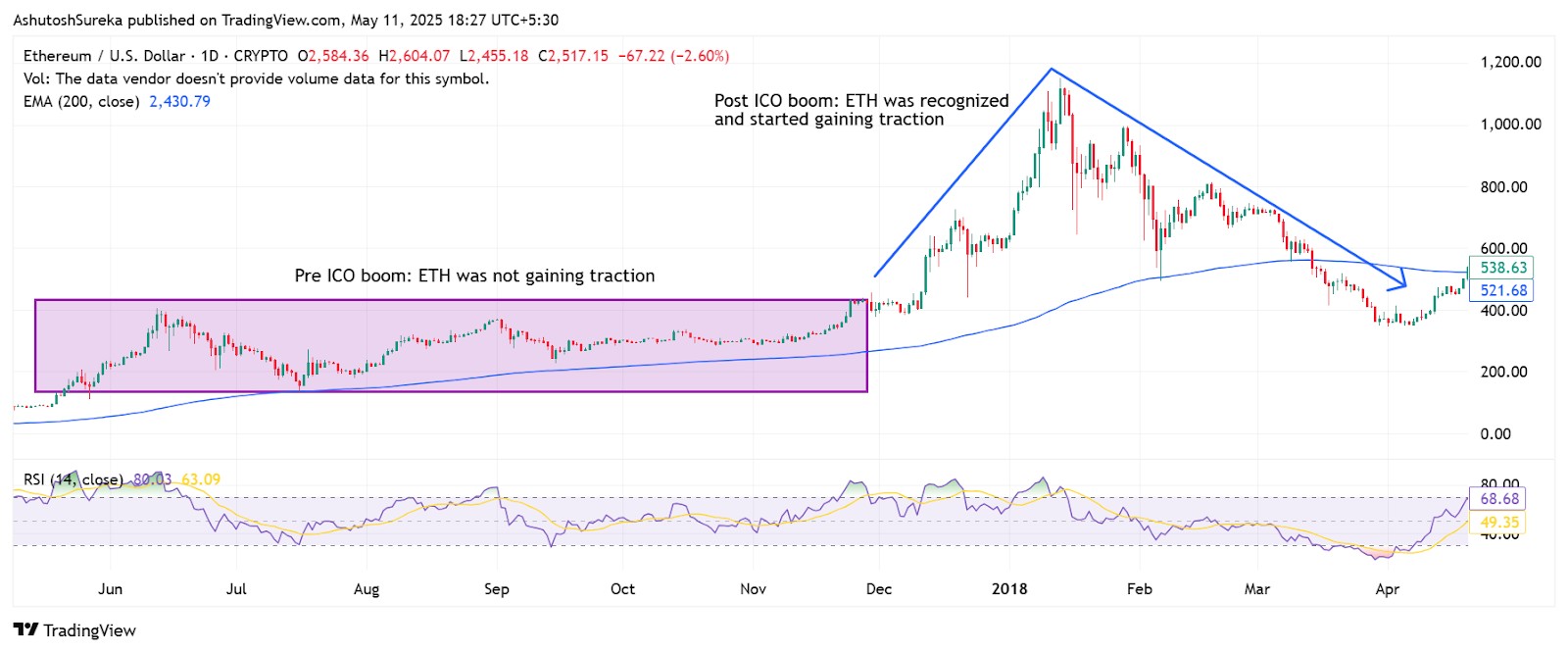
ICOs weren’t new in 2017, but that was the year they truly exploded. Ethereum made it easy to create and sell tokens, thanks to its smart contract system. When Ethereum itself raised $18 million in 2014, it showed what was possible. By 2017, crypto was buzzing, prices were climbing, and everyone wanted in.
Why it took off so fast
Anyone could join. You did not need a bank, broker, or big check. Just a crypto wallet.
Early success stories. Some ICOs made investors rich in weeks, fueling a buying frenzy.
Few rules in place. Projects launched fast, often without real scrutiny or clear plans.
Over $6 billion was raised in 2017 through ICOs. New projects were launching every day, with a mix of promising ideas and unproven concepts. ICOs became the hottest trend in crypto that year
Notable ICO successes and failures
The ICO boom had big winners and painful lessons.
Who got it right
Ethereum. It set the standard. The platform now supports most of the crypto world.
Binance. Started with a $15 million ICO and became one of the biggest crypto exchanges ever.
Chainlink. Built a key service for smart contracts and grew into a core part of the blockchain ecosystem.
Who got it wrong
Tezos. Raised over $200 million but was stuck in legal and team disputes for years.
Centra Tech. Got celebrity backing and millions in funding. Turned out to be a scam. The founders went to jail.

Countless one-pager projects. Many raised millions with flashy websites and vanished as soon as the hype faded.

Evolution beyond ICOs
Following the volatility of 2017, the crypto industry began exploring smarter and safer methods for raising capital. New models emerged, with some emphasizing regulatory compliance and others embracing decentralization. These updated fundraising approaches helped rebuild trust and offered both projects and investors more structured and reliable ways to engage. From exchange-led sales to staking-based models, crypto fundraising began to enter a more mature phase.
Initial Exchange Offerings (IEOs)
IEOs introduced a layer of credibility to token sales by partnering directly with centralized exchanges. In this model, a crypto project collaborates with an exchange, which then manages the token sale, conducts a vetting process, and ensures the token is listed for trading. To participate, buyers must use the host exchange’s platform.
Investors appreciate IEOs because exchanges act as preliminary filters against scams, tokens are typically listed immediately after the sale, and the process offers more security compared to transferring funds to unknown wallets.
However, there are trade-offs. Exchanges charge listing and participation fees, control access to the sale, and often prioritize larger, more established projects. And despite the added trust layer, investors still face the risk of losing money if the project underperforms or fails.
Initial DEX Offerings (IDOs)
IDOs shift the fundraising process back to the community by leveraging decentralized platforms. Projects launch their tokens directly on decentralized exchanges (DEXs) such as Uniswap, bypassing centralized approval processes. Instead, smart contracts handle the sale, distribution, and liquidity setup autonomously.
This approach is appealing because it’s open to anyone, removes the need for intermediaries, and enables rapid project launches with minimal barriers. However, the model carries significant risks. There are no formal review mechanisms, meaning any project — legitimate or not — can issue a token. Prices often swing wildly in the early stages, and the absence of oversight leaves room for scams and fraudulent launches.
Security Token Offerings (STOs)
STOs introduced legal rigor to crypto fundraising by aligning with established financial regulations. In this model, tokens are backed by real-world assets such as company equity or revenue-sharing rights, and the fundraising process adheres to securities laws, often targeting accredited investors. Participation involves thorough KYC procedures, legal documentation, and regulatory compliance checks.
Supporters value STOs because they are structured to be legally compliant from the outset, offering a level of transparency and security that appeals to institutional investors. They also serve as a bridge between the crypto world and the traditional economy.
However, this approach comes with trade-offs. Legal and regulatory requirements make the process more expensive and time-consuming, participation is typically limited to a narrower pool of qualified investors, and in many regions, the regulatory framework for STOs remains incomplete or inconsistent.
Initial Stake Pool Offerings (ISPOs)
ISPOs introduce an innovative fundraising model that lets supporters contribute without spending their crypto. Participants delegate their tokens to a staking pool controlled by the project, and while the staking rewards typically go to the project itself, users receive the project's native tokens over time as compensation.
This method is unique because it allows participants to retain ownership of their original crypto holdings, requires no upfront payment, and helps build a more engaged and long-term community around the project. However, the format has its limitations. It is primarily used within ecosystems that support staking, like Cardano. The value of the tokens received in return is uncertain, and projects may raise funds more slowly compared to traditional sales.
Regulatory landscape and investor protection
In the early days of crypto, fundraising was fast but carried significant risk. Anyone could launch a token, and investors often had no way to know what they were really buying. But that has started to change. Regulators, exchanges, and platforms are now putting up guardrails to make the space safer. Knowing how these protections have evolved can help you make smarter choices with your money.
Early challenges and lack of oversight
In 2017, crypto fundraising operated like the Wild West — unregulated, chaotic, and full of uncertainty. Most governments had not yet established frameworks for handling token sales, leaving the legal status of these offerings undefined. Virtually anyone with a whitepaper and a wallet address could attract millions in investment, regardless of credibility or technical capability. Investors were often left guessing whether they were purchasing future platform utility, equity rights, or simply speculative promises.
This lack of oversight created fertile ground for fraud, with scams and fake projects flourishing. Even well-intentioned teams frequently failed to deliver due to inexperience or poor planning. And when things went wrong, there was no legal recourse or regulatory body to protect investors or enforce accountability.
Emergence of compliance frameworks
Global regulators are steadily formalizing legal and compliance frameworks to address the unique characteristics of digital assets. One of the key shifts is the classification of tokens: when a token exhibits characteristics of an investment contract — such as offering profit expectations from the efforts of a third party — it increasingly falls under securities law. This position is reflected in the U.S. SEC’s “Howey Test” and recent frameworks for “Investment Contract” analysis (SEC Guidance, 2019).
Jurisdictions such as Switzerland have addressed token categorization in the FINMA Guidelines on ICOs (FINMA, 2018), which distinguish between payment tokens, utility tokens, and asset tokens, applying different regulatory standards accordingly. Meanwhile, Singapore’s Monetary Authority (MAS) issued a Guide to Digital Token Offerings clarifying when tokens fall under the Securities and Futures Act (SFA).
KYC and AML procedures have also become foundational. These are anchored in global standards such as the Financial Action Task Force (FATF) Recommendations (FATF Guidance on Virtual Assets, 2021), which most compliant platforms now follow to mitigate financial crime risks.
Despite this regulatory progress, global harmonization remains inconsistent. While the UAE has adopted the Virtual Asset Regulatory Authority (VARA) framework and the EU recently approved MiCA (Markets in Crypto-Assets) regulation (EU MiCA Regulation, 2023), many jurisdictions still lack clear legal pathways, creating challenges for cross-border offerings.
Nonetheless, this legal evolution reduces systemic risk, improves transparency, and enhances investor protection. For institutions, regulatory clarity is often a prerequisite for entry. As a result, projects operating within defined compliance frameworks gain greater legitimacy, improved access to capital, and higher resilience within the evolving financial ecosystem.
Role of exchanges and launchpads in due diligence
It is not just governments stepping in, exchanges are doing their part too:
Checking the basics. Many now review team details, code, and the overall idea before listing a token.
Protecting users. You usually need to verify your identity before taking part in token sales.
Helping projects. Some exchanges give teams help with tech, marketing, and structure to improve their launch.
It helps investors trust what they are buying. Projects have to meet a higher standard before they go public. Crypto fundraising becomes less risky and more professional
Assessing the viability of token-based fundraising
Token sales have changed how startups raise money. They are fast, global, and often powered by community support instead of venture capital. But moving quickly comes with its own risks. Whether you are launching a project or considering an investment, it is important to examine both the opportunities and the challenges that come with token-based fundraising.
Advantages over traditional funding methods
Token sales offer benefits that traditional fundraising often cannot match:
Open to everyone. Anyone with crypto and a wallet can join, not just professional investors.
Fast to launch. Projects can raise money in days, without spending months pitching to venture firms.
Tradable tokens. Investors may be able to sell tokens soon after buying, unlike private equity that stays locked up.
Community-driven. Investors often become part of the project’s early user base, helping it grow through word of mouth and feedback.
Risks and considerations for investors
Token fundraising can offer big rewards but also big dangers.
What can go wrong
No clear rules. Many sales happen in countries without strong protections for investors.
Early stage = high risk. Some teams raise funds before building anything. That leaves a lot of room for failure.
Wild price swings. Token prices often drop right after the sale due to hype and low liquidity.
Outright scams. Some projects are created to raise funds and disappear. These are often hard to spot without deep research.

Why it matters
Token fundraising is still finding its footing.
The best projects are building real things with real teams.
The smartest investors always do their homework first.
If you wish to invest in crypto and are looking to open an account with a crypto exchange, we suggest you choose one from the options listed below. They are known for being beginner-friendly.
| Crypto | Foundation year | Min. Deposit, $ | Coins Supported | Spot Taker fee, % | Spot Maker Fee, % | Alerts | Copy trading | Tier-1 regulation | TU overall score | Open an account | |
|---|---|---|---|---|---|---|---|---|---|---|---|
| Yes | 2012 | 10 | 400+ | 0.5 | 0.5 | Yes | No | Yes | 8.5 | Go to broker Your capital is at risk. |
|
| Yes | 2017 | 10 | 600+ | 0.1 | 0.08 | Yes | Yes | No | 8.46 | Go to broker Your capital is at risk. |
|
| Yes | 2011 | 10 | 399 | 0.3 | 0.2 | No | Yes | Yes | 8.08 | Go to broker Your capital is at risk.
|
|
| Yes | 2018 | No | 1000 | 0 | 0 | Yes | Yes | No | 7.8 | Go to broker Your capital is at risk. |
|
| Yes | 2016 | 1 | 400+ | 0.5 | 0.25 | Yes | No | Yes | 7.76 | Go to broker Your capital is at risk. |
Token utility is defined by design, not hype

One of the biggest missteps beginners make when looking at ICOs or token sales is treating the token as if it were a stock. It is not. A token can be a utility pass, a payment method, a governance vote or none of those depending on how the smart contract works. If you do not read the actual mechanics of the token supply burn schedule and distribution model you are flying blind. Whitepapers often give you a story. But smart contracts tell you the rules. If you want to understand where a token’s value comes from, stop looking at pitch decks and start tracing where the incentives go.
Another overlooked trap is assuming the success of a token is linked to the success of the project itself. Many times the project grows but the token does not move because its role was never aligned with long-term value capture. If the token exists just to raise funds or as a loyalty badge it might have no reason to grow even if the company behind it thrives. Before you buy into anything ask yourself a simple question. If this project wins, who is forced to buy or use this token? If the answer is no one the market will forget it faster than it remembers the buzz around launch day.
Conclusion
ICOs and token sales reshaped more than fundraising. They shifted who gets access to early opportunities and who controls the upside. But with that freedom came noise hype and blurred signals. For anyone serious about navigating this space the trick is not chasing every launch. It is learning how to read the design behind the token and the system it powers. In a market where code replaces contracts, clarity beats excitement every time.
FAQs
How do exchanges vet projects before hosting an IEO?
Exchanges conduct due diligence on project fundamentals, team background, tokenomics, legal compliance, and technical readiness before hosting an Initial Exchange Offering. This vetting helps protect their reputation and investor trust.
What role do smart contracts play in token sales?
Smart contracts automate token distribution, fund collection, and compliance checks during token sales. They ensure transparency, reduce the risk of manual errors, and enforce sale rules without intermediaries.
Are there geographical restrictions for participating in ICOs?
Yes, many ICOs restrict participation from certain countries due to regulatory concerns, especially jurisdictions like the U.S. or China. These restrictions are often enforced through KYC and IP filtering processes.
How has investor sentiment towards token sales evolved?
Investor sentiment has shifted from early hype and speculation to a more cautious, research-driven approach. Regulatory scrutiny and past scams have made investors prioritize project quality, utility, and team credibility.
Editors' Top Picks and Insights






Related Articles
Team that worked on the article
Anton Kharitonov is an active trader and analyst. He employs both short- and long-term trading strategies, primarily based on fundamental factors, supported by technical indicators and intermarket analysis.
Andreas Kristo Saragih is a seasoned equity research analyst with over a decade of experience across both buy-side and sell-side roles, focused on the Indonesian capital market. He has extensive sector coverage, including banking, consumer goods, retail, real estate, healthcare, transportation, poultry, cement, pharmaceuticals, construction, and infrastructure.
Chinmay Soni is a financial analyst with more than 5 years of experience in working with stocks, Forex, derivatives, and other assets. As a founder of a boutique research firm and an active researcher, he covers various industries and fields, providing insights backed by statistical data.
Index in trading is the measure of the performance of a group of stocks, which can include the assets and securities in it.
Copy trading is an investing tactic where traders replicate the trading strategies of more experienced traders, automatically mirroring their trades in their own accounts to potentially achieve similar results.
FINMA is a government body in Switzerland overlooking financial markets including banks, insurance companies, stock exchange, cryptocurrencies, etc
Cryptocurrency is a type of digital or virtual currency that relies on cryptography for security. Unlike traditional currencies issued by governments (fiat currencies), cryptocurrencies operate on decentralized networks, typically based on blockchain technology.
Volatility refers to the degree of variation or fluctuation in the price or value of a financial asset, such as stocks, bonds, or cryptocurrencies, over a period of time. Higher volatility indicates that an asset's price is experiencing more significant and rapid price swings, while lower volatility suggests relatively stable and gradual price movements.

-
 Afghanistan
-
 Albania
-
 Algeria
-
 Angola
-
 Argentina
-
 Armenia
-
 Australia
-
 Austria
-
 Azerbaijan
-
 Bahamas
-
 Bahrain
-
 Bangladesh
-
 Belarus
-
 Belgium
-
 Bolivia
-
 Botswana
-
 Brazil
-
 Brunei
-
 Bulgaria
-
 Cambodia
-
 Cameroon
-
 Canada
-
 Chile
Chile
-
 China
China
-
 Colombia
-
 Congo
Congo
-
 Costa Rica
-
 Cote d'Ivoire
-
 Croatia
-
 Cuba
Cuba
-
 Cyprus
-
 Czechia
-
 DR Congo
-
 Denmark
-
 Dominican Republic
-
 Ecuador
-
 Egypt
Egypt
-
 El Salvador
-
 Estonia
-
 Eswatini
-
 Ethiopia
-
 Finland
-
 France
-
 Georgia
-
 Germany
-
 Ghana
Ghana
-
 Greece
-
 Haiti
Haiti
-
 Hong Kong
-
 Hungary
-
 India
India
-
 Indonesia
-
 Iran, Islamic republic
-
 Iraq
Iraq
-
 Ireland
-
 Israel
-
 Italy
Italy
-
 Jamaica
-
 Japan
Japan
-
 Jordan
-
 Kazakhstan
-
 Kenya
Kenya
-
 Korea
Korea
-
 Kuwait
-
 Kyrgyzstan
-
 Laos
Laos
-
 Latvia
-
 Lebanon
-
 Lesotho
-
 Libya
Libya
-
 Lithuania
-
 Luxembourg
-
 Madagascar
-
 Malaysia
-
 Malta
Malta
-
 Mauritius
-
 Mexico
-
 Moldova
-
 Mongolia
-
 Montenegro
-
 Morocco
-
 Mozambique
-
 Myanmar
-
 Namibia
-
 Nepal
Nepal
-
 Netherlands
-
 New Zealand
-
 Nigeria
-
 North Macedonia
-
 Norway
-
 Oman
Oman
-
 Pakistan
-
 Palestine
-
 Panama
-
 Papua New Guinea
-
 Paraguay
-
 Peru
Peru
-
 Philippines
-
 Poland
-
 Portugal
-
 Puerto Rico
-
 Qatar
Qatar
-
 Reunion
-
 Romania
-
 Rwanda
-
 Saudi Arabia
-
 Serbia
-
 Singapore
-
 Slovakia
-
 Slovenia
-
 Somalia
-
 South Africa
-
 Spain
Spain
-
 Sri Lanka
-
 Sweden
-
 Switzerland
-
 Syria
Syria
-
 Taiwan
-
 Tajikistan
-
 Tanzania
-
 Thailand
-
 Trinidad and Tobago
-
 Tunisia
-
 Turkey
-
 UAE
UAE
-
 Uganda
-
 Ukraine
-
 United Kingdom
-
United States
-
 Uruguay
-
 Uzbekistan
-
 Venezuela
-
 Vietnam
-
 Yemen
Yemen
-
 Zambia
-
 Zimbabwe
- Forex
- Crypto












