
Is Bitcoin’s 4-Year Cycle Dead?


Editorial Note: While we adhere to strict Editorial Integrity, this post may contain references to products from our partners. Here's an explanation for How We Make Money. None of the data and information on this webpage constitutes investment advice according to our Disclaimer.
Bitcoin’s traditional 4-year cycle – driven by halving events that cut new coin issuance – may be fading as institutional capital reshapes market behavior. Analysts note that halvings now have a smaller effect on supply, while ETFs and macroeconomic factors exert greater influence on price movements. Instead of repeating predictable boom-and-bust patterns, Bitcoin appears to be evolving into a more mature, liquidity-driven asset whose performance increasingly mirrors global financial markets.
Throughout the history of the crypto market, everything has tended to move in four-year cycles around Bitcoin’s halving events. This is a preprogrammed aspect of bitcoin’s issuance policy where the amount of new bitcoin created every 210,000 blocks, which comes out to roughly every four years based on the targeted ten-minute block time, is cut in half.
Notably, this aspect of bitcoin’s monetary policy tends to control the movements of the entire crypto market rather than just bitcoin itself. While other crypto assets have their own internal dynamics at play, they still tend to follow the lead of the world’s first and largest cryptocurrency when it comes to longer-term trends.
For example, Ethereum (ETH) performed rather poorly in the lead up to the finalization of its move to proof-of-stake in September 2022, despite the deflationary effects the change was going to have on the ETH asset itself. This should have been viewed as a positive development for ETH’s supply dynamics, but the bitcoin bull market had ended after peaking around $69,000 in November 2021 and brought the rest of the crypto market down with it as it eventually fell below $20,000 one year later – around the time of crypto exchange FTX’s bankruptcy filing.
With all that said, there are many analysts who now agree that the four-year crypto cycle that has been centered around Bitcoin’s halving events is coming to an end. This is due to two main contributing factors: the halvings themselves are less impactful on bitcoin’s rate of issuance and the institutional money that has entered the market is simply too overwhelming.
Halvings are less impactful
The issuance rate of new bitcoin declines over time, but that rate has already declined quite substantially from the early days. Bitcoin’s rate of issuance was astronomical when the crypto network first launched, as was required for an asset going from zero to a few million units in a matter of years. After settling down to roughly 10% in the early 2010s, the annual rate of issuance has now fallen below 1% for the first time after the most recent halving in April 2024.
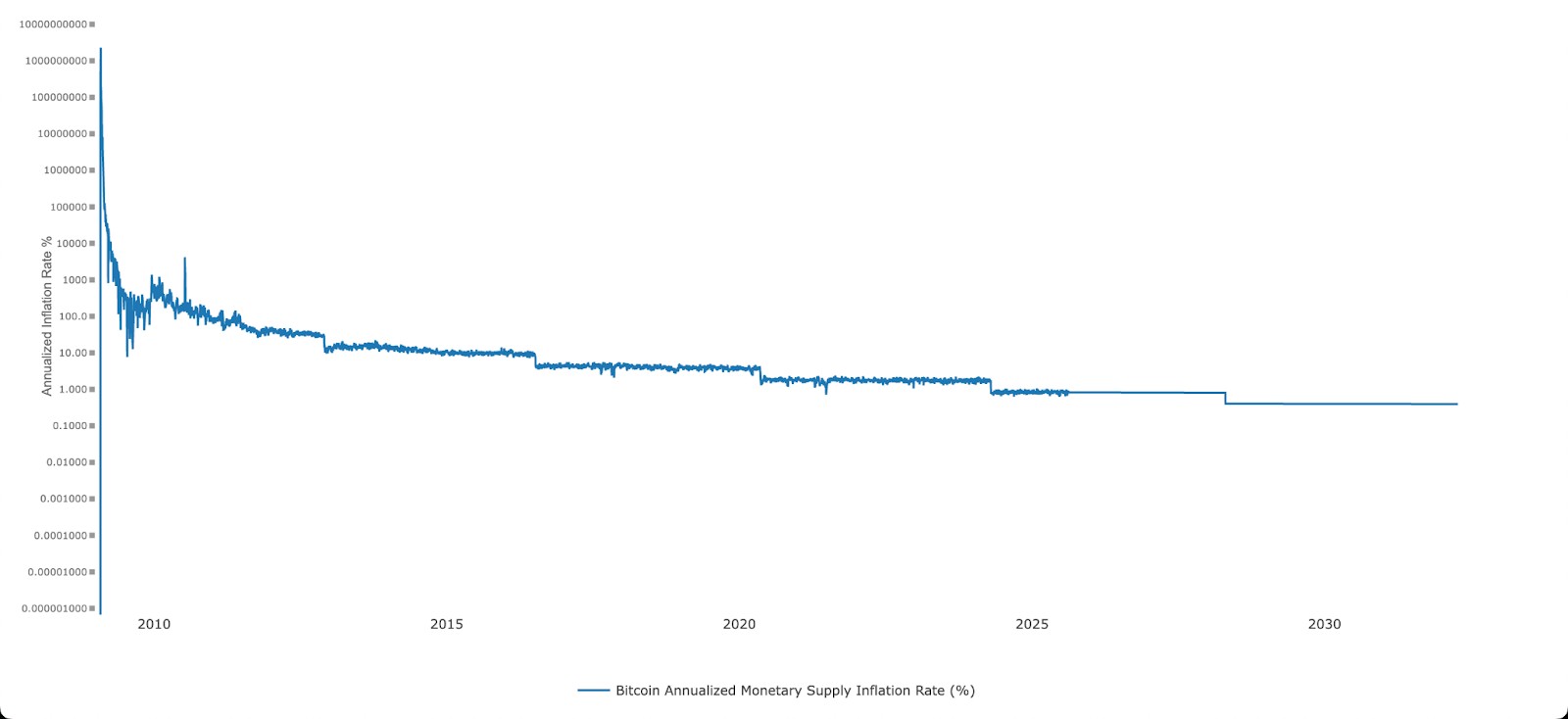
In the past, Bitcoin halvings have caused supply shocks on the market, as the amount of new bitcoin being generated by miners was cut in half overnight. However, the actual change in the issuance rate also declines over time. The first halving cut the amount of new bitcoin created in each block by 25, while the most recent halving only saw a decline of 3.125 bitcoin. Additionally, that smaller cut in issuance is also measured against a further expanded supply of existing bitcoin.
Notably, the magnitude of each major bitcoin bull cycle up to this point – with local tops hit in 2013, 2017, 2021, and 2025 – has been smaller than the previous cycle’s, as bitcoin has followed a process of diminishing returns. Additionally, the most recent halving was the first time the bitcoin price had hit a new all-time high prior to the halving event (rather than in the months that followed it).
| Month | Minimum Price, $ | Average Price, $ | Maximum Price, $ |
|---|---|---|---|
| November 2026 | 37 | 38 | 39 |
| December 2026 | 34 | 34 | 35 |
Institutional money has entered the market
On top of the halving dynamics, much larger amounts of money are now affecting bitcoin price movements, especially with the introduction of the Bitcoin exchange-traded funds (ETFs) in the U.S. According to data from The Block, the U.S.-based ETFs now account for roughly 25% of spot bitcoin trading volume. BlackRock’s iShares BitcoinTrust (IBIT) has been the main driver of institutional demand, holding more than $90 billion worth of bitcoin in its fund.
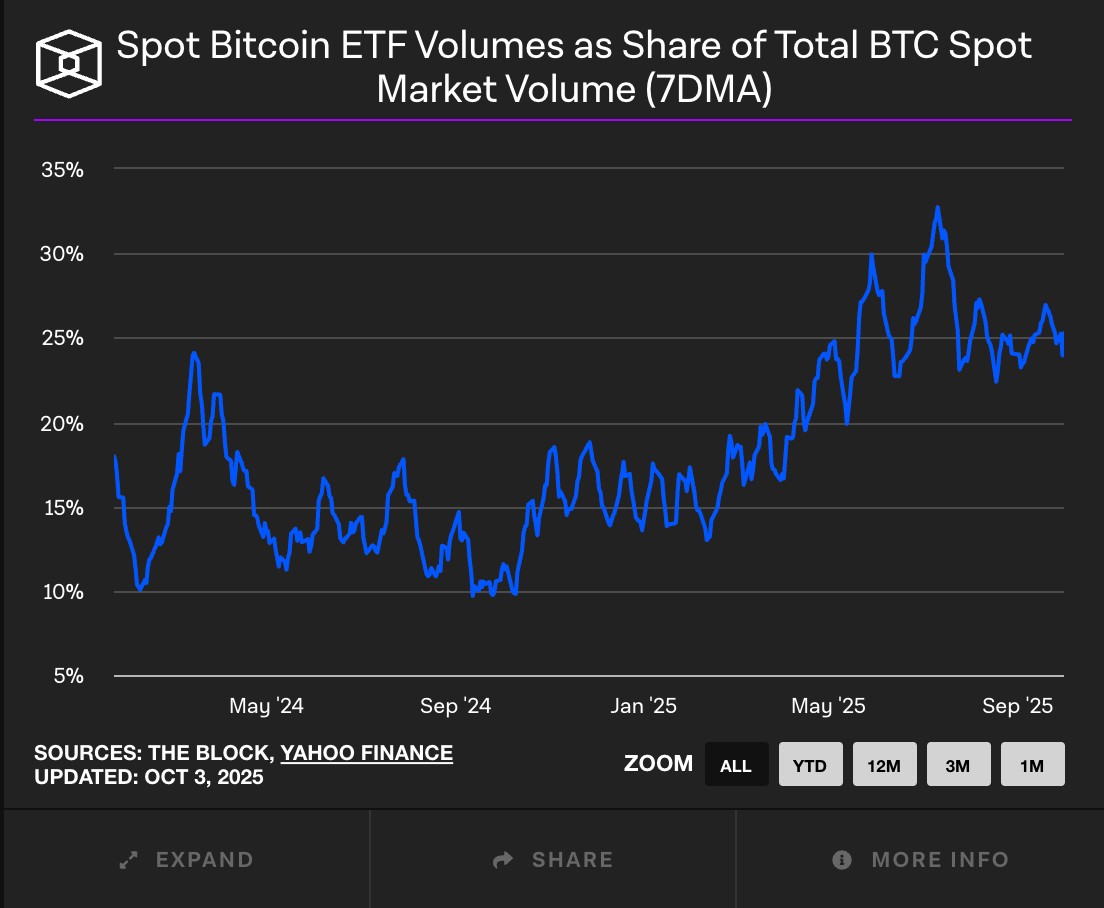
The scale of institutional money that has entered the market dwarfs the kind of money that used to be associated with the sector, which provides greater levels of liquidity and makes it more difficult for one entity to move the price in either direction.
Now that bitcoin is more closely associated with traditional markets, it’s clear that the whims of these institutional players and macroeconomic considerations will have more say over the bitcoin price than the cryptocurrency’s own supply dynamics. These altered dynamics enabled by bitcoin ETF approvals in the U.S. were explained in a report from Coinbase prior to the most recent halving event.
As Bitcoin increasingly integrates with global financial markets, access to reliable trading platforms becomes an important consideration for both retail and institutional participants. Liquidity, trading fees, available derivatives, and security standards can significantly affect trading efficiency and risk management. The comparison below highlights several cryptocurrency exchanges where investors can trade Bitcoin and other digital assets under competitive conditions.
| Coinbase | OKX | BTCC | Cryptohopper | Crypto.com | |
|---|---|---|---|---|---|
|
Demo account |
No | Yes | Yes | No | No |
|
Coins Supported |
400+ | 600+ | 399 | 1000 | 400+ |
|
Min. Deposit, $ |
10 | 10 | 10 | No | 1 |
|
Spot leverage |
1:3 | 1:10 | 1:1 | No | 1:3 |
|
Spot Maker Fee, % |
0.5 | 0.08 | 0.2 | 0 | 0.25 |
|
Spot Taker fee, % |
0.5 | 0.1 | 0.3 | 0 | 0.5 |
|
TU overall score |
8.5 | 8.46 | 8.08 | 7.8 | 7.76 |
|
Open an account |
Go to broker Your capital is at risk. |
Go to broker Your capital is at risk. |
Go to broker Your capital is at risk.
|
Go to broker Your capital is at risk. |
Go to broker Your capital is at risk. |
What happens next?
To be clear, whether the four-year cycles are over for bitcoin is still unknown, as this current cycle has yet to reach its final stages. That said, market observers should have a better grasp on whether the four-year cycle will continue or if there is a “new normal” by the end of the year. In the previous three cycles, the bull market reversed course in the last quarter of the calendar year in rather dramatic fashion.
While some have theorized that a collapse in the digital asset treasury (DAT) company market could cause a sharp reversal in bitcoin’s upward trajectory this time around, there has yet to be much sign of trouble in that sector up to this point.
As indicated by a new joint report from Checkonchain and Unchained, it’s still possible bitcoin could rise much further from its current price level around $120,000; however, it’s less clear if the usual mania will occur in the closing months of the year or if a slow and steady rise could continue beyond the usual four-year window.
Bitcoin News

Charles Schwab opens Bitcoin and Ethereum trading to all U.S. retail clients

BTC/USD holds above 82,000 as sticky U.S. inflation and ETF outflows test key support

Jimmy Song: Trump has failed to meet Bitcoiners' expectations

Bitcoin price prediction: $82,552 resistance in focus? BTC trades flat

Can renewed US demand support Bitcoin?

BTC/USD remains under pressure near $81,000 as inflation fears fuel selling
Investors should stop fixating on the calendar and start focusing on liquidity cycles

As someone who has followed Bitcoin’s evolution for over a decade, I believe we’re entering an entirely new phase – one defined less by programmed scarcity and more by global capital flows. The four-year cycle was a product of Bitcoin’s adolescence: a simple feedback loop between halving events, media attention, and retail speculation. That rhythm worked when liquidity was thin and narratives drove sentiment. But today, the market’s heartbeat is set by different forces – interest rate policy, ETF inflows, and institutional allocation strategies.
From my perspective, investors should stop fixating on the calendar and start focusing on liquidity cycles and risk appetite across global markets. Bitcoin has effectively become a macro asset, and its price behavior will increasingly mirror the same patterns that govern equities, bonds, and gold. This doesn’t mean the halving is irrelevant – it still affects miner economics and long-term supply – but its role as a timing mechanism for bull and bear markets is fading.
If I had to make a forward-looking call, I’d say we’re heading into an era where Bitcoin trades more like digital gold than a speculative tech bet. Price growth may become steadier, less explosive, but also more sustainable. Those expecting another “post-halving moonshot” might be disappointed, but those who adapt to this structural maturity will likely find greater stability – and potentially longer-term opportunity – in the years ahead.
Conclusion
As Bitcoin matures and institutional inflows via ETFs accelerate, the once-predictable 4-year halving cycle appears to be losing its dominance in shaping price action. The market’s new drivers—massive institutional capital, regulatory shifts, and global macroeconomic factors—are diluting the halving’s historical impact, as evidenced by more muted post-halving rallies and price movements governed by broader investor sentiment. For instance, recent ETF launches in the U.S. propelled significant price gains, independent of the halving timetable. Ultimately, Bitcoin’s future hinges less on code-driven scarcity events and more on its adoption by the financial mainstream—signaling that the asset’s destiny is increasingly written by Wall Street rather than cryptographic math.
FAQs
How do Bitcoin ETFs and institutional participation alter the traditional halving-driven cycle?
Why are diminishing returns observed in each successive Bitcoin cycle?
What role do macroeconomic factors now play in Bitcoin’s price dynamics?
Could other cryptocurrencies break away from Bitcoin’s influence as cycles change?
Editors' Top Picks and Insights





Related Articles
Team that worked on the article
Kyle began exploring Bitcoin in 2013, when public interest in cryptocurrencies was just beginning to grow. At first, it was more of a hobby.
Dan Blystone began his trading career in 1998 as an arbitrage clerk on the floor of the Chicago Mercantile Exchange (CME). He later traded bond and Eurex futures at proprietary firms such as Altea Trading, gaining valuable experience in high-frequency trading and risk management.
Chinmay Soni is a financial analyst with more than 5 years of experience in working with stocks, Forex, derivatives, and other assets. As a founder of a boutique research firm and an active researcher, he covers various industries and fields, providing insights backed by statistical data.
Index in trading is the measure of the performance of a group of stocks, which can include the assets and securities in it.
Cryptocurrency is a type of digital or virtual currency that relies on cryptography for security. Unlike traditional currencies issued by governments (fiat currencies), cryptocurrencies operate on decentralized networks, typically based on blockchain technology.
CFD is a contract between an investor/trader and seller that demonstrates that the trader will need to pay the price difference between the current value of the asset and its value at the time of contract to the seller.
Forex leverage is a tool enabling traders to control larger positions with a relatively small amount of capital, amplifying potential profits and losses based on the chosen leverage ratio.
A bear market is a period of time in which an investment asset, such as stocks, bonds, or commodities, experiences a decline in price for an extended period of time.

-
 Afghanistan
-
 Albania
-
 Algeria
-
 Angola
-
 Argentina
-
 Armenia
-
 Australia
-
 Austria
-
 Azerbaijan
-
 Bahamas
-
 Bahrain
-
 Bangladesh
-
 Belarus
-
 Belgium
-
 Bolivia
-
 Botswana
-
 Brazil
-
 Brunei
-
 Bulgaria
-
 Cambodia
-
 Cameroon
-
 Canada
-
 Chile
Chile
-
 China
China
-
 Colombia
-
 Congo
Congo
-
 Costa Rica
-
 Cote d'Ivoire
-
 Croatia
-
 Cuba
Cuba
-
 Cyprus
-
 Czechia
-
 DR Congo
-
 Denmark
-
 Dominican Republic
-
 Ecuador
-
 Egypt
Egypt
-
 El Salvador
-
 Estonia
-
 Eswatini
-
 Ethiopia
-
 Finland
-
 France
-
 Georgia
-
 Germany
-
 Ghana
Ghana
-
 Greece
-
 Haiti
Haiti
-
 Hong Kong
-
 Hungary
-
 India
India
-
 Indonesia
-
 Iran, Islamic republic
-
 Iraq
Iraq
-
 Ireland
-
 Israel
-
 Italy
Italy
-
 Jamaica
-
 Japan
Japan
-
 Jordan
-
 Kazakhstan
-
 Kenya
Kenya
-
 Korea
Korea
-
 Kuwait
-
 Kyrgyzstan
-
 Laos
Laos
-
 Latvia
-
 Lebanon
-
 Lesotho
-
 Libya
Libya
-
 Lithuania
-
 Luxembourg
-
 Madagascar
-
 Malaysia
-
 Malta
Malta
-
 Mauritius
-
 Mexico
-
 Moldova
-
 Mongolia
-
 Montenegro
-
 Morocco
-
 Mozambique
-
 Myanmar
-
 Namibia
-
 Nepal
Nepal
-
 Netherlands
-
 New Zealand
-
 Nigeria
-
 North Macedonia
-
 Norway
-
 Oman
Oman
-
 Pakistan
-
 Palestine
-
 Panama
-
 Papua New Guinea
-
 Paraguay
-
 Peru
Peru
-
 Philippines
-
 Poland
-
 Portugal
-
 Puerto Rico
-
 Qatar
Qatar
-
 Reunion
-
 Romania
-
 Rwanda
-
 Saudi Arabia
-
 Serbia
-
 Singapore
-
 Slovakia
-
 Slovenia
-
 Somalia
-
 South Africa
-
 Spain
Spain
-
 Sri Lanka
-
 Sweden
-
 Switzerland
-
 Syria
Syria
-
 Taiwan
-
 Tajikistan
-
 Tanzania
-
 Thailand
-
 Trinidad and Tobago
-
 Tunisia
-
 Turkey
-
 UAE
UAE
-
 Uganda
-
 Ukraine
-
 United Kingdom
-
United States
-
 Uruguay
-
 Uzbekistan
-
 Venezuela
-
 Vietnam
-
 Yemen
Yemen
-
 Zambia
-
 Zimbabwe
- Forex
- Crypto












