
Money On The Sidelines Is Not What You Think


Editorial Note: While we adhere to strict Editorial Integrity, this post may contain references to products from our partners. Here's an explanation for How We Make Money. None of the data and information on this webpage constitutes investment advice according to our Disclaimer.
“Money on the sidelines” doesn’t literally exist – every dollar is always held by someone. When cash leaves the Fed’s reverse repo facility and flows into money markets or banks, it doesn’t increase M2 but can stimulate markets by becoming more active. The difference is not in how much money exists, but in how fast it circulates.
When people talk about “money on the sidelines,” they imply there’s a pile of cash that’s been sitting out the rally and is now ready to flood into markets. It’s a comforting image – but misleading. There’s nuance hidden behind the phrase, especially now that the Federal Reserve’s Overnight Reverse Repo Facility (ON RRP) has effectively gone to zero.
The Mechanics: what the Reverse Repo market really is
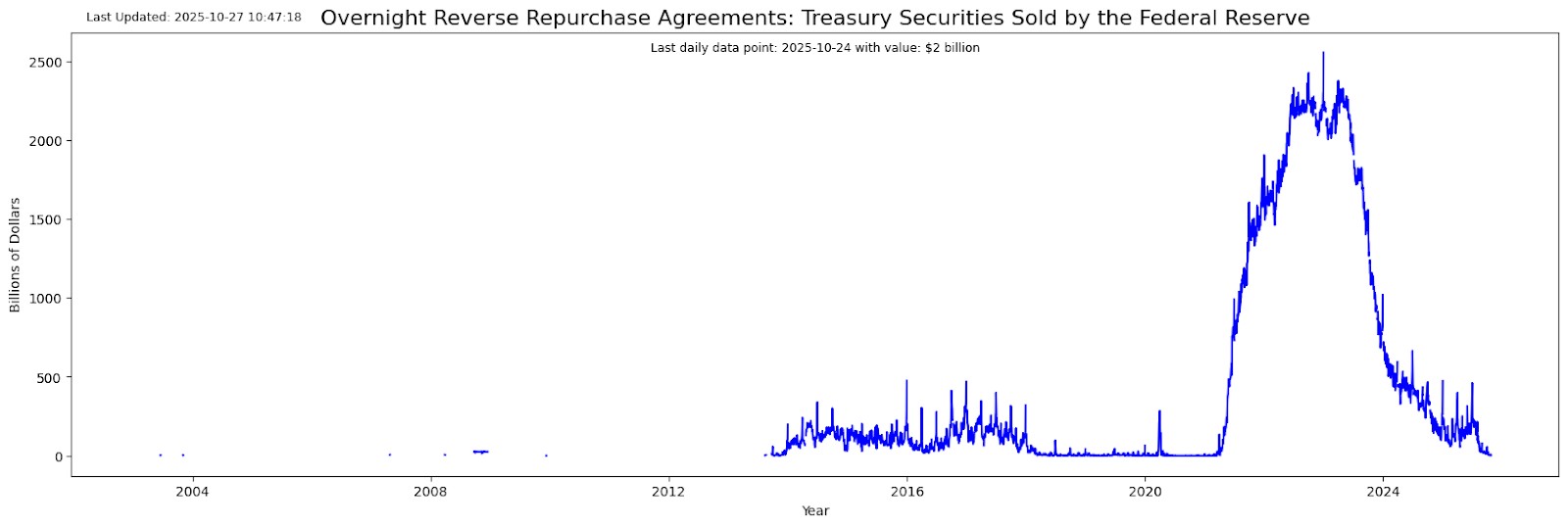
The ON RRP is a tool the Federal Reserve uses to absorb short-term liquidity. In a reverse repo, money-market funds and other institutions lend cash to the Fed overnight in exchange for Treasury collateral. The next day, the Fed repays the cash plus interest at the RRP rate.
It’s essentially a safe overnight parking lot for cash – guaranteed by the Fed. When the Fed’s rate is attractive, trillions flow in; when it’s not, the funds leave.
After 2021’s massive pandemic stimulus and Fed asset purchases (QE), the facility ballooned to $2.5 trillion. As the Fed pivoted to quantitative tightening (QT) – letting maturing Treasuries and MBS roll off – the ON RRP balance collapsed to near zero. The latest figures show only $2 billion remaining, a rounding error.
Where the money went
As the RRP drained, money-market fund assets surged to roughly $7.5 trillion. This sparked the “money on the sidelines” chatter – especially among market bulls arguing that this cash will soon power equities higher.
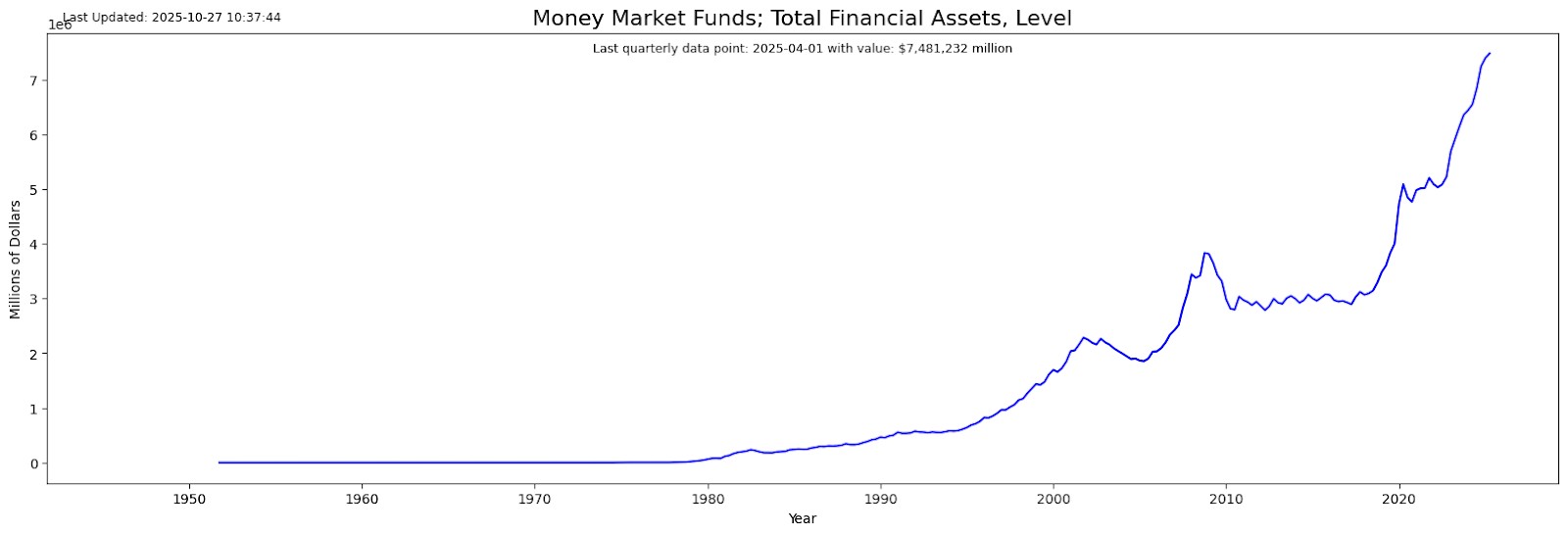
But to test that claim, we need to understand whether this shift actually creates new money or simply moves it.
John Hussman’s perspective: the identity problem
Economist Dr. John Hussman famously wrote:
“There is no such thing as money going into or out of the market – only a change in who holds it.”
He’s right in a strict accounting sense. When an investor buys a stock, cash moves from buyer → seller, not into or out of “the market.” The total amount of cash in the system remains constant.
Similarly, when money-market funds placed cash in the ON RRP, they simply exchanged one claim (bank reserves) for another (a Fed reverse repo). Both are money-like assets, just different pockets of the same system.
So yes, as Hussman insists – there are no sidelines. Every dollar is always held by someone.
The behavioral counterpoint: where the identity fails
While Hussman’s identity is logically true, it’s behaviorally incomplete.
When cash moves into the RRP, it becomes inert – locked up at the Fed.
When it moves back out into T-bills, repos, or deposits, it becomes active, influencing rates and risk appetite.
So even though the quantity of money (M2) doesn’t change, its velocity – how quickly it circulates – does. That’s the subtle but powerful distinction between a balance-sheet identity and a monetary stimulus.
M2 and velocity
M2 includes currency in circulation, bank deposits, and retail money-market funds – but not the institutional money funds that dominate RRP activity. Therefore, when cash leaves the RRP and returns to institutional MMFs, M2 doesn’t rise. It’s a reshuffling of liquidity, not a creation of new money.
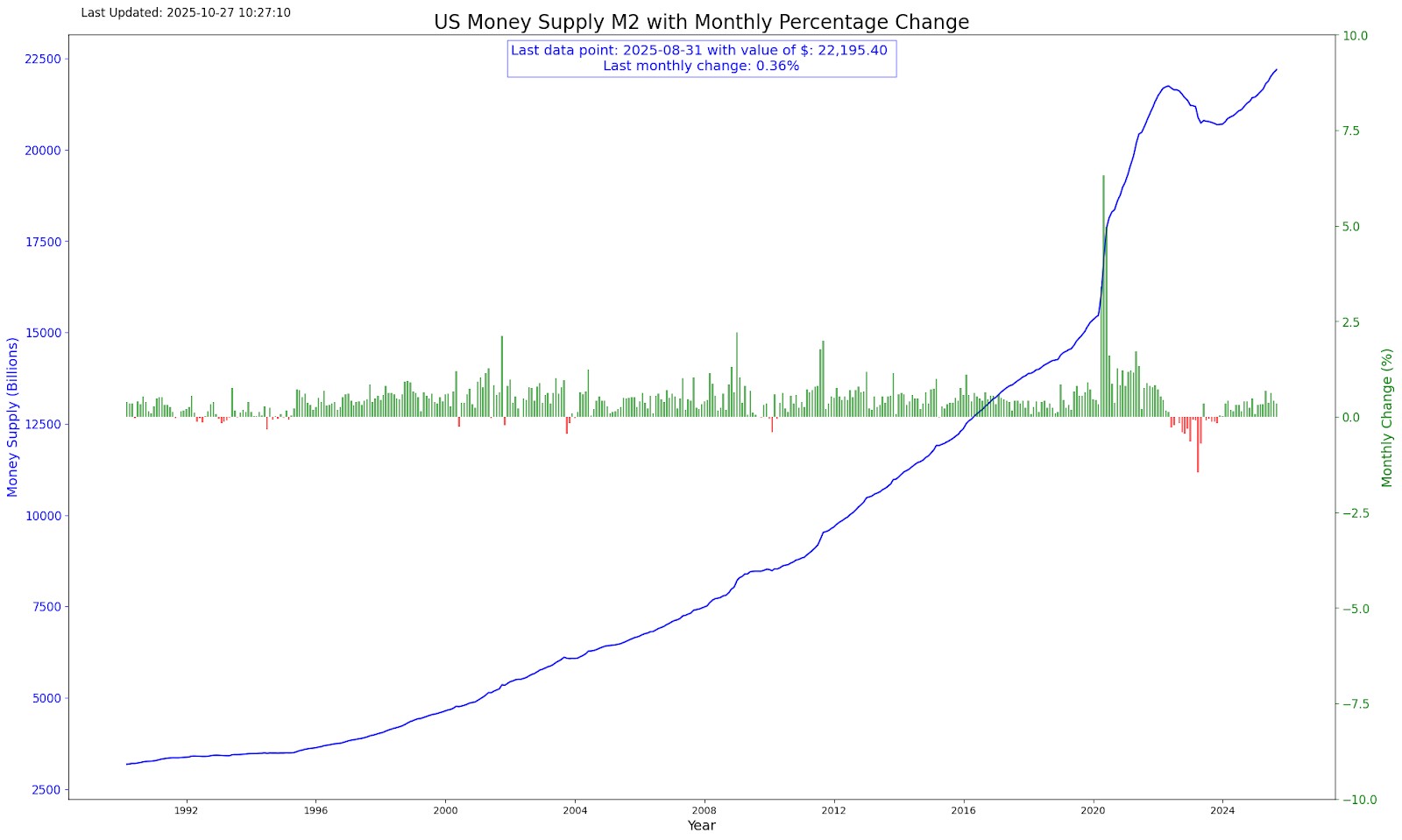
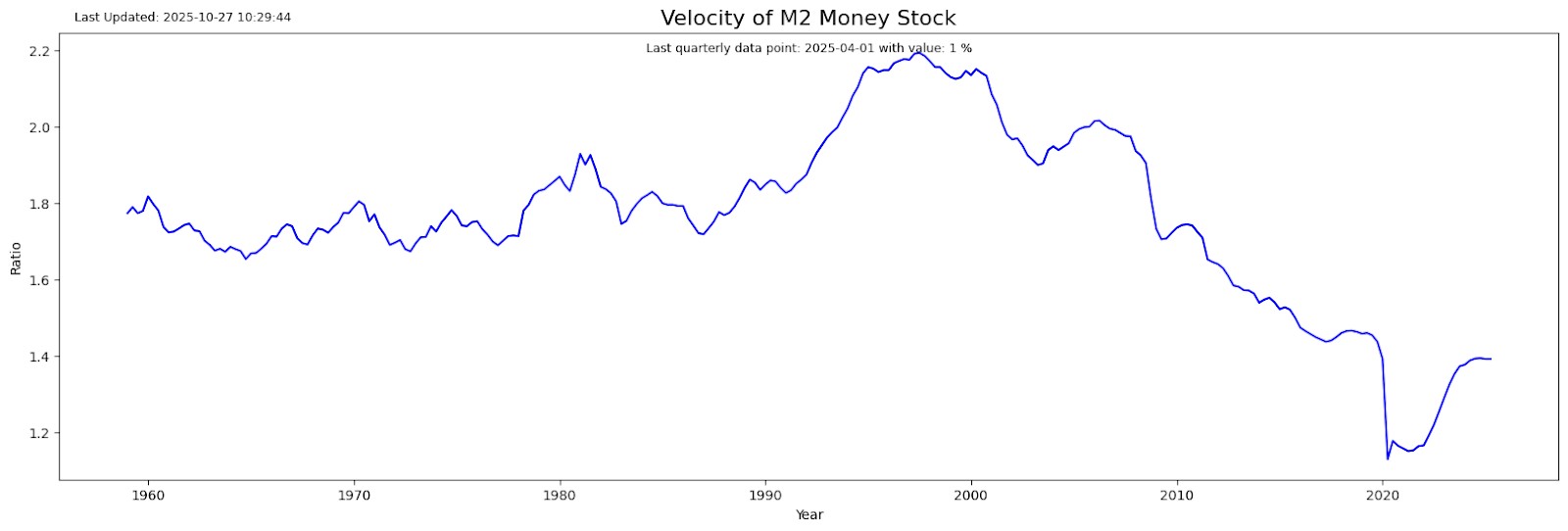
However, velocity – how fast that money turns over – can still change. Since 2000, velocity has fallen sharply, even as M2 exploded. The economy grew, but each dollar was used fewer times because stimulus increasingly came from debt expansion, not spending activity.
After the pandemic, velocity briefly rebounded as stimulus cash circulated – but it’s recently plateaued. This plateau signals that while liquidity remains abundant, its willingness to move is what matters most.
A logical identity meets human behavior
Hussman’s statement – “every dollar is always held by someone” – is an accounting identity, like saying a light switch is either on or off. Always true, but not always useful.
Economics happens in the space between those states – between money sitting and money moving. The difference is not semantic; it’s functional. Liquidity sitting in the Fed’s vault behaves very differently from liquidity chasing yield in credit markets.
Getting off the sidelines: a practical view
In reality, there’s nothing stopping the money sitting idly in reserves or MMFs from being re-lent, re-invested, or spent, increasing velocity even without expanding M2. This is the bridge between Hussman’s logic and market behavior.
So while there’s no mythical pile of “new money” waiting to rush in, there is potential energy within the system – liquidity that can shift from idle to active when confidence, yields, or risk appetite change.
The bulls are wrong that a cash avalanche is guaranteed, but the bears are wrong to think it can’t happen. The truth is latent liquidity – always present, occasionally unleashed.
The semantics are real, but so are the consequences

As someone who has spent decades in both research and trading, I’ve seen how seductive neat theories can be – whether it’s the perfect backtest or the tidy accounting identity. The danger lies in believing that technical accuracy equals predictive power. Dr. Hussman is right that there are no sidelines in a closed system, but markets are not governed solely by balance sheets; they’re driven by behavior, confidence, and institutional plumbing.
What matters is where liquidity rests and how fast it moves. When the Fed’s ON RRP drained from trillions to nearly zero, that shift didn’t change M2, but it changed the emotional temperature of markets – the willingness to take risk. Recognizing that distinction is critical for investors and policymakers alike. Monetary mechanics describe the stage, but velocity and psychology decide the play.
In short: the semantics are real, but so are the consequences.
Conclusion
In examining the so-called 'money on the sidelines,' it’s clear that the concept is more nuanced than widely believed. Factors like Federal Reserve reverse repos and sluggish M2 velocity demonstrate that idle liquidity doesn’t automatically translate into market fuel unless underlying demand or fiscal impulses change. John Hussman’s analysis underscores that true monetary stimulus arises not from cash wishing for a home, but from the willingness of participants to take real risk and spend—something mere reserves can’t force. For example, record-high money market balances in 2023 did little to spark inflation or market rallies without corresponding shifts in risk appetite. Ultimately, the idea of sidelined money is more about market psychology than mechanical market power—reminding us that liquidity’s impact depends on where, and how, it chooses to move.
FAQs
How does the Federal Reserve's reverse repo facility influence market liquidity?
Why is the phrase 'money on the sidelines' considered misleading in financial discussions?
What role does confidence and risk appetite play in activating idle liquidity?
Is there a direct relationship between changes in M2 and increases in market activity?
Editors' Top Picks and Insights






Related Articles
Team that worked on the article
Andrey Mastykin is an experienced author, editor, and content strategist who has been with Traders Union since 2020. As an editor, he is meticulous about fact-checking and ensuring the accuracy of all information published on the Traders Union platform.
Dan Blystone began his trading career in 1998 as an arbitrage clerk on the floor of the Chicago Mercantile Exchange (CME). He later traded bond and Eurex futures at proprietary firms such as Altea Trading, gaining valuable experience in high-frequency trading and risk management.
Chinmay Soni is a financial analyst with more than 5 years of experience in working with stocks, Forex, derivatives, and other assets. As a founder of a boutique research firm and an active researcher, he covers various industries and fields, providing insights backed by statistical data.
Index in trading is the measure of the performance of a group of stocks, which can include the assets and securities in it.
Yield refers to the earnings or income derived from an investment. It mirrors the returns generated by owning assets such as stocks, bonds, or other financial instruments.
A bear market is a period of time in which an investment asset, such as stocks, bonds, or commodities, experiences a decline in price for an extended period of time.
CFD is a contract between an investor/trader and seller that demonstrates that the trader will need to pay the price difference between the current value of the asset and its value at the time of contract to the seller.
Risk management is a risk management model that involves controlling potential losses while maximizing profits. The main risk management tools are stop loss, take profit, calculation of position volume taking into account leverage and pip value.

-
 Afghanistan
-
 Albania
-
 Algeria
-
 Angola
-
 Argentina
-
 Armenia
-
 Australia
-
 Austria
-
 Azerbaijan
-
 Bahamas
-
 Bahrain
-
 Bangladesh
-
 Belarus
-
 Belgium
-
 Bolivia
-
 Botswana
-
 Brazil
-
 Brunei
-
 Bulgaria
-
 Cambodia
-
 Cameroon
-
 Canada
-
 Chile
Chile
-
 China
China
-
 Colombia
-
 Congo
Congo
-
 Costa Rica
-
 Cote d'Ivoire
-
 Croatia
-
 Cuba
Cuba
-
 Cyprus
-
 Czechia
-
 DR Congo
-
 Denmark
-
 Dominican Republic
-
 Ecuador
-
 Egypt
Egypt
-
 El Salvador
-
 Estonia
-
 Eswatini
-
 Ethiopia
-
 Finland
-
 France
-
 Georgia
-
 Germany
-
 Ghana
Ghana
-
 Greece
-
 Haiti
Haiti
-
 Hong Kong
-
 Hungary
-
 India
India
-
 Indonesia
-
 Iran, Islamic republic
-
 Iraq
Iraq
-
 Ireland
-
 Israel
-
 Italy
Italy
-
 Jamaica
-
 Japan
Japan
-
 Jordan
-
 Kazakhstan
-
 Kenya
Kenya
-
 Korea
Korea
-
 Kuwait
-
 Kyrgyzstan
-
 Laos
Laos
-
 Latvia
-
 Lebanon
-
 Lesotho
-
 Libya
Libya
-
 Lithuania
-
 Luxembourg
-
 Madagascar
-
 Malaysia
-
 Malta
Malta
-
 Mauritius
-
 Mexico
-
 Moldova
-
 Mongolia
-
 Montenegro
-
 Morocco
-
 Mozambique
-
 Myanmar
-
 Namibia
-
 Nepal
Nepal
-
 Netherlands
-
 New Zealand
-
 Nigeria
-
 North Macedonia
-
 Norway
-
 Oman
Oman
-
 Pakistan
-
 Palestine
-
 Panama
-
 Papua New Guinea
-
 Paraguay
-
 Peru
Peru
-
 Philippines
-
 Poland
-
 Portugal
-
 Puerto Rico
-
 Qatar
Qatar
-
 Reunion
-
 Romania
-
 Rwanda
-
 Saudi Arabia
-
 Serbia
-
 Singapore
-
 Slovakia
-
 Slovenia
-
 Somalia
-
 South Africa
-
 Spain
Spain
-
 Sri Lanka
-
 Sweden
-
 Switzerland
-
 Syria
Syria
-
 Taiwan
-
 Tajikistan
-
 Tanzania
-
 Thailand
-
 Trinidad and Tobago
-
 Tunisia
-
 Turkey
-
 UAE
UAE
-
 Uganda
-
 Ukraine
-
 United Kingdom
-
United States
-
 Uruguay
-
 Uzbekistan
-
 Venezuela
-
 Vietnam
-
 Yemen
Yemen
-
 Zambia
-
 Zimbabwe
- Forex
- Crypto










- The Mechanics: what the Reverse Repo market really is
- Where the money went
- John Hussman’s perspective: the identity problem
- The behavioral counterpoint: where the identity fails
- M2 and velocity
- A logical identity meets human behavior
- Getting off the sidelines: a practical view
- Expert opinion
- Conclusion
- FAQs


