
What Currency Does Poland Use?


Editorial Note: While we adhere to strict Editorial Integrity, this post may contain references to products from our partners. Here's an explanation for How We Make Money. None of the data and information on this webpage constitutes investment advice according to our Disclaimer.
Poland's official currency is the Polish złoty (PLN), symbolized as zł. It's managed by the National Bank of Poland under a floating exchange rate system. The currency is available in both coins and banknotes, with the highest denomination being 500 zł. While Poland is a member of the European Union, it has not adopted the euro and continues to use the złoty.
Poland is a leading economy in Central and Eastern Europe and has a strong presence in EU trade and financial markets. Despite being a member of the European Union, Poland has retained its national currency, the Polish złoty (PLN). Here’s a look at the structure of Poland’s monetary system, major economic factors, and things traders should know when dealing with the PLN.
What currency does Poland use?
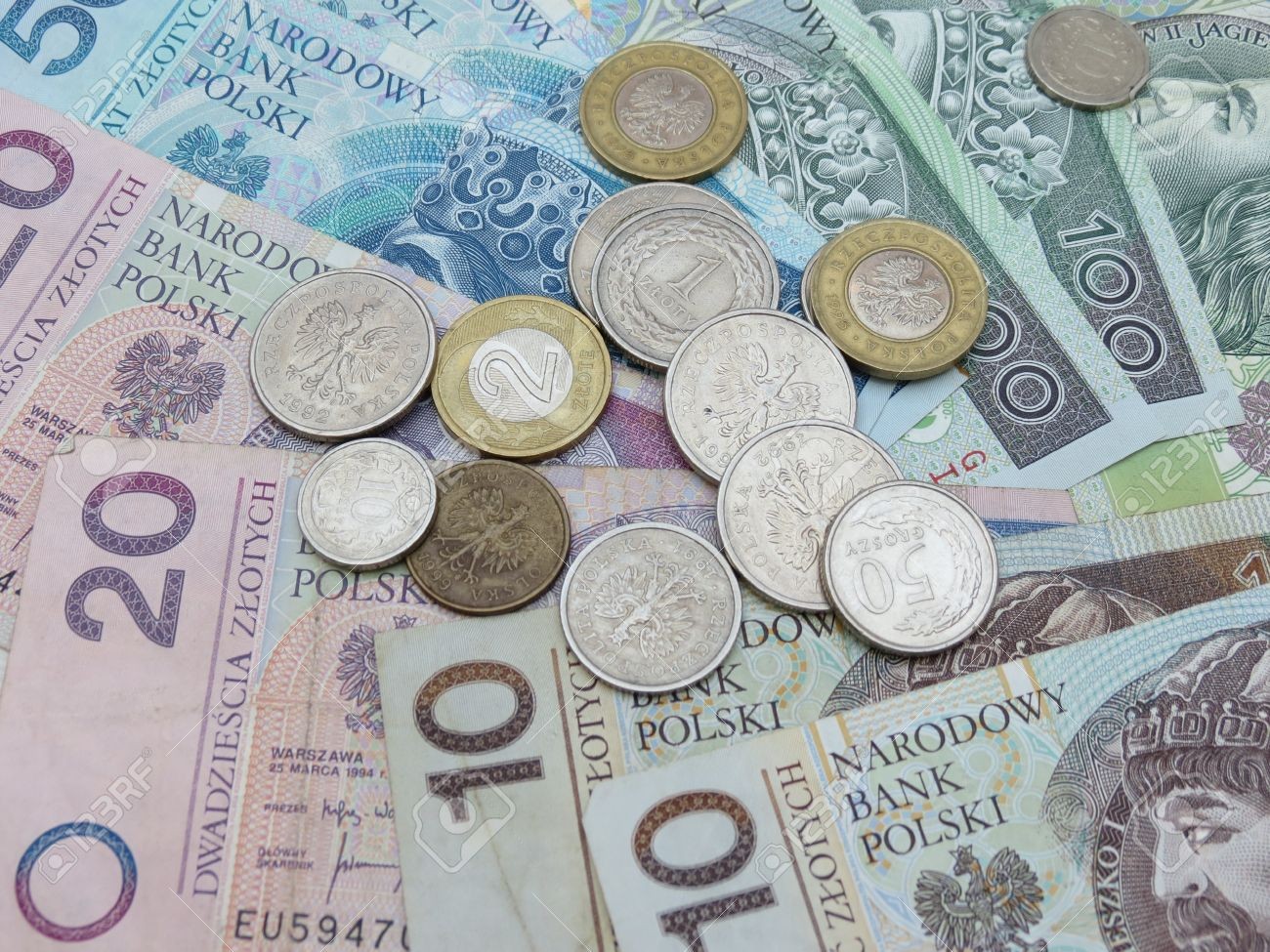
Poland uses the Polish złoty (PLN) as its official currency. It is the sole legal tender for all domestic transactions, including banking, taxation, retail trade, and government services. The Polish złoty is issued and managed by the National Bank of Poland (Narodowy Bank Polski, NBP) under a free-floating exchange rate regime.
Although Poland joined the EU in 2004, it has not adopted the euro and maintains full monetary sovereignty. The government has not announced any near-term plans for eurozone accession.
Poland currency overview
Currency name. Polish złoty
Currency code. PLN
Symbol. zł
Subunit. 1 złoty = 100 groszy
Central bank. Narodowy Bank Polski
Exchange rate system. Free-floating
Legal tender since. 1924 (restructured in 1995)
Background. The term “złoty” translates to “golden” in Polish. It succeeded previous currencies during the 20th century, with a re-denomination occurring in 1995. The modern złoty is commonly used throughout Poland's economy.
Denominations of the Polish Złoty (2026)
Coins
1 grosz, 2 groszy, 5 groszy
10 groszy, 20 groszy, 50 groszy
1 zł, 2 zł, 5 zł
Banknotes
10 zł, 20 zł, 50 zł, 100 zł, 200 zł, 500 zł
Coins are commonly used in everyday commerce. The 500 zł note was introduced in 2017 to reduce the need for carrying large volumes of lower-value notes. All denominations feature prominent historical figures and security elements such as watermarks and microprint.
Current exchange rates and macroeconomic indicators
Exchange rates. USD/PLN: ~3.77; EUR/PLN: ~4.28
Inflation rate. April 2025: 4.9% year-on-year, consistent with March's rate.
Interest rate. NBP Reference Rate: 5.75%, unchanged since October 2023.
Trade balance. February 2025: Trade deficit of €919 million.
Economic outlook. The National Bank of Poland maintains a steady monetary policy stance, citing persistent inflationary pressures and a robust labor market. It anticipates inflation to remain elevated throughout 2025, with a projected return to the 2.5% target by 2027. The OECD forecasts Poland's economy to grow by 3.4% in 2025, supported by external demand and moderated inflation.
Is the Polish Złoty convertible?
Yes. The Polish złoty is a freely traded currency used for all types of transactions. Investors and traders can exchange currencies without limitations. The złoty’s value is set by market forces and is not tied to the euro or any specific currency.

Traders analyzing PLN should pay attention to the following factors:
Interest rates
The National Bank of Poland has maintained its benchmark interest rate at 5.75% since October 2023. Discussions among policymakers suggest that potential rate cuts could occur in the second half of 2025, depending on economic indicators.
Inflation
As of March 2025, Poland's annual inflation rate stands at 4.9%, exceeding the central bank's target range of 1.5–3.5%. This persistent inflation may delay any monetary easing, potentially supporting the currency in the short term.
Energy and subsidies
The Polish government has extended its household energy price freeze through the first nine months of 2025. This initiative, costing approximately €1.3 billion, aims to mitigate rising energy costs but also impacts the fiscal balance and inflation control efforts.
External trade and EU dependency
Poland remains closely integrated with the eurozone economy. A trade deficit recorded in January 2025 highlights the country's reliance on imports, particularly in fuel and manufacturing components.
Digital payments and financial infrastructure
Poland has made significant strides in digital payments, introducing several unique features that distinguish its financial infrastructure:
BLIK's record-breaking growth. In 2024, BLIK processed over 2.4 billion transactions, totaling approximately PLN 347.3 billion, marking a 37% increase in transaction volume and a 43% rise in value compared to the previous year.
Contactless BLIK transactions surge. Contactless payments via BLIK more than doubled in 2024, reaching 263.1 million transactions, with an average transaction value of PLN 45.
Digital payments market growth. Poland's digital payments market is projected to reach a total transaction value of approximately USD 117.79 billion in 2025, reflecting the country's rapid adoption of digital payment solutions.
Fintech sector expansion. As of March 2025, Poland hosts 796 fintech companies, indicating robust growth and innovation within the financial technology sector.
Mobile banking adoption. By the third quarter of 2024, the number of users of mobile banking apps in Poland reached significant levels, demonstrating the population's increasing reliance on mobile financial services.
Internet penetration. At the beginning of 2025, Poland had approximately 34.5 million internet users, accounting for 89.8% of the total population, facilitating the widespread use of digital payment platforms.
Regulatory support for fintech. Poland's regulatory environment continues to evolve, with initiatives aimed at fostering innovation in digital payments and fintech, ensuring consumer protection, and aligning with EU directives.
Trading the Polish Złoty (PLN)
The Polish złoty is one of the most traded emerging European currencies and is commonly paired with the euro and U.S. dollar. It is featured in many European Forex portfolios and ETFs focused on Central and Eastern Europe.
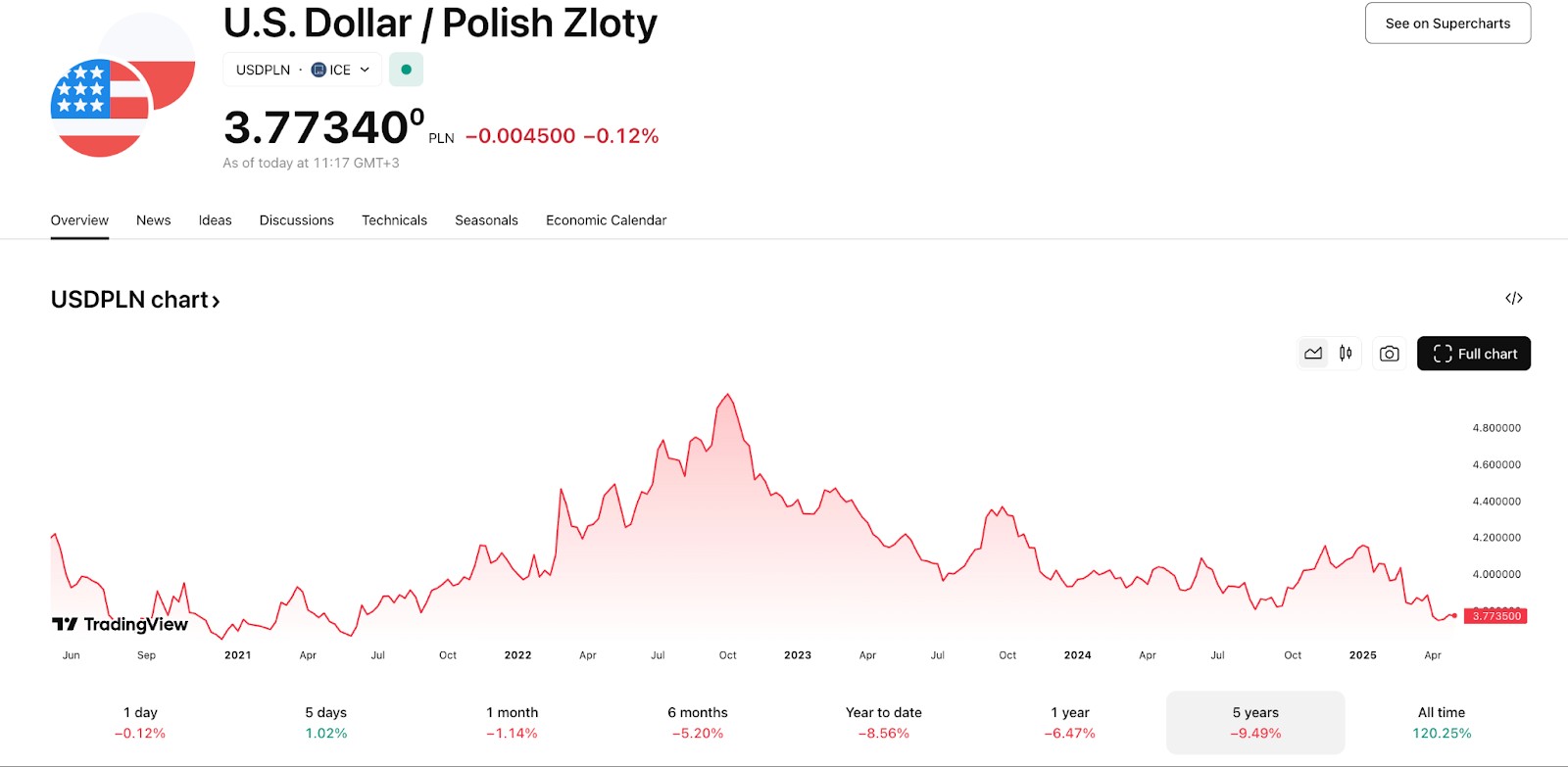
The majorly traded PLN pairs are:
USD/PLN. The most liquid PLN pair, widely traded due to Poland's significant trade relations with the United States.
EUR/PLN. A highly active pair, reflecting Poland's strong economic ties with the Eurozone.
GBP/PLN. Moderately traded, influenced by historical and ongoing trade relationships between Poland and the United Kingdom.
CHF/PLN. Traded due to financial interactions between Poland and Switzerland, including loans and investments.
JPY/PLN. Less commonly traded, but still notable due to Japan's role in global finance and trade.
AUD/PLN. An exotic pair, reflecting trade relations between Poland and Australia.
CAD/PLN. Another exotic pair, influenced by trade and investment flows between Poland and Canada.
These pairs are considered exotic in the Forex market. They often feature wider spreads and lower liquidity compared to major currency pairs. Traders should be aware of potential volatility and conduct thorough analysis before engaging in trades involving these pairs.
If you’re considering trading the Polish Zloty (PLN) in the Forex market, you’ll need to sign up with a broker that includes PLN pairs in its offerings. Below, we’ve compiled a list of reputable Forex brokers that allow trading with the Polish Zloty. Take time to assess their tools, fees, and platform features to find the one that aligns with your trading objectives.
| Fusion Markets | Vantage Markets | RoboForex | XM | GTCFX | |
|---|---|---|---|---|---|
|
PLN |
Yes | Yes | Yes | Yes | Yes |
|
Currency pairs |
90 | 40 | 28 | 57 | 150 |
|
Min. deposit, $ |
1 | 50 | 10 | 5 | 30 |
|
Max. leverage |
1:500 | 1:2000 | 1:2000 | 1:1000 | 1:1000 |
|
Deposit fee, % |
No | No | No | No | No |
|
Withdrawal fee, % |
No | No | 0-4 | No | No |
|
TU overall score |
9.25 | 7.95 | 9.15 | 9.35 | 9.2 |
|
Open an account |
Go to broker Your capital is at risk. |
Go to broker Your capital is at risk. |
Go to broker Your capital is at risk. |
Go to broker Your capital is at risk. |
Go to broker Your capital is at risk. |
Why trust us
15+ years of independent market analysis
140+ evaluation criteria, reviewed by 50+ experts
Data-driven reviews of 200+ platforms, updated regularly
20+ industry awards & a wide network of global media partners
Learn more about our methodology and editorial policies.


Key tips for beginners
Watch NBP sentiment, not just rates. The Polish central bank (NBP) often signals intent through tone shifts in press briefings before actual rate decisions. Traders who decode these hints usually enter early and exit smarter.
Use Warsaw Stock Exchange cues. PLN often moves in sync with foreign capital inflows into the WSE’s large-cap stocks; monitoring equity turnover can give you early signs of currency pressure or relief.
Track German data as a proxy. Since Poland is deeply tied to Germany’s supply chain, surprises in German manufacturing or export data often spill into PLN moves before Polish data even hits the wires.
Trade PLN around EU budget cycles. Poland’s relationship with EU funds directly affects fiscal outlooks; announcements or disputes around EU budget disbursements can cause rapid PLN shifts. Watch for Brussels’ calendar, not just Warsaw’s.
Scalp PLN during local CPI leaks. Inflation data in Poland often leaks to insiders and causes sharp PLN moves minutes before the official release. Tighten your charts around CPI mornings and watch for sudden liquidity shifts.
Use currency baskets for hedging. Hedging PLN exposure with a basket of Czech koruna (CZK) and Hungarian forint (HUF) allows better risk management since these currencies move with similar macro drivers but lower volatility.
PLN forwards react to politics. Because Poland has a track record of political volatility, forward contracts often price in unexpected shifts. Track domestic political polls for subtle clues, especially around judicial reforms or EU conflicts.
Pros and cons of PLN
- Pros
- Cons
Fully convertible and liquid in European markets.
Managed by an independent and transparent central bank.
Positive real interest rates relative to inflation.
Strong digital infrastructure and stable financial system.
Volatility driven by EU policy tensions or regional instability.
Trade deficits and energy price shocks can weaken PLN.
Market reactivity to German and eurozone macro data.
Potential capital flight during broader emerging market selloffs.
Subsidies and foreign flows distort PLN movement beyond rate policy

If you're just getting a real feel for what moves PLN, look out for quiet government signals, especially when they extend energy subsidies or freeze prices. There’s more going on than politics. These moves are basically telling traders that inflation might stick around longer than expected. Most people only look at the NBP’s rate decisions or inflation numbers and miss this deeper layer. That disconnect often keeps the złoty stronger than it “should be”, even when everyone’s expecting cuts.
PLN never really moves on its own. Because Poland is deeply tied to the eurozone, and still has that leftover exposure to Swiss franc mortgages. It’s caught in a weird three-way tug-of-war. If EUR/PLN suddenly drops, it might not be about Poland at all. It could be a chain reaction starting in Frankfurt or Zurich. So if you’re watching PLN in isolation, you’re always playing catch-up. The smart move? Read the room in Europe before reading the chart in Warsaw.
Conclusion
The Polish złoty remains a fully convertible and resilient currency, reflecting both Poland’s economic strength and its robust integration with the European market. Successful trading or investing in PLN requires a keen eye on not just National Bank of Poland policy but also cross-border influences such as German economic data and EU politics. For example, sharp PLN movements can be triggered by local inflation leaks or EU budget disputes, illustrating the currency’s sensitivity to both domestic and international signals. In navigating the PLN, the smartest strategy is to see the broader European context, as shifts often ripple through Warsaw from decisions made in Frankfurt or Brussels.
FAQs
How does Poland’s central bank manage the value of the Polish Złoty (PLN)?
What denominations of coins and banknotes are available in Polish Złoty (PLN)?
Which economic indicators should traders monitor when analyzing the Polish Złoty?
How does Poland’s integration with the EU affect the Polish Złoty’s performance?
Editors' Top Picks and Insights





Related Articles
Team that worked on the article
Andrey Mastykin is an experienced author, editor, and content strategist who has been with Traders Union since 2020. As an editor, he is meticulous about fact-checking and ensuring the accuracy of all information published on the Traders Union platform.
Dan Blystone began his trading career in 1998 as an arbitrage clerk on the floor of the Chicago Mercantile Exchange (CME). He later traded bond and Eurex futures at proprietary firms such as Altea Trading, gaining valuable experience in high-frequency trading and risk management.
Chinmay Soni is a financial analyst with more than 5 years of experience in working with stocks, Forex, derivatives, and other assets. As a founder of a boutique research firm and an active researcher, he covers various industries and fields, providing insights backed by statistical data.

-
 Afghanistan
-
 Albania
-
 Algeria
-
 Angola
-
 Argentina
-
 Armenia
-
 Australia
-
 Austria
-
 Azerbaijan
-
 Bahamas
-
 Bahrain
-
 Bangladesh
-
 Belarus
-
 Belgium
-
 Bolivia
-
 Botswana
-
 Brazil
-
 Brunei
-
 Bulgaria
-
 Cambodia
-
 Cameroon
-
 Canada
-
 Chile
Chile
-
 China
China
-
 Colombia
-
 Congo
Congo
-
 Costa Rica
-
 Cote d'Ivoire
-
 Croatia
-
 Cuba
Cuba
-
 Cyprus
-
 Czechia
-
 DR Congo
-
 Denmark
-
 Dominican Republic
-
 Ecuador
-
 Egypt
Egypt
-
 El Salvador
-
 Estonia
-
 Eswatini
-
 Ethiopia
-
 Finland
-
 France
-
 Georgia
-
 Germany
-
 Ghana
Ghana
-
 Greece
-
 Haiti
Haiti
-
 Hong Kong
-
 Hungary
-
 India
India
-
 Indonesia
-
 Iran, Islamic republic
-
 Iraq
Iraq
-
 Ireland
-
 Israel
-
 Italy
Italy
-
 Jamaica
-
 Japan
Japan
-
 Jordan
-
 Kazakhstan
-
 Kenya
Kenya
-
 Korea
Korea
-
 Kuwait
-
 Kyrgyzstan
-
 Laos
Laos
-
 Latvia
-
 Lebanon
-
 Lesotho
-
 Libya
Libya
-
 Lithuania
-
 Luxembourg
-
 Madagascar
-
 Malaysia
-
 Malta
Malta
-
 Mauritius
-
 Mexico
-
 Moldova
-
 Mongolia
-
 Montenegro
-
 Morocco
-
 Mozambique
-
 Myanmar
-
 Namibia
-
 Nepal
Nepal
-
 Netherlands
-
 New Zealand
-
 Nigeria
-
 North Macedonia
-
 Norway
-
 Oman
Oman
-
 Pakistan
-
 Palestine
-
 Panama
-
 Papua New Guinea
-
 Paraguay
-
 Peru
Peru
-
 Philippines
-
 Poland
-
 Portugal
-
 Puerto Rico
-
 Qatar
Qatar
-
 Reunion
-
 Romania
-
 Rwanda
-
 Saudi Arabia
-
 Serbia
-
 Singapore
-
 Slovakia
-
 Slovenia
-
 Somalia
-
 South Africa
-
 Spain
Spain
-
 Sri Lanka
-
 Sweden
-
 Switzerland
-
 Syria
Syria
-
 Taiwan
-
 Tajikistan
-
 Tanzania
-
 Thailand
-
 Trinidad and Tobago
-
 Tunisia
-
 Turkey
-
 UAE
UAE
-
 Uganda
-
 Ukraine
-
 United Kingdom
-
United States
-
 Uruguay
-
 Uzbekistan
-
 Venezuela
-
 Vietnam
-
 Yemen
Yemen
-
 Zambia
-
 Zimbabwe
- Forex
- Crypto










- What currency does Poland use?
- Poland currency overview
- Denominations of the Polish Złoty
- Current exchange rates
- Is the Polish Złoty convertible?
- Macroeconomic drivers of the Polish Złoty
- Digital payments and financial infrastructure
- Trading the Polish Złoty (PLN)
- Key tips for beginners
- Pros and cons
- Expert opinion
- Conclusion
- FAQs


