
Is The Arrival Of Tokenized Stocks The Great Financial Leveller For South Africa?


Editorial Note: While we adhere to strict Editorial Integrity, this post may contain references to products from our partners. Here's an explanation for How We Make Money. None of the data and information on this webpage constitutes investment advice according to our Disclaimer.
Tokenized stocks are crypto versions of traditional shares that track the price movements of the actual shares without direct ownership in the shares. Rather than receiving cash dividends, tokenized stock owners are paid in the form of additional stock.
The African investment landscape is undergoing a major transformation as blockchain technology merges with traditional finance. Tokenized stocks are opening doors that were once shut to all but the wealthiest investors, removing high entry costs, time delays, and complex regulations. For the first time, everyday South Africans can gain exposure to global giants like Tesla, Apple, and Nvidia using local currency – and even buy just a fraction of a share. This shift is not only expanding market access but also redefining how, when, and where people can invest, offering a 24/7 gateway to the world’s top companies from anywhere on the continent.
Risk warning: Cryptocurrency markets are highly volatile, with sharp price swings and regulatory uncertainties. Research indicates that 75-90% of traders face losses. Only invest discretionary funds and consult an experienced financial advisor.
Why South Africa needs tokenized stocks
The great promise of the blockchain was “democratization of finance”. Others saw the blockchain as a solution in search of a problem. With tokenized stocks, both claims are satisfied.
The arrival of tokenized stocks in South Africa – with two local companies now offering them to their clients – demonstrates the rate at which the crypto world is gatecrashing the traditional finance party.
The main vehicle for South Africans in search of investment opportunities is the Johannesburg Stock Exchange (JSE), home to around 400 listings. It’s the largest stock market in Africa but faces a steady exodus of companies groaning under the weight of regulatory compliance and a flaccid economy.
South Africans are able to invest abroad using allowances of up to R11 million ($630,000) a year provided they receive authorization from the central bank, which in turn requires tax clearance from South African Revenue Services.
That seems generous enough, but the costs of moving money abroad are high: up to 3% in Forex fees and 1%-1.5% in annual management fees. This eats into capital and it can take weeks for funds to move cross-border because of the regulatory issues.
Tokenized stocks overcome many of these issues – investors can pay in local currency, ownership is immediate rather than reflecting days later, they can purchase fractions of a share, and the costs are comparable to buying on the JSE (and should fall as trading volumes increase).
How xStocks are changing the game
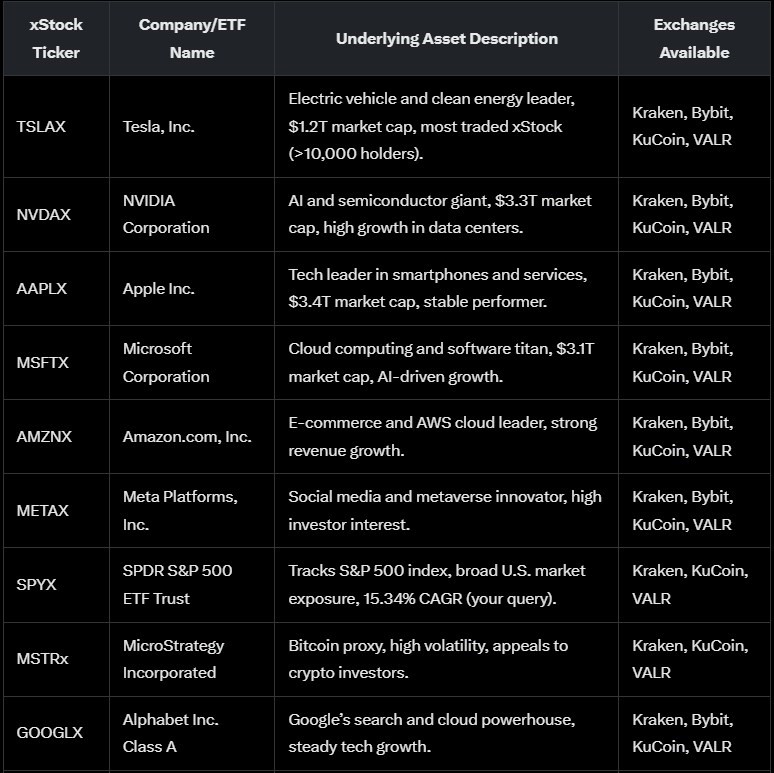
Two South African companies – crypto exchanges Luno and VALR – launched xStocks on their platforms in August 2025, making Tesla, Nvidia, Circle, Robinhood and other famous companies available to the average investor – rather than just the rich – for the first time. xStocks are issued by Backed Assets and are backed 1:1 by the underlying shares held in regulated custodian banks like Alpaca Securities and InCore Bank.

VALR’s chief operating officer Gianluca Sacci says the advantages of xStocks is not just easier access for the average investor, but the ability to trade 24/7 rather than during traditional trading hours. “The pricing of xStocks on our exchange is fully transparent. You can see our order book on the exchange which shows you the price at which you can buy and sell. It’s open and visible to our customers and that order book is visible 24/7 along with the full history of all trade data.”
Luno country manager for South Africa, Christo de Wit, argues that tokenization is another giant step in broadening stock ownership in South Africa, and ultimately the broader continent. Cryptocurrency is now firmly entrenched in traditional finance, and the global, digital stock market built on crypto technology is the answer.
“Buying Apple stock once meant paying over R3 000 ($170), waiting several days for settlement, and trading only during market hours. Tokenization eliminates these barriers, enabling instant, round-the-clock share purchases in the same seamless way people buy cryptocurrency through an app”, - notes De Wit.
You can now buy Apple or Tesla for the equivalent of $1, allowing those of modest means to start building a portfolio of world class companies.
Sacci explains that the benefits of tokenized stocks go far beyond traditional stock ownership – you can pay for your groceries (through VALR Pay) in xStocks, you can transfer them to a friend as a gift and you can self-custody them in a wallet of your choosing.
Fast African access to tokenized stocks

xStocks are not unique to South Africa – they are available on numerous international exchanges such as Kraken, Bybit and Kucoin, but what is impressive is the speed with which the broader African market can now tap into these investment opportunities without having to navigate past exchange control regimes.
They’re also not without risk, the chief one being the risks of losing money if you are speculating, and then there is counter-party risk. You have to trust the issuer of xStocks, being Backed Assets and the custodians behind them which, in truth, have a sound reputation.
All in all, this is a pretty major development on the African continent and I have no doubts we will see many more such opportunities emerge from the blockchain.
Conclusion
The arrival of tokenized stocks represents a pivotal moment for financial inclusion in South Africa, breaking down long-standing barriers that kept global investments out of reach for ordinary citizens. With platforms like Luno and VALR allowing users to invest in blue-chip companies like Apple and Tesla with just a few dollars and in real time, the investment landscape is being fundamentally reshaped. This innovation not only democratizes access but also brings flexibility, transparency, and convenience to a broader market. As tokenized stocks redefine what it means to participate in global finance from Africa, the true levelling power of blockchain technology becomes increasingly undeniable.
FAQs
What are the main benefits of tokenized stocks for South African investors?
How does trading tokenized stocks differ from traditional stock exchanges in terms of accessibility?
Can tokenized stocks be used for purposes other than investment?
What risks should South African investors consider when buying tokenized stocks?
Editors' Top Picks and Insights





Related Articles
Team that worked on the article
Ciaran Ryan is a veteran financial journalist based in South Africa, where he covers cryptocurrency, mining, stock markets, and governance for Moneyweb. He also hosts the weekly Moneyweb Crypto Podcast.
Andreas Kristo Saragih is a seasoned equity research analyst with over a decade of experience across both buy-side and sell-side roles, focused on the Indonesian capital market. He has extensive sector coverage, including banking, consumer goods, retail, real estate, healthcare, transportation, poultry, cement, pharmaceuticals, construction, and infrastructure.
Chinmay Soni is a financial analyst with more than 5 years of experience in working with stocks, Forex, derivatives, and other assets. As a founder of a boutique research firm and an active researcher, he covers various industries and fields, providing insights backed by statistical data.

-
 Afghanistan
-
 Albania
-
 Algeria
-
 Angola
-
 Argentina
-
 Armenia
-
 Australia
-
 Austria
-
 Azerbaijan
-
 Bahamas
-
 Bahrain
-
 Bangladesh
-
 Belarus
-
 Belgium
-
 Bolivia
-
 Botswana
-
 Brazil
-
 Brunei
-
 Bulgaria
-
 Cambodia
-
 Cameroon
-
 Canada
-
 Chile
Chile
-
 China
China
-
 Colombia
-
 Congo
Congo
-
 Costa Rica
-
 Cote d'Ivoire
-
 Croatia
-
 Cuba
Cuba
-
 Cyprus
-
 Czechia
-
 DR Congo
-
 Denmark
-
 Dominican Republic
-
 Ecuador
-
 Egypt
Egypt
-
 El Salvador
-
 Estonia
-
 Eswatini
-
 Ethiopia
-
 Finland
-
 France
-
 Georgia
-
 Germany
-
 Ghana
Ghana
-
 Greece
-
 Haiti
Haiti
-
 Hong Kong
-
 Hungary
-
 India
India
-
 Indonesia
-
 Iran, Islamic republic
-
 Iraq
Iraq
-
 Ireland
-
 Israel
-
 Italy
Italy
-
 Jamaica
-
 Japan
Japan
-
 Jordan
-
 Kazakhstan
-
 Kenya
Kenya
-
 Korea
Korea
-
 Kuwait
-
 Kyrgyzstan
-
 Laos
Laos
-
 Latvia
-
 Lebanon
-
 Lesotho
-
 Libya
Libya
-
 Lithuania
-
 Luxembourg
-
 Madagascar
-
 Malaysia
-
 Malta
Malta
-
 Mauritius
-
 Mexico
-
 Moldova
-
 Mongolia
-
 Montenegro
-
 Morocco
-
 Mozambique
-
 Myanmar
-
 Namibia
-
 Nepal
Nepal
-
 Netherlands
-
 New Zealand
-
 Nigeria
-
 North Macedonia
-
 Norway
-
 Oman
Oman
-
 Pakistan
-
 Palestine
-
 Panama
-
 Papua New Guinea
-
 Paraguay
-
 Peru
Peru
-
 Philippines
-
 Poland
-
 Portugal
-
 Puerto Rico
-
 Qatar
Qatar
-
 Reunion
-
 Romania
-
 Rwanda
-
 Saudi Arabia
-
 Serbia
-
 Singapore
-
 Slovakia
-
 Slovenia
-
 Somalia
-
 South Africa
-
 Spain
Spain
-
 Sri Lanka
-
 Sweden
-
 Switzerland
-
 Syria
Syria
-
 Taiwan
-
 Tajikistan
-
 Tanzania
-
 Thailand
-
 Trinidad and Tobago
-
 Tunisia
-
 Turkey
-
 UAE
UAE
-
 Uganda
-
 Ukraine
-
 United Kingdom
-
United States
-
 Uruguay
-
 Uzbekistan
-
 Venezuela
-
 Vietnam
-
 Yemen
Yemen
-
 Zambia
-
 Zimbabwe
- Forex
- Crypto












