
A List Of The Most Volatile Forex Pairs



Editorial Note: While we adhere to strict Editorial Integrity, this post may contain references to products from our partners. Here's an explanation for How We Make Money. None of the data and information on this webpage constitutes investment advice according to our Disclaimer.
Most volatile Forex pairs:
AUD/JPY: 102.5 pips or 1.16% per day
NZD/JPY: 95.9 pips or 1.15% per day
AUD/USD: 72 pips or 1.08% per day
NZD/USD: 68.70 pips or 1.09% per day
CAD/JPY: 132.98 pips or 1.00% per day
USD/RUB: 1.77% per day
USD/ZAR: 1.54% per day
USD/BRL: 1.14% per day
The Forex market, renowned for its pronounced volatility, offers abundant trading prospects and heightened risks. Multiple factors contribute to currency volatility, including liquidity, time of day, geopolitical tensions, economic stability, and the sentiment of Forex traders.
This article comprehensively evaluates these factors to rank the most volatile Forex pairs, focusing on major and minor pairs possessing greater liquidity than infrequently traded exotics.
How do you find volatile Forex pairs?
You can use online tools like scanners and calculators to identify volatile Forex pairs. These tools help analyze market data and highlight currency pairs experiencing significant price movements. By monitoring these fluctuations, traders can gain insights into which pairs are more dynamic and potentially lucrative.
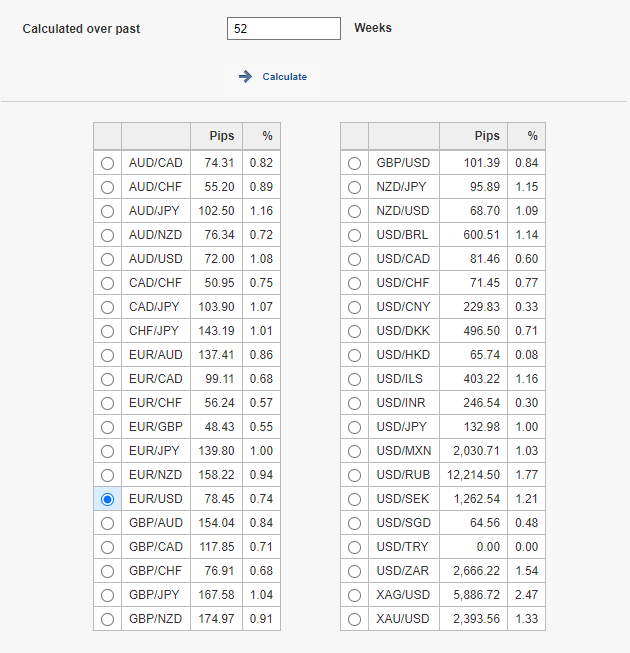
One tool for measuring volatility is the calculator from Investinig.com. This is what we used to prepare this rating of the most volatile Forex pairs.
To understand and measure volatility in the Forex market, you can refer to this article on - How to Measure Volatility In Forex.
The most volatile major and minor Forex pairs
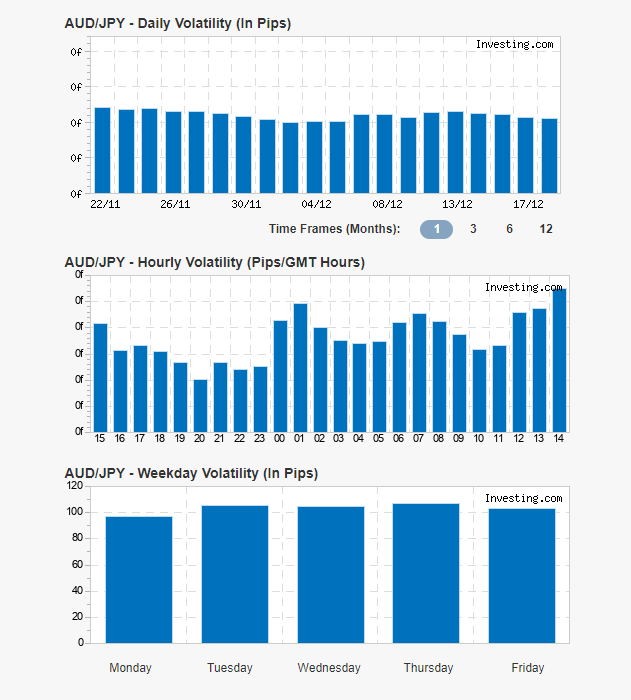
AUD/JPY. This pairing involving the Australian dollar (AUD) and Japanese yen is consistently among the most volatile currency pairs. The country's exports of minerals and metals have an impact on the commodity currency AUD, whereas the Japanese yen is special because the Bank of Japan has a distinctive and independent monetary policy. The uniqueness of the AUD/JPY pair, which increases its volatility, is the fact that it is actively traded during all three trading sessions: Asian, European, and American.
NZD/JPY. As New Zealand's economy is closely linked to Australia due to its geographical location, the reasons for the high volatility of the NZD/JPY pair are the same as those listed for AUD/JPY above.
AUD/USD. AUD/USD, featuring the US dollar, ranks among the most actively traded volatile FX pairs. Australia’s economy, heavily influenced by commodity exports like coal and iron, contributes to high trading volumes. The London session is considered optimal for trading this major pair, likely influenced by global financial activity across Tokyo, London, and New York sessions.
NZD/USD. New Zealand's agricultural exports, which include milk, eggs, meat, and timber, have a significant impact on NZD, another commodity currency. Export destinations primarily include nearby countries such as China and Australia, creating few economic ties to the USD. Pairing these currencies represents economies on opposite sides of the world relying on different economic drivers.
CAD/JPY. The Canadian dollar (CAD) and Japanese yen pairing involve two economies linked by the presence of a commodity currency (CAD). Japan, heavily dependent on oil, and Canada, a significant oil exporter, see their economies influenced by oil prices. While Canada doesn’t export much oil to Japan, the shared dependence on oil prices contributes to volatility in the CAD/JPY exchange rate. Significant trade relations between Canada and Japan in other markets enhance the overall volatility of the exchange rate.
The most volatile exotic Forex pair
USD/RUB. The "US Dollar and Russian Ruble" is a currency pair subject to the tumultuous effects of geopolitical tensions and economic instability. Geopolitical turmoil, including sanctions, military conflicts, and international relations, significantly influences the Ruble's value. Escalation can lead to a downward spiral, while de-escalation or positive diplomatic developments can result in sudden surges. Global oil and gas prices further impact the Ruble, with rising energy prices and robust export volumes strengthening the currency while falling prices or export disruptions weaken it. Another element of unpredictability is the Ruble's internal economic stability, which is a result of central bank decisions and fiscal policies.
USD/ZAR. The pairing of the United States dollar (USD) and the South African rand (ZAR) revolves around the value of gold. Major gold exporter South Africa observes how USD-denominated gold prices affect the value of its currency. When the US economy strengthens, it can impact gold prices and, consequently, the rand's value. Beyond gold, South Africa faces economic challenges such as energy and infrastructure crises. The USD, considered one of the most stable currencies, contributes to the volatility in this currency pair, given the instability of the rand.
USD/BRL. The US dollar and Brazilian real pairing reflect the exchange rate between theUnited States and Brazil. An emerging market, Brazil grapples with a turbulent economy and potential political scandals. Both former president Jair Bolsonaro and current president Lula da Silva have been involved in corruption scandals, impacting the national economy. Coupled with the challenges of developing a commodity export-based economy, the real value exhibits considerable volatility against the stable USD.
How to trade volatile pairs
Trading in volatile pairs demands a thoughtful strategy, acknowledging the inherent fluctuations in the market. When tackling this distinctive challenge, it's crucial to be mindful that:
Increase stop-loss size. Adjusting the size of your stop-loss can serve as a protective measure during heightened volatility. A broader safety net helps mitigate the impact of sudden and significant price swings, enhancing risk management.
Reduce position size. Scaling down your position size in volatile markets effectively minimizes potential risks. A smaller position offers greater flexibility and reduces exposure to sharp market movements, safeguarding your capital during unpredictable market conditions.
Adjust settings of indicators/strategy. Volatility may necessitate modifying the settings of your chosen indicators or trading strategy. Adapting these parameters to align with current market conditions enhances the effectiveness of your strategy in navigating unpredictable price actions.
To navigate this dynamic landscape, here's a step-by-step guide:
Open broker account. Open a broker account, and for reliable recommendations, consult lists like "Forex Brokers List for 2026 — the Reliable & Licensed."
Choose your strategy. Select a strategy that aligns with your goals and risk appetite in Forex trading.
Practice on a demo account. Practice on a demo account before engaging in real trades. It allows you to refine your skills, understand market dynamics, and test your chosen strategy without risking actual funds.
Switch to Real:
Move to real trading once you've gained confidence and proficiency through demo trading.
Apply the principles of your chosen strategy to navigate the live market.
Consider potential adjustments for volatile pairs, including increasing stop-loss size, reducing position size, and tweaking indicator or strategy settings to align with market volatility.
This approach ensures a well-informed and strategic entry into trading volatile currency pairs.
After understanding how to approach volatile pairs and manage the risks associated with them, the next step is choosing a reliable broker that provides stable execution, competitive spreads, and access to the necessary trading instruments. Below is a list of Forex brokers that are well-suited for trading in highly volatile market conditions.
| zForex | Plus500 | OANDA | Trading.com USA | FOREX.com | |
|---|---|---|---|---|---|
|
Trading bots (EAs) |
Yes | No | Yes | Yes | Yes |
|
Tradable assets |
80 | 2800 | 129 | 69 | 5500 |
|
Min. deposit, $ |
10 | 100 | No | 50 | 100 |
|
Demo |
Yes | Yes | Yes | Yes | Yes |
|
Deposit fee, % |
No | No | No | No | No |
|
Withdrawal fee, % |
No | No | No | No | No |
|
Max. Regulation Level |
Not regulated | Tier-1 | Tier-1 | Tier-1 | Tier-1 |
|
Open an account |
Go to broker Your capital is at risk.
|
Go to broker 80% of retail CFD accounts lose money. |
Go to broker Your capital is at risk. |
Go to broker Your capital is at risk. |
Study review |
What are the least volatile major pairs?
EUR/CHF. The pairing of the Euro (EUR) and the Swiss Franc (CHF) presents a scenario where the Swiss Franc, known for its stability and safe-haven status, tends to exhibit limited movements. With occasional exceptions like the black swan event in 2015, the CHF typically remains relatively stable, especially against major currencies such as the Euro and the US Dollar. The average volatility of the pair in 2026 was 0.57% per day.
EUR/GBP: Like the euro/franc, the euro/dollar pair reflects the proximity of the twoeconomies defined by geography. EUR/GBP fluctuations are therefore not significant, averaging 0.55% per day over 2026.
Treat volatile pairs as instruments that require adaptation

I wouldn’t recommend choosing a currency pair based solely on its volatility — that’s a common mistake I often see among beginners. In practice, large price swings don’t automatically translate into better opportunities if you don’t understand how that volatility behaves and when it becomes tradable.
Personally, I treat volatile pairs as instruments that require adaptation. It’s not about finding the “most active” pair, but about selecting one whose price action you can read and anticipate within your strategy. Some pairs are better suited for momentum trading, while others offer more consistent pullbacks or range setups.
My recommendation is to start by testing one or two volatile pairs on a demo account and observe how they behave across different trading sessions. Once you begin to recognize patterns instead of reacting to random spikes, volatility will become an advantage rather than a source of unnecessary risk.
Conclusion
Trading volatile Forex pairs can unlock significant opportunities, but it demands discipline, adaptability, and deep understanding of market dynamics. While pairs like AUD/JPY or USD/RUB promise wide price swings, the real edge comes from knowing how to navigate these rapid movements with robust risk management—such as adjusting stop-losses and fine-tuning trade sizes. It's not sheer volatility that matters, but your ability to interpret and anticipate price action within your strategy. Approach volatile pairs as specialized instruments that reward thoughtful adaptation, and remember: practical experience on a demo account is essential for transforming volatility from a challenge into an advantage.
FAQs
What common economic factors make a Forex pair more volatile?
Are certain trading sessions better for trading volatile Forex pairs?
What are key risk management strategies when trading highly volatile currency pairs?
How does the volatility of exotic Forex pairs differ from that of major or minor pairs?
Editors' Top Picks and Insights

Crypto test drive: How automakers are exploring digital assets

Lindsey Graham death: U.S. senator’s crypto legacy

Tether under pressure: USDT in Europe, audit questions, and the fight for trust

Lean Ethereum: Why Buterin wants to rebuild the network

SK Hynix debuts on Nasdaq: Largest U.S. offering by foreign company

SpaceX falls out of orbit: Does anyone still want Musk’s stock?
Related Articles
Team that worked on the article
Upendra Goswami is a full-time digital content creator, marketer, and active investor. As a creator, he loves writing about online trading, blockchain, cryptocurrency, and stock trading.
Dr. BJ Johnson is a PhD in English Language and an editor with over 15 years of experience. He earned his degree in English Language in the U.S and the UK.
Tobi Opeyemi Amure is an editor and expert writer with over 7 years of experience. In 2023, Tobi joined the Traders Union team as an editor and fact checker, making sure to deliver trustworthy and reliable content.
An investor is an individual, who invests money in an asset with the expectation that its value would appreciate in the future. The asset can be anything, including a bond, debenture, mutual fund, equity, gold, silver, exchange-traded funds (ETFs), and real-estate property.
CFD is a contract between an investor/trader and seller that demonstrates that the trader will need to pay the price difference between the current value of the asset and its value at the time of contract to the seller.
Index in trading is the measure of the performance of a group of stocks, which can include the assets and securities in it.
Forex indicators are tools used by traders to analyze market data, often based on technical and/or fundamental factors, to make informed trading decisions.
Forex leverage is a tool enabling traders to control larger positions with a relatively small amount of capital, amplifying potential profits and losses based on the chosen leverage ratio.

-
 Afghanistan
-
 Albania
-
 Algeria
-
 Angola
-
 Argentina
-
 Armenia
-
 Australia
-
 Austria
-
 Azerbaijan
-
 Bahamas
-
 Bahrain
-
 Bangladesh
-
 Belarus
-
 Belgium
-
 Bolivia
-
 Botswana
-
 Brazil
-
 Brunei
-
 Bulgaria
-
 Cambodia
-
 Cameroon
-
 Canada
-
 Chile
Chile
-
 China
China
-
 Colombia
-
 Congo
Congo
-
 Costa Rica
-
 Cote d'Ivoire
-
 Croatia
-
 Cuba
Cuba
-
 Cyprus
-
 Czechia
-
 DR Congo
-
 Denmark
-
 Dominican Republic
-
 Ecuador
-
 Egypt
Egypt
-
 El Salvador
-
 Estonia
-
 Eswatini
-
 Ethiopia
-
 Finland
-
 France
-
 Georgia
-
 Germany
-
 Ghana
Ghana
-
 Greece
-
 Haiti
Haiti
-
 Hong Kong
-
 Hungary
-
 India
India
-
 Indonesia
-
 Iran, Islamic republic
-
 Iraq
Iraq
-
 Ireland
-
 Israel
-
 Italy
Italy
-
 Jamaica
-
 Japan
Japan
-
 Jordan
-
 Kazakhstan
-
 Kenya
Kenya
-
 Korea
Korea
-
 Kuwait
-
 Kyrgyzstan
-
 Laos
Laos
-
 Latvia
-
 Lebanon
-
 Lesotho
-
 Libya
Libya
-
 Lithuania
-
 Luxembourg
-
 Madagascar
-
 Malaysia
-
 Malta
Malta
-
 Mauritius
-
 Mexico
-
 Moldova
-
 Mongolia
-
 Montenegro
-
 Morocco
-
 Mozambique
-
 Myanmar
-
 Namibia
-
 Nepal
Nepal
-
 Netherlands
-
 New Zealand
-
 Nigeria
-
 North Macedonia
-
 Norway
-
 Oman
Oman
-
 Pakistan
-
 Palestine
-
 Panama
-
 Papua New Guinea
-
 Paraguay
-
 Peru
Peru
-
 Philippines
-
 Poland
-
 Portugal
-
 Puerto Rico
-
 Qatar
Qatar
-
 Reunion
-
 Romania
-
 Rwanda
-
 Saudi Arabia
-
 Serbia
-
 Singapore
-
 Slovakia
-
 Slovenia
-
 Somalia
-
 South Africa
-
 Spain
Spain
-
 Sri Lanka
-
 Sweden
-
 Switzerland
-
 Syria
Syria
-
 Taiwan
-
 Tajikistan
-
 Tanzania
-
 Thailand
-
 Trinidad and Tobago
-
 Tunisia
-
 Turkey
-
 UAE
UAE
-
 Uganda
-
 Ukraine
-
 United Kingdom
-
United States
-
 Uruguay
-
 Uzbekistan
-
 Venezuela
-
 Vietnam
-
 Yemen
Yemen
-
 Zambia
-
 Zimbabwe
- Forex
- Crypto











