
Best Currency Pairs


Editorial Note: While we adhere to strict Editorial Integrity, this post may contain references to products from our partners. Here's an explanation for How We Make Money. None of the data and information on this webpage constitutes investment advice according to our Disclaimer.
The best Forex currency pairs to trade are:
- EUR/USD – most traded globally, offering high liquidity and tight spreads.
- USD/JPY – highly liquid, influenced by U.S. and Japanese economic indicators.
- GBP/USD – known for volatility, suitable for active trading strategies.
- AUD/USD – correlates with commodity prices, ideal for trend trading.
- USD/CHF – considered a safe-haven pair, offering stability during market uncertainty.
Navigating the Forex market requires selecting the right currency pairs to trade. With numerous options available, identifying the most profitable and stable pairs is crucial for both novice and experienced traders. In this comprehensive guide, Traders Union analysts present the top Forex currency pairs, backed by extensive research and trader surveys, to help you make informed trading decisions.
Opinions from open sources: no consensus among experts
Having reviewed the opinions on the selection of the best currency pairs to trade in the Forex market, published in the open sources (tradingview.com, finder.com, sc.squaredfinancial.com, dailypriceaction.com, dailyfx.com, investopedia.com and others), the team of TU analysts established that there is no agreement of opinion on the best currency pairs to trade in the Forex market. Some experts assume that trading currency pairs with high volatility will bring the maximum profit. Others are convinced that trading highly volatile currency pairs carries extremely high risks. Some traders note that liquidity of a currency pair should not be given too much significance, while others claim that volatility is the most important criterion for choosing the trading instrument.
Theoretical part: Forex liquidity leaders
At the beginning of the research, the team of our analysts processed statistical data of reliable sources in terms of trading volumes in the Forex market in order to determine the most liquid currency pairs.
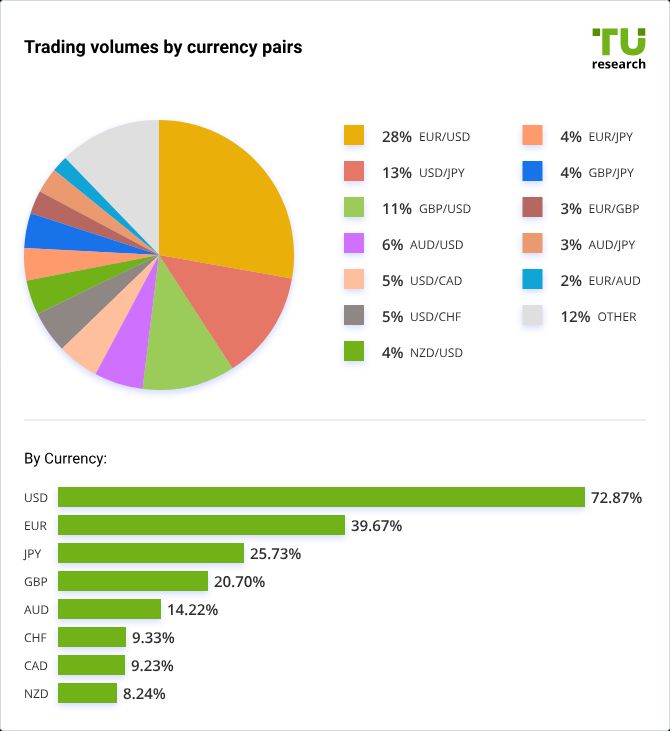
According to BIS (Bank for International Settlements), the EUR/USD pair accounts for 27.95% of the total volume of trading in the Forex market. Next follows USD/JPY with 13.34% of the total trading volume. The positions of the following currency pairs are as follows:
GBP/USD — 11.27%, AUD/USD — 6.37%, USD/CAD — 5.22%, USD/CHF — 4.63%, NZD/USD — 4.08%, EUR/JPY — 3.93%, GBP/JPY — 3.57%, EUR/GBP — 2.78%, AUD/JPY — 2.73%, EUR/AUD — 1.8%. The other currency pairs account for the remaining 12.33%.
Types of Forex currency pairs
According to the general classification, all Forex currency pairs are divided into the following groups:
Majors
Minors/Crosses
Exotic pairs
Major currency pairs
The currencies traded at the highest volume against USD make up the group of major currencies together with the US dollar. The currency pairs of this type are the most liquid ones, as the analysis of trading volume data has shown.
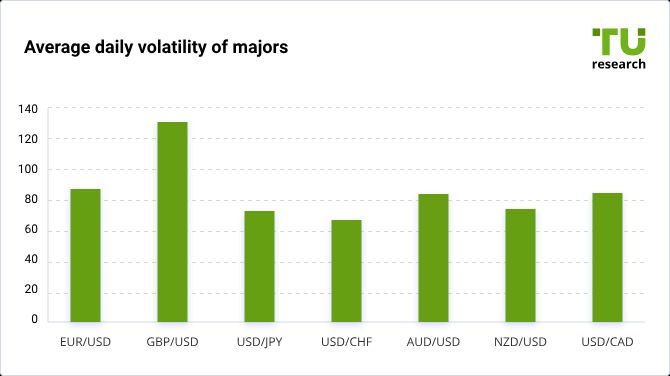
Major currency pairs, with the exception of GBP/USD and USD/CAD, have a moderate level of volatility, not exceeding 100 pips per day. This correlates with high liquidity of these currency pairs. The most volatile pair among them is GBP/USD with an indicator of 131 pips (per trading day). The least volatile pair among majors is USD/CHF with the daily indicator at 68 pips.
The features of the major currency pairs include:
high liquidity;
moderate volatility;
tight spreads;
quick order execution;
minimum swaps;
low probability of slippage.
Minor currency pairs (crosses)
Currency pairs, in which the US dollar (USD) is not one of the currencies, are called minors or crosses. The trading volume of these pairs is much lower than the majors, making them less liquid.
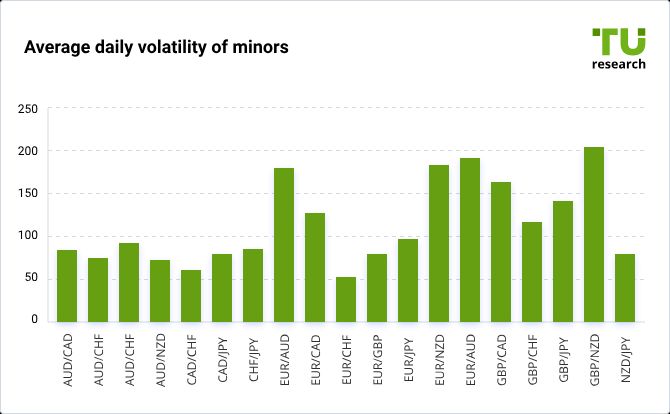
Having analyzed minors volatility data, the team of TU analysts established that their average volatility is higher than that of the majors. As you can see on the chart of the average volatility of crosses below, the most volatile pairs in this group have GBP as one of the currencies. In these crosses, the volatility indicator is ‘confidently’ above 100 pips. The most volatile pair among the minors is GBP/NZD with an indicator exceeding 205 pips. The least volatile currency pair among the minors we analyzed is EUR/CHF with an average volatility indicator at 53 pips.
The features of the minor currency pairs include:
moderate liquidity;
average volatility;
average spreads;
average cost of swaps.
Exotic currency pairs
The exotic pairs are the currency pairs, which include currencies of developing markets or developed countries with a small share in the global trade. The general feature of exotic pairs is that their trading offers higher profit potential, but also carries higher risks. The liquidity of this group of currency pairs is minimal, as the trading volumes of exotic currency pairs are comparatively low. In terms of volatility of this type of currency pairs, in the majority of cases it is very high, although there are exceptions.
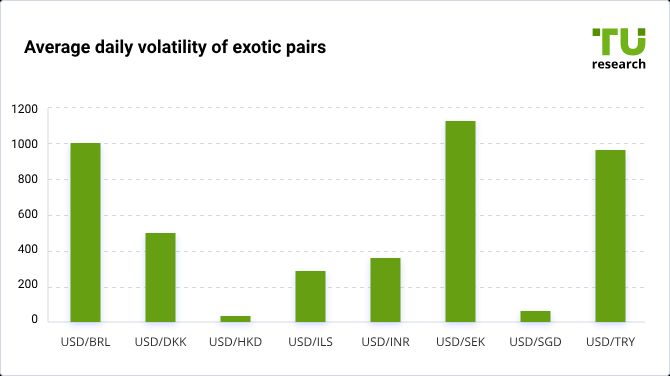
Among the exotic currency pairs TU team of experts analyzed, USD/SEK and USD/BRL are undisputed leaders in terms of volatility with an average volatility indicator at 1,127 and 1,006 pips respectively. The USD/TRY pair is not far behind them with 968 pips. At that, USD/HKD is the least volatile pair with the volatility indicator ranging within 26 pips, which is much lower than the indicators of the other pairs, including majors.
The features of the exotic currency pairs include:
low liquidity;
higher level of volatility on average;
wider spreads;
high cost of swaps;
increased slippage risk.
Note: Experts would like to warn novice traders against trading exotic currency pairs due to the increased risk and high transaction expenses, possible slippages and sharp price fluctuations.
Survey-based analysis: what traders really trade
To answer the question of which currency pairs are the best for trading in the Forex market, the team of TU analysts surveyed 2,500 successful traders – clients of the brokers from the TOP 10 of the TU rating. All surveyed traders have shown profitable trading for at least one year. The survey was conducted using the CAWI (Computer Assisted Web Interviewing) method. The non-sampling error of the survey with a confidence level of 95% is no more than 2.2%.
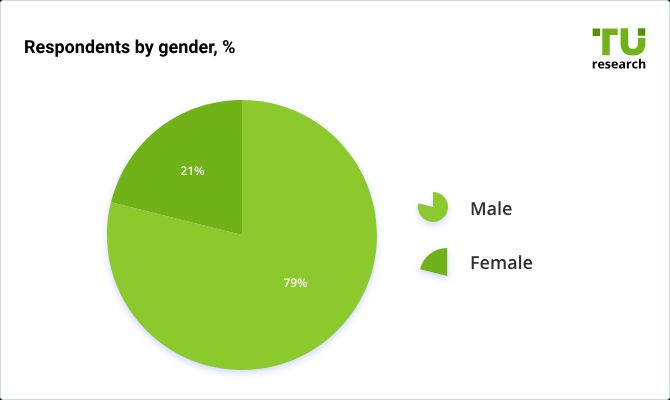
6.1 Surveyed traders by gender:
79% men
21% women
6.2 The age groups in the sample:
42% aged 18–30
36% aged 30–45
18% aged 45–60
4% older than 60

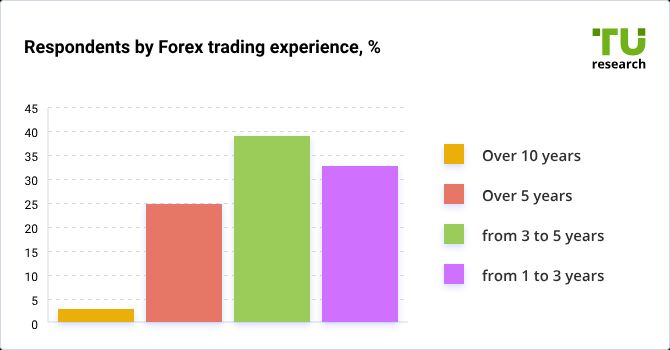
6.3 Forex trading experience:
3% — over 10 years
25% — more than 5 years
39% — 3–5 years
33% — 1–3 years
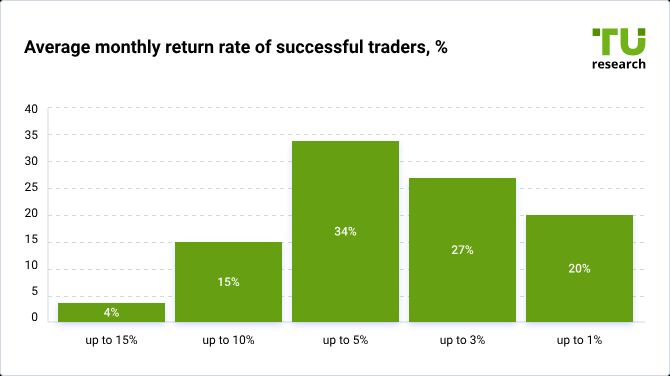
6.4 Monthly deposit growth (past 12 months):
4% — up to 15%
15% — up to 10%
34% — up to 5%
27% — up to 3%
20% — up to 1%
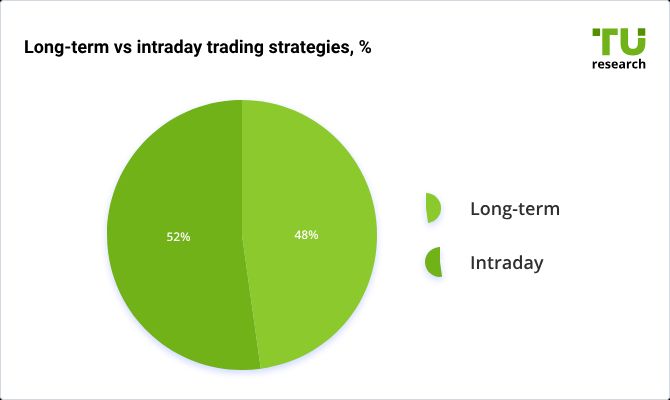
6.5 Trading strategies used:
48% — long-term
52% — intraday
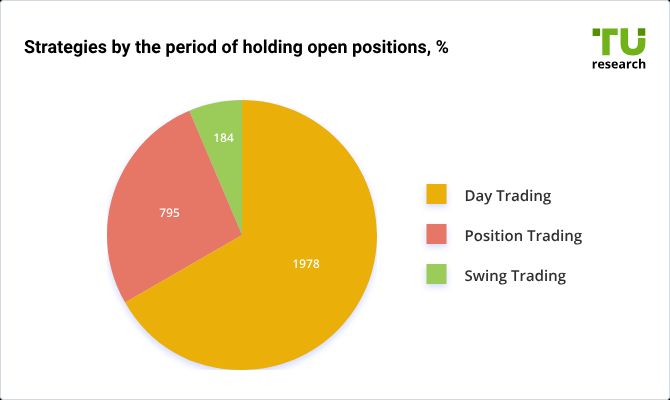
6.6 Currency pair types preferred for trading:
| Type of currency pair | Votes | % |
|---|---|---|
Major pairs | 1,978 | 67% |
Minor pairs | 795 | 27% |
Exotic pairs | 184 | 6% |
Total | 2,957 | 100% |
6.7 Factors influencing pair selection:
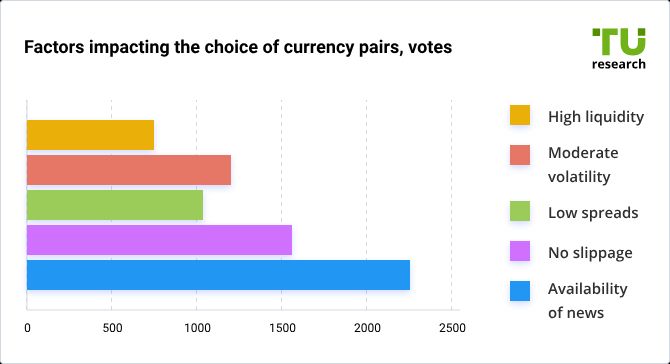
| Factors impacting the choice of currency pairs | Votes | % |
|---|---|---|
High liquidity | 2,253 | 33% |
Moderate volatility | 1,569 | 23% |
Low spreads | 1,044 | 15% |
No slippage | 1,212 | 18% |
Availability of news and analytical materials | 764 | 11% |
Total | 6,842 | 100% |
Key takeaways from our analysts
Based on the results of the research, our analysts have come to the following conclusions:
The vast majority of the traders choose the major currency pairs group.
The surveyed traders most frequently take into consideration high liquidity (33% of all votes) when choosing currency pairs.
The traders who prefer long-term trading strategies use exotic pairs and crosses more often than intraday traders.
Novice traders trade exotic currency pairs much more rarely than experienced traders.
Traders with the highest average return rate in the past 12 months choose minor currency pairs more often than other categories.
What are the best Forex currency pairs for profitable trading

With a wide range of currency pairs available on the Forex market, choosing the right one requires careful consideration of your individual risk tolerance, which is largely influenced by the pair’s liquidity and volatility. It’s also important to evaluate how well a specific currency pair aligns with your broker’s trading conditions—such as spreads, commissions, slippage, and execution speed—as well as the availability of relevant news and analysis. Your trading strategy should reflect your approach to risk and be tailored to the characteristics of the selected pair. Once chosen, the pair should be thoroughly tested—either on a demo account or with minimal volume and leverage—to ensure it complements your strategy. This methodical approach increases the chances of achieving stable and consistent profits in Forex trading.
Conclusion
Choosing the best Forex currency pairs for trading is a strategic decision that depends on a trader’s goals, experience, and risk tolerance. TU analysts found that most successful traders prefer major currency pairs due to their high liquidity, tight spreads, and predictable behavior. However, those with higher returns over the past year often diversify with minor pairs, while experienced long-term traders occasionally opt for exotic pairs to capitalize on volatility. The key to success lies not just in the pair itself, but in matching it with a well-tested strategy, proper risk management, and a broker offering favorable trading conditions. By aligning these elements, traders can significantly improve their chances of consistent profitability in the Forex market.
FAQs
What are the most popular Forex currency pairs?
The most popular Forex pairs are major pairs like EUR/USD, USD/JPY, GBP/USD, and AUD/USD. These pairs offer high liquidity, tighter spreads, and are ideal for both beginners and experienced traders.
Are exotic currency pairs good for beginners?
Exotic pairs are generally not recommended for beginners due to their low liquidity, wider spreads, and higher volatility. They carry a higher risk of slippage and unpredictable price movements.
Why is liquidity important when choosing a currency pair?
High liquidity ensures faster order execution, tighter spreads, and more stable pricing. This reduces trading costs and improves the reliability of technical analysis.
How can I test a currency pair before trading it live?
You can test any currency pair using a demo account or by opening small trades with minimal leverage. This allows you to assess how well the pair fits your strategy without taking on significant risk.
Editors' Top Picks and Insights






Related Articles
Team that worked on the article
Andrey Mastykin is an experienced author, editor, and content strategist who has been with Traders Union since 2020. As an editor, he is meticulous about fact-checking and ensuring the accuracy of all information published on the Traders Union platform.
Dan Blystone began his trading career in 1998 as an arbitrage clerk on the floor of the Chicago Mercantile Exchange (CME). He later traded bond and Eurex futures at proprietary firms such as Altea Trading, gaining valuable experience in high-frequency trading and risk management.
Chinmay Soni is a financial analyst with more than 5 years of experience in working with stocks, Forex, derivatives, and other assets. As a founder of a boutique research firm and an active researcher, he covers various industries and fields, providing insights backed by statistical data.
Scalping in trading is a strategy where traders aim to make quick, small profits by executing numerous short-term trades within seconds or minutes, capitalizing on minor price fluctuations.
Day trading involves buying and selling financial assets within the same trading day, with the goal of profiting from short-term price fluctuations, and positions are typically not held overnight.
Trend trading is a trading strategy where traders aim to profit from the directional movements of an asset's price over an extended period.
Forex leverage is a tool enabling traders to control larger positions with a relatively small amount of capital, amplifying potential profits and losses based on the chosen leverage ratio.
Exotic currencies are currencies from countries with smaller or emerging economies, and they are less commonly traded in the foreign exchange market compared to major currencies like the US Dollar, Euro. These currencies are often considered exotic because they are not as liquid or widely used in international trade and finance.

-
 Afghanistan
-
 Albania
-
 Algeria
-
 Angola
-
 Argentina
-
 Armenia
-
 Australia
-
 Austria
-
 Azerbaijan
-
 Bahamas
-
 Bahrain
-
 Bangladesh
-
 Belarus
-
 Belgium
-
 Bolivia
-
 Botswana
-
 Brazil
-
 Brunei
-
 Bulgaria
-
 Cambodia
-
 Cameroon
-
 Canada
-
 Chile
Chile
-
 China
China
-
 Colombia
-
 Congo
Congo
-
 Costa Rica
-
 Cote d'Ivoire
-
 Croatia
-
 Cuba
Cuba
-
 Cyprus
-
 Czechia
-
 DR Congo
-
 Denmark
-
 Dominican Republic
-
 Ecuador
-
 Egypt
Egypt
-
 El Salvador
-
 Estonia
-
 Eswatini
-
 Ethiopia
-
 Finland
-
 France
-
 Georgia
-
 Germany
-
 Ghana
Ghana
-
 Greece
-
 Haiti
Haiti
-
 Hong Kong
-
 Hungary
-
 India
India
-
 Indonesia
-
 Iran, Islamic republic
-
 Iraq
Iraq
-
 Ireland
-
 Israel
-
 Italy
Italy
-
 Jamaica
-
 Japan
Japan
-
 Jordan
-
 Kazakhstan
-
 Kenya
Kenya
-
 Korea
Korea
-
 Kuwait
-
 Kyrgyzstan
-
 Laos
Laos
-
 Latvia
-
 Lebanon
-
 Lesotho
-
 Libya
Libya
-
 Lithuania
-
 Luxembourg
-
 Madagascar
-
 Malaysia
-
 Malta
Malta
-
 Mauritius
-
 Mexico
-
 Moldova
-
 Mongolia
-
 Montenegro
-
 Morocco
-
 Mozambique
-
 Myanmar
-
 Namibia
-
 Nepal
Nepal
-
 Netherlands
-
 New Zealand
-
 Nigeria
-
 North Macedonia
-
 Norway
-
 Oman
Oman
-
 Pakistan
-
 Palestine
-
 Panama
-
 Papua New Guinea
-
 Paraguay
-
 Peru
Peru
-
 Philippines
-
 Poland
-
 Portugal
-
 Puerto Rico
-
 Qatar
Qatar
-
 Reunion
-
 Romania
-
 Rwanda
-
 Saudi Arabia
-
 Serbia
-
 Singapore
-
 Slovakia
-
 Slovenia
-
 Somalia
-
 South Africa
-
 Spain
Spain
-
 Sri Lanka
-
 Sweden
-
 Switzerland
-
 Syria
Syria
-
 Taiwan
-
 Tajikistan
-
 Tanzania
-
 Thailand
-
 Trinidad and Tobago
-
 Tunisia
-
 Turkey
-
 UAE
UAE
-
 Uganda
-
 Ukraine
-
 United Kingdom
-
United States
-
 Uruguay
-
 Uzbekistan
-
 Venezuela
-
 Vietnam
-
 Yemen
Yemen
-
 Zambia
-
 Zimbabwe
- Forex
- Crypto












