
How To Day Trade Forex



Editorial Note: While we adhere to strict Editorial Integrity, this post may contain references to products from our partners. Here's an explanation for How We Make Money. None of the data and information on this webpage constitutes investment advice according to our Disclaimer.
Forex day trading refers to a trading approach in which traders engage in the buying and selling of currency pairs within a single trading day to take advantage of short-term price movements. The primary objective is to leverage intraday fluctuations, avoiding overnight positions.
Forex day trading can be interesting for many beginner-traders due to its fast-paced nature, offering the potential for quick profits and dynamic market opportunities within a single trading day.
This article serves as a comprehensive guide for potential Forex day traders, offering valuable insights to help them understand the market better and avoid typical mistakes. Geared towards those stepping into the dynamic world of Forex day trading, TU expert emphasizes the importance of risk management, starting with liquid currency pairs, and considering trading costs.
What is Forex day trading?
Forex day trading is a trading style where traders buy and sell currency pairs within the same trading day to profit from short-term price movements. It aims to capitalize on intraday fluctuations, not holding positions overnight. Day traders usually rely on technical analysis to make trading decisions.
Commonly used time frames are 1-minute, 5-minute, 15-minute, and 1-hour charts. Traders focus on these shorter intervals for quick entries and exits. Day traders can make multiple trades in a day, ranging from 1 to several of trades.
The key Forex day trading benefit is that it offers potential for quick profits due to frequent trades and leveraged positions.
On the flip side, the main risk of day trading lies in the higher exposure to market volatility. The short-term price movements can be unpredictable, making effective risk management essential for traders to navigate these increased risks successfully.
Overall, Forex day trading requires expertise, effective strategies, and strict discipline. It offers the potential for significant gains in a short time but demands careful analysis and control to manage the associated risks effectively.
Is day trading a good idea for me?
Forex day trading can be a rewarding venture for certain individuals, particularly those possessing specific qualities and abilities. It is a good idea for traders who are willing to dedicate most of their working day to monitor charts, as day trading requires constant attention and quick decision-making. Additionally, successful day traders are capable of controlling their emotions and maintaining a rational mindset during volatile market conditions. Other essential qualities include discipline, as day trading demands adherence to strict trading plans and risk management strategies, and the ability to learn continuously and practice to improve trading skills.
Forex day trading may not be advisable for those who struggle with discipline, as impulsive or emotional decisions can lead to substantial losses. Moreover, day trading is not a viable option for individuals who lack the time and commitment to learn the complexities of the Forex market and practice trading consistently.
Forex day trading guide for beginners
Starting with this TU guide will help you to get started well-prepared in Forex day trading, equipping you with essential knowledge and strategies to navigate the market confidently and effectively.
Learn Forex. Be sure you understand the Forex market's mechanics, technical and fundamental analysis, risk management, and trading psychology. Learning Forex terms, strategies, and concepts is crucial for beginners. Continuous learning and practice are key to gaining experience and confidence as a Forex day trader. Review TU free Forex trading library
Choose a low-cost Forex broker. Consider your trading costs. Opt for brokers offering tight spread accounts with good liquidity and low commissions, especially those with ECN (Electronic Communication Network) accounts, which provide direct access to the interbank market and transparent pricing
Open a Forex demo account. It allows traders to practice in a risk-free environment using virtual funds. Forex demo trading provides an opportunity to familiarize yourself with the trading platform, test different strategies, and gain practical experience without risking real money
Pay special attention to Forex risk management rules. It is a crucial skill for Forex day traders because day trading involves higher risks due to the volatile nature of short-term price movements. Implementing proper risk management strategies, such as setting stop-loss and take-profit levels, can help protect your capital and limit potential lossesy
Understand the Forex market structure, various Forex trading patterns, and indicators. Knowledge of support and resistance levels, chart patterns, and technical indicators can help you identify potential entry and exit points more effectively
Start with the most liquid currency pairs, like EUR/USD, GBP/USD, and USD/JPY. These pairs have higher trading volumes, tighter spreads, and better price stability, making them more suitable for day trading
Stay updated with the economic calendar. Economic announcements, central bank decisions, and other macroeconomic data can significantly impact currency prices, and being aware of these events helps in making informed trading decisions

Top 5 Forex day trading strategies for beginners
Even the simplest strategies can be effective if mastered thoroughly, with a keen understanding of market structure and clear take profit and stop-loss points. TU has prepared top 5 popular Forex day trading strategies to consider.
Remember, mastering any Forex strategies requires practice, discipline, and risk management. It's essential for beginners to start with demo accounts and gradually transition to live trading as they gain confidence in their abilities. Continuous learning and researching different strategies are essential aspects of successful Forex day trading.
Breakout Forex strategy
Breakout Forex trading involves identifying key support and resistance levels and executing trades when the price breaks out of these levels. Beginners should focus on strong breakout signals and use proper risk management to avoid false breakouts.
Entry point:
Look for significant price levels where the market has repeatedly tested and failed to break through (support or resistance levels). Enter a trade when the price breaks decisively above resistance or below support.
Stop Loss:
Set the stop loss just below the breakout point for a long trade (above for short trade) to limit potential losses if the breakout is false.
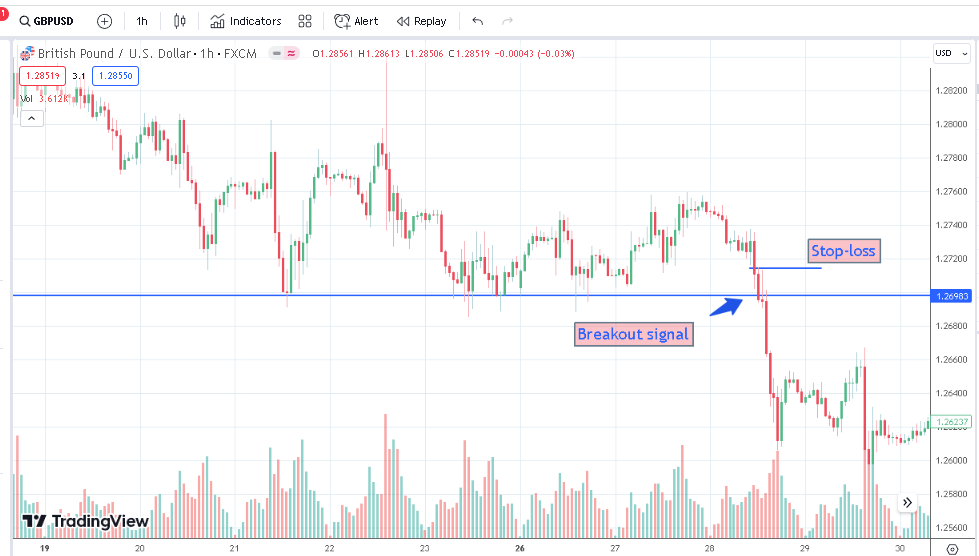 Breakout Forex strategy
Forex pattern trading
Recognizing Forex chart patterns like triangles, head and shoulders, and double tops/bottoms can provide trading signals. Novice traders should confirm patterns with other technical indicators and wait for valid breakout or breakdown signals.
Entry point:
Identify chart patterns (e.g., head and shoulders, triangles) forming on the charts and enter a trade when the pattern is confirmed by a breakout or breakdown.
Stop Loss:
Place the stop loss below the pattern's breakout point for a long trade (above for short trade) to protect against false patterns.
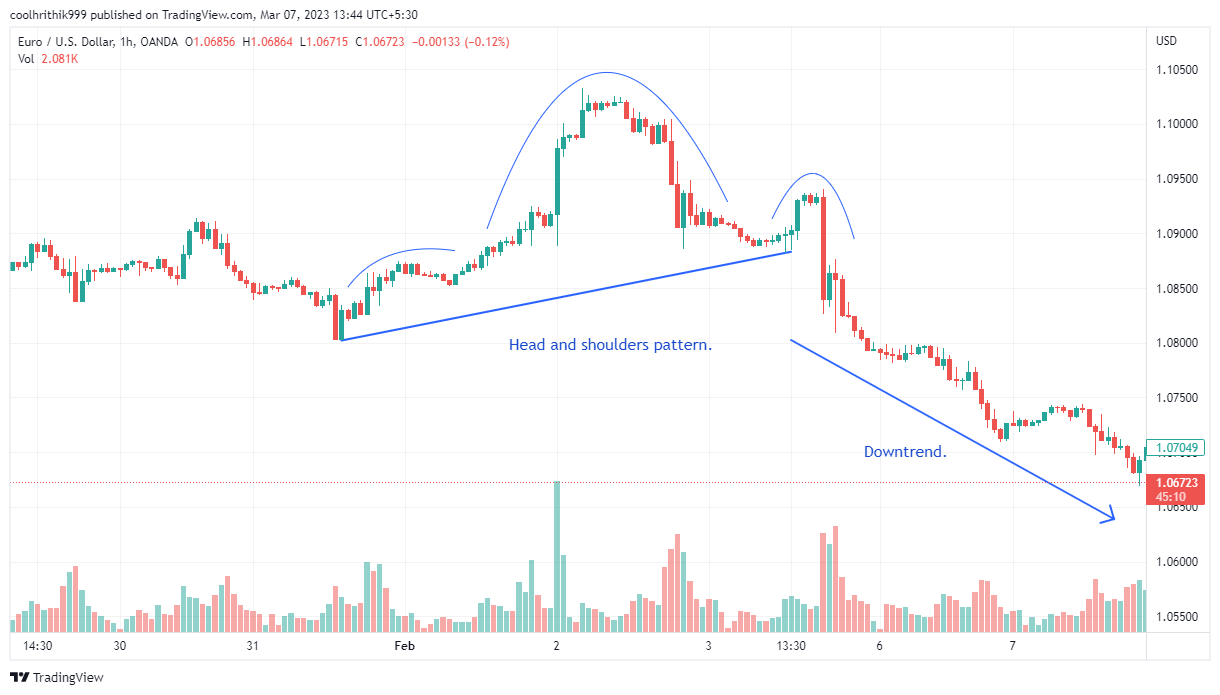 Forex chart patterns
Trend following strategy
Forex trend following involves riding the market trends and entering trades in the direction of the prevailing trend. Beginners should use trend lines, trend-following indicators like Moving Averages and ADX to identify trends and avoid counter-trend trades.
Entry point:
Enter trades in the direction of the prevailing trend. For an uptrend, enter long trades on pullbacks to support or when a new higher high is formed. For a downtrend, enter short trades on rallies to resistance or when a new lower low is formed.
Stop Loss:
Set the stop loss below the recent swing low for a long trade (above for short trade) to guard against trend reversals.
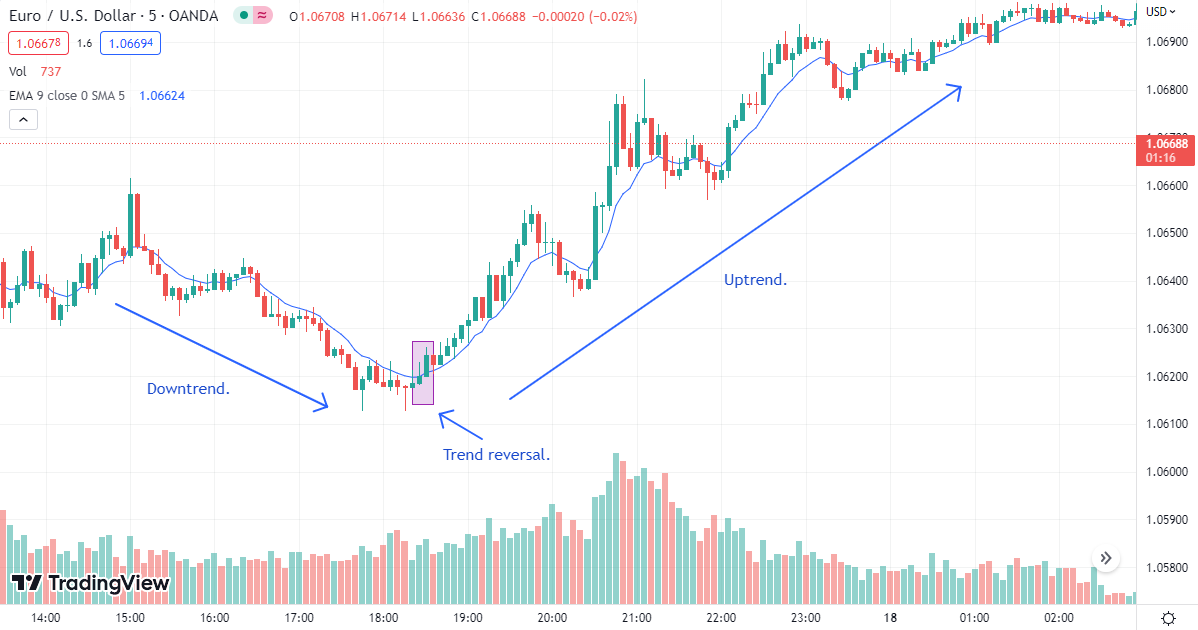 Trend following strategy
Moving average crossover strategy
Utilizing different moving averages can help traders spot trend direction and potential entry/exit points. Beginners should combine moving averages with other indicators to confirm signals and avoid whipsaw movements.
Entry point:
Look for crossovers of different moving averages (e.g., 50 ma and 100 ma). Enter a long trade when the shorter moving average crosses above the longer moving average and a short trade when it crosses below.
Stop Loss:
Set the stop loss below the recent swing low for a long trade (above for short trade) to minimize losses if the trade moves against the trend.
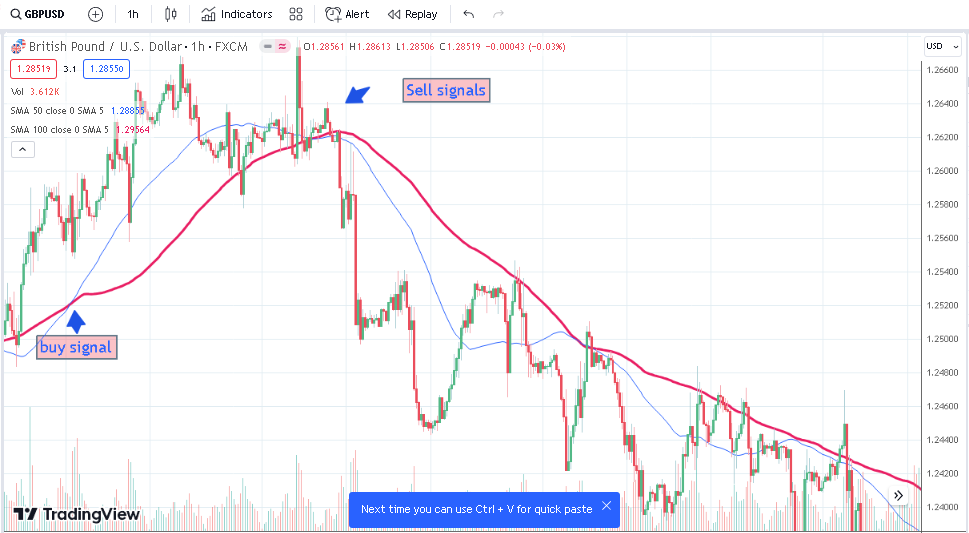 MA crossover strategy
50 pips a day strategy
The 50 pips a day Forex strategy is designed to achieve a daily gain of 50 pips by leveraging technical indicators to spot high-probability trades. Applicable to any currency pair, this approach relies on a 15-minute chart for precise entry and exit signals. Traders are advised to focus on currency pairs with tight spreads and clear trends, and then confirm the trend's validity using technical indicators like Moving Average and Relative Strength Index (RSI) to pinpoint opportune entry and exit points.
How much money do I need to day trade Forex?
The amount of money needed to start day trading Forex can vary depending on individual circumstances and trading goals. Technically, one could start with as little as $100, but it's crucial to understand that the more funds you have, the more flexibility you'll have in implementing conservative strategies with lower risks. Additionally, it's essential to consider living costs during the learning phase, as day trading requires time and dedication.
Experts generally recommend starting day trading with at least $500. This amount allows for a more comfortable trading experience and enables traders to better manage risks and potential losses. However, the specific amount can vary based on personal financial situations, living expenses, and the chosen trading style.
If you have limited capital but feel confident in your trading skills, considering Forex prop companies can be a viable option, as they provide traders with access to higher leverage and trading capital to potentially enhance their trading opportunities.
Is Forex day trading profitable?
Day trading in Forex presents significant earning potential, as it doesn't require substantial capital to start and leverage from brokerages can lead to substantial profits, but it's crucial to be aware of the inherent risks, as the market can be highly volatile, and inexperienced traders may suffer significant losses.
A well-developed strategy with proper risk management can help day traders achieve consistent profits, with potential gains ranging from 5 to 15 percent per month, making it possible to start with as little as $500 to $1000.
Forex day trading offers the potential for skilled traders to earn substantial profits and even become millionaires, it's essential to acknowledge that the reality is that a significant portion of traders (up to 80%) end up losing money due to the complexities of the market and the challenges of day trading. Success in day trading requires a high level of skill, experience, discipline, and continuous learning to navigate the risks and capitalize on market opportunities effectively. Learn also the richest Forex traders in the world trading lessons to understand their secrets better.
What are the best day trading brokers?
The best Forex day trading brokers typically offer ECN (Electronic Communication Network) accounts, which provide direct access to the interbank market. This grants traders access to liquidity providers, leading to better pricing and faster execution of trades.
Moreover, these brokers often offer free virtual private network (VPN) services, which ensure a secure and stable internet connection for uninterrupted trading. Additionally, they provide ultra-tight spreads (from 0.1 pips), which means the difference between the buying and selling price is minimal, reducing trading costs. Low commissions (from $2 to $3.5 per lot).
With these key features in mind, it becomes easier to evaluate which brokers actually meet the requirements of effective day trading. To help you make an informed choice, below is a comparison of brokers that are well-suited for traders who rely on tight spreads, fast execution, and stable trading conditions.
| zForex | OANDA | FOREX.com | Venom by Cobra Trading | IG Markets | |
|---|---|---|---|---|---|
|
Tradable assets |
80 | 129 | 5500 | No | 20000 |
|
Demo |
Yes | Yes | Yes | Yes | Yes |
|
Min. deposit, $ |
10 | No | 100 | 5000 | 1 |
|
ECN |
Yes | Yes | Yes | Yes | Yes |
|
ECN Commission |
7 | 3.5 | 5 | 1.5 | 2.3 |
|
Free VPS |
Yes | Yes | Yes | Yes | Yes |
|
Signals (alerts) |
Yes | Yes | Yes | No | Yes |
|
TU overall score |
7.95 | 6.89 | 6.87 | 6.84 | 6.83 |
|
Open an account |
Go to broker Your capital is at risk.
|
Go to broker Your capital is at risk. |
Study review | Study review | Study review |
Day trading rewards patience far more than aggressiveness

I can say that the biggest misconception about Forex day trading is that it’s a fast path to quick profits. In reality, the greatest advantage you can give yourself has nothing to do with technical indicators or perfect entries – it comes from building a structured routine and learning to think in probabilities rather than outcomes. When I first started, I made the same mistakes everyone makes: jumping into trades without a clear plan, risking too much on what felt like a strong setup, letting a small loss turn into a big one because I didn’t want to accept being wrong. What finally changed my results wasn’t a new strategy – it was developing the consistency to follow simple rules every single day.
My strongest recommendation for anyone considering day trading is to treat it like a professional skill, not a game. Before risking a dollar, build a habit of reviewing charts at the same time every day, logging hypothetical trades, and analyzing where you would have made decisions under pressure. This alone will teach you more about your weaknesses and reactions than any trading course. And once you move to a live account, start small. Small positions protect you not just financially but emotionally, allowing you to build confidence without the stress that often destroys discipline.
Above all, remember that day trading rewards patience far more than aggressiveness. If you learn to wait for clarity instead of forcing trades, you’ll already be ahead of most beginners. Quick profits will come – but only after your process becomes steady, repeatable, and grounded in risk control. That’s the real foundation of long-term success in Forex day trading.
Conclusion
Mastering Forex day trading requires not only an understanding of market movements but also disciplined execution of proven strategies and risk management. As outlined throughout the guide, tools like stop-loss orders or sticking to a clear trading plan can make a significant difference in minimizing losses and maximizing potential gains. For instance, a trader who patiently waits for high-probability setups is far more likely to succeed than one who chases every price fluctuation. Ultimately, the greatest asset in Forex day trading isn’t just knowledge—it's the trader's ability to remain consistent and unemotional, turning challenges into opportunities for growth.
FAQs
What are the main risks associated with Forex day trading for beginners?
How do economic announcements impact Forex day trading?
Why is continuous learning important in Forex day trading?
What technical tools are commonly used to identify entry and exit points in Forex day trading?
Editors' Top Picks and Insights

U.S. Bitcoin reserve: Trump’s unrealized crypto promise

Aiming for leadership: Payment giants prepare a new stablecoin

Proof of Reserves: the new standard for cryptocurrency exchanges

Three trends that could reshape the crypto market over the next decade

Trump financial disclosure: How the president's crypto income became a U.S. ethics issue

Code red: What's behind Bitcoin’s sharp selloff?
Related Articles
Team that worked on the article
Andrey Mastykin is an experienced author, editor, and content strategist who has been with Traders Union since 2020. As an editor, he is meticulous about fact-checking and ensuring the accuracy of all information published on the Traders Union platform.
Dan Blystone began his trading career in 1998 as an arbitrage clerk on the floor of the Chicago Mercantile Exchange (CME). He later traded bond and Eurex futures at proprietary firms such as Altea Trading, gaining valuable experience in high-frequency trading and risk management.
Chinmay Soni is a financial analyst with more than 5 years of experience in working with stocks, Forex, derivatives, and other assets. As a founder of a boutique research firm and an active researcher, he covers various industries and fields, providing insights backed by statistical data.
Scalping in trading is a strategy where traders aim to make quick, small profits by executing numerous short-term trades within seconds or minutes, capitalizing on minor price fluctuations.
An ECN, or Electronic Communication Network, is a technology that connects traders directly to market participants, facilitating transparent and direct access to financial markets.
CFD is a contract between an investor/trader and seller that demonstrates that the trader will need to pay the price difference between the current value of the asset and its value at the time of contract to the seller.
Fundamental analysis is a method or tool that investors use that seeks to determine the intrinsic value of a security by examining economic and financial factors. It considers macroeconomic factors such as the state of the economy and industry conditions.
Cryptocurrency is a type of digital or virtual currency that relies on cryptography for security. Unlike traditional currencies issued by governments (fiat currencies), cryptocurrencies operate on decentralized networks, typically based on blockchain technology.

-
 Afghanistan
-
 Albania
-
 Algeria
-
 Angola
-
 Argentina
-
 Armenia
-
 Australia
-
 Austria
-
 Azerbaijan
-
 Bahamas
-
 Bahrain
-
 Bangladesh
-
 Belarus
-
 Belgium
-
 Bolivia
-
 Botswana
-
 Brazil
-
 Brunei
-
 Bulgaria
-
 Cambodia
-
 Cameroon
-
 Canada
-
 Chile
Chile
-
 China
China
-
 Colombia
-
 Congo
Congo
-
 Costa Rica
-
 Cote d'Ivoire
-
 Croatia
-
 Cuba
Cuba
-
 Cyprus
-
 Czechia
-
 DR Congo
-
 Denmark
-
 Dominican Republic
-
 Ecuador
-
 Egypt
Egypt
-
 El Salvador
-
 Estonia
-
 Eswatini
-
 Ethiopia
-
 Finland
-
 France
-
 Georgia
-
 Germany
-
 Ghana
Ghana
-
 Greece
-
 Haiti
Haiti
-
 Hong Kong
-
 Hungary
-
 India
India
-
 Indonesia
-
 Iran, Islamic republic
-
 Iraq
Iraq
-
 Ireland
-
 Israel
-
 Italy
Italy
-
 Jamaica
-
 Japan
Japan
-
 Jordan
-
 Kazakhstan
-
 Kenya
Kenya
-
 Korea
Korea
-
 Kuwait
-
 Kyrgyzstan
-
 Laos
Laos
-
 Latvia
-
 Lebanon
-
 Lesotho
-
 Libya
Libya
-
 Lithuania
-
 Luxembourg
-
 Madagascar
-
 Malaysia
-
 Malta
Malta
-
 Mauritius
-
 Mexico
-
 Moldova
-
 Mongolia
-
 Montenegro
-
 Morocco
-
 Mozambique
-
 Myanmar
-
 Namibia
-
 Nepal
Nepal
-
 Netherlands
-
 New Zealand
-
 Nigeria
-
 North Macedonia
-
 Norway
-
 Oman
Oman
-
 Pakistan
-
 Palestine
-
 Panama
-
 Papua New Guinea
-
 Paraguay
-
 Peru
Peru
-
 Philippines
-
 Poland
-
 Portugal
-
 Puerto Rico
-
 Qatar
Qatar
-
 Reunion
-
 Romania
-
 Rwanda
-
 Saudi Arabia
-
 Serbia
-
 Singapore
-
 Slovakia
-
 Slovenia
-
 Somalia
-
 South Africa
-
 Spain
Spain
-
 Sri Lanka
-
 Sweden
-
 Switzerland
-
 Syria
Syria
-
 Taiwan
-
 Tajikistan
-
 Tanzania
-
 Thailand
-
 Trinidad and Tobago
-
 Tunisia
-
 Turkey
-
 UAE
UAE
-
 Uganda
-
 Ukraine
-
 United Kingdom
-
United States
-
 Uruguay
-
 Uzbekistan
-
 Venezuela
-
 Vietnam
-
 Yemen
Yemen
-
 Zambia
-
 Zimbabwe
- Forex
- Crypto











