
Best Day Trading Forex Brokers In 2026



Editorial Note: While we adhere to strict Editorial Integrity, this post may contain references to products from our partners. Here's an explanation for How We Make Money. None of the data and information on this webpage constitutes investment advice according to our Disclaimer.
Top day trading Forex brokers:
- Trading.com USA - A broker registered with the CFTC and NFA that focuses on spot Forex trading through MT5 and proprietary platforms.
- ZForex - High transaction speeds, automatic tracking system of clients’ risks..
- Plus500 - Best premium client support (personal manager, exclusive analysis, webinars)
- OANDA - Best for trading with advanced technical analysis tools (TradingView charts support)
- FOREX.com - Diverse range of tradable assets (80+ currency pairs)
Day trading in the Forex market demands speed, precision, and constant access to real-time information. Traders who focus on intraday opportunities rely on platforms that can process orders instantly, offer tight spreads, and deliver stable performance during fast market movements. Not every broker provides the tools required for this style of trading, which is why choosing the best Forex broker for day trading becomes essential. A reliable platform should support advanced analytics, low-latency execution, and flexible order types suitable for short-term strategies. This guide explains what to look for in the best platform for day trading in Forex markets and presents the top brokers that offer the conditions day traders need.
Which broker is the best for Forex day trading?
With many brokers offering intraday trading conditions, choosing a reliable partner can be challenging. Some firms provide better execution speed, tighter spreads, and stronger platforms, making them more suitable for active traders. Our team reviewed the leading options and selected the best brokers for day trading in the Forex market based on regulation, stability, platform quality, and trading conditions. These brokers are proven providers with strong reputations and long-standing experience in the industry. Each one offers the tools and features that traders typically expect when looking for the best broker for day trading in Forex.
| Trading.com USA | ZForex | Plus500 | OANDA | FOREX.com | |
|---|---|---|---|---|---|
|
Min. deposit, $ |
50 | 10 | 100 | No | 100 |
|
Max. leverage |
1:50 | 1:1000 | 1:300 | 1:200 | 1:50 |
|
Tradable assets |
69 | 80 | 2800 | 129 | 5500 |
|
Standard EUR/USD spread |
1.1 | 0.3 | 0.7 | 0.3 | 1.0 |
|
Tier-1 regulation |
Yes | No | Yes | Yes | Yes |
|
TU overall score |
8.8 | 7.89 | 7.54 | 6.85 | 6.82 |
|
Open an account |
Go to broker Your capital is at risk. |
Go to broker Your capital is at risk.
|
Go to broker 80% of retail CFD accounts lose money. |
Go to broker Your capital is at risk. |
Study review |



Why trust us
15+ years of independent market analysis
140+ evaluation criteria, reviewed by 50+ experts
Data-driven reviews of 200+ platforms, updated regularly
20+ industry awards & a wide network of global media partners
Learn more about our methodology and editorial policies.


How to choose the best Forex broker for day trading
Day trading in the Forex market requires fast execution and precise order handling, since trades are opened and closed within the same day. The right broker provides real-time data, stable platforms, and tight spreads that help traders capture short-term price movements effectively.
When comparing the best Forex brokers for day trading, it is essential to focus on the fees that directly affect intraday performance. The most important cost factors include:
Spreads. Tight pricing from 0.0 pips reduces the cost of each entry and exit.
Commissions. ECN accounts may charge a fixed amount per lot, which matters for high-frequency trading.
Deposits and withdrawals. Some brokers apply fees for funding or cashing out, which can affect active traders who move money often.
Platform or monthly fees. Certain forex day trading apps charge maintenance costs, especially for advanced Forex day trading software.
Inactivity fees. Relevant for traders who trade in sessions or only during specific market hours.
This streamlined list helps traders quickly compare pricing models and choose the best broker for day trading in Forex based on their style and trade volume.
STP/ECN account
STP and ECN accounts are often the top choice for traders who work with short-term strategies, since these account types provide fast execution and more direct access to market liquidity. An STP account sends orders straight to liquidity providers, reducing delays during volatile periods and improving price accuracy.
An ECN account connects traders to an electronic network where orders are matched at the best available price, usually with spreads starting from 0.0 pips. Instead of widening spreads, ECN brokers charge a clear commission, which helps day traders manage costs more effectively. These features are especially important for anyone looking for the best broker for day trading in Forex, where speed, low spreads, and transparent pricing directly influence trade outcomes. When comparing brokers, it is useful to confirm whether the platform offers true STP or ECN execution, as these models support the precision required for intraday trading.
Additional services that support day trading in Forex
Beyond regulation and pricing, the quality of a broker’s extra services can strongly influence day trading performance. Traders who want the best broker for day trading in Forex often look for platforms that provide useful tools, consistent research, and reliable educational support. These services make it easier to analyze fast market movements and act quickly when opportunities appear. When choosing the best platform for day trading in Forex, consider whether the broker offers features such as:
Multi-platform access. Many brokers support MetaTrader, cTrader, or proprietary systems. A flexible setup allows traders to work across desktop, web, and mobile.
Advanced charting tools. Real-time charts, custom indicators, and one-click trading help traders enter and exit positions quickly.
Research and market insights. Some brokers publish daily reports and expert analysis that support intraday decision-making.
Educational resources. Video lessons, strategy guides, and training materials help new traders build skills before trading live.
These services create a more efficient trading workflow and support the speed and accuracy needed for intraday strategies.
Can I make money in Forex day trading?
It is possible to make money through day trading in the Forex market, but it requires skill, discipline, and consistent analysis. Intraday strategies involve frequent decision-making, which means traders must monitor markets closely and react quickly to price changes. This approach is not ideal for casual traders, since successful day trading demands time, focus, and a clear risk management plan. Using a reliable platform can improve execution quality, but profitability still depends on the trader’s strategy, timing, and ability to control losses.
Basic Forex day trading strategies
Day traders use different techniques depending on their goals, risk tolerance, and market experience. Execution speed, spreads, and platform stability all influence how well these strategies perform, so choosing a reliable broker is essential for day trading. Key intraday strategies include:
Scalping. This approach focuses on capturing very small price changes by placing many trades throughout the day. It works best with tight spreads, fast execution, and a platform designed for day trading in Forex that supports one-click trading.
Pivot points. Traders use calculated support and resistance levels based on the previous session’s prices. These levels help identify potential entry and exit points, especially when paired with real-time charting tools on a reliable platform for day trading in Forex.
Momentum trading. This strategy targets currency pairs that show strong directional movement backed by volume or sentiment. Traders enter during acceleration and exit before momentum slows. Fast data feeds and stable analytics tools are essential.
Breakout trading. This method looks for price breaks above resistance or below support. Breakouts often happen quickly, so traders need minimal slippage and fast order processing to take advantage of these moves.
Forex day trading example
Joey Gracia decided to test Admiral Markets as one of the best day trading platforms. He completed registration using his Google account and deposited 3,000 dollars and set his maximum risk per trade at 30 dollars with a reward-to-risk ratio of 1 to 1.5.
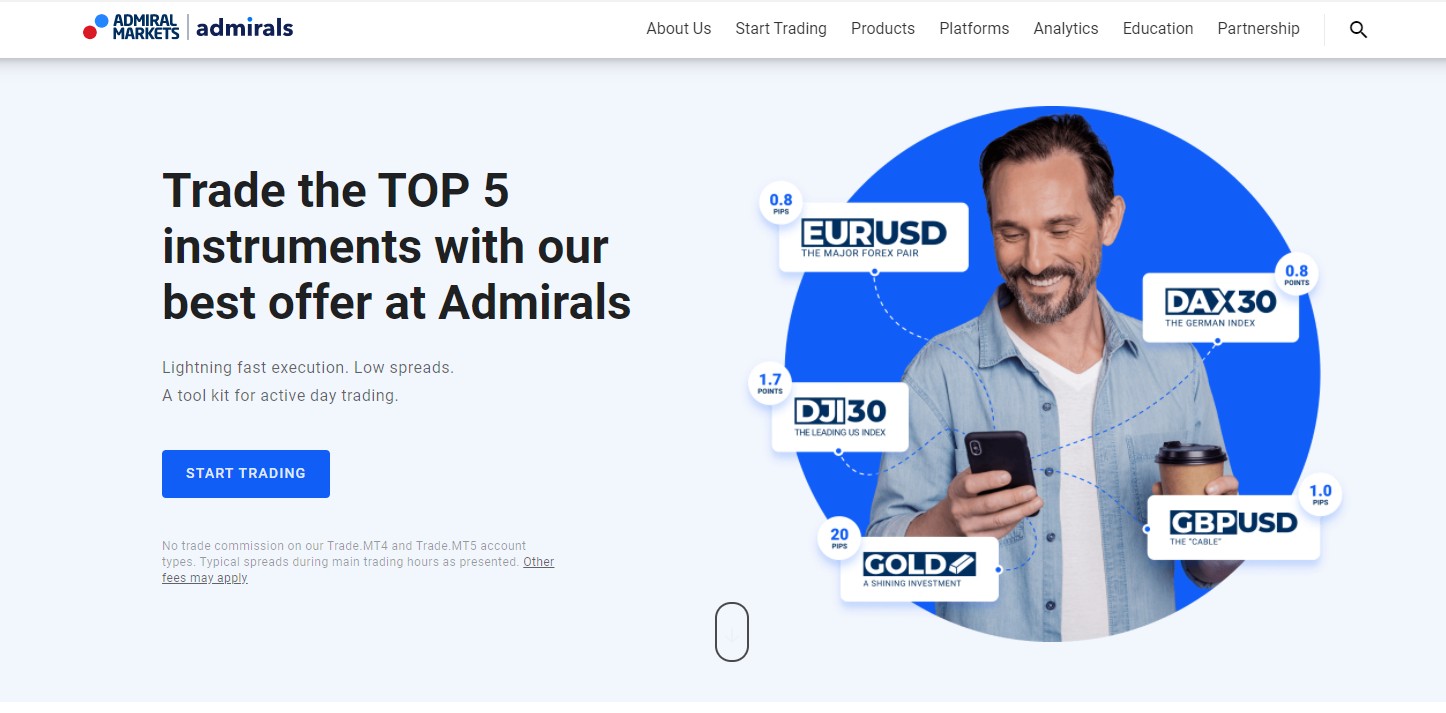
To guide his intraday decisions, Joey used a 15 minute chart and relied on moving averages for entry signals. His approach assumes that even if 15 trades are profitable and 10 are not, the positive reward-to-risk ratio helps him stay net profitable over time. This example shows how structured risk control and a clear strategy can support day trading results when paired with fast execution and reliable tools.
Choose a fast, regulated broker with stable tools and consistent pricing

When I help traders choose a broker for day trading in the Forex market, I focus first on execution quality. Even small delays or slippage can affect results across many intraday trades, so platforms with fast order processing and reliable liquidity provide a clear advantage. I also pay close attention to spreads and commissions, since cost efficiency becomes more important as trading frequency increases.
A strong broker offers stable platforms, access to tools like MetaTrader or cTrader, and clear risk management features that support high-speed strategies. Testing the platform through a demo account is always worthwhile, since it shows whether execution stays consistent during volatility and whether the tools fit the trader’s workflow. A dependable, well-regulated broker gives traders confidence in their setup, which is essential for disciplined day trading.
Methodology for compiling our ratings of Forex brokers
Traders Union applies a rigorous methodology to evaluate brokers using over 100 quantitative and qualitative criteria. Multiple parameters are given individual scores that feed into an overall rating.
Key aspects of the assessment include:
-
Regulation and safety. Brokers are evaluated based on the level/reputation of licenses and regulations they operate under.
-
User reviews. Client reviews and feedback are analyzed to determine customer satisfaction levels. Reviews are fact-checked and verified.
-
Trading instruments. Brokers are evaluated on the range of assets offered, as well as the breadth and depth of available markets.
-
Fees and commissions. All trading fees and commissions are analyzed comprehensively to determine overall costs for clients.
-
Trading platforms. Brokers are assessed based on the variety, quality, and features of platforms offered to clients.
-
Other factors like brand popularity, client support, and educational resources are also evaluated.
Find out more about the unique broker assessment methodology developed by Traders Union specialists.
Conclusion
Selecting the best Forex broker for day trading is fundamentally about gaining every possible edge through fast execution, tight spreads, and reliable platforms. With options like Admiral Markets demonstrating how efficient tools and structured risk management can drive consistent results, it’s clear that the right broker can profoundly impact a trader’s performance. Prioritizing features such as true STP/ECN execution, advanced charting, and strong regulatory oversight ensures traders remain competitive in the fast-paced world of intraday Forex. Ultimately, success in day trading is not just about quick decisions—it’s about partnering with a broker that empowers those decisions to deliver real, measurable gains.
FAQs
What factors influence order execution speed when day trading Forex?
How do tight spreads benefit Forex day traders?
Why is platform stability crucial for fast day trading in Forex?
What role do educational and research tools play in Forex day trading?
Editors' Top Picks and Insights

Shifting priorities: Governments back mining as businesses turn to AI

Intel's comeback: Apple, Trump and the AI bet

Bitcoin price prediction based on RSI: Is BTC poised for a new rally?

Toncoin becomes Gram: Why Durov restored token's original name

Why Tether flipping Ethereum is a pivotal moment for crypto

MiCA deadline: Why crypto companies are leaving Europe
Related Articles
Team that worked on the article
Aleksandra Chaikina has been a contributor to Traders Union since 2021. With over 15 years of experience in copywriting and more than 5 years focused on financial content, she specializes in producing detailed guides, analytics, and comparative reviews across various sectors, including cryptocurrencies, Forex, investment strategies, and financial technologies.
Dan Blystone began his trading career in 1998 as an arbitrage clerk on the floor of the Chicago Mercantile Exchange (CME). He later traded bond and Eurex futures at proprietary firms such as Altea Trading, gaining valuable experience in high-frequency trading and risk management.
Chinmay Soni is a financial analyst with more than 5 years of experience in working with stocks, Forex, derivatives, and other assets. As a founder of a boutique research firm and an active researcher, he covers various industries and fields, providing insights backed by statistical data.
Bitcoin is a decentralized digital cryptocurrency that was created in 2009 by an anonymous individual or group using the pseudonym Satoshi Nakamoto. It operates on a technology called blockchain, which is a distributed ledger that records all transactions across a network of computers.
Forex trading, short for foreign exchange trading, is the practice of buying and selling currencies in the global foreign exchange market with the aim of profiting from fluctuations in exchange rates. Traders speculate on whether one currency will rise or fall in value relative to another currency and make trading decisions accordingly. However, beware that trading carries risks, and you can lose your whole capital.
Breakout trading is a trading strategy that focuses on identifying and profiting from significant price movements that occur when an asset's price breaches a well-defined level of support or resistance.
Day trading involves buying and selling financial assets within the same trading day, with the goal of profiting from short-term price fluctuations, and positions are typically not held overnight.
Forex leverage is a tool enabling traders to control larger positions with a relatively small amount of capital, amplifying potential profits and losses based on the chosen leverage ratio.

-
 Afghanistan
-
 Albania
-
 Algeria
-
 Angola
-
 Argentina
-
 Armenia
-
 Australia
-
 Austria
-
 Azerbaijan
-
 Bahamas
-
 Bahrain
-
 Bangladesh
-
 Belarus
-
 Belgium
-
 Bolivia
-
 Botswana
-
 Brazil
-
 Brunei
-
 Bulgaria
-
 Cambodia
-
 Cameroon
-
 Canada
-
 Chile
Chile
-
 China
China
-
 Colombia
-
 Congo
Congo
-
 Costa Rica
-
 Cote d'Ivoire
-
 Croatia
-
 Cuba
Cuba
-
 Cyprus
-
 Czechia
-
 DR Congo
-
 Denmark
-
 Dominican Republic
-
 Ecuador
-
 Egypt
Egypt
-
 El Salvador
-
 Estonia
-
 Eswatini
-
 Ethiopia
-
 Finland
-
 France
-
 Georgia
-
 Germany
-
 Ghana
Ghana
-
 Greece
-
 Haiti
Haiti
-
 Hong Kong
-
 Hungary
-
 India
India
-
 Indonesia
-
 Iran, Islamic republic
-
 Iraq
Iraq
-
 Ireland
-
 Israel
-
 Italy
Italy
-
 Jamaica
-
 Japan
Japan
-
 Jordan
-
 Kazakhstan
-
 Kenya
Kenya
-
 Korea
Korea
-
 Kuwait
-
 Kyrgyzstan
-
 Laos
Laos
-
 Latvia
-
 Lebanon
-
 Lesotho
-
 Libya
Libya
-
 Lithuania
-
 Luxembourg
-
 Madagascar
-
 Malaysia
-
 Malta
Malta
-
 Mauritius
-
 Mexico
-
 Moldova
-
 Mongolia
-
 Montenegro
-
 Morocco
-
 Mozambique
-
 Myanmar
-
 Namibia
-
 Nepal
Nepal
-
 Netherlands
-
 New Zealand
-
 Nigeria
-
 North Macedonia
-
 Norway
-
 Oman
Oman
-
 Pakistan
-
 Palestine
-
 Panama
-
 Papua New Guinea
-
 Paraguay
-
 Peru
Peru
-
 Philippines
-
 Poland
-
 Portugal
-
 Puerto Rico
-
 Qatar
Qatar
-
 Reunion
-
 Romania
-
 Rwanda
-
 Saudi Arabia
-
 Serbia
-
 Singapore
-
 Slovakia
-
 Slovenia
-
 Somalia
-
 South Africa
-
 Spain
Spain
-
 Sri Lanka
-
 Sweden
-
 Switzerland
-
 Syria
Syria
-
 Taiwan
-
 Tajikistan
-
 Tanzania
-
 Thailand
-
 Trinidad and Tobago
-
 Tunisia
-
 Turkey
-
 UAE
UAE
-
 Uganda
-
 Ukraine
-
 United Kingdom
-
United States
-
 Uruguay
-
 Uzbekistan
-
 Venezuela
-
 Vietnam
-
 Yemen
Yemen
-
 Zambia
-
 Zimbabwe
- Forex
- Crypto







- Which broker is the best for Forex day trading?
- How to choose the best Forex broker for day trading
- STP/ECN account
- Additional services that support day trading in Forex
- Can I make money in Forex day trading?
- Basic Forex day trading strategies
- Forex day trading example
- Expert opinion
- Methodology
- Conclusion
- FAQs


