
Starlink IPO | All You Need To Know


Editorial Note: While we adhere to strict Editorial Integrity, this post may contain references to products from our partners. Here's an explanation for How We Make Money. None of the data and information on this webpage constitutes investment advice according to our Disclaimer.
A Starlink IPO refers to the potential initial public offering of SpaceX's satellite internet division. An IPO would involve offering shares of Starlink to the public for the first time. Step-by-step guide how to invest in Starlink:
The upcoming Starlink IPO has created a lot of interest in financial and tech circles. As part of Elon Musk’s broader efforts in space exploration and satellite internet, Starlink aims to change how people around the world access the internet. This article will cover what you need to know about the Starlink IPO, including its background and possible investment prospects.
Background on Starlink IPO
What is Starlink?
Starlink is a satellite internet constellation project developed by SpaceX, the aerospace manufacturer and space transport company founded by Elon Musk. The goal of Starlink is to provide high-speed internet access to underserved and remote areas worldwide. By deploying a network of low Earth orbit (LEO) satellites, Starlink aims to offer faster internet speeds with lower latency compared to traditional satellite internet services.
Basic facts about Starlink IPO
Starlink, the satellite internet arm of Elon Musk's SpaceX, has been the subject of significant IPO speculation over the past few years. Initially, Musk hinted at the possibility of taking Starlink public back in 2019, with early discussions suggesting an IPO could occur as soon as 2022. However, Musk later walked back these predictions, citing the need for Starlink to achieve more predictable cash flow before considering an IPO. He emphasized that many satellite ventures have gone bankrupt and that financial stability is crucial for Starlink before it goes public.
As of 2026, the StarlinkIPO is highly anticipated, with many investors eager to gain exposure to this groundbreaking technology. While an exact date for the IPO has not been announced, Elon Musk has hinted that it could take place in the near future. The IPO is expected to attract significant attention due to Starlink's innovative approach and its potential to dominate the global satellite internet market.
Potential market impact
Global reach. Starlink’s ability to provide high-speed internet to virtually any location on Earth presents a massive market opportunity. The service could disrupt traditional internet service providers, especially in regions where broadband infrastructure is lacking or unreliable.
Revenue streams. Starlink’s revenue model is based on subscription fees from consumers and businesses. With millions of potential users worldwide, the revenue potential is substantial. Additionally, Starlink could generate income from government contracts and partnerships with telecommunications companies.
Valuation benchmark: If successful, the IPO could establish a new valuation benchmark for space-related companies, potentially making Starlink one of the most valuable satellite-based internet providers globally.
Investment considerations
Growth potential. Investors are drawn to Starlink’s growth potential, especially considering the increasing demand for reliable internet access. The successful deployment of additional satellites and the expansion of services will be key factors in Starlink’s post-IPO performance.
Risks. As with any IPO, there are risks to consider. The primary risks for Starlink include regulatory challenges, competition from other satellite internet providers, and the significant capital required for ongoing satellite launches and maintenance.
Market competition. Starlink faces competition from other satellite internet providers like Amazon’s Project Kuiper and OneWeb. These competitors could impact Starlink’s market share and pricing power.
Financial experts are divided on the potential success of the Starlink IPO. While some believe that Starlink could be a game-changer in the tech industry, others caution against the high valuation and the inherent risks associated with space-based ventures.
How to invest in Starlink IPO?
If you're considering investing in the StarlinkIPO, it's essential to stay informed about the latest developments. Keep an eye on official announcements from SpaceX and Starlink, and consult with financial advisors to understand the potential risks and rewards.
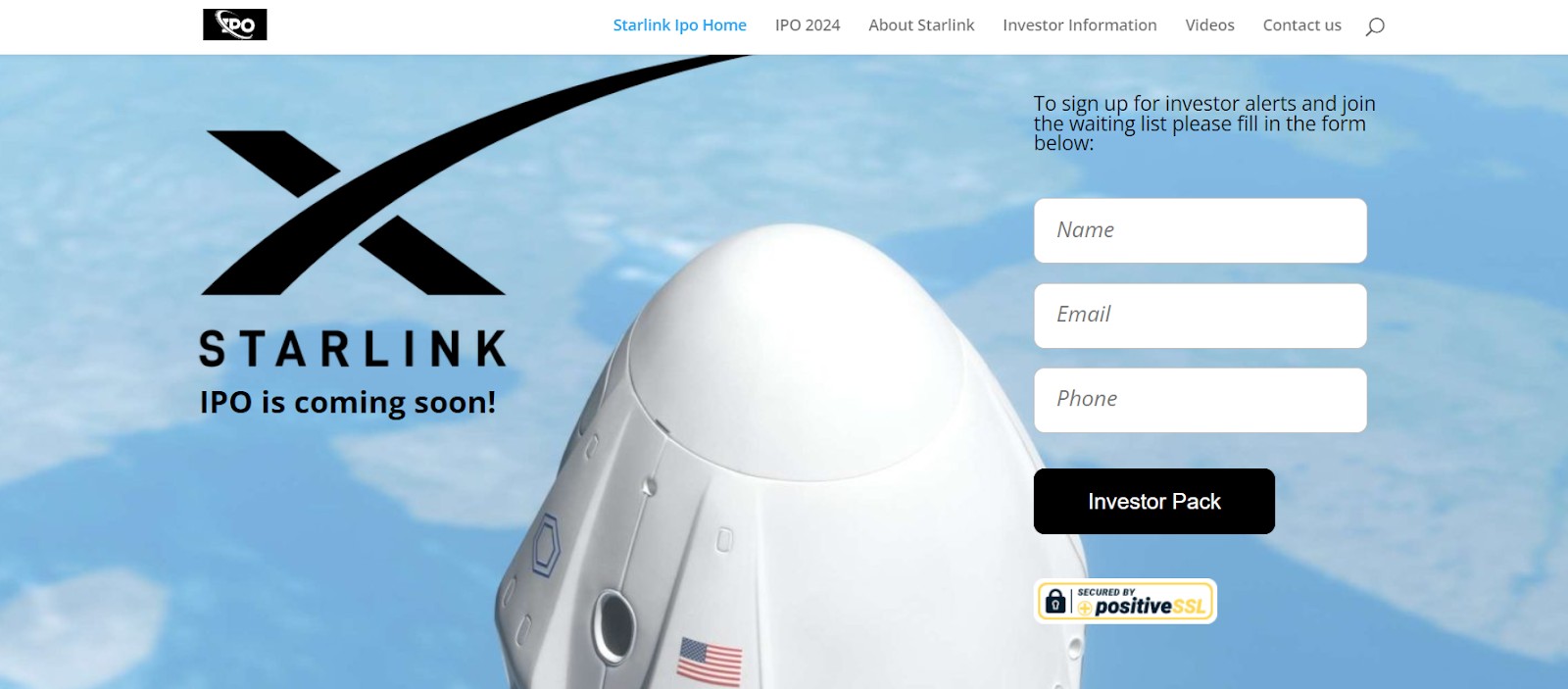
Step 1: Stay informed
Follow official announcements: Regularly check the official Starlink and SpaceX websites, along with reputable financial news sources, for updates on the IPO date and other relevant information.
Subscribe to newsletters: Consider subscribing to financial newsletters or alerts that cover IPO news, including Starlink, to receive timely updates.
Step 2: Choose a brokerage platform
Research brokers: Look for brokerage platforms that provide access to IPOs. Not all brokers offer IPO participation, so choose one that supports IPO investments.
| Access to IPOs | Demo | Account min. | Interest rate | Basic stock/ETF fee | Min. stock/ETF fee | Regulation level | Open an account | |
|---|---|---|---|---|---|---|---|---|
| Yes | Yes | 50 | 3,75 | No | No | Tier-1 | Go to broker Your capital is at risk. |
|
| Yes | Yes | 2,500 | No | $0.0025/$0,0009 | $0 | Tier-1 | Go to broker |
|
| Yes | Yes | 500 | No | $0.006 | Not specified | Tier-1 | Go to broker 81% of retail CFD accounts lose money. |
|
| Yes | Yes | 500 | 9% | $0,005 | $0.99 | Tier-1 | Go to broker Your capital is at risk. |
|
| Yes | Yes | No | 8.95% | $0 | $0 | Tier-1 | Study review |
Open an account: If you don’t already have a brokerage account, open one with a platform that meets your needs. Ensure it offers IPO access and aligns with your investment preferences.
Step 3: Understand the risks and rewards
Consult a financial advisor: Speak with a financial advisor to understand the potential risks and rewards of investing in Starlink. They can help you assess whether this investment aligns with your financial goals and risk tolerance.
Review your investment strategy: Consider how the Starlink IPO fits into your overall investment strategy. Determine how much you are willing to invest and whether you can afford the potential risks.
Step 4: Prepare for the IPO
Monitor the IPO price range: As the IPO date approaches, the price range for Starlink shares will be announced. Stay updated on this range to decide how much you want to invest. Also read our article on the best upcoming IPOs.
Set up notifications: Enable notifications on your brokerage platform to alert you when the Starlink IPO becomes available for investment.
Step 5: Place your order
Submit a buy order: On the day of the IPO, log into your brokerage account and submit a buy order for Starlink shares. You can usually place a market order (to buy at the current price) or a limit order (to buy at a specific price).
Review order details: Double-check the order details, including the number of shares and the price, before submitting.
Step 6: Monitor your investment
Track performance: After purchasing Starlink shares, monitor their performance regularly. Use your brokerage platform or financial apps to track price changes and market trends.
Adjust your strategy: Depending on how the stock performs, you may need to adjust your investment strategy. Consider whether to hold your shares for the long term or sell based on market conditions.
Step 7: Stay updated
Follow starlink's progress: Continue following Starlink’s business developments and announcements. Staying informed will help you make better decisions about holding or selling your shares in the future.
Review quarterly earnings: Keep an eye on Starlink’s quarterly earnings reports and other financial disclosures to assess the company’s performance and outlook.
Avoiding investment hype traps

The potential for growth is enormous, but so is the risk. It's easy to get caught up in the hype, especially when it's a company led by someone as visionary as Elon Musk. However, it's crucial to approach this with a clear mind and a well-thought-out strategy.
First and foremost, do your homework. Don’t just rely on the headlines or what’s trending on social media. Dive deep into the financials, the market potential, and the competitive landscape. Understanding the fundamentals of Starlink's business and its long-term vision is key to making a sound investment decision.
Next, think about how this investment fits into your broader portfolio. It’s tempting to go all-in on something that feels like a sure bet, but diversification is your best friend in the markets.
Patience is another vital quality. The stock market can be volatile, especially in the days and weeks following an IPO. Prices may surge and dip, and it can be nerve-wracking to see your investment fluctuate.
Lastly, trust your instincts but temper them with caution. After years of trading, I’ve learned that intuition can be valuable, but it should always be backed by analysis and facts. Don’t let fear of missing out drive your decisions. Instead, approach the StarlinkIPO with the same discipline and rigor that you would with any other investment.
Conclusion
The potential Starlink IPO represents a rare opportunity to invest in a revolutionary satellite internet venture at the frontier of technology and global connectivity. While excitement around Elon Musk’s vision is understandable, the true value lies in Starlink’s ability to disrupt traditional internet markets and reach underserved areas worldwide. Investors must balance their optimism with disciplined research and diversification, as the risks inherent in space-based enterprises and regulatory challenges remain substantial. Ultimately, a thoughtful investment in Starlink could catalyze not only personal financial growth but also technological progress on a planetary scale.
FAQs
What factors could influence the timing of the Starlink IPO?
How might Starlink’s IPO valuation compare to other recent tech or satellite offerings?
What steps should potential investors take before the Starlink IPO is announced?
What long-term trends could impact Starlink’s business following its IPO?
Editors' Top Picks and Insights





Related Articles
Team that worked on the article
Oleg Tkachenko is an economic analyst and risk manager having more than 14 years of experience in working with systemically important banks, investment companies, and analytical platforms. He has been a Traders Union analyst since 2018.
Dan Blystone began his trading career in 1998 as an arbitrage clerk on the floor of the Chicago Mercantile Exchange (CME). He later traded bond and Eurex futures at proprietary firms such as Altea Trading, gaining valuable experience in high-frequency trading and risk management.
Chinmay Soni is a financial analyst with more than 5 years of experience in working with stocks, Forex, derivatives, and other assets. As a founder of a boutique research firm and an active researcher, he covers various industries and fields, providing insights backed by statistical data.
An investor is an individual, who invests money in an asset with the expectation that its value would appreciate in the future. The asset can be anything, including a bond, debenture, mutual fund, equity, gold, silver, exchange-traded funds (ETFs), and real-estate property.
Risk management is a risk management model that involves controlling potential losses while maximizing profits. The main risk management tools are stop loss, take profit, calculation of position volume taking into account leverage and pip value.
CFD is a contract between an investor/trader and seller that demonstrates that the trader will need to pay the price difference between the current value of the asset and its value at the time of contract to the seller.
Index in trading is the measure of the performance of a group of stocks, which can include the assets and securities in it.
Cryptocurrency is a type of digital or virtual currency that relies on cryptography for security. Unlike traditional currencies issued by governments (fiat currencies), cryptocurrencies operate on decentralized networks, typically based on blockchain technology.

-
 Afghanistan
-
 Albania
-
 Algeria
-
 Angola
-
 Argentina
-
 Armenia
-
 Australia
-
 Austria
-
 Azerbaijan
-
 Bahamas
-
 Bahrain
-
 Bangladesh
-
 Belarus
-
 Belgium
-
 Bolivia
-
 Botswana
-
 Brazil
-
 Brunei
-
 Bulgaria
-
 Cambodia
-
 Cameroon
-
 Canada
-
 Chile
Chile
-
 China
China
-
 Colombia
-
 Congo
Congo
-
 Costa Rica
-
 Cote d'Ivoire
-
 Croatia
-
 Cuba
Cuba
-
 Cyprus
-
 Czechia
-
 DR Congo
-
 Denmark
-
 Dominican Republic
-
 Ecuador
-
 Egypt
Egypt
-
 El Salvador
-
 Estonia
-
 Eswatini
-
 Ethiopia
-
 Finland
-
 France
-
 Georgia
-
 Germany
-
 Ghana
Ghana
-
 Greece
-
 Haiti
Haiti
-
 Hong Kong
-
 Hungary
-
 India
India
-
 Indonesia
-
 Iran, Islamic republic
-
 Iraq
Iraq
-
 Ireland
-
 Israel
-
 Italy
Italy
-
 Jamaica
-
 Japan
Japan
-
 Jordan
-
 Kazakhstan
-
 Kenya
Kenya
-
 Korea
Korea
-
 Kuwait
-
 Kyrgyzstan
-
 Laos
Laos
-
 Latvia
-
 Lebanon
-
 Lesotho
-
 Libya
Libya
-
 Lithuania
-
 Luxembourg
-
 Madagascar
-
 Malaysia
-
 Malta
Malta
-
 Mauritius
-
 Mexico
-
 Moldova
-
 Mongolia
-
 Montenegro
-
 Morocco
-
 Mozambique
-
 Myanmar
-
 Namibia
-
 Nepal
Nepal
-
 Netherlands
-
 New Zealand
-
 Nigeria
-
 North Macedonia
-
 Norway
-
 Oman
Oman
-
 Pakistan
-
 Palestine
-
 Panama
-
 Papua New Guinea
-
 Paraguay
-
 Peru
Peru
-
 Philippines
-
 Poland
-
 Portugal
-
 Puerto Rico
-
 Qatar
Qatar
-
 Reunion
-
 Romania
-
 Rwanda
-
 Saudi Arabia
-
 Serbia
-
 Singapore
-
 Slovakia
-
 Slovenia
-
 Somalia
-
 South Africa
-
 Spain
Spain
-
 Sri Lanka
-
 Sweden
-
 Switzerland
-
 Syria
Syria
-
 Taiwan
-
 Tajikistan
-
 Tanzania
-
 Thailand
-
 Trinidad and Tobago
-
 Tunisia
-
 Turkey
-
 UAE
UAE
-
 Uganda
-
 Ukraine
-
 United Kingdom
-
United States
-
 Uruguay
-
 Uzbekistan
-
 Venezuela
-
 Vietnam
-
 Yemen
Yemen
-
 Zambia
-
 Zimbabwe
- Forex
- Crypto












