
Prop Trading Profit Split: How Payout Models Work


Editorial Note: While we adhere to strict Editorial Integrity, this post may contain references to products from our partners. Here's an explanation for How We Make Money. None of the data and information on this webpage constitutes investment advice according to our Disclaimer.
A prop trading profit split determines how trading profits are divided between the trader and the firm, with traders typically receiving 70% to 90%. However, the advertised percentage does not always equal the amount a trader can withdraw. Minimum trading days, drawdown limits, consistency rules, and payout cycles can all affect the final payout.
Prop trading offers access to larger trading capital without requiring traders to fund the full account themselves. But earning a profit and actually receiving it are two different things. Profit splits, payout rules, and account conditions all determine how much of the generated profit ultimately reaches the trader.
Understanding the prop firm profit split means looking beyond the headline percentage. This guide explains how profit-sharing models work, what can reduce or delay payouts, and how to compare offers based on realistic earning potential rather than advertised numbers.
Risk warning: Proprietary trading involves substantial financial risk. Using firm capital can lead to gains or losses, and failure to meet targets may result in account closure. Over 85% of prop traders do not achieve long-term profitability. Understand the risks and seek professional guidance.
What is a prop trading profit split?
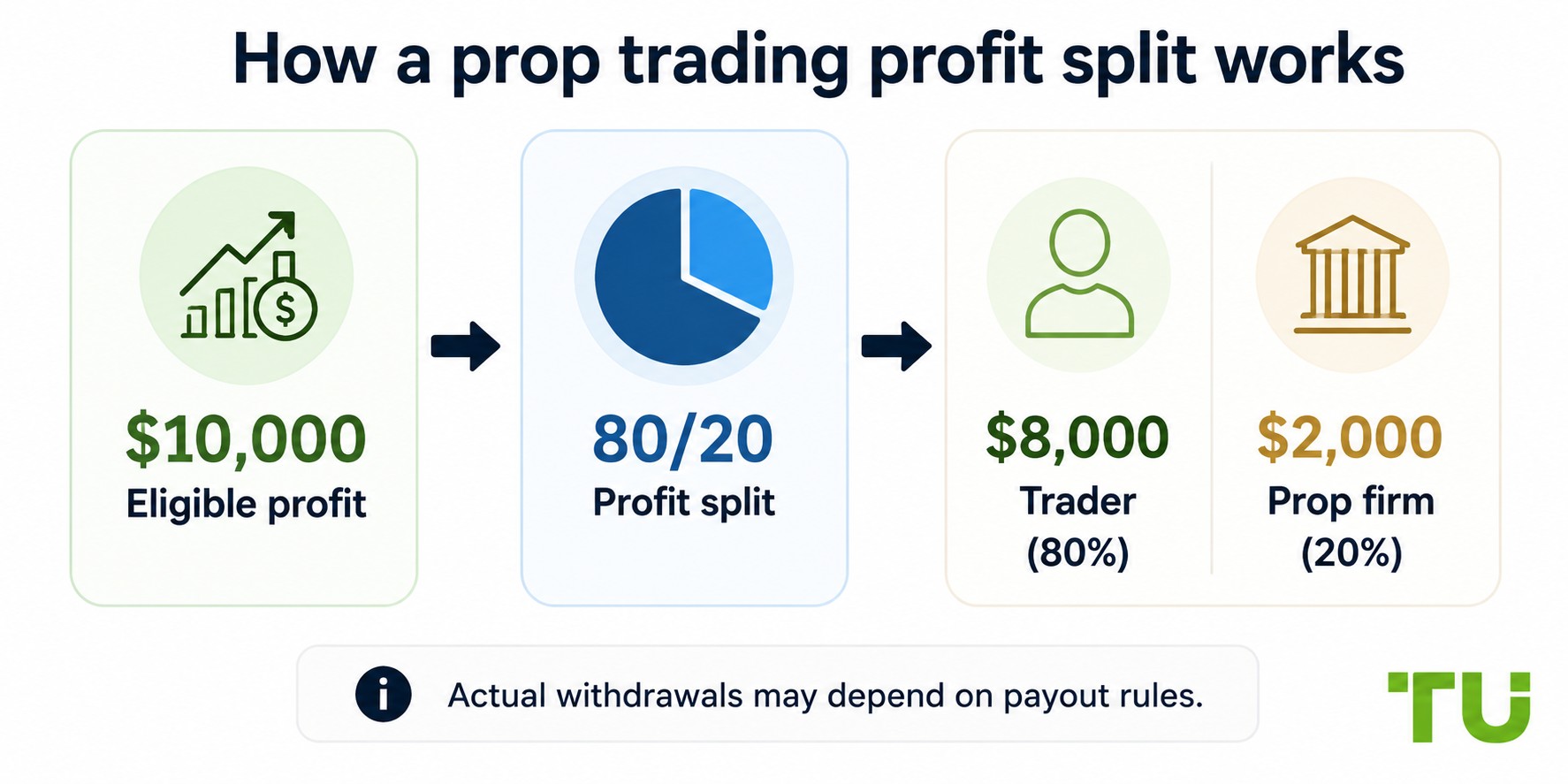
A prop trading profit split is the percentage of eligible profits shared between the trader and the prop firm. For example, with an 80/20 split, the trader receives 80% of eligible profits and the firm keeps 20%.
The percentage alone, however, does not show how much a trader can actually withdraw. A prop firm profit split works together with payout rules that determine when profits become eligible for withdrawal and whether any restrictions apply.
When comparing profit splits, traders should consider:
the percentage of profits they keep;
how eligible profit is calculated;
when the first payout becomes available;
how often payouts can be requested;
whether payout caps or other conditions apply.
This is why two firms offering the same 80% profit split can produce very different payout experiences.
How profit sharing works inside prop firms
The profit split process for traders at prop firms usually begins after the evaluation has been passed and continues through the funded stage until an eligible payout is requested.
Pass the evaluation
In evaluation-based programs, traders must first meet the required profit target without violating drawdown or other challenge rules. Profits generated during this stage are generally part of the evaluation rather than withdrawable earnings.
Start trading the funded account
After passing, the trader moves to a funded account and the agreed prop firm profit split becomes relevant. Profits generated at this stage may qualify for withdrawal once the firm's payout requirements are met.
Meet the trading and payout rules
Funded accounts remain subject to conditions such as daily and maximum drawdown limits, minimum trading days, consistency requirements, and strategy restrictions. Breaking these rules can reduce payout eligibility or result in account termination.
Request a payout
Once the trader meets the firm's requirements, eligible profits are divided according to the agreed split. For example, an 80% split on $10,000 of eligible profit would produce an $8,000 payout before any other applicable fees or deductions.
Real payout examples and scenarios
The advertised profit split provides a starting point for calculating a payout. If a trader generates $10,000 in eligible profit with an 80% split, the calculation is straightforward:
Payout = eligible profit × profit split
$10,000 × 80% = $8,000
In practice, payout caps and eligibility rules can change how much is available for withdrawal.
Scenario 1: Payout cap applies
Suppose the firm allows the trader to withdraw only 50% of eligible profits during the first payout cycle.
$10,000 × 50% = $5,000 eligible for withdrawal
$5,000 × 80% = $4,000 payout
The remaining profit stays in the account or becomes eligible for withdrawal later, depending on the firm's rules.
Scenario 2: Consistency rule is not met
Suppose a firm requires the trader's largest profitable day to account for no more than 30% of total profit. The trader earns $10,000 overall, but $6,000 comes from a single day.
That day represents 60% of total profit, so the trader does not yet satisfy the 30% consistency requirement. Depending on the firm's rules, the trader may need to continue trading and generate additional profits before becoming eligible for a payout.
The 80% profit split has not changed. What has changed is when the trader can access it.
Common prop firm profit split models
Prop firms structure profit sharing in different ways. Some offer the same percentage from the first payout, while others increase the trader's share after certain milestones or as the funded account grows. Understanding the model is therefore just as important as comparing the advertised percentage.
Fixed profit split
A fixed model gives the trader the same percentage of eligible profits for every payout. For example, an 80% split remains 80% regardless of the number of successful withdrawals or account growth.
The main advantage is predictability. Traders know their share in advance and do not need to reach additional milestones to unlock a higher percentage.
Tiered profit split
A tiered model increases the trader's share after specific milestones. A trader might begin with a 70% or 80% split and qualify for a higher percentage after several successful payouts or a defined period of consistent trading.
This model can reward long-term performance, but traders should check exactly what is required to reach each tier.
Conditional profit split
A conditional model offers a higher profit share only when certain requirements are met. These may include purchasing an account add-on, reaching a performance target, maintaining consistency, or satisfying other program conditions.
For this reason, the highest advertised prop firm profit split may not be available to every trader from the start.
Scaling profit split
Some scaling programs increase both the funded capital and the trader's profit share as performance milestones are reached. The trader may therefore gain access to a larger account and keep a greater percentage of eligible profits over time.
The potential benefit is greater long-term earning capacity, but progression usually depends on sustained performance and compliance with the firm's scaling rules.
| Model | How the split works | Main advantage | Main limitation |
|---|---|---|---|
| Fixed | Percentage remains unchanged | Predictable profit share | No automatic increase |
| Tiered | Percentage increases after defined milestones | Higher share over time | Higher tiers must be unlocked |
| Conditional | Higher split depends on additional requirements | Potentially higher percentage | Advertised maximum may not apply immediately |
| Scaling | Split may increase as the account scales | Greater long-term earning potential | Requires sustained performance |
Why a higher profit split does not always mean a better deal
A higher prop firm profit split does not necessarily result in higher or faster payouts. An 80% offer with flexible withdrawal rules may be more attractive in practice than a 90% split with strict payout conditions.
When comparing profit splits, look beyond the percentage and consider:
Payout frequency. Longer payout cycles mean waiting longer to access profits.
Minimum withdrawal requirements. Higher thresholds can delay smaller payouts.
Consistency rules. Limits on how much profit can come from a single trading day may affect payout eligibility.
Minimum trading days. Some firms require a certain number of active days before a withdrawal can be requested.
Drawdown limits. Strict limits can make it harder to maintain the account long enough to reach a payout.
Strategy restrictions. Rules on news trading, holding positions overnight, or other strategies may affect how traders generate eligible profits.
The typical profit split in prop trading firms is therefore only one part of the offer. Traders should compare the percentage they can keep with the rules that determine how easily and how often those profits can actually be withdrawn.
Common mistakes when comparing prop firm profit splits
A high advertised percentage can be attractive, but beginners often give it too much weight when comparing prop firms. Common mistakes include:
Choosing the highest percentage. A 90% split is not automatically better than an 80% split if withdrawals are harder to access.
Ignoring payout rules. Payout frequency, minimum withdrawal amounts, and eligibility requirements can matter as much as the percentage itself.
Assuming the maximum split applies immediately. Some firms reserve their highest profit share for higher tiers, scaled accounts, or optional upgrades.
Ignoring strategy compatibility. A favorable split has limited value if the firm's trading rules make it difficult to use your normal strategy.
The best comparison is therefore based on the complete payout structure, not simply the percentage displayed on the firm's website.
Top prop firms
A competitive profit split is only one part of a strong prop trading offer. Account size, evaluation costs, minimum trading days, risk limits, and other trading conditions can all affect how easily traders reach the payout stage and keep their share of the profits.
The table below compares top prop firms across key trading conditions, including the maximum profit split available.
| FundedNext | Goat Funded Trader | SabioTrade | Funded Trading Plus | Plutus Trade Base | Earn2Trade | |
|---|---|---|---|---|---|---|
|
Max. Leverage |
1:100 | 1:100 | 1:30 | 1:30 | 1:100 | 1:30 |
|
Refundable Fee |
Yes | No | Yes | No | No | No |
|
Funding Up To, $ |
4 000 000 | 2 000 000 | 1 000 000 | 200 000 | 500 000 | 400 000 |
|
Profit split up to, % |
95 | 95 | 90 | 90 | 95 | 80 |
|
Trading period |
Unlimited | Unlimited | Unlimited | Unlimited | 7 | Unlimited |
|
One-time-payment |
Yes | Yes | Yes | Yes | Yes | No |
|
TU overall score |
9.4 | 9.2 | 9.1 | 8.7 | 8.37 | 8.26 |
|
Open an account |
Go to broker Your capital is at risk. |
Go to broker Your capital is at risk.
|
Go to broker Your capital is at risk.
|
Go to broker Your capital is at risk. |
Go to broker Your capital is at risk. |
Go to broker Your capital is at risk. |
What is a virtual profit split in prop trading?
A virtual profit split refers to profit sharing on a simulated funded account. The trader operates with virtual capital, but eligible profits may still result in real payouts according to the prop firm's rules.
This differs from a model in which trades are executed with the firm's capital in the live market or where the firm hedges some trader positions externally. From the trader's perspective, however, the basic profit split can look similar. An 80% split still means the trader is entitled to 80% of eligible profits under the firm's payout rules.
The main difference is therefore how trading activity is handled by the firm, not necessarily the percentage offered to the trader. Prop firms may use:
simulated funded accounts;
live funded accounts;
hybrid models that combine simulated trading with external risk management or selective market exposure.
For traders, the more practical questions are whether the firm clearly explains its account model, how profits become eligible for withdrawal, and whether payouts are processed reliably. A virtual profit split should not automatically be considered better or worse than a live-account model based on execution type alone.
Look beyond the advertised profit split

When choosing a prop firm, I would not automatically prioritize the highest profit split. A slightly lower percentage can be a better deal if the firm offers clear payout rules, reasonable withdrawal requirements, and conditions that fit your trading strategy. What matters is how much of your profit you can consistently withdraw, not the maximum percentage shown on the website.
Before committing to a larger account or scaling with a firm, check how payouts work in practice. Review the payout schedule, minimum withdrawal requirements, consistency rules, and any conditions attached to a higher profit split. It is also worth checking the firm's payout history and whether traders regularly report problems with withdrawals.
Finally, make sure the trading rules fit the way you actually trade. A 90% profit split has little value if the drawdown limits or strategy restrictions make it difficult to reach a payout. I would choose a sustainable setup with predictable withdrawals over a higher headline percentage with conditions that are difficult to meet.
Conclusion
When evaluating prop trading profit splits, traders should look far beyond the advertised percentage and scrutinize the rules that determine real withdrawal potential. An 80 percent split with transparent, flexible payout requirements can be far more valuable than a 90 percent split tied to strict consistency rules or infrequent payout cycles. For example, some firms cap first payouts at 50 percent of earned profit or delay eligibility until certain milestones are met. The difference between headline numbers and actual, accessible earnings is critical, so the smartest traders focus on how consistently and reliably they can convert profits into real payouts.
FAQs
What factors can reduce the actual payout in a prop trading profit split?
How do tiered and scaling profit split models differ from fixed models in prop trading?
Why should traders review both the profit split percentage and payout rules before joining a prop firm?
How does the account type (virtual or live) affect profit split payouts in prop trading?
Editors' Top Picks and Insights





Related Articles
Team that worked on the article
Aleksandra Chaikina has been a contributor to Traders Union since 2021. With over 15 years of experience in copywriting and more than 5 years focused on financial content, she specializes in producing detailed guides, analytics, and comparative reviews across various sectors, including cryptocurrencies, Forex, investment strategies, and financial technologies.
Ciaran Ryan is a veteran financial journalist based in South Africa, where he covers cryptocurrency, mining, stock markets, and governance for Moneyweb. He also hosts the weekly Moneyweb Crypto Podcast.
Chinmay Soni is a financial analyst with more than 5 years of experience in working with stocks, Forex, derivatives, and other assets. As a founder of a boutique research firm and an active researcher, he covers various industries and fields, providing insights backed by statistical data.
Ethereum is a decentralized blockchain platform and cryptocurrency that was proposed by Vitalik Buterin in late 2013 and development began in early 2014. It was designed as a versatile platform for creating decentralized applications (DApps) and smart contracts.
Proprietary trading (prop trading) is a financial trading strategy where a financial firm or institution uses its own capital to trade in various financial markets, such as stocks, bonds, commodities, or derivatives, with the aim of generating profits for the company itself. Prop traders typically do not trade on behalf of clients but instead trade with the firm's money, taking on the associated risks and rewards.
Index in trading is the measure of the performance of a group of stocks, which can include the assets and securities in it.
Bitcoin is a decentralized digital cryptocurrency that was created in 2009 by an anonymous individual or group using the pseudonym Satoshi Nakamoto. It operates on a technology called blockchain, which is a distributed ledger that records all transactions across a network of computers.
Cryptocurrency is a type of digital or virtual currency that relies on cryptography for security. Unlike traditional currencies issued by governments (fiat currencies), cryptocurrencies operate on decentralized networks, typically based on blockchain technology.


