
Prop Firm Taxes: Full Guide for Funded Traders


Editorial Note: While we adhere to strict Editorial Integrity, this post may contain references to products from our partners. Here's an explanation for How We Make Money. None of the data and information on this webpage constitutes investment advice according to our Disclaimer.
Prop firm taxes often apply when payouts are treated as business or contract income rather than capital gains. Depending on the jurisdiction, traders may pay income tax and, in some cases, self-employment tax. Accurate reporting requires tracking three key elements: total payouts, deductible expenses, and payout timing. Careful tax planning, including how and when payouts are received, may help reduce the overall tax burden.
Prop trading has changed how individuals access capital, but taxation remains one of the least understood aspects of the model. Unlike retail brokerage accounts, funded accounts often follow different tax rules, affecting how payouts are classified, reported, and taxed. Understanding how prop firm taxes work can help traders stay compliant, claim eligible deductions, and avoid costly reporting mistakes.
Many funded traders underestimate how tax obligations change as payouts grow. In practice, the distinction between trading income and contract or business income often determines how prop firm tax is calculated and reported, making accurate record-keeping essential from the first payout.
Risk warning: Proprietary trading involves substantial financial risk. Using firm capital can lead to gains or losses, and failure to meet targets may result in account closure. Over 85% of prop traders do not achieve long-term profitability. Understand the risks and seek professional guidance.
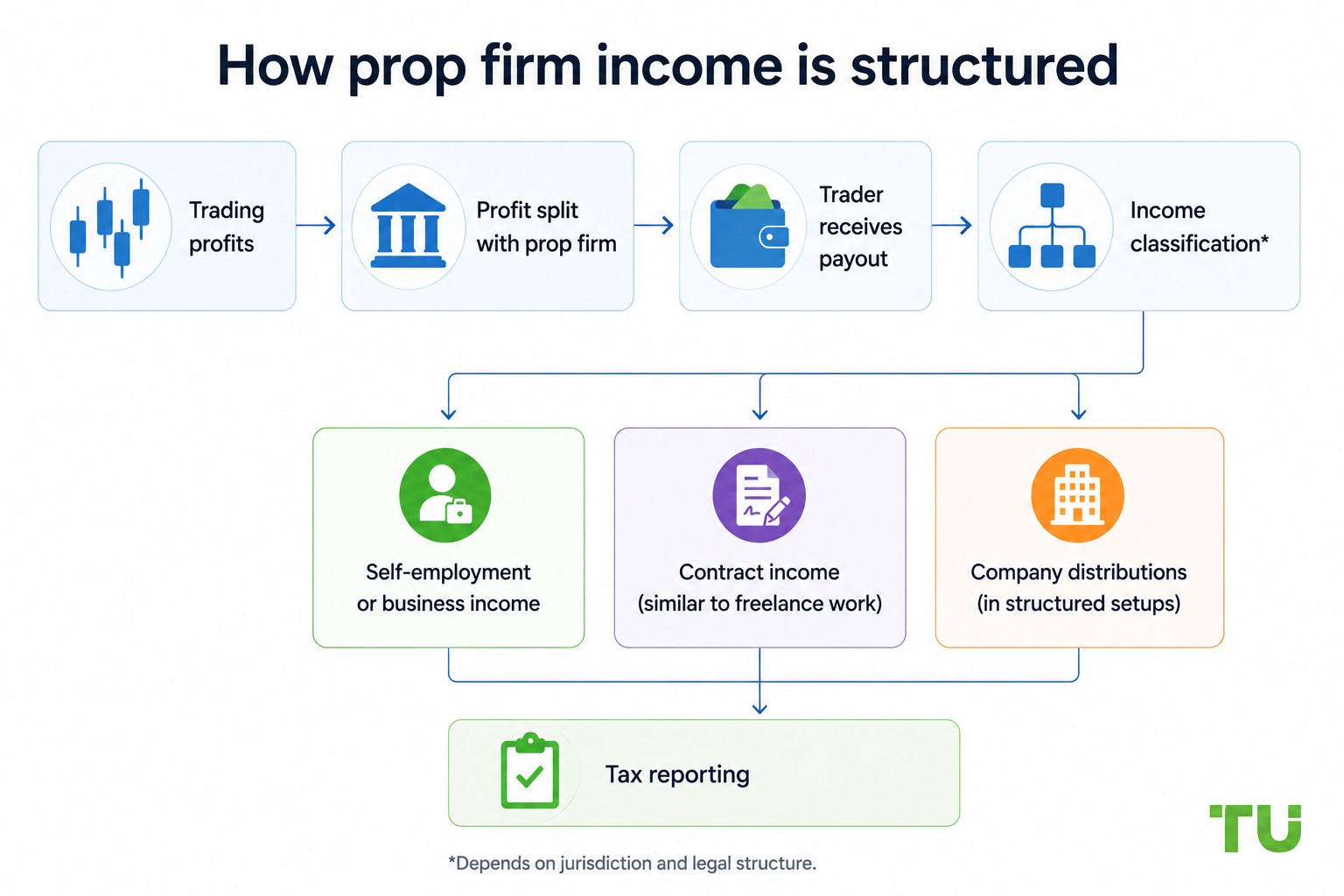
How prop firm income is structured
Unlike retail traders, funded traders do not trade their own capital. Instead, they operate under an agreement with a proprietary trading firm and receive a share of the profits they generate. In many jurisdictions, these payouts are treated as compensation for services rather than capital gains, which is why prop firm trading taxes often differ from the tax treatment of personal investment accounts.
Most prop firm payouts are generally classified as one of the following:
self-employment or business income;
contract income, similar to freelance earnings;
company distributions in certain business structures.
The exact classification depends on the legal relationship between the trader and the prop firm, as well as the tax rules in the trader's country of residence, not simply on the fact that trading activity took place.
Independent contractor income is generally taxed differently from investment income and may be subject to self-employment tax, according to IRS guidance. Similar principles apply in many jurisdictions, although the specific rules vary. Understanding this distinction is essential because prop trading taxes are often based on the legal nature of the payout rather than on market profits alone.
Key differences between prop firm and retail trading taxation
Although both involve trading financial markets, retail traders and funded traders are often taxed under different rules. The main distinction is that retail traders generate profits from trading their own capital, while funded traders receive payouts from a proprietary trading firm under a contractual agreement.
As a result, prop firm payouts are frequently treated as business, contract, or self-employment income rather than capital gains, although the exact tax treatment depends on the jurisdiction. Understanding these differences helps traders report income correctly and plan for their tax obligations more effectively.
| Factor | Retail trading | Prop firm trading |
|---|---|---|
| Capital ownership | Trader uses personal funds and bears full financial risk | Trading is conducted with firm capital under a profit-sharing agreement |
| Legal status | Individual investor or trader | Contractor, service provider, or business relationship with the firm |
| Tax classification | Usually capital gains or trading income, depending on the jurisdiction | Commonly business, contract, or self-employment income |
| Income source | Profits generated from personal trading | Payouts received from the prop firm after the profit split |
| Loss deductions | Trading losses may offset taxable gains, subject to local tax rules | Business expense deductions may apply, while trading losses are generally treated differently |
| Expense deductions | Usually limited to eligible trading-related expenses | Business-related expenses, such as software, market data, VPS services, or challenge fees, may be deductible, depending on local tax rules |
| Tax reporting (U.S. example) | Broker-issued Form 1099-B | Form 1099-NEC, other tax documents, or self-reported income, depending on the arrangement |
| Tax rates | Capital gains or ordinary income tax rates, depending on the jurisdiction | Standard income tax and, in some cases, self-employment tax |
| Payment frequency | Determined by trading activity and withdrawals | Defined by the firm's payout schedule |
| Reporting complexity | Generally supported by broker statements | Often requires traders to maintain detailed records of payouts and deductible expenses |
How prop firm payouts are taxed
The tax treatment of prop firm payouts varies across jurisdictions, but one principle is common: taxation usually depends on the trader's tax residency and legal relationship with the prop firm, rather than where the firm is located. Understanding these differences helps traders report income correctly and avoid unexpected tax liabilities.
U.S.
In the U.S., many funded traders receive payouts as independent contractors rather than investors. As a result, prop firm income may be subject to:
federal income tax;
self-employment tax (Social Security and Medicare);
state income tax, where applicable.
Self-employment tax is currently 15.3% of net earnings, U.S. Internal Revenue Service (IRS) guidance states. This illustrates how prop firm payouts are generally taxed as earned income rather than investment gains.
Europe
Across Europe, tax treatment varies by country, but several common approaches apply:
personal income tax on prop firm payouts;
business registration for traders operating on a regular basis;
value-added tax (VAT) considerations in certain situations.
In many European countries, tax liability is determined primarily by the trader's tax residency rather than the location of the prop firm.
Global perspective
Outside the U.S. and Europe, tax rules differ significantly. Some countries operate territorial tax systems, while others tax residents on their worldwide income. In practice, prop firm payouts are often taxable in the country where the trader is a tax resident, even if the prop firm is based abroad.
For traders working with international prop firms, understanding how local tax rules apply to foreign payouts is an important part of accurate reporting and long-term tax planning.
Prop firm features that matter for tax planning
Although tax obligations depend primarily on local laws and a trader's individual circumstances, certain prop firm features can influence cash flow, record-keeping, and the timing of taxable income. Profit splits, payout schedules, evaluation fees, and refund policies all play a role in how traders manage their finances throughout the year.
The comparison below highlights leading prop firms and their key trading conditions. While these features do not determine how prop firm income is taxed, they can affect payout timing, deductible business expenses, and overall tax planning.
| FundedNext | FTUK | Goat Funded Trader | SabioTrade | FTMO | Funded Trading Plus | |
|---|---|---|---|---|---|---|
|
Max. Leverage |
1:100 | 1:100 | 1:100 | 1:30 | 1:100 | 1:30 |
|
Refundable Fee |
Yes | No | No | Yes | Yes | No |
|
Funding Up To, $ |
4 000 000 | 6 400 000 | 2 000 000 | 1 000 000 | 2 000 000 | 200 000 |
|
Profit split up to, % |
95 | 90 | 95 | 90 | 90 | 90 |
|
Trading period |
Unlimited | Unlimited | Unlimited | Unlimited | Unlimited | Unlimited |
|
One-time-payment |
Yes | Yes | Yes | Yes | Yes | Yes |
|
TU overall score |
9.4 | 9.2 | 9.1 | 8.9 | 8.48 | 8.4 |
|
Open an account |
Go to broker Your capital is at risk. |
Go to broker Your capital is at risk. |
Go to broker Your capital is at risk.
|
Go to broker Your capital is at risk.
|
Go to broker Your capital is at risk. |
Go to broker Your capital is at risk. |
Common mistakes in prop firm tax handling
Even experienced traders can make costly tax mistakes when working with funded accounts. Most errors result from misunderstanding how prop firm payouts are classified or from maintaining incomplete financial records.
Misclassifying income
One of the most common mistakes is treating prop firm payouts as capital gains instead of business, contract, or self-employment income, where applicable. Since taxation is generally based on the legal relationship with the prop firm rather than the trading activity itself, incorrect classification can lead to reporting errors and potential penalties.
Overlooking deductible expenses
Many traders fail to keep records of legitimate business expenses, including:
data feeds;
VPS services;
platform subscriptions.
Depending on local tax rules, these and other trading-related costs may reduce taxable income. This is particularly relevant when determining whether prop firm evaluation fees and ongoing business expenses qualify for tax deductions.
Mixing personal and trading finances
Using the same accounts for personal and trading-related transactions can make it difficult to track payouts, business expenses, and supporting documentation. Keeping separate records throughout the year simplifies tax reporting and helps reduce the risk of errors.
Are prop firm losses deductible?
Whether prop firm losses are deductible depends on how your income is classified and on the tax rules in your country of residence. Unlike retail traders, funded traders generally do not trade their own capital, which means trading losses are not always treated in the same way as investment losses.
In many jurisdictions, deductions are more commonly available for legitimate business expenses than for losses resulting from unsuccessful trading performance. Evaluation fees, platform subscriptions, market data, VPS services, and other trading-related costs may qualify as deductible expenses, depending on local tax rules and the trader's tax status.
Because tax treatment varies between jurisdictions, traders should verify which expenses are deductible before filing a tax return and maintain clear records to support any claims.
Tax planning strategies for funded traders
Managing prop firm taxes involves more than reporting payouts. Good record-keeping and thoughtful financial planning can simplify compliance and, depending on local tax rules, reduce the overall tax burden.
Consider an appropriate business structure
For some traders, operating through a sole proprietorship, LLC, or another business entity may simplify accounting and make eligible business expenses easier to document. The most suitable structure depends on local regulations and individual circumstances.
Track income and expenses throughout the year
Maintaining accurate records of payouts, evaluation fees, software subscriptions, VPS services, and other business-related expenses makes tax reporting easier and helps support legitimate deductions where permitted.
Plan payout timing
Some traders choose to delay or accelerate withdrawals to manage taxable income across financial years. Whether this approach is beneficial depends on local tax rules and should be considered as part of a broader tax strategy.
Prop firm rules can also influence tax planning. Payout schedules, profit splits, evaluation fees, and withdrawal policies affect cash flow and the timing of taxable income, even though they do not determine how income is classified.
Record-keeping requirements
Accurate record-keeping is an essential part of managing prop firm taxes, especially for traders working with multiple firms or receiving cross-border payouts. Maintaining complete documentation helps support income reporting, deductible expenses, and the correct calculation of prop firm payout taxes.
Traders should retain records such as:
payout statements from the prop firm;
invoices or payment confirmations;
receipts for business-related expenses;
bank statements or payment records.
Maintaining complete records simplifies tax reporting and helps support deductions if requested by tax authorities. Clear documentation is particularly important when reporting income received from foreign prop firms or managing prop trading taxes across multiple income sources.
Advanced tax considerations for experienced traders
As trading activity expands, managing prop firm taxes often becomes more complex. Traders operating multiple funded accounts should track each payout separately, while those working with overseas prop firms may face additional reporting requirements or potential double taxation, depending on local tax laws and international tax treaties.
When prop trading becomes a primary source of income, tax obligations may also change. In many jurisdictions, full-time funded traders are more likely to treat prop trading taxes as part of an ongoing business activity, making structured accounting, detailed record-keeping, and professional tax advice increasingly important, particularly when managing larger or international income streams.
Treat taxes as part of your trading routine

One of the biggest mistakes funded traders make is thinking about taxes only when it is time to file a return. A better approach is to treat taxes as part of your regular trading routine. Setting aside a fixed percentage of every payout for future tax obligations helps avoid cash flow problems and makes it easier to meet payment deadlines, even when trading results vary throughout the year.
Good record-keeping is equally important. Save payout confirmations, invoices, receipts, and bank records as you go instead of trying to reconstruct them months later. This not only simplifies tax reporting but also helps support legitimate business expense deductions if additional documentation is ever required.
As your trading income grows, review your tax position regularly rather than relying on the same approach every year. Changes in income, trading activity, or business structure can affect how prop firm taxes apply, making periodic consultation with a qualified tax professional a practical investment in your long-term trading business.
Conclusion
The key to successful tax management for prop firm traders lies in understanding that most payouts are treated as business or self-employment income rather than capital gains. Accurate record-keeping of payouts and deductible expenses, such as evaluation fees and software subscriptions, is essential to minimize tax liabilities and remain compliant. For example, tracking every payout from different firms or maintaining receipts for business-related services can make a significant difference during tax season. Ultimately, treating tax planning as an ongoing part of your trading routine, rather than a year-end afterthought, empowers traders to avoid costly mistakes and stay ahead in their financial journey.
FAQs
What documentation should funded traders keep to support their prop firm tax filings?
How do payout schedules from prop firms affect taxable income reporting?
Are evaluation fees and other trading-related expenses always deductible for prop firm traders?
What challenges do traders face when managing prop firm taxes across multiple jurisdictions?
Editors' Top Picks and Insights






Related Articles
Team that worked on the article
Aleksandra Chaikina has been a contributor to Traders Union since 2021. With over 15 years of experience in copywriting and more than 5 years focused on financial content, she specializes in producing detailed guides, analytics, and comparative reviews across various sectors, including cryptocurrencies, Forex, investment strategies, and financial technologies.
Ciaran Ryan is a veteran financial journalist based in South Africa, where he covers cryptocurrency, mining, stock markets, and governance for Moneyweb. He also hosts the weekly Moneyweb Crypto Podcast.
Chinmay Soni is a financial analyst with more than 5 years of experience in working with stocks, Forex, derivatives, and other assets. As a founder of a boutique research firm and an active researcher, he covers various industries and fields, providing insights backed by statistical data.
Index in trading is the measure of the performance of a group of stocks, which can include the assets and securities in it.
Proprietary trading (prop trading) is a financial trading strategy where a financial firm or institution uses its own capital to trade in various financial markets, such as stocks, bonds, commodities, or derivatives, with the aim of generating profits for the company itself. Prop traders typically do not trade on behalf of clients but instead trade with the firm's money, taking on the associated risks and rewards.
An investor is an individual, who invests money in an asset with the expectation that its value would appreciate in the future. The asset can be anything, including a bond, debenture, mutual fund, equity, gold, silver, exchange-traded funds (ETFs), and real-estate property.
Cryptocurrency is a type of digital or virtual currency that relies on cryptography for security. Unlike traditional currencies issued by governments (fiat currencies), cryptocurrencies operate on decentralized networks, typically based on blockchain technology.
Forex leverage is a tool enabling traders to control larger positions with a relatively small amount of capital, amplifying potential profits and losses based on the chosen leverage ratio.


