
Forwardly Review 2026


Editorial Note: While we adhere to strict Editorial Integrity, this post may contain references to products from our partners. Here's an explanation for How We Make Money. None of the data and information on this webpage constitutes investment advice according to our Disclaimer.
Forwardly is a fintech payment platform that enables businesses to send and receive payments in real time while managing cash flow from a single dashboard. It supports instant bank transfers and ACH payments and integrates with accounting tools such as QuickBooks, Xero, and Zoho Books, helping companies automate accounts payable and receivable processes.
Managing vendor payments and collecting money from clients used to mean juggling spreadsheets, email chains, and multiple logins. Business finance teams are now moving toward dedicated payment automation tools that handle invoices, approvals, and transfers in one place.
Forwardly is one platform built for exactly this. In this review, we look at how the platform works, what it costs, and whether it is worth using for your business. We cover features, user ratings, integrations, pricing, and real limitations so you can make an informed decision.
What is Forwardly?
Many businesses first encounter the platform when researching automated accounts payable solutions. So what is Forwardly, exactly?
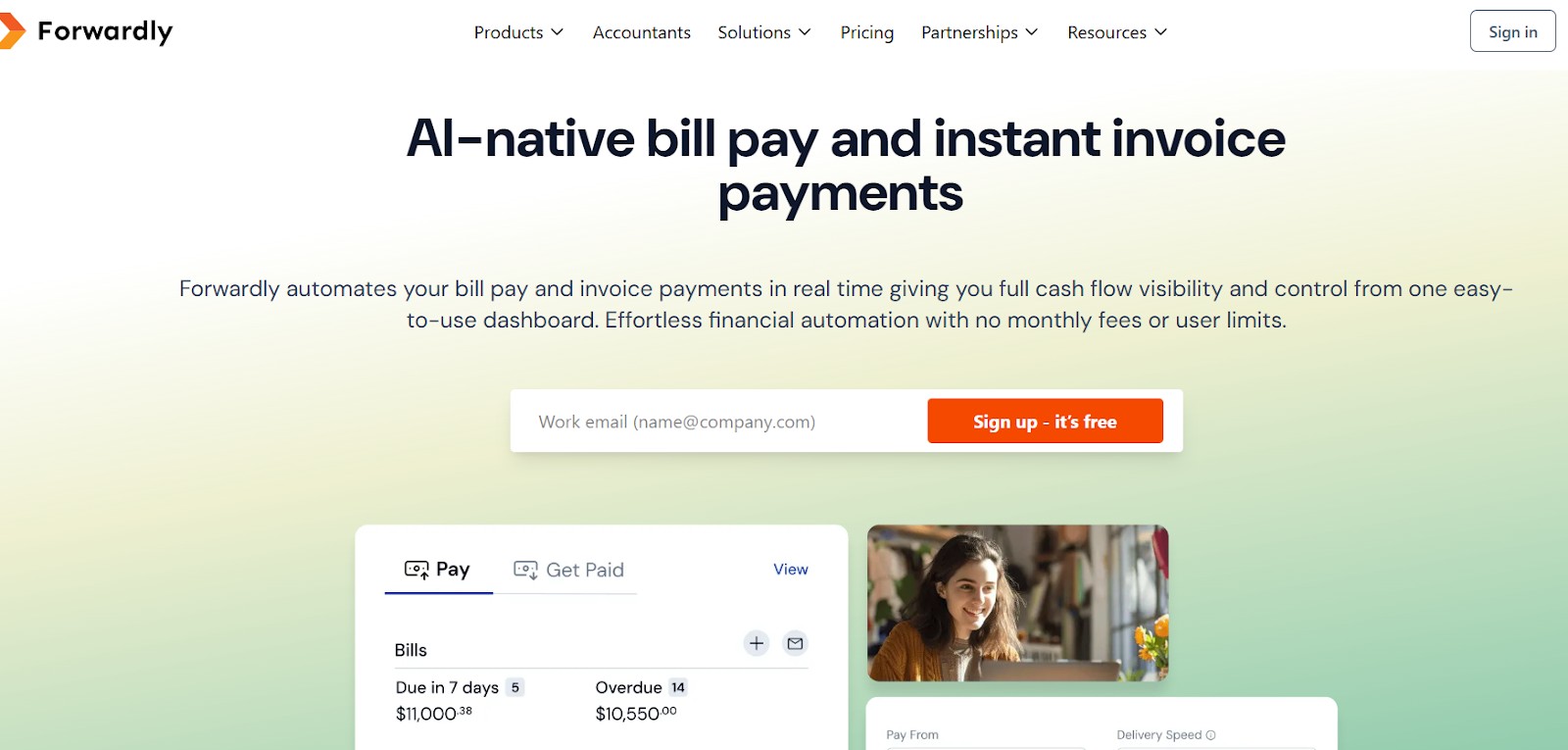
Forwardly is a business payments platform designed to automate accounts payable, accounts receivable, and invoice workflows. It is not a full accounting system. Instead, it connects to your existing accounting software and handles the operational side of payments, from invoice capture to final settlement.
The platform uses AI to extract invoice data, route approvals, and execute payments in roughly 60 seconds. According to the official Forwardly website, users save more than 70 hours of manual financial work each month.
The platform mainly targets:
small and mid-sized businesses looking to reduce manual payment work;
accounting firms managing payments across multiple clients;
finance teams that need real-time payment execution without switching tools.
Key features of the Forwardly app
The Forwardly app focuses on operational finance rather than broad accounting tools. Every feature is built around reducing the manual work involved in sending and receiving business payments.
Here is what the platform includes:
Accounts payable automation. Upload invoices, route them through approval chains, and complete vendor payments without switching between tools.
Accounts receivable support. Send invoice reminders and digital payment links to collect customer payments faster.
Real-time payment execution. Payments can be processed in roughly 60 seconds using instant bank transfers, same-day ACH, or next-day ACH.
AI-powered invoice capture. Artificial intelligence extracts invoice data automatically and populates transaction fields, reducing manual entry errors.
Approval workflows. Define who approves which payments and at what thresholds, so every transaction has a clearly responsible person before it moves.
Central dashboard. One view shows upcoming payments, outstanding invoices, completed transactions, and cash flow activity across the business.
Multi-entity management. Accounting firms and businesses with multiple entities can manage all payment workflows from a single login.
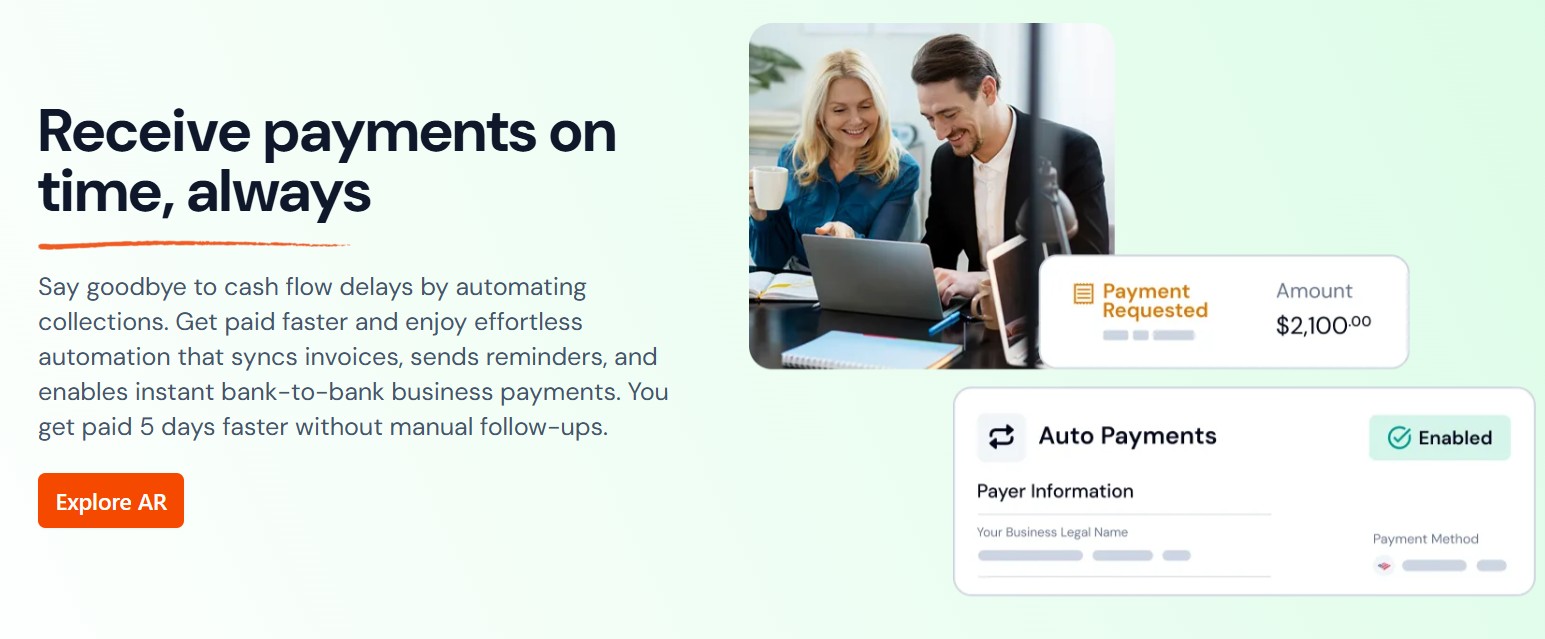
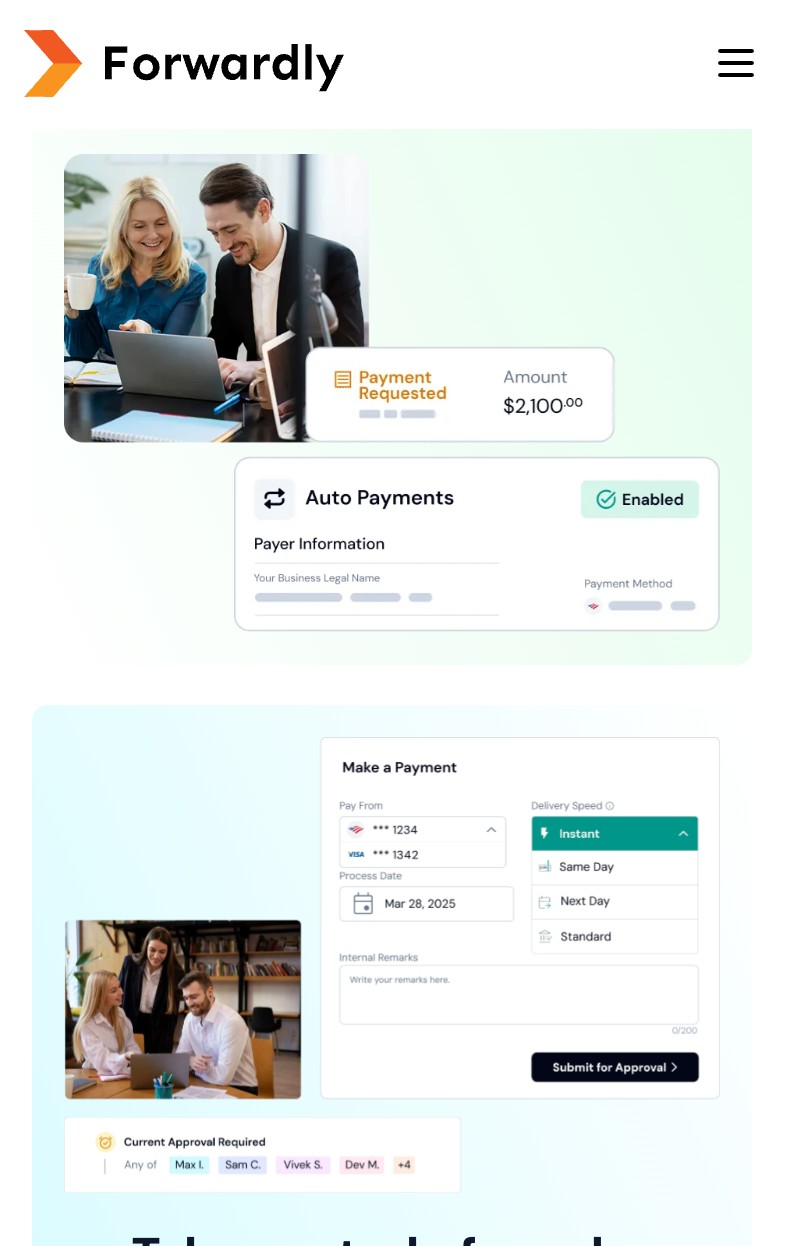
Forwardly app and user interface
A finance tool is only useful if the team actually wants to use it. The Forwardly app is built around a clean, simplified dashboard that keeps payments and invoices front and center, without the clutter of full accounting software.
From the main interface, users can:
upload and capture invoices;
schedule or trigger instant payments;
route transactions through approval steps;
track payment status in real time.
Forwardly integrations with accounting software
Accounting compatibility is one of the first things finance teams check when evaluating a payments tool. Forwardly integrations focus on the accounting platforms that small and mid-sized businesses already use most.
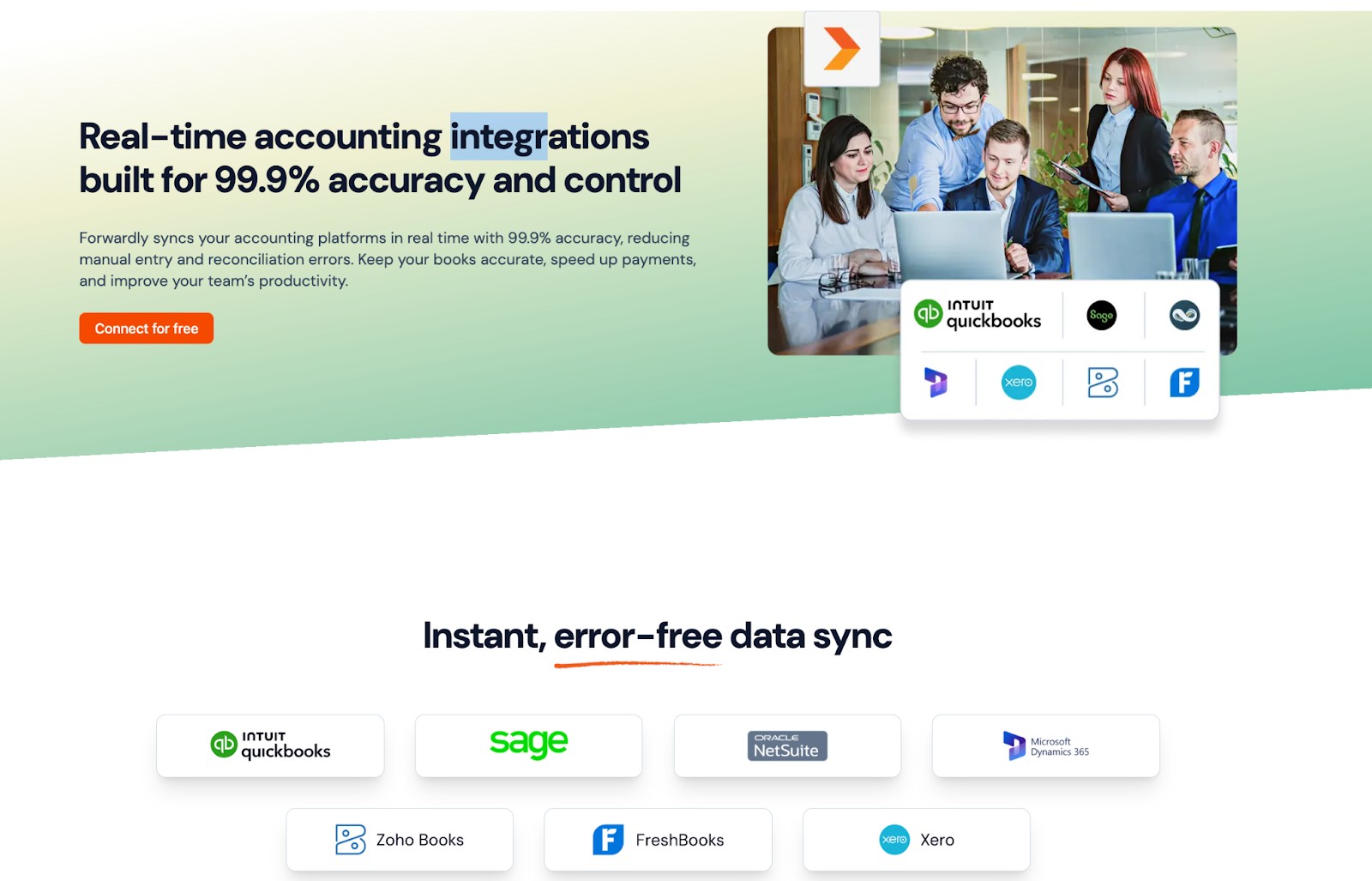
What sets Forwardly apart here is its four-way sync. Changes made in the Forwardly payments platform reflect immediately in the connected accounting system, and vice versa. This eliminates double entry and keeps records consistent across both tools without any manual reconciliation.
Forwardly integrates with several accounting and ERP systems including QuickBooks Online, Xero, Zoho Books, FreshBooks, Oracle NetSuite, Sage Intacct, and Microsoft Dynamics 365. While the platform supports these native integrations, businesses needing highly customized workflows may still need to confirm API or developer access directly with the provider.
Forwardly pricing and transaction fees
Forwardly does not charge a monthly subscription fee. Standard bank payments are typically free up to five transactions, while fees mainly apply to instant bank transfers and credit card payments. There is no limit on user accounts, and businesses can manage multiple entities from one dashboard at no extra cost.
| Method | Payment type and speed | Cost |
|---|---|---|
| Bank account (ACH) | Standard ACH (3-5 business days) | $0.50 per payment. Five free monthly |
| Bank account (ACH) | Next-day ACH | 1% fee (min $1, max $10) |
| Bank account (ACH) | Same-day ACH | 1% fee (min $1, max $20) |
| Bank account (ACH) | Instant bank transfer (~60 seconds) | 1% fee (min $1, max $30) |
| Card payment | Card settlement (2-3 business days) | Free or 2.99% + $0.25 per transaction |
| Method | Payment type and speed | Cost |
|---|---|---|
| Bank account (ACH) | Standard ACH (3-5 business days) | $0.50 per payment. Five free monthly |
| Bank account (ACH) | Next-day ACH | 1% fee (min $1, max $10) |
| Bank account (ACH) | Same-day ACH | 1% fee (min $1, max $20) |
| Bank account (ACH) | Instant bank transfer (~60 seconds) | 1% fee (min $1, max $30) |
| Card payment | Card settlement (2-3 business days) | Free or 2.99% + $0.25 per transaction |
Note that full pricing details are not always listed publicly. Some fee structures are confirmed during onboarding. When researching costs, contact Forwardly directly to get a complete breakdown for your payment volume.
Security and compliance
Handling business payments means trusting a platform with sensitive financial data. Forwardly is SOC 2 Type 2 certified, which means an independent auditor has verified that the platform meets established standards for security, availability, and data confidentiality.
Beyond certification, the platform applies several standard protections:
Encrypted payment processing. All transaction data is encrypted in transit and at rest.
Multi-factor authentication. Users must verify identity through more than one step before accessing the account.
Secure bank connections. Bank accounts are linked through protected integrations that do not store raw credentials.
SOC 2 Type 2 is one of the more meaningful compliance benchmarks for financial software, as it covers an extended audit period rather than a single point-in-time review. For finance teams with internal control requirements, this certification is worth confirming directly with Forwardly during onboarding.
Forwardly vs Melio: Which one fits your business
When evaluating accounts payable tools, the Forwardly vs Melio comparison comes up often. Both platforms handle vendor payments and invoice management, but they are built around different priorities.
Forwardly focuses on payment speed and workflow automation. Melio focuses on payment flexibility, particularly the ability to pay vendors with a credit card even when the vendor only accepts bank transfers. The table below covers the key differences:
| Feature | Forwardly | Melio |
|---|---|---|
| Platform focus | Payment automation and real-time execution | Flexible vendor payment methods |
| Accounts payable | Automated invoice capture, approvals, and scheduling | Manual bill entry with flexible payment options |
| Payment speed | Standard, next-day, same-day, and instant (60 seconds) | Standard bank transfers, no instant payment option |
| Real-time payments | Supported | Not available |
| Credit card payments | Available for vendor payments | Strong feature, pay any vendor by card |
| Monthly fee | None | Free basic plan, paid tiers from $25/month |
User feedback and ratings
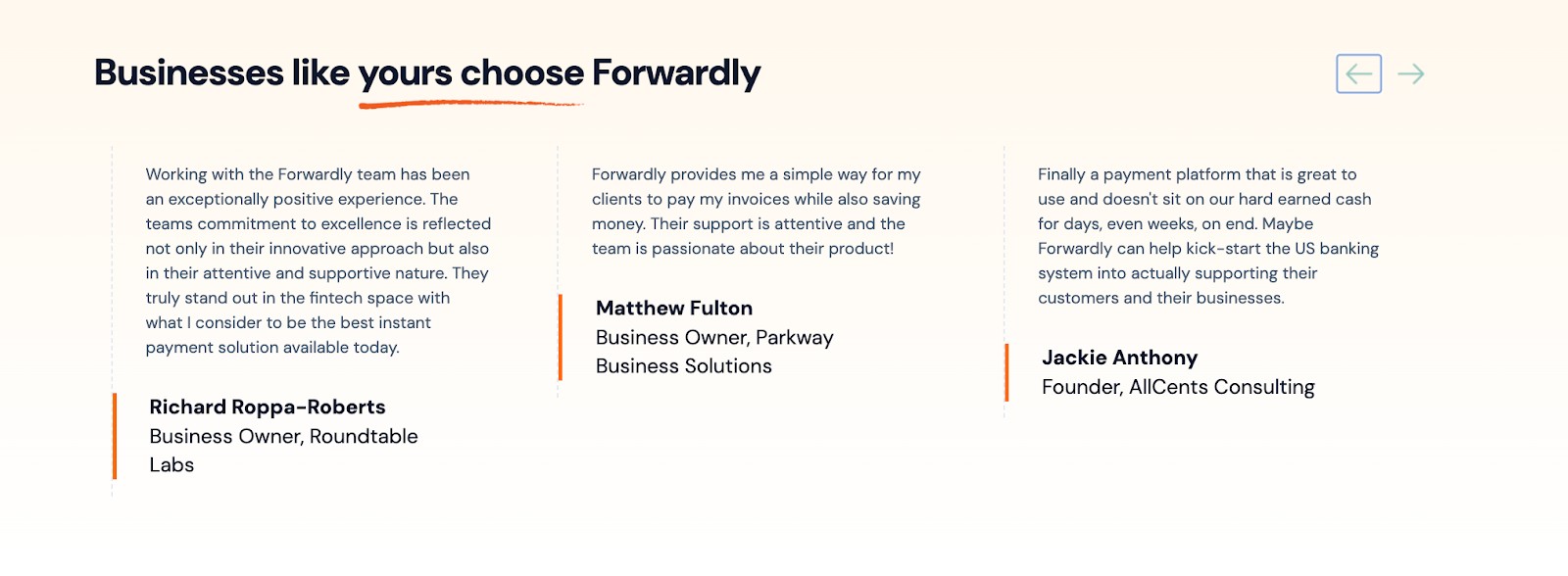
Public sentiment around Forwardly is generally positive, though the total number of reviews across platforms remains small. Most Forwardly reviews highlight operational efficiency gains and ease of setup. The platform has secured ratings of 4+ out of 5 across both Capterra and GetApp.
Users most commonly mention the following positives:
reduced time spent on manual payment processing;
simple invoice management and approval flows;
fast and responsive customer support;
smooth syncing with accounting software.
Pros and cons of Forwardly
- Pros
- Cons
Fast payment execution. Instant bank transfers settle in roughly 60 seconds, which is significantly faster than standard ACH timelines.
No monthly subscription fee. Businesses pay only for transactions processed, making costs scale naturally with usage.
Four-way accounting sync. Real-time syncing with QuickBooks, Xero, Zoho Books, and FreshBooks eliminates double entry.
Multi-entity support. Accounting firms and businesses with multiple entities can manage everything from one login.
SOC 2 Type 2 certified. Independent security audit provides a meaningful compliance benchmark for finance teams.
Small review base. Few public reviews on major platforms makes it difficult to assess long-term reliability at scale.
Limited integration marketplace. While Forwardly supports several accounting and ERP platforms, its ecosystem is still smaller than larger fintech competitors with extensive app marketplaces.
Partial pricing transparency. Full fee details are not always listed publicly and may require direct contact during onboarding.
No full accounting functionality. The platform relies entirely on a connected accounting system and cannot operate as a standalone finance tool.
Who Forwardly is best suited for
As per the U.S. Faster Payments Council, more than 80% of surveyed organizations consider faster payments a critical capability for modern financial operations. Tools like Forwardly are a direct response to that demand.
The platform is particularly well suited for:
Accounting firms. Managing payment workflows across multiple clients from one dashboard reduces switching between accounts and speeds up processing for every client.
Professional services businesses. Agencies and consultancies with recurring vendor payments benefit from automated approvals and scheduled transfers.
Growing small businesses. Teams that have outgrown manual invoice processing but are not ready for enterprise finance software find the platform a practical middle step.
Finance teams with AP backlogs. Businesses dealing with delayed vendor payments or slow approval chains can use the platform to reduce bottlenecks without replacing their accounting software.
If your goal goes beyond payment automation and you are also considering investing or trading across different markets, the choice of platform becomes just as important. Many investors prefer brokers that provide access to multiple asset classes from a single account. The table below highlights brokers that offer a wide range of assets, including Forex, stocks, crypto, and other markets, so you can explore different opportunities without switching platforms.
| Trading.com USA | Plus500 | OANDA | FOREX.com | IG Markets | |
|---|---|---|---|---|---|
|
Currency pairs |
69 | 60 | 68 | 80 | 80 |
|
Crypto |
No | Yes | Yes | Yes | Yes |
|
Stocks |
No | Yes | Yes | Yes | Yes |
|
Min. deposit, $ |
50 | 100 | No | 100 | 1 |
|
Max. leverage |
1:50 | 1:300 | 1:200 | 1:50 | 1:200 |
|
Regulation |
CFTC, NFA | CySEC, FCA, ASIC, FMA, FSCA, FSA Seychelles, EFSA, MAS, DFSA, SCB | FSC (BVI), ASIC, IIROC, FCA, CFTC, NFA | CIMA, FCA, FSA (Japan), NFA, IIROC, ASIC, CFTC | FCA, BaFin, ASIC, MAS, CySec, FINMA, BMA, CFTC, NFA |
|
TU overall score |
6.88 | 6.67 | 6.63 | 6.47 | 6.38 |
|
Open an account |
Go to broker Your capital is at risk. |
Go to broker 81% of retail CFD accounts lose money. |
Go to broker Your capital is at risk. |
Study review | Study review |
Clear ownership and a gradual rollout make automation work

Starting with payment automation does not have to mean overhauling your entire finance setup. The smarter approach is to pick a handful of regular vendors, run a few payment cycles, and watch how the approval chain behaves. When reconciliation starts happening on its own and manual corrections stop appearing, the platform is already earning its place.
The one thing worth getting right from the start is the approval structure. Keep it simple and assign clear ownership over every payment. In my experience, most delays in business payments do not come from the software. They come from unclear responsibility. Fix that first, and the rest follows naturally.
Conclusion
Forwardly stands out as a future-ready payment automation solution that streamlines business cash flow management through its real-time payment execution and seamless accounting integration. For small to midsize businesses and accounting firms, the platform eliminates manual bottlenecks by automating invoice capture and approvals, saving hours each month. Its instant bank transfers and four-way sync with tools like QuickBooks and Xero are practical features that turn tedious finance tasks into smooth, scalable workflows. Ultimately, what gives Forwardly its edge is the ability to introduce efficiency and clarity to business payments without the need for a full-scale accounting software overhaul.
FAQs
What types of businesses benefit most from using Forwardly?
How does Forwardly handle data security and financial compliance?
Which accounting platforms can Forwardly integrate with for automated syncing?
Are there any limitations or drawbacks to consider before adopting Forwardly?
Editors' Top Picks and Insights






Related Articles
Team that worked on the article
Andrey Mastykin is an experienced author, editor, and content strategist who has been with Traders Union since 2020. As an editor, he is meticulous about fact-checking and ensuring the accuracy of all information published on the Traders Union platform.
Dan Blystone began his trading career in 1998 as an arbitrage clerk on the floor of the Chicago Mercantile Exchange (CME). He later traded bond and Eurex futures at proprietary firms such as Altea Trading, gaining valuable experience in high-frequency trading and risk management.
Chinmay Soni is a financial analyst with more than 5 years of experience in working with stocks, Forex, derivatives, and other assets. As a founder of a boutique research firm and an active researcher, he covers various industries and fields, providing insights backed by statistical data.
CFD is a contract between an investor/trader and seller that demonstrates that the trader will need to pay the price difference between the current value of the asset and its value at the time of contract to the seller.
An investor is an individual, who invests money in an asset with the expectation that its value would appreciate in the future. The asset can be anything, including a bond, debenture, mutual fund, equity, gold, silver, exchange-traded funds (ETFs), and real-estate property.
Index in trading is the measure of the performance of a group of stocks, which can include the assets and securities in it.
Bitcoin is a decentralized digital cryptocurrency that was created in 2009 by an anonymous individual or group using the pseudonym Satoshi Nakamoto. It operates on a technology called blockchain, which is a distributed ledger that records all transactions across a network of computers.
Risk management is a risk management model that involves controlling potential losses while maximizing profits. The main risk management tools are stop loss, take profit, calculation of position volume taking into account leverage and pip value.

-
 Afghanistan
-
 Albania
-
 Algeria
-
 Angola
-
 Argentina
-
 Armenia
-
 Australia
-
 Austria
-
 Azerbaijan
-
 Bahamas
-
 Bahrain
-
 Bangladesh
-
 Belarus
-
 Belgium
-
 Bolivia
-
 Botswana
-
 Brazil
-
 Brunei
-
 Bulgaria
-
 Cambodia
-
 Cameroon
-
 Canada
-
 Chile
Chile
-
 China
China
-
 Colombia
-
 Congo
Congo
-
 Costa Rica
-
 Cote d'Ivoire
-
 Croatia
-
 Cuba
Cuba
-
 Cyprus
-
 Czechia
-
 DR Congo
-
 Denmark
-
 Dominican Republic
-
 Ecuador
-
 Egypt
Egypt
-
 El Salvador
-
 Estonia
-
 Eswatini
-
 Ethiopia
-
 Finland
-
 France
-
 Georgia
-
 Germany
-
 Ghana
Ghana
-
 Greece
-
 Haiti
Haiti
-
 Hong Kong
-
 Hungary
-
 India
India
-
 Indonesia
-
 Iran, Islamic republic
-
 Iraq
Iraq
-
 Ireland
-
 Israel
-
 Italy
Italy
-
 Jamaica
-
 Japan
Japan
-
 Jordan
-
 Kazakhstan
-
 Kenya
Kenya
-
 Korea
Korea
-
 Kuwait
-
 Kyrgyzstan
-
 Laos
Laos
-
 Latvia
-
 Lebanon
-
 Lesotho
-
 Libya
Libya
-
 Lithuania
-
 Luxembourg
-
 Madagascar
-
 Malaysia
-
 Malta
Malta
-
 Mauritius
-
 Mexico
-
 Moldova
-
 Mongolia
-
 Montenegro
-
 Morocco
-
 Mozambique
-
 Myanmar
-
 Namibia
-
 Nepal
Nepal
-
 Netherlands
-
 New Zealand
-
 Nigeria
-
 North Macedonia
-
 Norway
-
 Oman
Oman
-
 Pakistan
-
 Palestine
-
 Panama
-
 Papua New Guinea
-
 Paraguay
-
 Peru
Peru
-
 Philippines
-
 Poland
-
 Portugal
-
 Puerto Rico
-
 Qatar
Qatar
-
 Reunion
-
 Romania
-
 Rwanda
-
 Saudi Arabia
-
 Serbia
-
 Singapore
-
 Slovakia
-
 Slovenia
-
 Somalia
-
 South Africa
-
 Spain
Spain
-
 Sri Lanka
-
 Sweden
-
 Switzerland
-
 Syria
Syria
-
 Taiwan
-
 Tajikistan
-
 Tanzania
-
 Thailand
-
 Trinidad and Tobago
-
 Tunisia
-
 Turkey
-
 UAE
UAE
-
 Uganda
-
 Ukraine
-
 United Kingdom
-
United States
-
 Uruguay
-
 Uzbekistan
-
 Venezuela
-
 Vietnam
-
 Yemen
Yemen
-
 Zambia
-
 Zimbabwe
- Forex
- Crypto










- What is Forwardly?
- Key features of the Forwardly app
- Forwardly app and user interface
- Forwardly integrations with accounting software
- Forwardly pricing and transaction fees
- Security and compliance
- Forwardly vs Melio: Which one fits your business
- User feedback and ratings
- Pros and cons of Forwardly
- Who Forwardly is best suited for
- Expert opinion
- Conclusion
- FAQs


