
What Prop Firms Offer Payouts in Crypto?


Editorial Note: While we adhere to strict Editorial Integrity, this post may contain references to products from our partners. Here's an explanation for How We Make Money. None of the data and information on this webpage constitutes investment advice according to our Disclaimer.
Best prop firms with payouts in crypto:
- FundedNext - Beginners-friendly offers (free trial, trade copier software is allowed)
- FTUK - Trading terms suitable for high-risk trading (leverage up to 1:100, fixed drawdown level)
- Goat Funded Trader - A prop trading firm offering simulated capital of up to $400,000 for Forex and CFD trading
- SabioTrade - Best for those who want to work as non-staff traders with up to 90% of profit
- FTMO - One of the largest prop companies with favorable conditions (profit split up to 90%)
Prop firms that offer crypto payouts allow traders to withdraw profits in digital assets such as USDT or USDC through on-chain transfers or specialized payment processors. Established firms often process payout requests within one to two days, support weekly or bi-weekly withdrawal cycles, and set minimum withdrawal amounts between $50 and $100. The most efficient systems combine stablecoin support, low network fees, and flexible payout rules, making prop firm crypto payouts an increasingly popular option for traders operating across borders.
Risk warning: Proprietary trading involves substantial financial risk. Using firm capital can lead to gains or losses, and failure to meet targets may result in account closure. Over 85% of prop traders do not achieve long-term profitability. Understand the risks and seek professional guidance.
Which prop firms support crypto payouts
An increasing number of proprietary trading firms now support cryptocurrency withdrawals, but the payment method alone does not determine the quality of the payout experience. Processing times, supported networks, withdrawal conditions, and trading rules can vary significantly between providers.
When comparing which prop firms payout in crypto, traders should look beyond the availability of USDT, USDC, or Bitcoin. The overall payout process, including approval times, minimum withdrawal requirements, and supported blockchain networks, often has a greater impact on convenience than the choice of digital asset itself.
The table below compares leading prop firms that support crypto payouts, highlighting their trading conditions, funding terms, and account features to help traders evaluate the overall withdrawal experience.
| FundedNext | FTUK | Goat Funded Trader | SabioTrade | FTMO | Funded Trading Plus | |
|---|---|---|---|---|---|---|
|
Crypto |
Yes | Yes | Yes | Yes | Yes | Yes |
|
Refundable Fee |
Yes | No | No | Yes | Yes | No |
|
Funding Up To, $ |
4 000 000 | 6 400 000 | 2 000 000 | 1 000 000 | 2 000 000 | 200 000 |
|
Profit split up to, % |
95 | 90 | 95 | 90 | 90 | 90 |
|
Trading period |
Unlimited | Unlimited | Unlimited | Unlimited | Unlimited | Unlimited |
|
BTC |
Yes | No | Yes | Yes | Yes | Yes |
|
USDT |
Yes | Yes | Yes | Yes | Yes | Yes |
|
Open an account |
Go to broker Your capital is at risk. |
Go to broker Your capital is at risk. |
Go to broker Your capital is at risk.
|
Go to broker Your capital is at risk.
|
Go to broker Your capital is at risk. |
Go to broker Your capital is at risk. |






Why trust us
15+ years of independent market analysis
140+ evaluation criteria, reviewed by 50+ experts
Data-driven reviews of 200+ platforms, updated regularly
20+ industry awards & a wide network of global media partners
Learn more about our methodology and editorial policies.


Why crypto payouts matter in today’s prop trading environment
The growing use of crypto payouts reflects broader changes in global payments. According to CoinGecko, stablecoin market capitalization reached $311 billion last year, growing nearly 49% year over year. The expanding use of stablecoins has made blockchain-based transfers faster, more accessible, and less dependent on traditional banking infrastructure.
Traditional cross-border payments remain comparatively expensive and slow. IMF data shows that international transfer fees can reach up to 20% in some corridors, making stablecoin settlements an increasingly attractive alternative for traders operating across multiple jurisdictions.
As a result, more traders are looking for prop firms that payout in crypto, not only for faster access to profits but also for lower transfer costs and greater flexibility in managing trading capital.
How crypto payouts work
Not all crypto payouts follow the same process. While the end result is a transfer in digital assets, proprietary trading firms use different payment models depending on their infrastructure, compliance procedures, and supported networks.
Direct wallet transfers
This is the simplest and most transparent approach. Profits are sent directly to the trader's cryptocurrency wallet without first being converted into fiat currency. In most cases, prop firms that payout in crypto use this model to provide straightforward on-chain settlements.
Processor-based payouts
Some firms process withdrawals through third-party payment providers. Although traders still receive cryptocurrency, the transaction may include internal conversions, compliance checks, or batch processing before funds reach the wallet. This approach is commonly described as a prop firm payout crypto model.
Hybrid payout systems
Many firms support both cryptocurrency and traditional withdrawal methods, allowing traders to choose between stablecoin transfers, bank wires, or other payment options. This flexibility is common among prop firms that pay in crypto, particularly those serving traders across multiple countries.
What to compare beyond payment methods
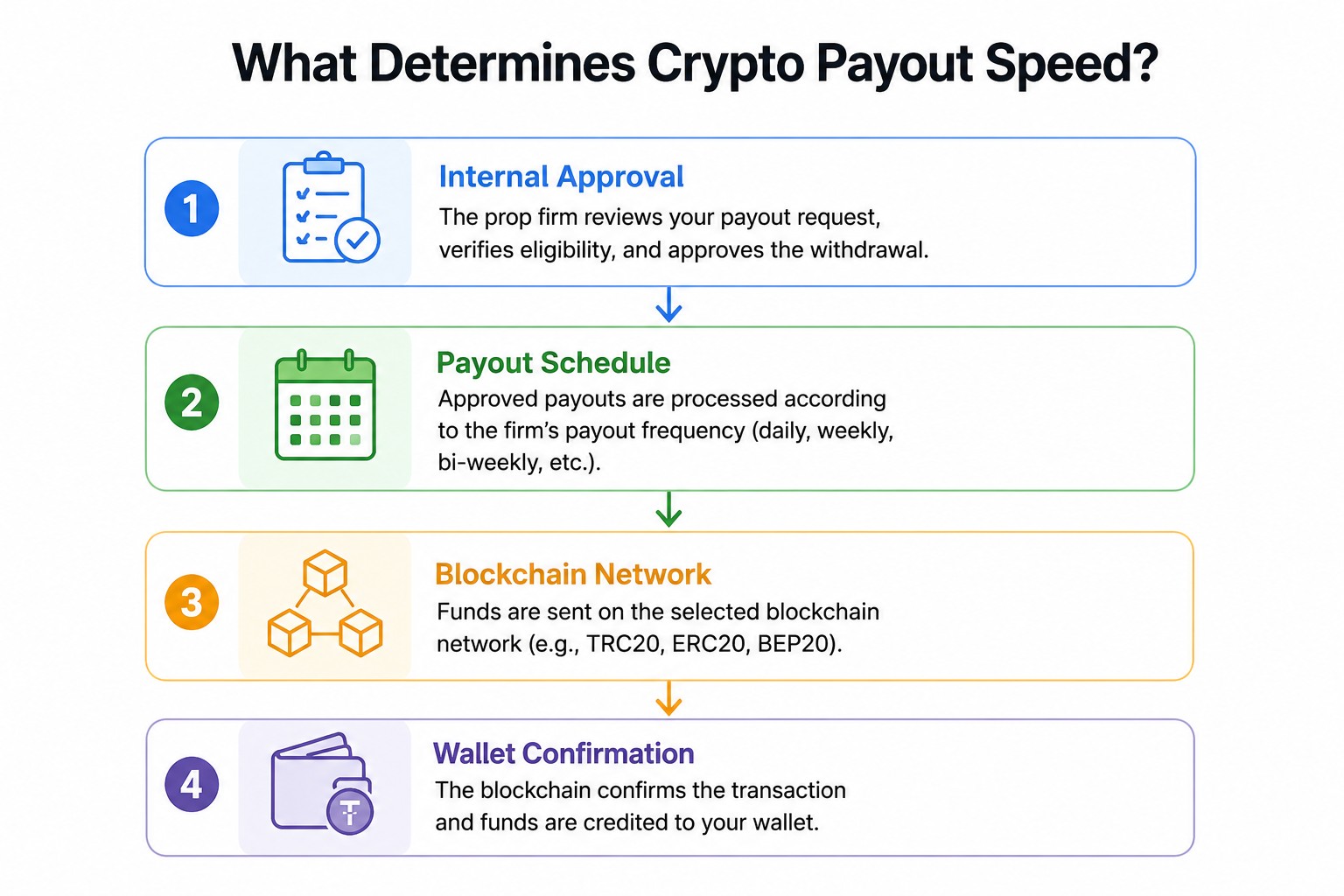
Choosing a prop firm based solely on its support for crypto withdrawals can be misleading. Two firms may both offer payouts in USDT, yet provide very different withdrawal experiences depending on their internal approval process, payout schedule, and supported blockchain networks.
When comparing prop firms that payout in crypto, traders should evaluate the operational details that determine how quickly and efficiently profits become available.
| Factor | What it controls | Why it matters |
|---|---|---|
| Approval time | Internal review before funds are released | Determines when payouts are processed |
| Payout frequency | How often withdrawals are allowed | Affects cash flow and capital availability |
| Minimum withdrawal | Lowest amount that can be withdrawn | Influences flexibility and risk management |
| Blockchain network | Transfer costs and confirmation speed | Affects the final amount received and settlement time |
| Profit split | Share of profits paid to the trader | Matters only after payout conditions have been met |
No single factor determines the quality of a payout system. The most practical solution combines transparent approval procedures, reasonable withdrawal requirements, and efficient blockchain networks rather than focusing on a single headline feature such as the profit split.
How payout rules affect real profitability
Receiving profits in cryptocurrency does not automatically make withdrawals faster or more efficient. In practice, the firm's payout rules determine when traders can access their earnings and how easily they can use that capital for future trading.
Approval times influence how quickly profits become available after a withdrawal request, while payout frequency determines how often trading capital can be recycled into new positions. Minimum withdrawal thresholds also affect flexibility, particularly for traders who prefer making regular withdrawals instead of accumulating larger balances.
The choice of blockchain network can influence both transaction costs and settlement speed, reducing or increasing the amount ultimately received. Profit splits are another important consideration, but they should be viewed alongside payout rules. A higher percentage offers limited value if withdrawals are delayed or subject to restrictive conditions.
For this reason, experienced traders typically evaluate the entire payout process rather than focusing on a single feature. Transparent rules, predictable approval times, and efficient payment infrastructure often have a greater impact on long-term profitability than headline profit splits or promotional claims.
Common pitfalls to avoid
Not all crypto payout systems offer the same level of convenience or transparency. Before choosing a funded trading program, traders should review the firm's payout process carefully rather than relying on marketing claims alone.
Common warning signs include:
Unclear support for blockchain networks or stablecoins.
Vague payout schedules or approval timelines.
Restrictive withdrawal rules and eligibility requirements.
Promotional claims focused on transfer speed rather than the overall payout process.
Even when prop firms that payout in crypto support fast blockchain transfers, internal approval procedures and trading rules ultimately determine when profits become available.
Who benefits most from crypto payouts
Crypto payouts are particularly valuable for traders who need fast, flexible access to trading profits without relying on traditional banking systems. They are especially well suited to those who:
Trade across multiple countries or jurisdictions.
Manage capital primarily in stablecoins.
Need quicker access to profits for active trading.
Have limited access to international banking services.
Regularly transfer funds between exchanges and funded trading accounts.
These advantages explain why more traders are choosing prop firms that pay in crypto, particularly where cross-border payments remain expensive, slow, or subject to additional banking restrictions.
Look beyond fast crypto payouts

Choosing a prop firm with crypto payouts involves more than confirming that it supports USDT, USDC, or Bitcoin. The most reliable providers explain how withdrawals are processed, which blockchain networks are available, and how long approvals typically take. Before purchasing a challenge, review the payout policy as carefully as the trading rules, since access to profits depends on both.
It is equally important to evaluate the payout process over time rather than judging a firm by the first withdrawal. Consistent approval times, reasonable network fees, and transparent eligibility requirements are stronger indicators of reliability than promotional claims about fast payouts. Traders who compare these factors carefully are more likely to find prop firms that payout in crypto capable of supporting long-term funded trading.
Methodology for compiling our ratings of prop firms
Traders Union applies a rigorous methodology to evaluate prop companies using over 100 quantitative and qualitative criteria. Multiple parameters are given individual scores that feed into an overall rating.
Key aspects of the assessment include:
-
Trader testimonials and reviews. Collecting and analyzing feedback from existing and past traders to understand their experiences with the firm.
-
Trading instruments. Companies are evaluated on the range of assets offered, as well as the breadth and depth of available markets.
-
Challenges and evaluation process. Analyzing the firm's challenge system, account types, evaluation criteria, and the process for granting funding.
-
Profit split. Reviewing the profit split structure and terms, scaling plans, and how the firm handles profit distributions.
-
Trading conditions. Examining leverage, execution speeds, commissions, and other trading costs associated with the firm.
-
Platform and technology. Assessing the firm's proprietary trading platform or third-party platforms it supports, including ease of use, functionality, and stability.
-
Education and support. Quality and availability of training materials, webinars, and one-on-one coaching.
Conclusion
Choosing a prop firm with crypto payouts is about much more than just the ability to withdraw in USDT, USDC, or Bitcoin—it’s the structure and transparency of the entire payout process that truly determines your trading experience. As seen with firms offering direct wallet transfers or hybrid payout systems, the speed, flexibility, and real accessibility of your profits depend on factors like approval times, minimum withdrawals, and supported blockchain networks. For example, a seemingly attractive profit split loses value if your earnings are tied up by slow approvals or unclear withdrawal rules. Ultimately, traders who prioritize clear, efficient payout policies over flashy marketing promises position themselves for greater long-term profitability in today’s evolving prop trading landscape.
FAQs
What types of cryptocurrencies are most commonly used for prop firm payouts?
How do internal approval processes impact withdrawal times for crypto payouts?
Are there specific risks associated with choosing crypto payouts over traditional methods?
What should traders look for in a prop firm's crypto payout policy to ensure reliability?
Editors' Top Picks and Insights






Related Articles
Team that worked on the article
Aleksandra Chaikina has been a contributor to Traders Union since 2021. With over 15 years of experience in copywriting and more than 5 years focused on financial content, she specializes in producing detailed guides, analytics, and comparative reviews across various sectors, including cryptocurrencies, Forex, investment strategies, and financial technologies.
Ciaran Ryan is a veteran financial journalist based in South Africa, where he covers cryptocurrency, mining, stock markets, and governance for Moneyweb. He also hosts the weekly Moneyweb Crypto Podcast.
Chinmay Soni is a financial analyst with more than 5 years of experience in working with stocks, Forex, derivatives, and other assets. As a founder of a boutique research firm and an active researcher, he covers various industries and fields, providing insights backed by statistical data.
Bitcoin is a decentralized digital cryptocurrency that was created in 2009 by an anonymous individual or group using the pseudonym Satoshi Nakamoto. It operates on a technology called blockchain, which is a distributed ledger that records all transactions across a network of computers.
Risk management is a risk management model that involves controlling potential losses while maximizing profits. The main risk management tools are stop loss, take profit, calculation of position volume taking into account leverage and pip value.
Prop trading firms come in a variety of forms, each with its own unique characteristics and strategies. These include: independent prop trading firms, bank prop trading desks, broker-dealer prop trading desks, market-making firms
Cryptocurrency is a type of digital or virtual currency that relies on cryptography for security. Unlike traditional currencies issued by governments (fiat currencies), cryptocurrencies operate on decentralized networks, typically based on blockchain technology.
Index in trading is the measure of the performance of a group of stocks, which can include the assets and securities in it.


