
Best White Label Asset Tokenization Platforms In 2026


Editorial Note: While we adhere to strict Editorial Integrity, this post may contain references to products from our partners. Here's an explanation for How We Make Money. None of the data and information on this webpage constitutes investment advice according to our Disclaimer.
The best white-label tokenization platforms in 2026:
Tokeny. EU-based platform for equity and real estate with full compliance and T-REX protocol.
Polymesh. Native blockchain for regulated securities with on-chain identity.
Blocksquare. White label real estate tokenization platform with EU legal kits and marketplace support.
DigiShares. Focused on property and green energy; includes investor portals and automation.
Securitize. U.S.-licensed for equity and funds with public chain and broker-dealer integration.
The digitalization of capital markets is no longer aspirational. In the current landscape, tokenization is reshaping how traders and institutions access, manage, and distribute assets. Central to this revolution is the rise of white-label tokenization platforms: a turnkey solution that empowers firms to create regulated digital asset ecosystems without starting from zero.
For both startups and established firms, deploying a white-label asset tokenization platform provides a competitive edge through automation, faster onboarding, and global reach. With institutional adoption accelerating and compliance frameworks maturing, the time to act is now.
What is a white-label tokenization platform?
A white-label tokenization platform allows businesses to tokenize real-world or digital assets, such as property, equity, debt, or commodities, using a ready-made infrastructure under their brand. These platforms offer modules for issuance, compliance, smart contracts, investor onboarding, and reporting.
Choosing a white-label tokenization platform solution eliminates the high capital expense (often exceeding $300,000 in 2025) of building proprietary systems. Companies instead focus on go-to-market speed and investor experience while relying on audited backend systems.
Best white-label tokenization platforms in 2026
Tokeny
Tokeny is a global platform for equity and real estate tokenization. It works on Ethereum and Polygon, two of the most trusted blockchains for scalability and security. Tokeny helps companies issue, manage, and distribute digital securities with full regulatory support.
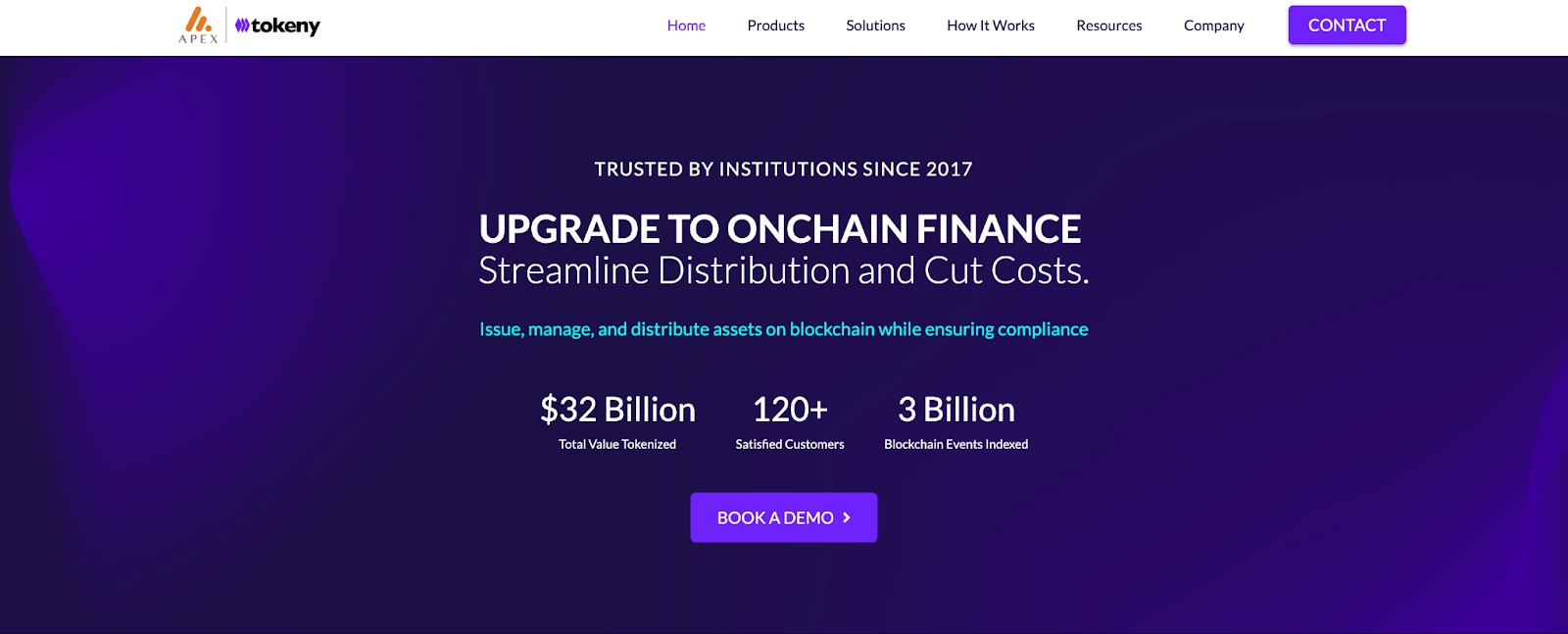
Its built-in compliance modules meet laws in the EU, US, and Asia, making it ideal for firms working across multiple regions. The platform automates investor processes through smart contracts and includes a secondary market for easier trading. Tokeny uses a license-based pricing model, providing companies with full access and long-term support.
Key features
tokenization for equity and real estate assets;
works on Ethereum and Polygon blockchains;
smart contract automation for investor processes;
global compliance across EU, US, and Asia;
built-in secondary market for trading tokens;
license-based pricing model with full platform access.
Polymesh
Polymesh is a specialized blockchain designed for security tokens. It was built from the ground up to handle regulated financial assets instead of general-purpose blockchain applications. This gives Polymesh stronger privacy, compliance, and governance tools.
It uses smart contracts to automate token operations and employs a global network of regulatory nodes to maintain transparency and trust. These nodes make sure that all transactions follow global financial laws. Polymesh uses custom pricing, allowing large institutions to design flexible cost structures. Its focus on regulation and security makes it a strong choice for institutional-grade projects.
Key features
native blockchain made for security tokens;
smart contracts for automated workflows;
global compliance through regulatory nodes;
focus on privacy and data protection;
custom pricing for enterprise users.
Blocksquare
Blocksquare is a platform focused on real estate tokenization. It allows property owners and developers to convert assets into blockchain-based tokens. The platform runs on Ethereum, combining traditional property management with digital efficiency.

Blocksquare uses smart contracts to manage ownership, revenue sharing, and investor rights. It is built for EU-focused compliance, helping firms follow European financial regulations. The subscription pricing model makes it affordable for small and medium-sized firms. Although it does not yet support a secondary market, Blocksquare remains a strong entry point for companies looking to digitize property ownership.
Key features
real estate-focused tokenization system;
Ethereum-based platform;
smart contracts for automatic revenue distribution;
EU-focused compliance framework;
subscription pricing model for affordable access.
DigiShares
DigiShares helps tokenize real estate and green energy projects, making it easier for firms to raise capital and manage investors digitally. It runs on Ethereum and uses smart contracts to automate all major functions, from token issuance to reporting.
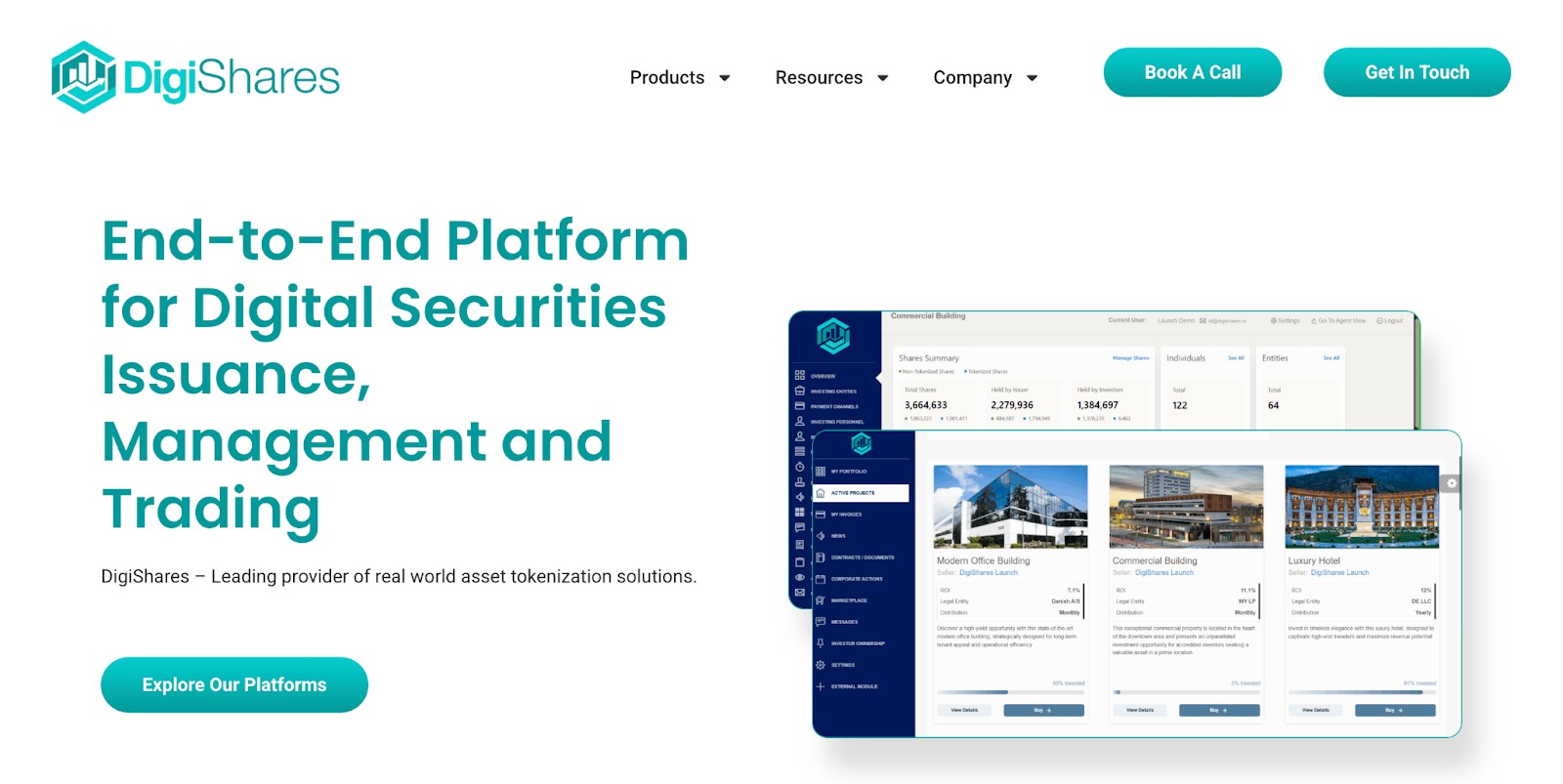
The platform offers compliance tools for both EU and US regulations and provides a secondary market where investors can trade their tokens. DigiShares also includes modules for cap table management, investor onboarding, and dividend tracking. Its license-based model gives long-term software access for continuous use and updates.
Key features
tokenization for real estate and green energy projects;
Ethereum blockchain for stability and transparency;
smart contracts for automation and compliance;
EU and US regulatory support;
secondary market access for investors;
license-based pricing for long-term users.
Securitize
Securitize is a top name in the digital securities market. It supports tokenization of equity, funds, and other regulated assets using Algorand and Avalanche blockchains. The platform connects traditional finance with digital assets, making it one of the most reliable systems for compliant token offerings.
Securitize is fully compliant with U.S. securities regulations, including RegD and RegS. It supports a secondary market where users can trade tokens freely and safely. Its commission-based model charges users per transaction, which can be cost-efficient for growing companies. Securitize also handles KYC/AML checks and investor onboarding to keep tokenized assets secure and fully regulated.
Key features
tokenization for equity and fund assets;
operates on Algorand and Avalanche blockchains;
smart contracts for secure automation;
U.S. compliance with RegD and RegS;
secondary market for digital asset trading;
commission-based pricing model;
integrated KYC and AML verification.
| Platform | Supported assets | Blockchain | Smart contracts | Compliance modules | Secondary market | Pricing model |
|---|---|---|---|---|---|---|
| Tokeny | Equity, Real Estate | Ethereum, Polygon | Yes | EU, US, Asia | Yes | License |
| Polymesh | Securities | Native blockchain | Yes | Global (Regulatory Nodes) | Yes | Custom pricing |
| Blocksquare | Real Estate | Ethereum | Yes | EU-focused | No | Subscription |
| DigiShares | Real Estate, Green Energy | Ethereum | Yes | EU, US | Yes | License |
| Securitize | Equity, Funds | Algorand, Avalanche | Yes | US RegD & RegS | Yes | Commission-based |
Benefits of white-label tokenization for businesses
Faster time-to-market
Using a white label tokenization software provider, businesses can launch a compliant offering in under 30 days; a significant edge in fast-moving markets like real estate and alternative investments.
Compliance automation
An established white-label tokenization platform development strategy includes pre-coded rules for investor KYC, AML, accreditation tiers, jurisdictional blocking, and distribution limits. This built-in compliance simplifies multi-market fundraising.
Asset class specialization
Real estate firms especially benefit from purpose-built systems. A good white-label real estate tokenization platform would support features like multi-property dashboards, cap table tokenization, income automation, and peer-to-peer investor tools, all under your own interface.
Partnering with a white label real estate tokenization company ensures legal readiness, especially when managing property law intersections across countries.
Where white-label tokenization excels
Real estate
As per Deloitte, the global market for tokenized real estate is projected to reach about US $4 trillion by 2035, up from less than US $300 billion in 2024. It also reports that tokenized private real-estate funds could grow to around US $1 trillion over that period and tokenized ownership of loans and securitisations in real estate may reach US $2.39 trillion by 2035.
Private equity and funds
As per EY, investors indicate they may allocate 7 % to 9 % of their entire portfolio to tokenized assets by around 2027. This is because tokenization of funds offers fractional ownership and greater liquidity for private-asset funds.
Commodities and infrastructure
As per EY-Parthenon, tokenization of assets, such as infrastructure projects or commodities, enhances accessibility and efficiency; the report highlights benefits including lower transaction costs, increased liquidity, and faster settlement (“T+0”).
These trends show how deploying a tailored white-label tokenization platform enhances operational speed, reduces capital barriers, and unlocks new investor segments across sectors.

Key considerations when selecting a platform
When evaluating a white label tokenization platform development partner, ask them the following questions:
Are smart contracts fully open-source and audited?
Is custody managed internally or through third parties like Fireblocks or Anchorage?
Does the platform offer multi-layer compliance and dynamic risk scoring?
Can it support multi-token (security, utility, payment) configurations?
Potential pitfalls to avoid
While white-label tokenization platforms offer speed, scalability, and compliance, there are strategic risks that can undermine their long-term value, particularly if the platform isn’t aligned with your business model or asset type.
Vendor lock-In
Some providers use proprietary smart contract frameworks and closed APIs, making it difficult to switch vendors or migrate investor data. This can lead to technical debt, increased exit costs, and long-term platform dependency. To mitigate this, choose platforms offering open-source smart contracts or modular architecture with data portability options.
Over-generalized features
Not all platforms are optimized for your asset class. Many white-label solutions provide surface-level tools that lack critical functions for niche sectors. For example:
REITs may require dividend automation, rent-flow distribution, and complex investor tiers.
Startup equity tokenization often needs vesting, lock-ups, and cap table integrations.
Using a platform without tailored modules leads to operational inefficiencies or manual workarounds - eroding the benefits of tokenization.
Lack of real liquidity
Some platforms advertise "secondary market" capability, but in reality, they offer only static peer-to-peer modules with no user base. Before committing, evaluate:
Is the platform connected to a licensed exchange?
Are there live order books and transaction histories?
Does it support integrations with DEXs or regulated ATS?
Misaligned compliance framework
Tokenization is only valuable if it’s legally enforceable. Platforms without dynamic KYC/AML updates, investor whitelisting, and jurisdictional filters may expose issuers to non-compliance or fundraising bans. Always verify that the platform supports real-time regulatory logic and updates for your target jurisdictions.
By recognizing and planning around these risks, firms can choose a white label tokenization platform solution that supports both current needs and future growth – without sacrificing flexibility or investor trust.
If you’re comparing tokenization vendors, it also helps to use a reliable exchange for funding, settlements, and on-/off-ramping. Check our picks of the best crypto exchanges in your region to open a compliant account you can pair with your chosen white-label platform.
| Crypto | Foundation year | Min. Deposit, $ | Coins Supported | Spot Taker fee, % | Spot Maker Fee, % | Alerts | Copy trading | Tier-1 regulation | TU overall score | Open an account | |
|---|---|---|---|---|---|---|---|---|---|---|---|
| Yes | 2012 | 10 | 400+ | 0.5 | 0.5 | Yes | No | Yes | 8.5 | Go to broker Your capital is at risk. |
|
| Yes | 2017 | 10 | 600+ | 0.1 | 0.08 | Yes | Yes | No | 8.46 | Go to broker Your capital is at risk. |
|
| Yes | 2011 | 10 | 399 | 0.3 | 0.2 | No | Yes | Yes | 8.08 | Go to broker Your capital is at risk.
|
|
| Yes | 2018 | No | 1000 | 0 | 0 | Yes | Yes | No | 7.8 | Go to broker Your capital is at risk. |
|
| Yes | 2016 | 1 | 400+ | 0.5 | 0.25 | Yes | No | Yes | 7.76 | Go to broker Your capital is at risk. |
Test the vendor with a weeklong, break-it trial

If you are just starting out, don’t choose a white-label tokenization platform based only on features or big promises. Ask for a short trial and build a small mock project first. Tokenize a sample asset, invite test investors from a few regions, and even try to make a compliance error on purpose. This simple exercise will reveal how well their platform handles real issues and how fast their support team reacts when something goes wrong. It’s a small effort that can save you major trouble later.
Conclusion
In summary, the best white label tokenization platforms of 2026 empower companies to seamlessly launch digital asset and real estate projects with robust compliance and scalability. Solutions like Tokeny and Polymath exemplify the maturity of these tools, offering customizable modules that cater to both regulatory requirements and market innovation. As tokenization becomes increasingly mainstream, choosing a flexible, future-proof platform is the single most important decision for project success. In this rapidly evolving landscape, adaptability and institutional-grade security are not just advantages—they are prerequisites. Ultimately, the right platform doesn't just unlock new markets; it sets the foundation for digital asset leadership in the years ahead.
FAQs
How do white label tokenization platforms handle compliance across multiple regulatory jurisdictions?
What are the main benefits of using a white label tokenization platform for real estate projects?
What features should startups prioritize when selecting a white label tokenization platform?
How can businesses assess the true liquidity options offered by a white label tokenization platform?
Editors' Top Picks and Insights






Related Articles
Team that worked on the article
Viktoras Karapetjanc is a seasoned financial trader, market analyst, and content creator with over 20 years of expertise in Forex, cryptocurrency, and stock markets. As a contributor to the Traders Union website, he provides in-depth analysis, data-driven strategies, and educational content to empower traders of all levels.
Dan Blystone began his trading career in 1998 as an arbitrage clerk on the floor of the Chicago Mercantile Exchange (CME). He later traded bond and Eurex futures at proprietary firms such as Altea Trading, gaining valuable experience in high-frequency trading and risk management.
Chinmay Soni is a financial analyst with more than 5 years of experience in working with stocks, Forex, derivatives, and other assets. As a founder of a boutique research firm and an active researcher, he covers various industries and fields, providing insights backed by statistical data.
An investor is an individual, who invests money in an asset with the expectation that its value would appreciate in the future. The asset can be anything, including a bond, debenture, mutual fund, equity, gold, silver, exchange-traded funds (ETFs), and real-estate property.
A Security Token is one of the latest exchange instruments. It is a digital analog of physical securities (stocks, bonds), running on blockchain and representing a smart contract (as a non-fungible token).
Index in trading is the measure of the performance of a group of stocks, which can include the assets and securities in it.
Risk management is a risk management model that involves controlling potential losses while maximizing profits. The main risk management tools are stop loss, take profit, calculation of position volume taking into account leverage and pip value.
Copy trading is an investing tactic where traders replicate the trading strategies of more experienced traders, automatically mirroring their trades in their own accounts to potentially achieve similar results.

-
 Afghanistan
-
 Albania
-
 Algeria
-
 Angola
-
 Argentina
-
 Armenia
-
 Australia
-
 Austria
-
 Azerbaijan
-
 Bahamas
-
 Bahrain
-
 Bangladesh
-
 Belarus
-
 Belgium
-
 Bolivia
-
 Botswana
-
 Brazil
-
 Brunei
-
 Bulgaria
-
 Cambodia
-
 Cameroon
-
 Canada
-
 Chile
Chile
-
 China
China
-
 Colombia
-
 Congo
Congo
-
 Costa Rica
-
 Cote d'Ivoire
-
 Croatia
-
 Cuba
Cuba
-
 Cyprus
-
 Czechia
-
 DR Congo
-
 Denmark
-
 Dominican Republic
-
 Ecuador
-
 Egypt
Egypt
-
 El Salvador
-
 Estonia
-
 Eswatini
-
 Ethiopia
-
 Finland
-
 France
-
 Georgia
-
 Germany
-
 Ghana
Ghana
-
 Greece
-
 Haiti
Haiti
-
 Hong Kong
-
 Hungary
-
 India
India
-
 Indonesia
-
 Iran, Islamic republic
-
 Iraq
Iraq
-
 Ireland
-
 Israel
-
 Italy
Italy
-
 Jamaica
-
 Japan
Japan
-
 Jordan
-
 Kazakhstan
-
 Kenya
Kenya
-
 Korea
Korea
-
 Kuwait
-
 Kyrgyzstan
-
 Laos
Laos
-
 Latvia
-
 Lebanon
-
 Lesotho
-
 Libya
Libya
-
 Lithuania
-
 Luxembourg
-
 Madagascar
-
 Malaysia
-
 Malta
Malta
-
 Mauritius
-
 Mexico
-
 Moldova
-
 Mongolia
-
 Montenegro
-
 Morocco
-
 Mozambique
-
 Myanmar
-
 Namibia
-
 Nepal
Nepal
-
 Netherlands
-
 New Zealand
-
 Nigeria
-
 North Macedonia
-
 Norway
-
 Oman
Oman
-
 Pakistan
-
 Palestine
-
 Panama
-
 Papua New Guinea
-
 Paraguay
-
 Peru
Peru
-
 Philippines
-
 Poland
-
 Portugal
-
 Puerto Rico
-
 Qatar
Qatar
-
 Reunion
-
 Romania
-
 Rwanda
-
 Saudi Arabia
-
 Serbia
-
 Singapore
-
 Slovakia
-
 Slovenia
-
 Somalia
-
 South Africa
-
 Spain
Spain
-
 Sri Lanka
-
 Sweden
-
 Switzerland
-
 Syria
Syria
-
 Taiwan
-
 Tajikistan
-
 Tanzania
-
 Thailand
-
 Trinidad and Tobago
-
 Tunisia
-
 Turkey
-
 UAE
UAE
-
 Uganda
-
 Ukraine
-
 United Kingdom
-
United States
-
 Uruguay
-
 Uzbekistan
-
 Venezuela
-
 Vietnam
-
 Yemen
Yemen
-
 Zambia
-
 Zimbabwe
- Forex
- Crypto












