
How to Earn on Coinbase: The Best Ways to Make Money


Editorial Note: While we adhere to strict Editorial Integrity, this post may contain references to products from our partners. Here's an explanation for How We Make Money. None of the data and information on this webpage constitutes investment advice according to our Disclaimer.
How to Earn on Coinbase:
Coinbase Earn – earn rewards by using supported crypto assets in eligible products.
Staking – earn rewards for participating in Proof of Stake blockchains.
USDC Rewards – earn rewards for holding USDC, subject to program terms.
Spot trading – earn from changes in cryptocurrency market prices.
Affiliate and referral programs – earn commissions or bonuses by referring users.
If you’re exploring how to earn on Coinbase, keep in mind that the availability of tools depends on your country of residence, account type, and the platform’s current terms. Let’s look at the main ways to earn on Coinbase, their potential returns, instructions for beginners, and financial risks.
Main ways to earn on Coinbase

Coinbase offers tools for active trading and earning rewards from digital assets. However, profitability depends on the strategy you choose, the amount of capital, and market conditions.
| Method | Source of income | Suitable for beginners? |
|---|---|---|
| Coinbase Earn | Rewards from supported crypto assets | Yes, after reviewing the terms |
| Staking | Blockchain network rewards | Yes, taking the risks into account |
| USDC Rewards | Rewards for holding USDC | Yes, if the program is available |
| Spot trading | The difference between buying and selling prices | After learning the basics |
| Affiliate and referral programs | Commissions and referral bonuses | Yes |
Coinbase Earn
Coinbase Earn is a platform offering that brings together tools for earning rewards from cryptocurrencies. Users can use supported cryptocurrencies and receive payouts according to the terms of the selected product.
Reward rates are usually expressed as APY—annual percentage yield, which accounts for the effect of compounding when applicable.
For example, at an illustrative annual yield of 4%, assets worth 1,000 USD could generate approximately 40 USD over a year. This is an illustrative calculation, not a forecast: actual rates change, and the value of cryptocurrency may fall.
Coinbase staking
Coinbase staking allows holders of supported cryptocurrencies to earn rewards for participating in the Proof of Stake mechanism. Users delegate the technical operations involved in running the blockchain to the platform, without needing to run a validator themselves.
Cryptocurrencies for which Coinbase offers staking in supported regions include Ethereum (ETH), Solana (SOL), Cardano (ADA), Polkadot (DOT), and other assets. Returns depend on the specific network, validator activity, Coinbase's terms, and applicable fees.
How to start staking on Coinbase:
Sign up for Coinbase and complete the required verification.
Buy a supported cryptocurrency or transfer it to your account.
Open the Earn section or the page for the relevant asset.
Select the staking feature, if available.
Check the estimated APY, fees, and withdrawal timeframes.
Enter the amount and confirm the staking transaction.
Once staking is active, you can track accrued rewards in your account. Consider an example with ETH at an illustrative annual yield of 3%.
| ETH value | Over 30 days | Over one year |
|---|---|---|
| 500 USD | 1.23 USD | 15 USD |
| 1,000 USD | 2.47 USD | 30 USD |
| 5,000 USD | 12.33 USD | 150 USD |
Calculations are approximate and exclude compounding, fees, and changes in ETH market value. The 3% rate is used for illustrative purposes only.
The main risk is that rewards are paid in cryptocurrency. Even with a positive staking yield, a drop in the price of ETH can result in a loss in dollar terms. In addition, unstaking assets can take anywhere from a few minutes to several weeks. In some cases, Coinbase offers expedited withdrawals for an additional fee.
USDC rewards
Another way to earn is through the USDC Rewards program. It allows eligible users to earn rewards for holding the USDC stablecoin on Coinbase.
USDC is designed to maintain a value of around 1 USD, so its price volatility is usually lower than that of BTC or ETH. However, it is not a bank deposit or a guarantee that your capital will be preserved.
How to earn USDC rewards:
Check whether USDC Rewards is available in your region and for your account.
Buy or transfer USDC to Coinbase.
Open the USDC page and review the reward terms.
Make sure the program is activated and your balance meets the requirements.
Track your rewards and any changes to the APY.
For eligible accounts, rewards are calculated daily and are usually paid weekly. For example, at an illustrative annual rate of 3%, holding 2,000 USDC for 30 days would earn around 4.93 USDC, excluding any changes to the program terms. In some countries, earning rewards requires a paid Coinbase One subscription. You should factor in its cost when calculating net returns.
Regional restrictions: USDC Rewards is unavailable to users in the European Economic Area (EEA) due to regulatory changes. Terms also vary in other regions.
Spot trading and Coinbase Advanced
Spot trading involves buying cryptocurrency and then selling it at a higher price. If the price falls, the trader may incur a loss.
For example, a user buys 1,000 USD worth of BTC. If its value rises by 8%, the position will be worth approximately 1,080 USD. The gross profit will be 80 USD, excluding trading fees and the spread. For more detailed order management, Coinbase offers the Coinbase Advanced interface.
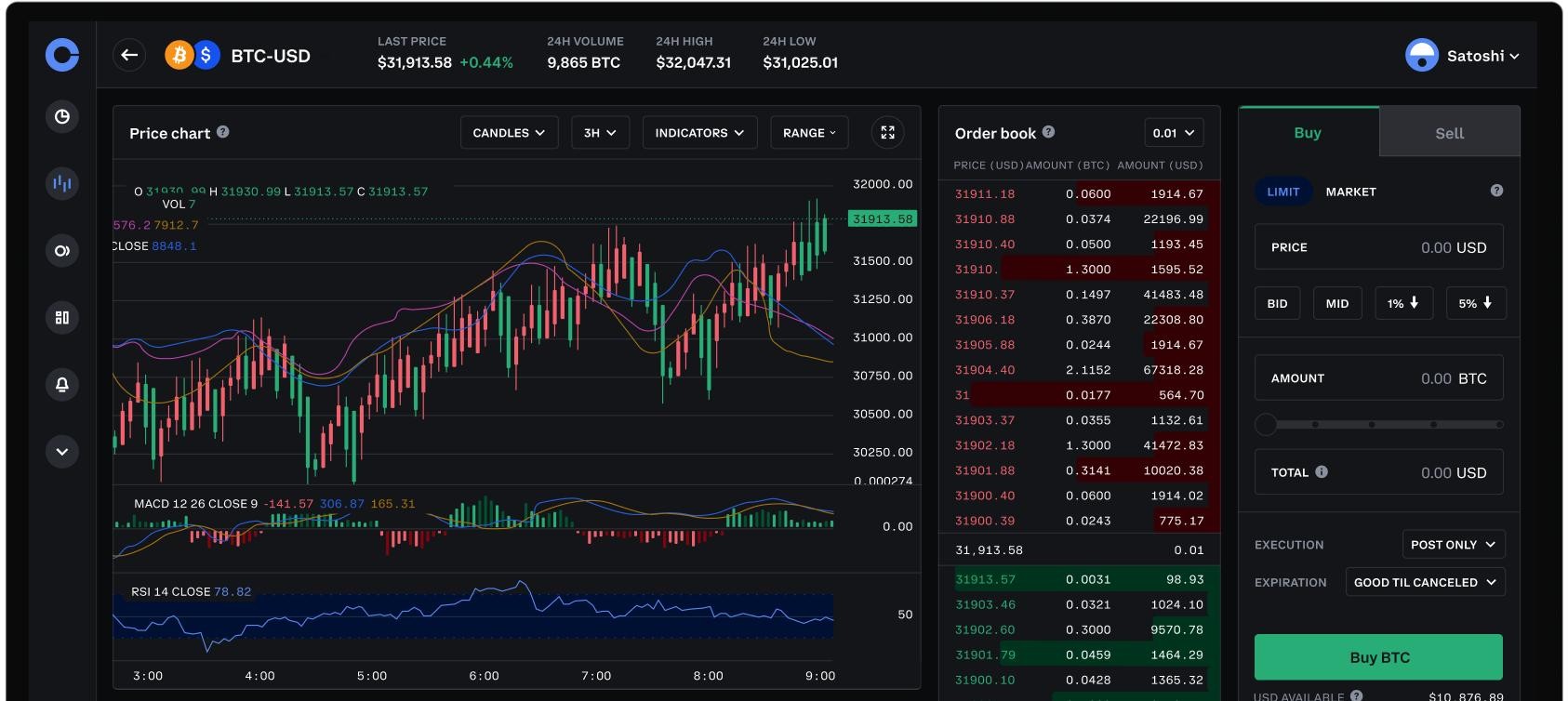
How to start trading on Coinbase:
Create an account and set up two-factor authentication.
Fund your balance using an available method.
Open Coinbase Advanced.
Choose a trading pair, such as BTC/USD.
Set the trade amount and order type.
Check the fees and confirm your purchase.
Monitor your position and follow your risk limits.
Coinbase Advanced supports market and limit orders. Fees depend on trading volume, product, and whether the order is a maker or taker order. Spot trading without everage does not expose a normally fully funded position to liquidation due to insufficient margin. However, the value of the cryptocurrency you buy can fall significantly.
Coinbase Affiliate and Referral Programs
If you’re looking for ways to earn on Coinbase without actively trading, you could consider referring new customers. However, the Coinbase affiliate program and the regular referral program are different.
The Coinbase Affiliate Program is primarily aimed at website owners, finance bloggers, niche media outlets, and other platforms with an audience. Affiliates receive unique links to promote Coinbase. Rewards depend on the qualifying actions taken by referred users.
On its official program page, Coinbase lists a commission of 50% of referrals’ trading fees for the first three months. Terms may differ in certain jurisdictions, including the EU/EEA.
How to become a Coinbase affiliate:
Visit the official Coinbase affiliate program page.
Apply to join the program.
Wait for your application to be reviewed and approved.
Get access to affiliate links and analytics.
Place the links in your own informational content.
Track your referrals and earned commissions.
Coinbase’s referral program lets you invite new users via a personalized link or code under the current offers.
Terms vary by region and offer. For example, some offers provide a reward when an invited user makes their first qualifying cryptocurrency purchase. Certain offers may have restrictions on the purchase method, registration period, and minimum transaction amount.
To use the program, check whether a referral offer is available in your account, review its terms, and share your link. Unlike the affiliate program, referral promotions generally don’t require you to run a professional content platform. However, they don’t provide a steady income, and some rewards are offered as discounts or bonuses rather than withdrawable cash.
How to Earn on Coinbase as a Beginner: Where to Start
Beginners should first decide whether their goal is to earn rewards on cryptocurrency they already own or to trade actively.
Recommended steps:
Check Coinbase availability. Make sure the services you need are supported in your country.
Secure your account. Enable two-factor authentication and use only official apps.
Review the fees. Compare the costs of buying, selling, and transferring assets.
Choose a tool. To explore passive income, consider Earn; for self-directed trading, use the spot market.
Start with a small amount. Don't use borrowed funds or money needed for everyday expenses.
Track your results. Take into account exchange rate changes, fees, and rewards earned.
If you're interested in earning on Coinbase without investing, look for available referral offers. But don't count on guaranteed bonuses or a steady income without capital.
How much can you earn on Coinbase
Your earnings depend on the tool you use.
| Method | Example return | Main limitation |
|---|---|---|
| Staking | 30 USD per year on 1,000 USD at an illustrative 3% | Changes in APY and exchange rates |
| USDC Rewards | 40 USD per year on 1,000 USDC at an illustrative 4% | Program availability |
| Spot trading | 50 USD if the position rises by 5% | Potential for loss |
| Affiliate program | Depends on referral fees | Need to attract customers |
| Referral promotions | Depends on the current offer | Promotion restrictions |
The platform does not guarantee a fixed income of 100 or 1,000 USD per month. To achieve this, you need to assess the capital required, the likelihood of losses, and the sustainability of your chosen strategy.
Risks of earning on Coinbase
Any way of earning income through a crypto platform involves financial and operational risks.
| Risk | Possible consequences |
|---|---|
| Cryptocurrency volatility | Decrease in capital value |
| Changes in APY | Lower-than-expected rewards |
| Staking restrictions | Delayed asset withdrawals |
| Stablecoin risks | USDC deviating from its target value |
| Smart contracts | Losses from using DeFi lending |
| Trading fees | Lower net profit |
| Regional restrictions | Some products may be unavailable |
| Phishing and scams | Loss of access to your account and assets |
Pay special attention to the terms of Earn. Staking, holding USDC, and lending have different sources of rewards and risks. They should not be treated as equivalent to a bank deposit.
Focus on net financial returns

When choosing how to earn on Coinbase, I recommend focusing on net financial returns rather than just the APY listed by the platform.
For example, staking ETH at an annual yield of 3% does not mean that an investor will necessarily earn 3% in dollar terms. If the price of ETH falls by 15% over the same period, the rewards earned will not offset the market loss.
When using USDC Rewards, you should factor in the terms of a Coinbase One subscription if one is required. Small rewards may not be worthwhile after paying for the subscription.
For active trading, I would calculate fees, the spread, and slippage separately. This approach helps you compare instruments objectively and avoid confusing potential returns with actual profits.
Conclusion
You can earn on Coinbase through staking, Coinbase Earn, USDC Rewards, spot trading, and affiliate programs. For beginners, staking and USDC Rewards are the easiest options to understand, if available in their region. Active trading requires market knowledge and risk management. The affiliate program is suitable for users who can attract an audience.
Keep in mind that none of these methods guarantees a profit. Before using Coinbase, check the current terms, fees, and availability of services in your country.
FAQs
Do I need to verify my identity to earn on Coinbase?
Yes. Identity verification (KYC) is required to use most Coinbase financial products. Users need to provide personal information and an identity document. The availability of certain features depends on the user's country of residence and verification status.
Can I trade and earn rewards on Coinbase at the same time?
Yes. Users can combine spot trading with staking and other available Coinbase Earn products. For example, you can use some of your cryptocurrency for long-term investment and another portion for active trading. However, staked assets may be temporarily unavailable for trading.
How often does Coinbase pay staking rewards?
The payout frequency depends on the cryptocurrency and the rules of the respective blockchain network. Rewards for some assets are credited every few days, while others are paid less frequently. You can check the exact schedule, estimated APY, and reward history in your Coinbase account.
Can I withdraw money earned on Coinbase to a bank card?
Withdrawal options depend on your country of residence and the payment methods supported there. In some regions, Coinbase allows users to withdraw fiat funds to a linked bank card or account. Before withdrawing, check the available methods, fees, limits, and verification requirements.
Related Articles
Team that worked on the article
Anastasiia has 17 years of experience in finance and content marketing. She believes that the support of information and expert opinion is very important for the success of investors and new traders.
Olga Shendetskaya has been a part of the Traders Union team as an author, editor and proofreader since 2017. Since 2020, Shendetskaya has been the assistant chief editor of the website of Traders Union, an international association of traders.
Chinmay Soni is a financial analyst with more than 5 years of experience in working with stocks, Forex, derivatives, and other assets. As a founder of a boutique research firm and an active researcher, he covers various industries and fields, providing insights backed by statistical data.
-
 Afghanistan
-
 Albania
-
 Algeria
-
 Angola
-
 Argentina
-
 Armenia
-
 Australia
-
 Austria
-
 Azerbaijan
-
 Bahamas
-
 Bahrain
-
 Bangladesh
-
 Belarus
-
 Belgium
-
 Bolivia
-
 Botswana
-
 Brazil
-
 Brunei
-
 Bulgaria
-
 Cambodia
-
 Cameroon
-
 Canada
-
 Chile
-
 China
-
 Colombia
-
 Congo
-
 Costa Rica
-
 Cote d'Ivoire
-
 Croatia
-
 Cuba
-
 Cyprus
-
 Czechia
-
 DR Congo
-
 Denmark
-
 Dominican Republic
-
 Ecuador
-
 Egypt
-
 El Salvador
-
 Estonia
-
 Eswatini
-
 Ethiopia
-
 Finland
-
 France
-
 Georgia
-
 Germany
-
 Ghana
-
 Greece
-
 Haiti
-
 Hong Kong
-
 Hungary
-
 India
-
 Indonesia
-
 Iran, Islamic republic
-
 Iraq
-
 Ireland
-
 Israel
-
 Italy
-
 Jamaica
-
 Japan
-
 Jordan
-
 Kazakhstan
-
 Kenya
-
 Korea
-
 Kuwait
-
 Kyrgyzstan
-
 Laos
-
 Latvia
-
 Lebanon
-
 Lesotho
-
 Libya
-
 Lithuania
-
 Luxembourg
-
 Madagascar
-
 Malaysia
-
 Malta
-
 Mauritius
-
 Mexico
-
 Moldova
-
 Mongolia
-
 Montenegro
-
 Morocco
-
 Mozambique
-
 Myanmar
-
 Namibia
-
 Nepal
-
 Netherlands
-
 New Zealand
-
 Nigeria
-
 North Macedonia
-
 Norway
-
 Oman
-
 Pakistan
-
 Palestine
-
 Panama
-
 Papua New Guinea
-
 Paraguay
-
 Peru
-
 Philippines
-
 Poland
-
 Portugal
-
 Puerto Rico
-
 Qatar
-
 Reunion
-
 Romania
-
 Rwanda
-
 Saudi Arabia
-
 Serbia
-
 Singapore
-
 Slovakia
-
 Slovenia
-
 Somalia
-
 South Africa
-
 Spain
-
 Sri Lanka
-
 Sweden
-
 Switzerland
-
 Syria
-
 Taiwan
-
 Tajikistan
-
 Tanzania
-
 Thailand
-
 Trinidad and Tobago
-
 Tunisia
-
 Turkey
-
 UAE
-
 Uganda
-
 Ukraine
-
 United Kingdom
-
United States
-
 Uruguay
-
 Uzbekistan
-
 Venezuela
-
 Vietnam
-
 Yemen
-
 Zambia
-
 Zimbabwe
- Forex
- Crypto











