
Berachain Review 2026



Editorial Note: While we adhere to strict Editorial Integrity, this post may contain references to products from our partners. Here's an explanation for How We Make Money. None of the data and information on this webpage constitutes investment advice according to our Disclaimer.
Berachain (BERA) is a Layer 1 blockchain utilizing a Proof-of-Liquidity (PoL) consensus mechanism to enhance liquidity incentives and governance participation. The BERA token was listed on Bybit on February 6, 2025, reaching an all-time high of $15.00. With a market cap of $540.30 million and growing institutional interest, Berachain presents opportunities for traders and investors but remains highly volatile due to market conditions.
Berachain (BERA) is a cutting-edge blockchain project utilizing the Proof-of-Liquidity (PoL) consensus mechanism, designed to optimize liquidity incentives and decentralized governance. With its mainnet launch and Bybit listing on February 6, 2025, BERA has gained massive attention in the DeFi space. This article explores Berachain’s tokenomics, market performance, investment potential, and expert insights for traders.
What is Berachain (BERA)?
Berachain (BERA) is a new blockchain project that has generated a lot of hype due to its innovative proof-of-liquidity (PoL) consensus mechanism. It aims to revolutionize liquidity incentives and governance participation while maintaining efficiency and decentralization. Berachain seeks to create an ecosystem where decentralized finance (DeFi) can thrive while offering strong incentives for liquidity providers. The blockchain leverages a tri-token system: BERA (the gas token), BGT (governance token), and HONEY (reward token), ensuring seamless interaction within its ecosystem.

Berachain tokenomics and key stats
Berachain follows a unique tokenomic model designed to reward liquidity providers and active participants. Below are the key aspects:
Market capitalization: $620.4 million USD.
Fully diluted market Cap: $2.88 billion USD.
Volume/Market cap ratio: 0.88.
All-time high (ATH) price: $14.99 USD on February 6, 2025.
Circulating supply: 107.48 million BERA.
Total supply: 500 million BERA.
Max supply: Not defined.
General thoughts
Delayed launch issues. The prolonged launch of Berachain led to heightened expectations, attracting thousands of users and projects. However, sustaining this large ecosystem remains a challenge.
Market positioning. Unlike competitors that launched with inflated valuations and experienced steep price drops, Berachain aims for a more controlled and sustainable entry.
Testnet feedback. Initial users expressed dissatisfaction with some aspects of the testnet, but these concerns are expected to stabilize post-launch.
New community members. A surge in new community members, both supporters and skeptics, indicates growing interest in Berachain’s ecosystem. The potential for earnings remains significant.
Berachain (BERA) listing and price performance
Berachain (BERA) is an Ethereum Virtual Machine (EVM)-compatible Layer 1 blockchain that uses a Proof-of-Liquidity (PoL) consensus model. This system integrates Ethereum's smart contract capabilities while focusing on liquidity and security in decentralized finance (DeFi). Berachain's mainnet launched on February 6, 2025.
Exchange listings
After launch, BERA tokens were listed on several major exchanges:
Binance: trading started on February 6, 2025, with pairs like BERA/BTC, BERA/USDT, BERA/USDC, BERA/BNB, BERA/FDUSD, and BERA/TRY.
KuCoin: BERA/USDT trading began on February 6, 2025.
Bybit: listed BERA/USDT on February 6, 2025.
Bitget: added BERA/USDT in the Innovation Zone on February 6, 2025.
MEXC: introduced BERA/USDT spot trading on February 6, 2025, and later launched a BERA/USDT perpetual contract with up to 50x leverage.
BingX: opened BERA/USDT spot trading on February 6, 2025.
Price performance
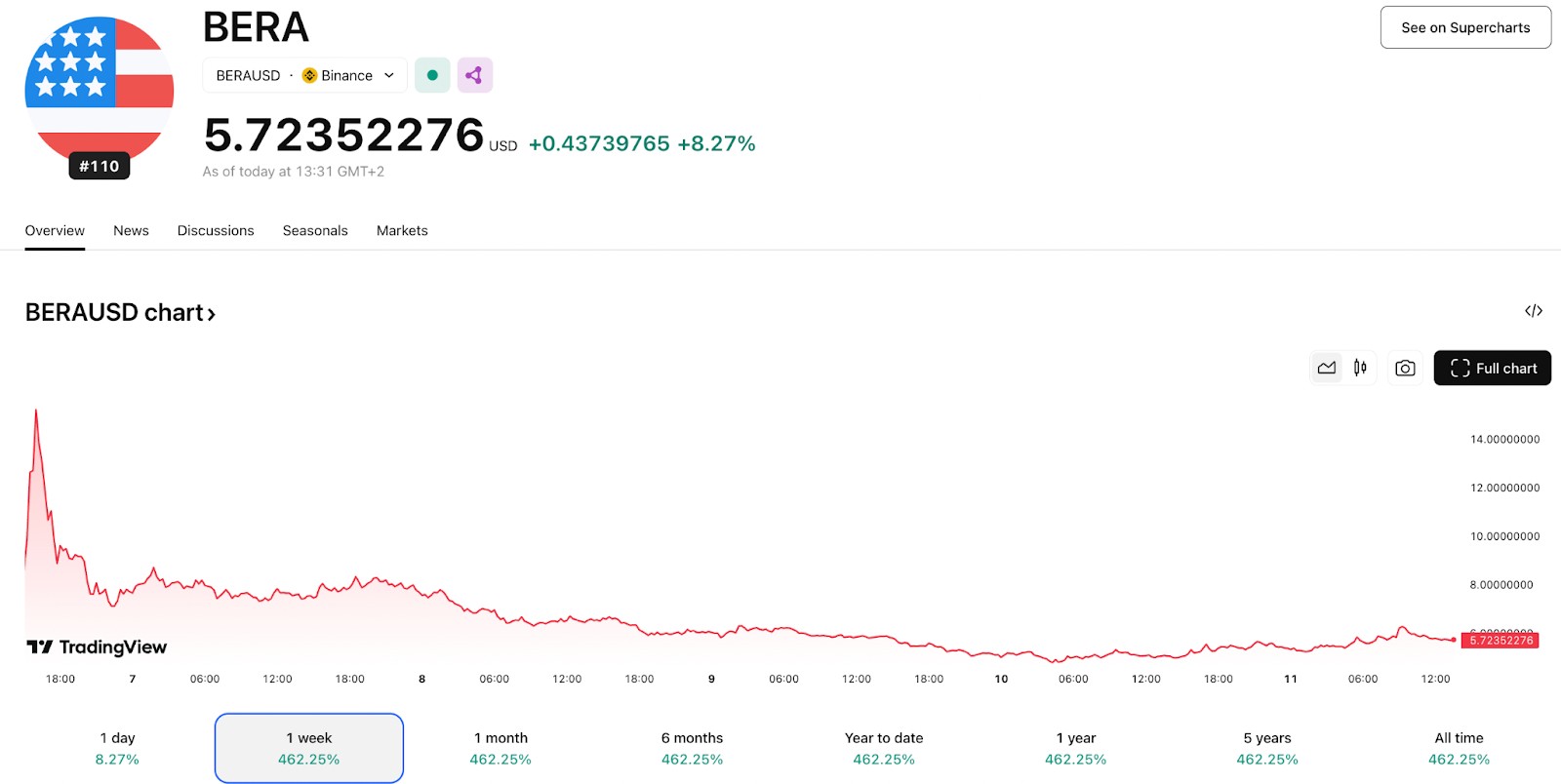
At launch, BERA's price showed volatility. It started around $8.03 per token on Aevo perpetual futures, with some reports indicating initial prices near $15.
In the days after, BERA's price fluctuated:
Berachain mainnet launch and its impact
Berachain, an Ethereum Virtual Machine (EVM)-compatible Layer 1 blockchain, officially launched its mainnet on February 6, 2025. This event marked an important step in the blockchain industry, introducing new mechanisms and attracting strong interest from the crypto community.
Proof-of-liquidity consensus mechanism
Berachain sets itself apart with its Proof-of-Liquidity (PoL) consensus mechanism. Unlike traditional Proof-of-Stake (PoS) systems, PoL integrates liquidity provision into the network's security framework. Validators stake liquidity assets, strengthening both security and liquidity within the ecosystem. This system encourages active participation and aligns the interests of validators and decentralized application (dApp) developers.
Airdrop and token distribution
To reward early supporters, Berachain conducted an airdrop of its native BERA tokens. Around 79 million BERA tokens, or 15.8% of the 500 million total supply, were distributed to eligible users, including Bong Bears NFT holders and contributors to affiliated projects. At the time of the airdrop, BERA was trading at around $8 per token, valuing the distribution at approximately $632 million.
Market performance post-launch
After the mainnet launch and airdrop, BERA saw strong market activity. Its market capitalization quickly reached $1 billion, showing high initial demand. Like many newly launched tokens, BERA’s price fluctuated due to market conditions and investor sentiment.
Community and ecosystem development
The launch has had a major impact on Berachain’s community and ecosystem. The PoL consensus model has drawn a range of dApp developers, expanding the network of decentralized applications. The airdrop also helped increase community involvement, fostering a sense of ownership among participants.
Future outlook
Berachain's success will depend on the long-term effectiveness of its PoL model and the expansion of its ecosystem. Its focus on liquidity and staking could influence other blockchain projects, shaping future developments in decentralized finance and blockchain adoption.
Plans for TGE (Token Generation Event)
Target price level: buy below $8, with an initial allocation of 50% at launch and another 50% if price corrections occur.
Diverse exchange deposits: funds have been allocated across multiple exchanges to exploit potential price differences.
Market sentiment: currently at a low due to the absence of strong bullish narratives, but expectations remain high that Berachain can sustain itself.
Berachain review: What experts say
Proponents highlight Berachain’s unique PoL mechanism, which provides a robust liquidity framework.
Skeptics warn about market volatility and regulatory challenges that could impact long-term sustainability.
Key strengths: strong governance participation, fair liquidity incentives, and an engaged community.
Latest news on Berachain (BERA)
BERA listed on major exchanges: expanded liquidity and accessibility.
Institutional investment interest: growing interest from institutional traders exploring Berachain’s DeFi capabilities.
Expanding community: over 50,000 new members have joined Berachain’s official channels post-listing.
Development roadmap updates: plans for enhanced governance features and ecosystem expansion.

Should you invest in Berachain (BERA)?
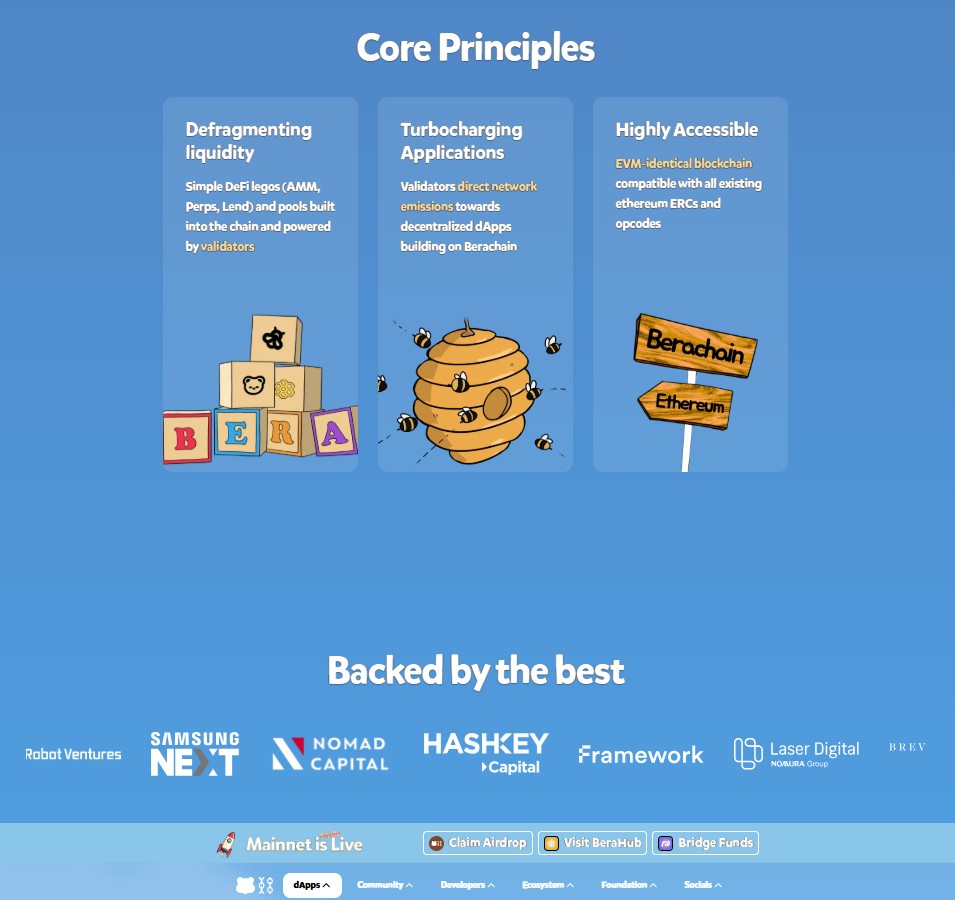
Berachain presents an exciting investment opportunity due to its innovative proof-of-liquidity model, which offers strong incentives for liquidity providers and governance participants, fostering a decentralized financial ecosystem with long-term sustainability. Its rapidly growing ecosystem, active community engagement, and a strong developer network indicate that Berachain is well-positioned for expansion in the DeFi sector.
However, newly listed tokens often experience significant price volatility, making BERA a high-risk asset that requires careful risk management and trading strategies. Regulatory uncertainty surrounding decentralized finance remains a concern, as changing policies could affect Berachain’s operational framework.
Additionally, the presence of well-established competitors in the Layer 1 space, such as Ethereum and Solana, may pose challenges to Berachain’s adoption and long-term market dominance. Investors should weigh the potential for growth against these inherent risks before making a decision.
Future of Berachain (BERA)
In the short term, Berachain is likely to experience further price volatility as traders react to market sentiment and liquidity stabilizes, while additional exchange listings could enhance accessibility and broaden its user base, and improvements in governance and liquidity rewards may create more long-term incentives for adoption.
Over the long term, Berachain's success will depend on the growth of its DeFi applications and NFT integrations, the increasing institutional interest that could drive liquidity and large-scale adoption, and the evolution of its governance frameworks to ensure decentralized decision-making remains at the core of the network.
| Month | Minimum Price, $ | Average Price, $ | Maximum Price, $ |
|---|---|---|---|
| August 2026 | 0.08 | 0.082 | 0.083 |
| September 2026 | 0.096 | 0.098 | 0.1 |
| October 2026 | 0.15 | 0.15 | 0.16 |
| November 2026 | 0.22 | 0.22 | 0.23 |
| December 2026 | 0.16 | 0.16 | 0.16 |
Berachain's tri-token model introduces distinct roles for each token

Investing in Berachain (BERA) offers a unique opportunity to engage with its innovative Proof-of-Liquidity (PoL) consensus mechanism. Unlike traditional Proof-of-Stake systems, PoL requires validators to stake liquidity assets, enhancing both security and liquidity within the ecosystem. This approach not only secures the network but also incentivizes active participation from liquidity providers, aligning the interests of validators and decentralized application developers. By understanding and engaging with this mechanism, investors can position themselves to benefit from the unique incentives offered by Berachain's ecosystem.
Furthermore, Berachain's tri-token model introduces distinct roles for each token: BERA serves as the native gas and staking token, BGT functions as a non-transferable governance token earned through liquidity provision, and HONEY acts as the chain's fully collateralized stablecoin. This structure creates multiple avenues for participation and reward within the network. Investors who strategically engage with each token's specific utility can maximize their involvement and potential returns within Berachain's multifaceted ecosystem.
Conclusion
Berachain (BERA) has gained significant attention due to its innovative liquidity incentives and governance model, with its Bybit listing and mainnet launch marking critical milestones in its development.
While early price fluctuations highlight the speculative nature of new blockchain projects, Berachain’s unique tri-token economy and DeFi focus offer long-term potential for liquidity providers and governance participants. However, market volatility, regulatory factors, and competition remain key risks, making a well-balanced investment strategy essential for those looking to participate.
FAQs
Why is the mainnet launch significant?
The February 6, 2025, mainnet launch marks Berachain’s transition from testnet to a fully operational blockchain, enabling smart contract functionality, liquidity pools, and governance participation.
Where can I trade BERA tokens?
BERA tokens can be traded on major crypto exchanges like Bybit, Binance, MEXC, and HTX, providing traders with multiple platforms to engage with the asset.
How does Berachain's proof-of-liquidity (PoL) model benefit traders?
The PoL model rewards liquidity providers with governance rights and staking incentives, ensuring a more stable and incentivized trading environment.
What are the risks of trading BERA?
Trading BERA involves high volatility, potential regulatory scrutiny, and competition from other DeFi platforms, making risk management crucial.
Editors' Top Picks and Insights

Tokenized stocks in the spotlight: How do they work and are they worth trading?

Do politicians make the best stock traders?

Crypto test drive: How automakers are exploring digital assets

Lindsey Graham death: U.S. senator’s crypto legacy

Tether under pressure: USDT in Europe, audit questions, and the fight for trust

Lean Ethereum: Why Buterin wants to rebuild the network
Related Articles
Team that worked on the article
Parshwa is a content expert and finance professional possessing deep knowledge of stock and options trading, technical and fundamental analysis, and equity research. As a Chartered Accountant Finalist, Parshwa also has expertise in Forex, crypto trading, and personal taxation.
Chinmay Soni is a financial analyst with more than 5 years of experience in working with stocks, Forex, derivatives, and other assets. As a founder of a boutique research firm and an active researcher, he covers various industries and fields, providing insights backed by statistical data.
Mirjan Hipolito is a journalist and news editor at Traders Union. She is an expert crypto writer with five years of experience in the financial markets.
Index in trading is the measure of the performance of a group of stocks, which can include the assets and securities in it.
Crypto trading involves the buying and selling of cryptocurrencies, such as Bitcoin, Ethereum, or other digital assets, with the aim of making a profit from price fluctuations.
Bitcoin is a decentralized digital cryptocurrency that was created in 2009 by an anonymous individual or group using the pseudonym Satoshi Nakamoto. It operates on a technology called blockchain, which is a distributed ledger that records all transactions across a network of computers.
Forex leverage is a tool enabling traders to control larger positions with a relatively small amount of capital, amplifying potential profits and losses based on the chosen leverage ratio.
Options trading is a financial derivative strategy that involves the buying and selling of options contracts, which give traders the right (but not the obligation) to buy or sell an underlying asset at a specified price, known as the strike price, before or on a predetermined expiration date. There are two main types of options: call options, which allow the holder to buy the underlying asset, and put options, which allow the holder to sell the underlying asset.

-
 Afghanistan
-
 Albania
-
 Algeria
-
 Angola
-
 Argentina
-
 Armenia
-
 Australia
-
 Austria
-
 Azerbaijan
-
 Bahamas
-
 Bahrain
-
 Bangladesh
-
 Belarus
-
 Belgium
-
 Bolivia
-
 Botswana
-
 Brazil
-
 Brunei
-
 Bulgaria
-
 Cambodia
-
 Cameroon
-
 Canada
-
 Chile
Chile
-
 China
China
-
 Colombia
-
 Congo
Congo
-
 Costa Rica
-
 Cote d'Ivoire
-
 Croatia
-
 Cuba
Cuba
-
 Cyprus
-
 Czechia
-
 DR Congo
-
 Denmark
-
 Dominican Republic
-
 Ecuador
-
 Egypt
Egypt
-
 El Salvador
-
 Estonia
-
 Eswatini
-
 Ethiopia
-
 Finland
-
 France
-
 Georgia
-
 Germany
-
 Ghana
Ghana
-
 Greece
-
 Haiti
Haiti
-
 Hong Kong
-
 Hungary
-
 India
India
-
 Indonesia
-
 Iran, Islamic republic
-
 Iraq
Iraq
-
 Ireland
-
 Israel
-
 Italy
Italy
-
 Jamaica
-
 Japan
Japan
-
 Jordan
-
 Kazakhstan
-
 Kenya
Kenya
-
 Korea
Korea
-
 Kuwait
-
 Kyrgyzstan
-
 Laos
Laos
-
 Latvia
-
 Lebanon
-
 Lesotho
-
 Libya
Libya
-
 Lithuania
-
 Luxembourg
-
 Madagascar
-
 Malaysia
-
 Malta
Malta
-
 Mauritius
-
 Mexico
-
 Moldova
-
 Mongolia
-
 Montenegro
-
 Morocco
-
 Mozambique
-
 Myanmar
-
 Namibia
-
 Nepal
Nepal
-
 Netherlands
-
 New Zealand
-
 Nigeria
-
 North Macedonia
-
 Norway
-
 Oman
Oman
-
 Pakistan
-
 Palestine
-
 Panama
-
 Papua New Guinea
-
 Paraguay
-
 Peru
Peru
-
 Philippines
-
 Poland
-
 Portugal
-
 Puerto Rico
-
 Qatar
Qatar
-
 Reunion
-
 Romania
-
 Rwanda
-
 Saudi Arabia
-
 Serbia
-
 Singapore
-
 Slovakia
-
 Slovenia
-
 Somalia
-
 South Africa
-
 Spain
Spain
-
 Sri Lanka
-
 Sweden
-
 Switzerland
-
 Syria
Syria
-
 Taiwan
-
 Tajikistan
-
 Tanzania
-
 Thailand
-
 Trinidad and Tobago
-
 Tunisia
-
 Turkey
-
 UAE
UAE
-
 Uganda
-
 Ukraine
-
 United Kingdom
-
United States
-
 Uruguay
-
 Uzbekistan
-
 Venezuela
-
 Vietnam
-
 Yemen
Yemen
-
 Zambia
-
 Zimbabwe
- Forex
- Crypto











