
New Cryptocurrencies With High Potential


Editorial Note: While we adhere to strict Editorial Integrity, this post may contain references to products from our partners. Here's an explanation for How We Make Money. None of the data and information on this webpage constitutes investment advice according to our Disclaimer.
List of new cryptocurrencies with high potential in 2026:
Cryptocurrencies have come a long way since Bitcoin's inception in 2009. From a niche digital asset to a global phenomenon, the crypto market has seen rapid growth and innovation. Today, there are thousands of cryptocurrencies, each with unique features and use cases. This article aims to guide traders and investors in identifying promising new cryptocurrencies for 2026. We'll explore the top contenders, evaluate their potential, and provide insights into making informed investment decisions.
New cryptocurrencies with high potential
When evaluating new cryptocurrencies, several factors come into play: technology, use case, team, market potential, and community support. These criteria help us identify projects with the potential for long-term success and significant returns.
Pepe Unchained (PEPE)
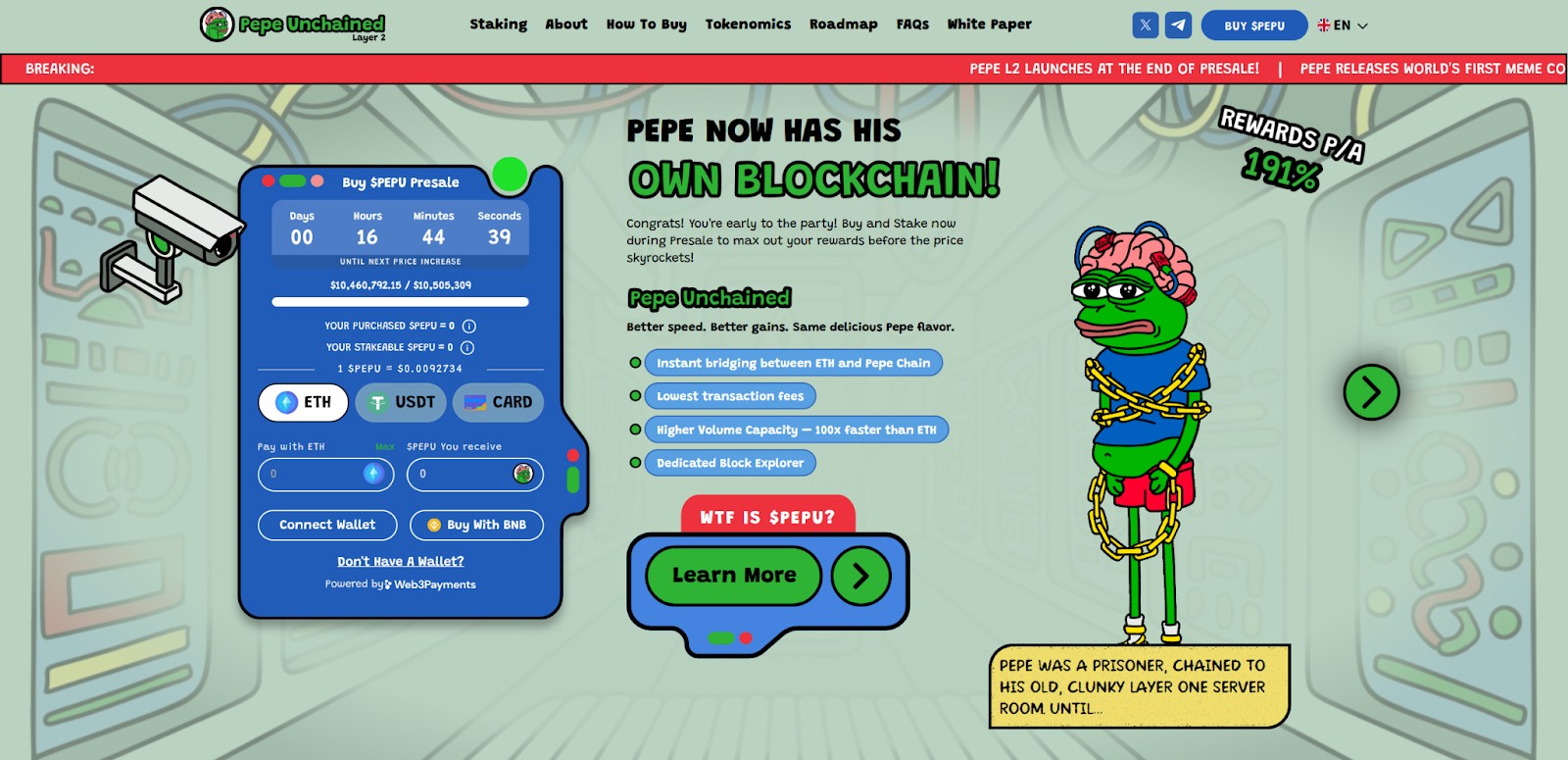
Pepe Unchained is a Layer 2 blockchain solution designed specifically for the meme coin sector. Launched in June 2024, it boasts significantly faster transaction speeds and lower fees compared to Ethereum. The $PEPE token is the native currency of the platform, and it is designed to offer staking opportunities with double rewards, making it an attractive option for early investors.
- Pros
- Cons
- Fast transaction speeds
- Low fees
- Unique focus on meme coins
- Strong community support
- Still in the early stages
- High competition in the meme coin sector
- Inherent risks with new projects
Worldcoin (WLD)
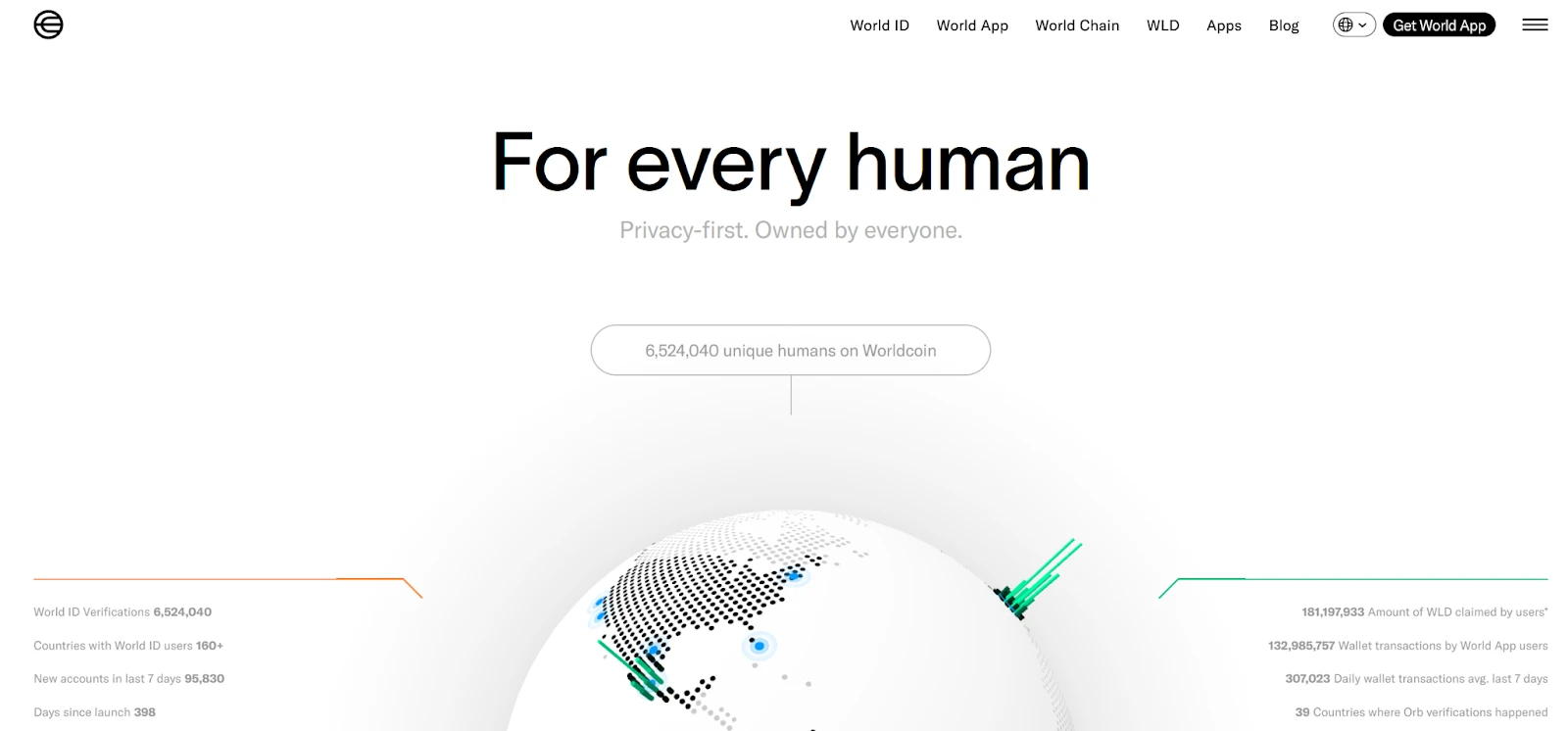
Worldcoin is a groundbreaking global cryptocurrency initiative aimed at distributing its native WLD tokens to every person on the planet. The project utilizes a novel biometric identification system to ensure fair distribution, promoting inclusivity in the digital economy. Launched in mid-2024, Worldcoin also seeks to establish a new standard for digital identity verification.
- Pros
- Cons
- Innovative approach to global financial inclusivity
- Strong focus on privacy and security
- Growing adoption
- Regulatory challenges
- Execution risks in global scaling
- Potential privacy concerns due to biometric data use
Stacks (STX)
Stacks is a Layer 1 blockchain designed to bring smart contracts and decentralized applications (DApps) to Bitcoin. By leveraging Bitcoin's robust security, Stacks enables advanced functionalities like smart contracts without altering Bitcoin’s core features. Launched in early 2024, Stacks is positioned to enhance Bitcoin’s utility significantly.
- Pros
- Cons
- Enhances Bitcoin's capabilities
- Strong integration with Bitcoin’s security model
- Growing developer interest
- Competition from other blockchain solutions
- Dependency on Bitcoin’s market performance
Manta Network (MANTA)
Manta Network is a privacy-focused blockchain leveraging zk-SNARKs technology to ensure complete anonymity in transactions. Launched in early 2024, the $MANTA token is used for transaction fees, governance, and securing the network. The project is gaining traction as privacy becomes an increasingly critical concern in the digital age.
- Pros
- Cons
- Strong focus on privacy
- Innovative use of zk-SNARKs
- Increasing adoption in privacy-centric applications
- Faces regulatory challenges
- Competition from other privacy coins
Blur (BLUR)

Blur is a high-performance NFT marketplace built on Ethereum that has quickly gained popularity, challenging established players like OpenSea. The BLUR token, launched in late 2023, serves as the platform's governance token and incentivizes user engagement. Blur offers unique features such as cross-marketplace NFT sweeping.
- Pros
- Cons
- Fast-growing marketplace
- Unique features
- Strong community support
- Potential for volatility due to token unlock schedules
- Competitive NFT marketplace
| Feature | PEPE | WLD | STX | MANTA | BLUR |
|---|---|---|---|---|---|
| Project Type | Layer-2 for meme coins | Global ID with biometric verification | Layer-1 smart contracts on Bitcoin | Privacy blockchain for DeFi | NFT marketplace for pro traders |
| Key Strengths | Fast transactions, staking rewards | Backed by Sam Altman, ID verification focus | DeFi and dApps on Bitcoin | Privacy-focused, growing demand | Liquidity, advanced NFT trading tools |
| Challenges | Speculative, meme coin dependency | Privacy and regulatory issues | Bitcoin’s slow transactions | Regulatory scrutiny on privacy coins | Volatile NFT market, strong competition |
| Growth Potential | High in meme coin sector | Promising in ID and inclusion | Strong for Bitcoin DeFi ecosystem | High in privacy-focused DeFi | Growth tied to NFT market recovery |
| Token Usage | Transactions, staking rewards | ID and inclusion tool | Smart contracts, governance | Private transactions on DeFi | NFT transactions, governance |
| Transaction Speed | 100x faster than Ethereum | Standard ERC-20 | Depends on Bitcoin (slow without Layer-2) | High-speed private transactions | Optimized for NFT trades |
Considerations for beginners
Dig into niche projects most people don’t talk about. Rather than chasing after cryptos everyone knows, explore smaller, lesser-known ones that solve specific real-world problems (like improving supply chains or decentralized data storage). These early-stage tokens often have big upside potential if they take off.
Pick the platform that matches your goals. Not all crypto platforms are built the same. Some focus on user-friendly interfaces and low fees, while others offer advanced trading tools, staking options, or a wide range of lesser-known coins. If you’re new, pick one that prioritizes security and ease of use. Look for platforms with insurance on digital assets, reliable customer support, and clear fee structures. These elements will protect you as you learn the ropes without overwhelming you with complex features.
| Min. Deposit, $ | Coins Supported | Spot Taker fee, % | Spot Maker Fee, % | Foundation year | Open an account | |
|---|---|---|---|---|---|---|
| 10 | 600+ | 0.1 | 0.08 | 2017 | Go to broker Your capital is at risk. |
|
| 10 | 400+ | 0.5 | 0.5 | 2012 | Go to broker Your capital is at risk. |
|
| 1 | 400+ | 0.5 | 0.25 | 2016 | Go to broker Your capital is at risk. |
|
| No | 1000 | 0 | 0 | 2018 | Go to broker Your capital is at risk. |
|
| 10 | 399 | 0.3 | 0.2 | 2011 | Go to broker Your capital is at risk.
|
Forget the hype, research the people behind it. Don’t get swept up by what’s trending. Do some detective work—look into the team’s history. Check if the people working on the project have had success with other ventures before. If they’ve proven themselves in tech or crypto, that can make all the difference. Buying new crypto before listing can be exciting but comes with risks, so it’s important to go beyond social media buzz and early-access hype.
Check who controls most of the tokens. You can’t just look at how many tokens are in circulation. Who’s holding the majority? Are there mechanisms in place to reduce the supply? These details can really affect how prices move in the long run.
Considerations for advanced traders
Look for cryptos that play well with others. Advanced investors should prioritize projects that make it easy to move assets between different blockchains. As crypto grows, these interoperable tokens will have more use and staying power. Discover the best crypto to invest in 2026 with top picks that offer strong growth potential, real use cases, and future-ready blockchain tech.
Watch the developers’ actual work, not just their announcements. Instead of relying on flashy PR, dive into their GitHub activity. Consistent updates and improvements are a sign of a strong team and a reliable project.
Use staking while staying flexible. Don’t just lock up your tokens for staking. Use platforms like Lido, where you can stake and still keep access to your funds. This way, you’re earning rewards and can still trade or invest in other opportunities.
How to evaluate new crypto projects
When dealing with new crypto projects, there are some unique aspects that must be kept in mind to avoid loss of capital:
Who’s really calling the shots? If only a few people have all the power, you’re looking at a big risk. A project with decentralized voting—where users actually get a say—is a safer bet because it's not just a handful of folks making all the decisions.
When does the team get their tokens? It’s easy to miss this. Developers sometimes hold onto huge amounts of tokens, and if they can sell them all at once, prices might crash. Find out when their tokens unlock so you don’t get caught off guard.
Can this coin survive on multiple blockchains? Coins that only work on one blockchain are more fragile. If something goes wrong with that network, the coin could be in trouble. Look for projects that can operate across different blockchains to spread out the risk.
Does this coin solve a real problem? Cool ideas are one thing, but do they actually work? Check if the crypto has real-world use cases—like partnerships or technology that's already being used in the real world. Ignore the fluff, and focus on what’s real.
Always check the token release plan and insider ownership

When diving into new cryptocurrencies with big potential, one key thing people tend to miss is checking the token release plan and insider ownership. It's not just about the hype or the promises in the whitepaper. If the majority of tokens are held by early investors and those tokens are about to hit the market soon, there's a real chance those insiders will sell off and tank the price. Always dig into the details of who owns what and when those tokens will unlock. That'll help you avoid nasty surprises.
Another important thing to watch is the liquidity of a new token on decentralized exchanges (DEXs). A lot of beginners miss this, but if there's not enough liquidity, prices can fluctuate wildly even on small trades. Make sure there's a healthy amount of liquidity so you don’t get stuck in a bad trade where the price changes dramatically from what you expected. Just take a quick look at the size of the liquidity pool, and you'll avoid some unnecessary risks.
Conclusion
New cryptocurrencies can be a goldmine, but managing them effectively requires more than just surface-level knowledge. Instead of blindly spreading your investments across a few new coins, dive deep into the community behind the token, look at its partnerships, and assess its real-world applications. Join niche online discussions to gain insider insights rather than depending on typical news outlets. Keep an eye on developer activity and community buzz—these can often give you an early hint of where the market is heading before prices catch up. Invest in coins that offer true technological advancements, not just fleeting market hype.
FAQs
Can I invest in these new cryptocurrencies using a credit card?
Yes, many cryptocurrency exchanges allow you to purchase cryptocurrencies using a credit card. Check the specific payment methods supported by your chosen platform.
Can new cryptocurrencies be mined?
Yes, some new cryptocurrencies can be mined if they use a proof-of-work consensus mechanism. Check the project’s documentation to see if mining is supported and profitable.
Can I earn passive income from new cryptocurrencies?
Yes, some new cryptocurrencies offer staking, lending, or yield farming opportunities that allow you to earn passive income on your holdings.
How can I store my new cryptocurrency securely?
You can store your cryptocurrencies securely in hardware wallets, or use software wallets with strong security features and two-factor authentication.
Editors' Top Picks and Insights




Related Articles
Team that worked on the article
Rinat Gismatullin is an entrepreneur and a business expert with 9 years of experience in trading. He focuses on long-term investing, but also uses intraday trading.
Chinmay Soni is a financial analyst with more than 5 years of experience in working with stocks, Forex, derivatives, and other assets. As a founder of a boutique research firm and an active researcher, he covers various industries and fields, providing insights backed by statistical data.
Mirjan Hipolito is a journalist and news editor at Traders Union. She is an expert crypto writer with five years of experience in the financial markets.
An investor is an individual, who invests money in an asset with the expectation that its value would appreciate in the future. The asset can be anything, including a bond, debenture, mutual fund, equity, gold, silver, exchange-traded funds (ETFs), and real-estate property.
Yield refers to the earnings or income derived from an investment. It mirrors the returns generated by owning assets such as stocks, bonds, or other financial instruments.
Ethereum is a decentralized blockchain platform and cryptocurrency that was proposed by Vitalik Buterin in late 2013 and development began in early 2014. It was designed as a versatile platform for creating decentralized applications (DApps) and smart contracts.
Day trading involves buying and selling financial assets within the same trading day, with the goal of profiting from short-term price fluctuations, and positions are typically not held overnight.
Bitcoin is a decentralized digital cryptocurrency that was created in 2009 by an anonymous individual or group using the pseudonym Satoshi Nakamoto. It operates on a technology called blockchain, which is a distributed ledger that records all transactions across a network of computers.

-
 Afghanistan
-
 Albania
-
 Algeria
-
 Angola
-
 Argentina
-
 Armenia
-
 Australia
-
 Austria
-
 Azerbaijan
-
 Bahamas
-
 Bahrain
-
 Bangladesh
-
 Belarus
-
 Belgium
-
 Bolivia
-
 Botswana
-
 Brazil
-
 Brunei
-
 Bulgaria
-
 Cambodia
-
 Cameroon
-
 Canada
-
 Chile
Chile
-
 China
China
-
 Colombia
-
 Congo
Congo
-
 Costa Rica
-
 Cote d'Ivoire
-
 Croatia
-
 Cuba
Cuba
-
 Cyprus
-
 Czechia
-
 DR Congo
-
 Denmark
-
 Dominican Republic
-
 Ecuador
-
 Egypt
Egypt
-
 El Salvador
-
 Estonia
-
 Eswatini
-
 Ethiopia
-
 Finland
-
 France
-
 Georgia
-
 Germany
-
 Ghana
Ghana
-
 Greece
-
 Haiti
Haiti
-
 Hong Kong
-
 Hungary
-
 India
India
-
 Indonesia
-
 Iran, Islamic republic
-
 Iraq
Iraq
-
 Ireland
-
 Israel
-
 Italy
Italy
-
 Jamaica
-
 Japan
Japan
-
 Jordan
-
 Kazakhstan
-
 Kenya
Kenya
-
 Korea
Korea
-
 Kuwait
-
 Kyrgyzstan
-
 Laos
Laos
-
 Latvia
-
 Lebanon
-
 Lesotho
-
 Libya
Libya
-
 Lithuania
-
 Luxembourg
-
 Madagascar
-
 Malaysia
-
 Malta
Malta
-
 Mauritius
-
 Mexico
-
 Moldova
-
 Mongolia
-
 Montenegro
-
 Morocco
-
 Mozambique
-
 Myanmar
-
 Namibia
-
 Nepal
Nepal
-
 Netherlands
-
 New Zealand
-
 Nigeria
-
 North Macedonia
-
 Norway
-
 Oman
Oman
-
 Pakistan
-
 Palestine
-
 Panama
-
 Papua New Guinea
-
 Paraguay
-
 Peru
Peru
-
 Philippines
-
 Poland
-
 Portugal
-
 Puerto Rico
-
 Qatar
Qatar
-
 Reunion
-
 Romania
-
 Rwanda
-
 Saudi Arabia
-
 Serbia
-
 Singapore
-
 Slovakia
-
 Slovenia
-
 Somalia
-
 South Africa
-
 Spain
Spain
-
 Sri Lanka
-
 Sweden
-
 Switzerland
-
 Syria
Syria
-
 Taiwan
-
 Tajikistan
-
 Tanzania
-
 Thailand
-
 Trinidad and Tobago
-
 Tunisia
-
 Turkey
-
 UAE
UAE
-
 Uganda
-
 Ukraine
-
 United Kingdom
-
United States
-
 Uruguay
-
 Uzbekistan
-
 Venezuela
-
 Vietnam
-
 Yemen
Yemen
-
 Zambia
-
 Zimbabwe
- Forex
- Crypto












