
Step-by-Step Guide To Verifying Your Binary Options Trading Account


Editorial Note: While we adhere to strict Editorial Integrity, this post may contain references to products from our partners. Here's an explanation for How We Make Money. None of the data and information on this webpage constitutes investment advice according to our Disclaimer.
To initiate the verification process:
Familiarize yourself with your chosen broker's specific document requirements, such as government-issued photo IDs, proof of address, and, occasionally, proof of income.
When gathering documents, ensure they are valid but also clear and comprehensive, opting for high-quality scanning or photography to facilitate seamless upload.
Navigate to the designated section on your broker's platform for uploading documents, where a user-friendly interface awaits.
Follow the provided instructions meticulously.
After uploading, your broker diligently reviews your documents for authenticity and accuracy. While this typically takes a few days, the duration may vary based on internal procedures and workload. Upon successful verification, congratulations are in order! Your account is fully activated, granting you access to real money trading features and fund withdrawal.
Verifying your binary options trading account is crucial in ensuring the security and legitimacy of your trading activities. It is akin to obtaining a "passport" for the financial world, allowing you to access the full range of features and functionalities offered by your chosen broker.
It boils down to two key factors: Know Your Customer (KYC) and Anti-Money Laundering (AML) regulations.
Why verify your binary options trading account?
Financial regulations, particularly Know Your Customer (KYC) and Anti-Money Laundering (AML) requirements, mandate brokers to verify the identity and address of their clients. These regulations aim to prevent illegal activities like fraud and financial crime. By confirming your identity and address, your chosen broker ensures you are who you say you are and helps combat unlawful economic activities.
Some brokers may allow you to open a demo account and explore the platform without verification. However, real money trading and fund withdrawal are restricted until your account is verified.
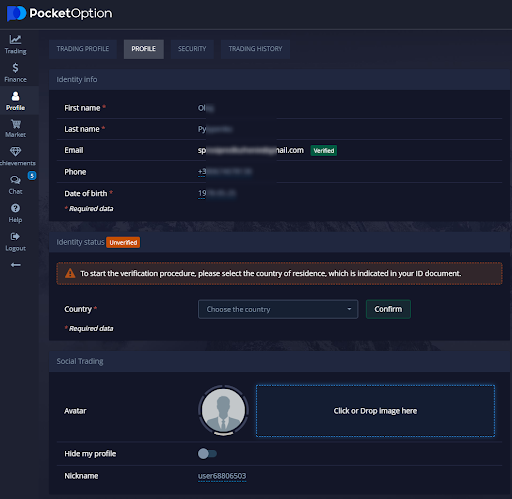 Example page for account verification
The image visually illustrates the initial steps of the verification process at Pocket Option, emphasizing the platform's user-friendly interface for uploading documents, making the verification process straightforward and accessible.
6 steps to verify your binary trading account
While the specific verification procedures might differ slightly between brokers, this step-by-step guide will equip you with the knowledge and confidence to navigate the process like a seasoned trader. Remember, a verified account is your passport to real money trading, and the journey is simpler than you might think.
Understanding verification requirements
Gathering required documents
Uploading documents to your broker's portal
Verification review and approval
Addressing potential issues
Account activation and trading
Step 1. Understanding verification requirements
Before starting on your verification, it's imperative to comprehend the specific documents your chosen broker requires. This step is similar to packing your travel essentials for a seamless trip. Typical requirements include:
Proof of identity (government-issued photo ID),
Proof of address (utility bill, bank statement),
Source of income (bank statement, pay stub, or tax return, depending on the broker).
Some brokers might request additional documents based on their internal policies and regulations.
Step 2. Gathering required documents
Armed with the knowledge of your broker's requirements, the next step is gathering the necessary documents. Ensure your documents are valid, not expired, clear, and contain all the required information. Scan or photograph your documents in high-quality formats like JPEG, PNG, or PDF. This is akin to preparing digital copies for a seamless upload.
Step 3. Uploading documents to your broker's portal
Most brokers provide a user-friendly online portal for document upload. Locate the designated section, often labeled "Verification" or "Account Settings," and follow the instructions for each document type. This step is crucial, as it serves as your gateway to trading freedom. Take your time and double-check everything before submitting.
Step 4. Verification review and approval
Once your documents are uploaded, relax and let the verification process commence. Your broker acts as the immigration officer, reviewing your documents for authenticity and accuracy. This process typically takes a few days, but the duration may vary based on your broker's workload and internal procedures. You will receive updates and notifications regarding your verification status, so stay tuned.
Step 5. Addressing potential issues
In the event of document rejection, don't be disheartened. Your broker will provide specific reasons and instructions for resubmission. Common issues include blurry images, missing information, or expired documents. Think of this as an opportunity to refine your travel documents for a smoother journey. Address the issues, resubmit your documents, and you'll be on your way to trading success in no time.
Step 6. Account activation and trading
The moment you've been eagerly awaiting has arrived! Upon verification approval, congratulations! Your account is fully activated, granting you access to the full spectrum of trading features and functionalities. Withdraw your profits, explore advanced trading tools, and experience the thrill of real-world binary options trading. You've earned your passport to financial freedom, so go forth and trade with confidence!
Remember, verification is a simple yet crucial step in your trading journey. By following these steps and understanding the process, you can unlock a world of possibilities and embark on a rewarding trading experience. So, pack your documents, navigate the verification process quickly, and get ready to conquer the exciting world of binary options trading!
Now that you understand how the verification process works, the next step is choosing a broker that makes it as straightforward and transparent as possible. Not all brokers handle account verification the same way – some offer faster approval times, more flexible document options, or better customer support.
To help you decide, here’s a comparison table of leading binary options brokers, summarizing their minimum deposit, verification speed, and key advantages. Use it as your quick reference before you start trading with real funds.
| CloseOption | Capitalcore | Nadex | Pocket Option | QUOTEX | |
|---|---|---|---|---|---|
|
Foundation year |
2013 | 2019 | 2009 | 2017 | 2019 |
|
Min. deposit |
5 | 10 | 250 | 5 | 10 |
|
Min. trade size |
1 | 1 | 1 | 1 | 1 |
|
Min. Payout (%) |
17 | 60 | No | 50 | 20 |
|
Max. Payout (%) |
95 | 90 | 100 | 128 | 98 |
|
Demo |
Yes | Yes | Yes | Yes | Yes |
|
Open an account |
Go to broker Your capital is at risk. |
Go to broker Your capital is at risk.
|
Study review | Go to broker Your capital is at risk. |
Go to broker Your capital is at risk. |
Examples of Forex and binary account verification
Now that you're equipped with the knowledge and confidence to conquer your account verification, let's get into the process in action. Explore detailed tutorials for verifying your account with popular Forex and binary options brokers:
Pocket Option: Access a comprehensive Pocket Option on How to verify Pocket Option account verification process guide here. This article meticulously breaks down the steps in verifying your account on the Pocket Option trading platform.
IQcent: Read this article for a focused exploration of the IQcent verification process - How to verify IQcent account. This tutorial dives deep into the specifics of IQCent verification, providing a step-by-step walkthrough of the necessary procedures and required documents.
Quotex: Discover the renowned user-friendly interface and streamlined approach of Quotex verification through - How to Verify Quotex account in this step-by-step tutorial. This guide will assist you in verifying your Quotex account, detailing the required documents and highlighting the benefits of completing the verification process.
These examples serve as practical guides to complement your understanding of the account verification process. By following these tutorials, you can confidently navigate the verification journey, regardless of the broker you choose. Each tutorial offers insights into the specific requirements of the respective platforms, empowering you to seamlessly complete the verification process and unlock the full potential of your trading account.
A properly verified account minimizes operational risks

Traders often overlook account verification because it feels like an administrative formality. In reality, the way you approach verification can influence not just your onboarding speed, but the overall reliability of your trading workflow. A properly verified account minimizes operational risks that new traders don’t always anticipate – frozen withdrawals, delayed deposits, restricted access to features, or compliance flags triggered at the worst possible time, usually when money is already at stake.
I always advise traders to treat verification as their first stress test of a broker. A platform that handles KYC efficiently, communicates clearly, and resolves document issues without friction is far more likely to offer dependable execution and responsive support later on. Conversely, if the verification experience is slow, confusing, or inconsistent, that’s often a sign of issues that may surface when you need urgent help during volatile market conditions.
It’s also important to recognize that KYC standards are tightening globally. Submitting clean, high-quality documents and keeping everything up to date isn’t just about getting approved – it’s about ensuring smooth operation months down the line, especially if transaction sizes grow or if regulators impose additional checks. My recommendation is simple: use verification as your first evaluation checkpoint. A broker who makes this process transparent and predictable is much more likely to be a reliable partner in your long-term trading journey.
Conclusion
Verifying your binary options trading account is not just a regulatory requirement—it’s a critical step in protecting your investments and personal information. By diligently completing each of the six recommended steps, such as submitting government-issued ID and confirming your email address, you establish a strong barrier against fraud and unauthorized access. For instance, traders who promptly verify their accounts often benefit from faster withdrawals and enhanced trust with reputable brokers. Ultimately, thorough verification empowers you to trade with confidence, knowing your assets and identity are well-shielded in the rapidly evolving world of binary options.
FAQs
What should you do if your binary options account verification documents are rejected?
Does a verified binary options account offer benefits beyond withdrawals and deposits?
How can the quality of your document uploads impact the verification process?
Why is the verification process considered an important first test of a broker's reliability?
Editors' Top Picks and Insights



Related Articles
Team that worked on the article
Upendra Goswami is a full-time digital content creator, marketer, and active investor. As a creator, he loves writing about online trading, blockchain, cryptocurrency, and stock trading.
Dr. BJ Johnson is a PhD in English Language and an editor with over 15 years of experience. He earned his degree in English Language in the U.S and the UK.
Tobi Opeyemi Amure is an editor and expert writer with over 7 years of experience. In 2023, Tobi joined the Traders Union team as an editor and fact checker, making sure to deliver trustworthy and reliable content.
Forex trading, short for foreign exchange trading, is the practice of buying and selling currencies in the global foreign exchange market with the aim of profiting from fluctuations in exchange rates. Traders speculate on whether one currency will rise or fall in value relative to another currency and make trading decisions accordingly. However, beware that trading carries risks, and you can lose your whole capital.
Index in trading is the measure of the performance of a group of stocks, which can include the assets and securities in it.
CFD is a contract between an investor/trader and seller that demonstrates that the trader will need to pay the price difference between the current value of the asset and its value at the time of contract to the seller.
Binary options trading is a financial trading method where traders speculate on the price movement of various assets, such as stocks, currencies, or commodities, by predicting whether the price will rise or fall within a specified time frame, often as short as a few minutes. Unlike traditional trading, binary options have only two possible outcomes: a fixed payout if the trader's prediction is correct or a loss of the invested amount if the prediction is wrong.
Bitcoin is a decentralized digital cryptocurrency that was created in 2009 by an anonymous individual or group using the pseudonym Satoshi Nakamoto. It operates on a technology called blockchain, which is a distributed ledger that records all transactions across a network of computers.

-
 Afghanistan
-
 Albania
-
 Algeria
-
 Angola
-
 Argentina
-
 Armenia
-
 Australia
-
 Austria
-
 Azerbaijan
-
 Bahamas
-
 Bahrain
-
 Bangladesh
-
 Belarus
-
 Belgium
-
 Bolivia
-
 Botswana
-
 Brazil
-
 Brunei
-
 Bulgaria
-
 Cambodia
-
 Cameroon
-
 Canada
-
 Chile
Chile
-
 China
China
-
 Colombia
-
 Congo
Congo
-
 Costa Rica
-
 Cote d'Ivoire
-
 Croatia
-
 Cuba
Cuba
-
 Cyprus
-
 Czechia
-
 DR Congo
-
 Denmark
-
 Dominican Republic
-
 Ecuador
-
 Egypt
Egypt
-
 El Salvador
-
 Estonia
-
 Eswatini
-
 Ethiopia
-
 Finland
-
 France
-
 Georgia
-
 Germany
-
 Ghana
Ghana
-
 Greece
-
 Haiti
Haiti
-
 Hong Kong
-
 Hungary
-
 India
India
-
 Indonesia
-
 Iran, Islamic republic
-
 Iraq
Iraq
-
 Ireland
-
 Israel
-
 Italy
Italy
-
 Jamaica
-
 Japan
Japan
-
 Jordan
-
 Kazakhstan
-
 Kenya
Kenya
-
 Korea
Korea
-
 Kuwait
-
 Kyrgyzstan
-
 Laos
Laos
-
 Latvia
-
 Lebanon
-
 Lesotho
-
 Libya
Libya
-
 Lithuania
-
 Luxembourg
-
 Madagascar
-
 Malaysia
-
 Malta
Malta
-
 Mauritius
-
 Mexico
-
 Moldova
-
 Mongolia
-
 Montenegro
-
 Morocco
-
 Mozambique
-
 Myanmar
-
 Namibia
-
 Nepal
Nepal
-
 Netherlands
-
 New Zealand
-
 Nigeria
-
 North Macedonia
-
 Norway
-
 Oman
Oman
-
 Pakistan
-
 Palestine
-
 Panama
-
 Papua New Guinea
-
 Paraguay
-
 Peru
Peru
-
 Philippines
-
 Poland
-
 Portugal
-
 Puerto Rico
-
 Qatar
Qatar
-
 Reunion
-
 Romania
-
 Rwanda
-
 Saudi Arabia
-
 Serbia
-
 Singapore
-
 Slovakia
-
 Slovenia
-
 Somalia
-
 South Africa
-
 Spain
Spain
-
 Sri Lanka
-
 Sweden
-
 Switzerland
-
 Syria
Syria
-
 Taiwan
-
 Tajikistan
-
 Tanzania
-
 Thailand
-
 Trinidad and Tobago
-
 Tunisia
-
 Turkey
-
 UAE
UAE
-
 Uganda
-
 Ukraine
-
 United Kingdom
-
United States
-
 Uruguay
-
 Uzbekistan
-
 Venezuela
-
 Vietnam
-
 Yemen
Yemen
-
 Zambia
-
 Zimbabwe
- Forex
- Crypto












