
Day Trading Indicators: Best Providers 2026


Editorial Note: While we adhere to strict Editorial Integrity, this post may contain references to products from our partners. Here's an explanation for How We Make Money. None of the data and information on this webpage constitutes investment advice according to our Disclaimer.
We have compiled a list of top Forex signal sources based solely on publicly available information from the providers. However, we have not independently verified their authenticity and cannot guarantee that the stated promises correspond to reality. It is important to understand that such offers often fail to meet expectations. We strongly advise using Forex signals only on trusted platforms such as Trading.com USA, Plus500 and OANDA, where signal providers are internal participants, and the statistics are transparent and trustworthy. These companies value their reputation and minimize risks.
Top day trading signals providers:
HowToTrade - is a perfect day trading signals provider.
Market Chameleon - best service provider for experienced options traders.
The Trading Analyst - best stock alert service.
Learn2Trade - connects users to the world’s premiere financial markets.
Zignaly - shares signals but also functions by way of profit sharing incentives.
FXPremiere.com - is a great way for you to learn about day trading signals in a community setting.
In the right hands, day trading makes for a powerful way to grow and enhance your wealth. Yet it’s far from a simple science – which is why aligning yourself with the best day trading signals and learning how to analyze day trading indicators can be such a powerful skill.
Luckily, this doesn’t need to be a complicated skill to learn. In fact, it can be surprisingly streamlined in the right hands. Daily signals rely on staying agile and moving fast with the markets. Once you’ve chosen the best day trading signals provider for you, doing so will be that much easier.
Best day trading signals websites and telegram channels
Any outlets that help investors by sharing daily signals can be classified as signals providers. They could be daily trading signals websites, specialist Telegram channels, or social media feeds. At the provider’s discretion, the daily signals can be shared for free, or could be locked behind a fee. Finding reliable day trading signals can improve your trading results. We’ve handpicked the top websites and Telegram channels that provide trustworthy trading tips, guiding your trading journey with real-time updates.
HowToTrade

HowToTrade has become a vibrant community of over 1.2 million traders worldwide, offering a blend of fellow traders and seasoned mentors who actively engage in dynamic discussions. This collaborative environment allows members to discover effective technical indicators for day trading through interactions with peers, guidance from mentors, and timely signal updates. With a 4.5-star rating on Trustpilot, based on 231 reviews, HowToTrade has earned positive feedback from its users. The platform also hosts daily interactive live streams led by experienced investors, providing an excellent opportunity to learn about day trading signals within a supportive community setting.
Market Chameleon

Market Chameleon is a financial research platform that provides traders with a variety of tools for analyzing stocks and options. It offers real-time market data, news updates, and detailed information on earnings and dividends. With a Premium Subscription, users gain access to exclusive content, in-depth analyses, and the ability to download data directly from the website. The platform also features educational videos that guide users in identifying trading opportunities. Market Chameleon is a valuable resource for traders seeking dependable stock and options insights.
The Trading Analyst

The Trading Analyst is a premium service that provides real-time options trading alerts via text messages. Led by experienced options traders, the service employs a swing trading strategy with a strong emphasis on trading volume. Subscribers receive straightforward alerts that include clear signals and pricing information, along with access to a live portfolio tracker. Additionally, members receive a weekly Trading Report, offering market insights and portfolio updates. With over 20,500 followers on Stocktwits, The Trading Analyst has assisted many traders in achieving their financial goals and enhancing their trading skills. Members have shared positive feedback, recognizing it as a leading options alert service.
Learn2Trade

Learn2Trade is a daily signal provider trusted by both seasoned investors and newcomers eager to learn. They offer insights into international finance and cryptocurrencies, with a strong emphasis on Forex day trading signals. These signals are known for their accuracy and verification, and are shared with users through a premium Telegram channel, typically three to five times daily. Additionally, real-time day trading signals are accessible online. By connecting users to leading financial markets, Learn2Trade appeals to beginners and experienced investors alike.
Zignaly

So much interest has been building up around cryptocurrencies, NFTs and the metaverse. Yet because the industry is so volatile and new, the best daily signals for crypto are often still being discovered today.
Yet Zignaly stands to put the power back in users’ hands. Primarily a social trading platform and with a minimum investment of only a dollar, Zignaly shares signals but also functions by way of profit sharing incentives that enrich everyone involved.
A statement feature of Zignaly is that it functions without fees. As perhaps a bullish show of confidence, Zignaly advertises that its users only pay for its crypto day trading indicators when they actually make you profit.
FXPremiere.com

Boasting up to 15 day trading signals per day via an exclusive Telegram channel, FXPremiere.com is popular with beginners – yet often stays a core component of many investors’ strategies over the long-term.
Promising 90% accuracy in day trading signals, all using low-risk investments, FXPremiere.com positions itself as a platform suitable for newcomers, experienced traders and those looking to diversify their assets.
A team of 20 professionals is at the helm at FXPremiere.com, and the platform has been in business since 2010. This level of longevity and experience gives many investors confidence that FXPremiere.com has some of the best technical indicators for day trading in the market today.
Apart from these, there are also reputable brokers that provide trading signals as a service. We have compiled a list of them below and also highlighted alternate offerings such as copy trading and trading bots:
| Trading.com USA | Plus500 | OANDA | FOREX.com | IG Markets | |
|---|---|---|---|---|---|
|
Signals (alerts) |
Yes | Yes | Yes | Yes | Yes |
|
Min. deposit, $ |
50 | 100 | No | 100 | 1 |
|
Max. leverage |
1:50 | 1:300 | 1:200 | 1:50 | 1:200 |
|
Trading bots (EAs) |
Yes | No | Yes | Yes | Yes |
|
Copy trading |
No | No | Yes | Yes | Yes |
|
Max. Regulation Level |
Tier-1 | Tier-1 | Tier-1 | Tier-1 | Tier-1 |
|
TU overall score |
6.88 | 6.67 | 6.63 | 6.47 | 6.38 |
|
Open an account |
Go to broker Your capital is at risk. |
Go to broker 81% of retail CFD accounts lose money. |
Go to broker Your capital is at risk. |
Study review | Study review |
Best day trading indicators
We have provided some indicators that traders often use.
Relative Strength Indicator (RSI)
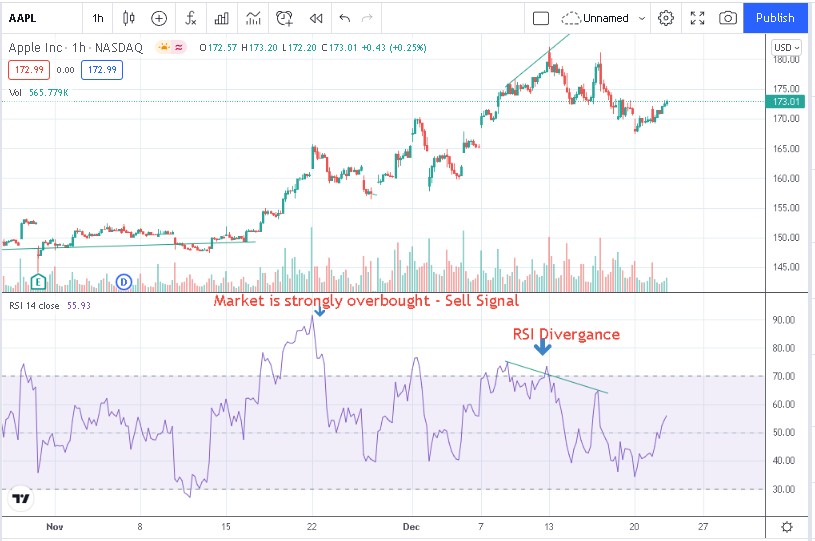
Even if you’re new to learning day trading indicators, you’ve likely seen an RSI before. A line that runs between 0 and 100, an RSI is a way of measuring whether the price of an asset is trustworthy. The way the RSI line converges or diverges in relationship with price data advises investors when to invest or sell up.
Because an RSI works by showing if an asset is overbought or oversold, it’s a delayed day trading signal. Also, traders often play divergence between the indicator trend and the price trend.
Simple Moving Average (SMA)
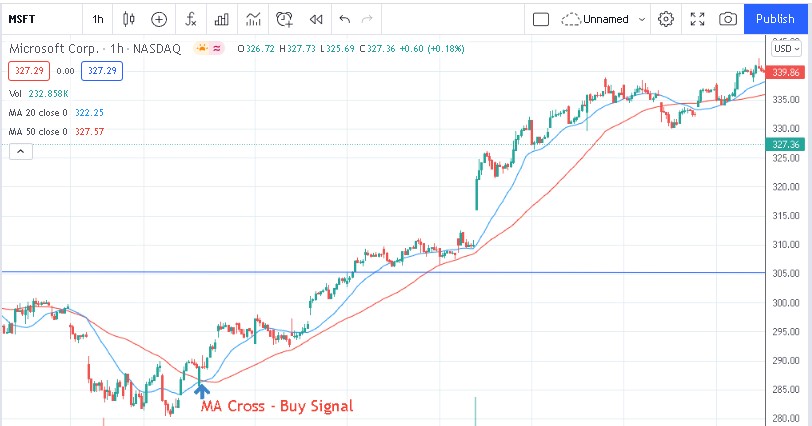
Every beginner to trading learns SMA day trading indicators. It’s a simple yet effective way of gauging the accurate growth of an asset over time, and the technique still remains relevant long into your trading career.
Advanced day trading signals rely on lines moving up and down in a pattern to mark when assets are bought and sold. The SMA smooths out these transactions into a more visually pleasing through-line.
That provides a late signal as to the upward or downward trends of an asset, giving day trading signals accordingly that inform your investment strategy.
On Balance Volume (OBV)
One of the most trusted day trading indicators since its discovery in the 1960s is the OBV technique. The principle behind this day trading indicator is that the volume and price of a given traded asset ought to move in harmony.
Using OBV, traders can have an early predictive tool to see if and when a price is due to rise or fall, simply by gauging volume versus price. An increase in volume affects the price of an asset, and you can also use OBV to also learn how to tell when retail investors and institutions are entering and exiting the market.
Fibonacci Retracement
Of all the early day trading indicators in use by both advanced and beginner traders today, the Fibonacci Retracement technique remains among the most popular.
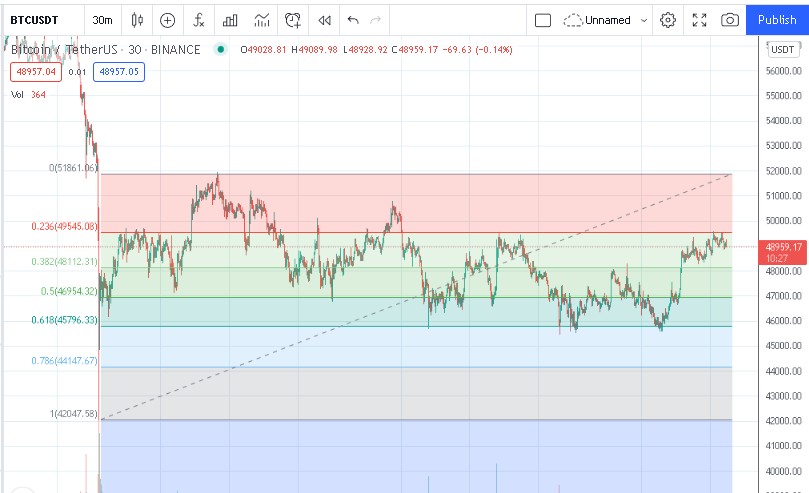
Using the Fibonacci numbers in mathematics, investors use Fibonacci Retracement to establish where the breakout, support and resistance lines are on a given asset’s stock price chart.
Using this information, investors can gauge if a price fall is a problem, if a sudden spike in price is a fluke or a true upward trend, and so forth. It’s a powerful way of fine-tuning your day trading signals to best work for you.
Volume Weighted Average Price (VWAP)
Another of the most trusted day trading indicators is VWAP. By breaking up the average price of an asset across the duration of a trading session, rather than the pikes and slopes of traditional graphs, VWAP is a delayed day trading signal that aims to steer investors to best recognize long-term trading and pricing trends.
As opposed to simply relying on the closing price of a given asset, this day trading indicator is used to evaluate the health of a given instrument. For example, if the price remains above the VWAP, a bullish sentiment is dominating that instrument, and investing deeper into it may well pay off.
Pros and cons day trading signals providers
Just as a diverse portfolio is always a wise investment strategy, it’s smart to keep a mix of day trading signals at hand. Telegram messaging is fantastic for signals sent straight to your device, especially if you need to react fast to the market. Yet livestreams and more educational long-term day trading signals can help elevate your confidence as an investor overall.
- Pros
- Cons
Cuts down your research time. Signal providers analyze the market, saving hours of personal research, especially helpful for new traders.
Access to pro strategies. Some providers share strategies used by seasoned traders, offering insight into less commonly discussed methods.
Helps you learn faster. Signals with explanations let you understand the market while trading, speeding up your learning curve.
Diversification made easy. Providers cover different assets, making it easier to diversify your portfolio without extra effort.
Makes you feel more secure about trades. Real-time alerts can reduce trading hesitation and build confidence during volatile market conditions.
Risk of depending too much. Over-relying on signals can hinder your ability to trade on your own.
Unexpected charges. Some providers have hidden fees or extra charges for premium features, affecting overall profits.
Unpredictable signal accuracy. Not all providers deliver accurate signals consistently; choosing the wrong one can cause losses.
Late trade alerts. Delays in receiving signals can lead to missed opportunities or bad trade entries.
Possible conflicts of interest. Some providers might profit from your trades through commissions, raising concerns about unbiased recommendations.
Use adaptive signals and custom alerts for smarter day trading

For beginners, the key to getting the most out of trading signals is to choose providers that offer adaptive signals. These alerts adjust based on live market conditions and trend strength, giving you tailored updates rather than generic buy/sell tips. Look for services with smart tools that filter out market noise using multi-timeframe analysis — this helps avoid acting on bad data when the market gets choppy.
Another smart move is customized signal integration. Find providers that allow API connections to your trading platform. This way, signals can trigger auto-trading or send instant notifications, helping you act fast while learning why each trade makes sense. It’s perfect for beginners who want to stay ahead in fast-moving markets without being glued to their screens all day.
Conclusion
In 2026, selecting the right day trading signal provider is more crucial than ever for traders seeking an edge in fast-moving markets. Leading platforms, such as TradeSignalPro and MarketPulse Alerts, stand out by delivering timely, data-driven insights and real-time notifications, enabling users to make informed decisions swiftly. The difference between success and missed opportunities often comes down to reliable, accurate signals. Ultimately, the true power of day trading lies not just in the signals themselves, but in pairing them with disciplined strategy and consistent execution. Trust in top-tier providers can transform your trading journey from reactive to proactive, unlocking lasting profitability.
FAQs
What are the most commonly used technical indicators for generating day trading signals?
What are potential drawbacks to using day trading signal providers?
How do adaptive signals and custom alerts enhance day trading strategies?
Why is diversification important when using day trading signals?
Editors' Top Picks and Insights





Related Articles
Team that worked on the article
Mikhail Vnuchkov joined Traders Union as an author in 2020. He began his professional career as a journalist-observer at a small online financial publication, where he covered global economic events and discussed their impact on the segment of financial investment, including investor income.
Chinmay Soni is a financial analyst with more than 5 years of experience in working with stocks, Forex, derivatives, and other assets. As a founder of a boutique research firm and an active researcher, he covers various industries and fields, providing insights backed by statistical data.
Mirjan Hipolito is a journalist and news editor at Traders Union. She is an expert crypto writer with five years of experience in the financial markets.
CFD is a contract between an investor/trader and seller that demonstrates that the trader will need to pay the price difference between the current value of the asset and its value at the time of contract to the seller.
Swing trading is a trading strategy that involves holding positions in financial assets, such as stocks or forex, for several days to weeks, aiming to profit from short- to medium-term price swings or "swings" in the market. Swing traders typically use technical and fundamental analysis to identify potential entry and exit points.
An investor is an individual, who invests money in an asset with the expectation that its value would appreciate in the future. The asset can be anything, including a bond, debenture, mutual fund, equity, gold, silver, exchange-traded funds (ETFs), and real-estate property.
Ethereum is a decentralized blockchain platform and cryptocurrency that was proposed by Vitalik Buterin in late 2013 and development began in early 2014. It was designed as a versatile platform for creating decentralized applications (DApps) and smart contracts.
Xetra is a German Stock Exchange trading system that the Frankfurt Stock Exchange operates. Deutsche Börse is the parent company of the Frankfurt Stock Exchange.

-
 Afghanistan
-
 Albania
-
 Algeria
-
 Angola
-
 Argentina
-
 Armenia
-
 Australia
-
 Austria
-
 Azerbaijan
-
 Bahamas
-
 Bahrain
-
 Bangladesh
-
 Belarus
-
 Belgium
-
 Bolivia
-
 Botswana
-
 Brazil
-
 Brunei
-
 Bulgaria
-
 Cambodia
-
 Cameroon
-
 Canada
-
 Chile
Chile
-
 China
China
-
 Colombia
-
 Congo
Congo
-
 Costa Rica
-
 Cote d'Ivoire
-
 Croatia
-
 Cuba
Cuba
-
 Cyprus
-
 Czechia
-
 DR Congo
-
 Denmark
-
 Dominican Republic
-
 Ecuador
-
 Egypt
Egypt
-
 El Salvador
-
 Estonia
-
 Eswatini
-
 Ethiopia
-
 Finland
-
 France
-
 Georgia
-
 Germany
-
 Ghana
Ghana
-
 Greece
-
 Haiti
Haiti
-
 Hong Kong
-
 Hungary
-
 India
India
-
 Indonesia
-
 Iran, Islamic republic
-
 Iraq
Iraq
-
 Ireland
-
 Israel
-
 Italy
Italy
-
 Jamaica
-
 Japan
Japan
-
 Jordan
-
 Kazakhstan
-
 Kenya
Kenya
-
 Korea
Korea
-
 Kuwait
-
 Kyrgyzstan
-
 Laos
Laos
-
 Latvia
-
 Lebanon
-
 Lesotho
-
 Libya
Libya
-
 Lithuania
-
 Luxembourg
-
 Madagascar
-
 Malaysia
-
 Malta
Malta
-
 Mauritius
-
 Mexico
-
 Moldova
-
 Mongolia
-
 Montenegro
-
 Morocco
-
 Mozambique
-
 Myanmar
-
 Namibia
-
 Nepal
Nepal
-
 Netherlands
-
 New Zealand
-
 Nigeria
-
 North Macedonia
-
 Norway
-
 Oman
Oman
-
 Pakistan
-
 Palestine
-
 Panama
-
 Papua New Guinea
-
 Paraguay
-
 Peru
Peru
-
 Philippines
-
 Poland
-
 Portugal
-
 Puerto Rico
-
 Qatar
Qatar
-
 Reunion
-
 Romania
-
 Rwanda
-
 Saudi Arabia
-
 Serbia
-
 Singapore
-
 Slovakia
-
 Slovenia
-
 Somalia
-
 South Africa
-
 Spain
Spain
-
 Sri Lanka
-
 Sweden
-
 Switzerland
-
 Syria
Syria
-
 Taiwan
-
 Tajikistan
-
 Tanzania
-
 Thailand
-
 Trinidad and Tobago
-
 Tunisia
-
 Turkey
-
 UAE
UAE
-
 Uganda
-
 Ukraine
-
 United Kingdom
-
United States
-
 Uruguay
-
 Uzbekistan
-
 Venezuela
-
 Vietnam
-
 Yemen
Yemen
-
 Zambia
-
 Zimbabwe
- Forex
- Crypto












