
What Is An ASIC Miner | All You Need To Know


Editorial Note: While we adhere to strict Editorial Integrity, this post may contain references to products from our partners. Here's an explanation for How We Make Money. None of the data and information on this webpage constitutes investment advice according to our Disclaimer.
An ASIC miner is a specialized device built to perform one task – mining cryptocurrency using the Proof-of-Work algorithm. Unlike CPUs or GPUs, ASICs are faster, more energy-efficient, and deliver higher hashrates, making them the dominant choice for Bitcoin mining and other PoW coins.
ASIC mining relies on specialized chips known as Application-Specific Integrated Circuits, designed solely to handle the complex cryptographic puzzles that secure blockchain transactions. This focus on a single task has changed the mining industry by delivering much greater hash rates and energy savings than standard CPUs or GPUs. For many traders and investors, evaluating an ASIC miner's profitability is central to deciding whether the investment is worthwhile, as these machines are known to deliver strong returns when used under the right conditions.
Risk warning: Cryptocurrency markets are highly volatile, with sharp price swings and regulatory uncertainties. Research indicates that 75-90% of traders face losses. Only invest discretionary funds and consult an experienced financial advisor.
What is an ASIC miner?
An ASIC miner is built around chips tailored to solve one cryptographic algorithm, typically SHA‑256 for Bitcoin or Scrypt for Litecoin. This specialization allows them to compute hashes much faster and with far lower energy per hash than multipurpose GPUs. The most efficient air‑cooled unit on the market, Bitmain’s Antminer S21, delivers 200 terahashes per second (TH/s) while consuming just 17.5 joules per terahash. The hydro‑cooled version pushes hashrate to 335 TH/s with similar efficiency, eclipsing older S19 models. Such performance advantages make ASICs mandatory for any meaningful share of network rewards.

Because each ASIC is designed around a single hashing algorithm, it cannot be repurposed to mine other coins or used for general computation. Once an algorithm becomes unprofitable, the machine’s resale value plummets. This single‑use design is the fundamental trade‑off for extreme efficiency.

How ASIC mining works
ASIC mining works in the following way:
Connecting to the network. The miner boots up, connects to a mining pool or the wider cryptocurrency network and downloads the latest block header.
Iterating nonces. Specialized chips repeatedly alter a nonce and recompute the block’s hash. Their goal is to produce a hash with enough leading zeros to satisfy the network’s current difficulty target. Because ASICs can perform billions of hashes per second, they outcompete other hardware in this race.
Submitting valid blocks. When a valid hash is found, the block is broadcast for verification. If accepted, the miner receives the block reward plus transaction fees. Most miners join pools to smooth income rather than relying on rare solo wins.
Hardware trends and performance metrics
New generation miners push efficiency boundaries. Bitmain’s Antminer S21 line is considered the benchmark for 2026. The air‑cooled S21 offers 200 TH/s at 17.5 J/TH while the S21 Hydro variant delivers 335 TH/s at around 16 J/TH. Whatsminer’s M60S and M63 series compete closely, consuming roughly 3,400 watts and delivering 200–216 TH/s. Older units like the S19 Pro operate around 110–120 TH/s at 30 J/TH and are rapidly losing profitability as network difficulty rises.
Noise and power draw require industrial infrastructure. Modern ASICs operate between 75 and 90 decibels, comparable to a vacuum cleaner or lawn mower. They draw 2,800–3,800 watts continuously and often require a 240 volt electrical circuit. Mining rigs are therefore unsuitable for shared living spaces; they need dedicated rooms, robust wiring and active ventilation or immersion cooling to prevent thermal throttling.
Energy consumption drives cost and environmental impact. An Antminer S21 running 24/7 consumes roughly 3,150 watts, equating to 75–82 kilowatt‑hours per day. PSU inefficiencies add another 5–10 % to this load. As a result, the breakeven electricity rate for a 390 TH/s miner drawing 7,215 W is about $0.05 per kilowatt‑hour; profits shrink dramatically above $0.06 and disappear beyond $0.08. These figures highlight why miners gravitate to regions with subsidized or renewable power.
ASIC profitability
Profitability depends on energy price, hashrate and Bitcoin’s price. In 2026 mining rewards come from block subsidies (currently 3.125 BTC per block after the 2024 halving) plus transaction fees. A modern 390 TH/s rig can earn around $10.79 per day at $0.05/kWh electricity costs. At $0.06/kWh that drops sharply; above $0.07–$0.08 miners are either breaking even or losing money. ROI periods typically range from 8 to 18 months depending on equipment price, power costs and Bitcoin’s price volatility.
Hosting and pool strategies lower variance. Many miners place equipment in professional hosting facilities with low‑cost electricity, industrial cooling and 24/7 maintenance. Others join mining pools like Foundry USA, F2Pool or ViaBTC to smooth revenue. Custom firmware such as Braiins OS+ can underclock devices to save power or overclock to chase higher returns, but it may void warranties and requires technical skill.
Cloud and indirect mining alternatives. Cloud mining, renting remote hashrate, has largely become unprofitable due to high fees and scams. Hosted mining is more viable, but miners must vet providers carefully. Those seeking exposure without running hardware can buy mining stocks or Bitcoin directly.
Once rewards are generated, miners need a reliable way to convert them into fiat or trade them for other digital assets. This is where choosing the right crypto exchange becomes critical. A well-regulated exchange ensures lower fees, faster withdrawals, and safer custody of your earnings. In the table below, we highlight the best crypto exchanges in your region, giving you a secure bridge between mining profits and everyday financial use.
| Crypto | Foundation year | Min. Deposit, $ | Coins Supported | Spot Taker fee, % | Spot Maker Fee, % | Alerts | Copy trading | Tier-1 regulation | TU overall score | Open an account | |
|---|---|---|---|---|---|---|---|---|---|---|---|
| Yes | 2017 | 10 | 600+ | 0.1 | 0.08 | Yes | Yes | No | 8.48 | Go to broker Your capital is at risk. |
|
| Yes | 2012 | 10 | 400+ | 0.5 | 0.5 | Yes | No | Yes | 7.84 | Go to broker Your capital is at risk. |
|
| Yes | 2016 | 1 | 400+ | 0.5 | 0.25 | Yes | No | Yes | 7.8 | Go to broker Your capital is at risk. |
|
| Yes | 2018 | No | 1000 | 0 | 0 | Yes | Yes | No | 7.76 | Go to broker Your capital is at risk. |
|
| Yes | 2011 | 10 | 399 | 0.3 | 0.2 | No | Yes | Yes | 7.6 | Go to broker Your capital is at risk.
|
Limitations of ASIC miners
ASICs are known for their power, but that power comes with trade-offs. Many beginners ask what an ASIC miner is really good at, and the answer is running a single algorithm with unmatched efficiency. And what is ASIC not suited for? Flexibility. Once built, these machines cannot be reprogrammed or repurposed for other tasks. Their long-term value is tied closely to how profitable the targeted algorithm remains over time.
While ASIC crypto mining delivers exceptional performance for specific algorithms, there are several important limitations traders and miners need to understand:
Lack of flexibility
An application-specific integrated circuit is designed to perform calculations for one particular algorithm, such as SHA-256 used in Bitcoin. Because of this focus, it cannot easily switch to other algorithms or tasks. In contrast, GPUs can handle gaming, AI processing, or mining multiple coins. This specialization makes ASIC miners powerful but limited.
Rapid depreciation and resale challenges
The resale market for ASIC miners is tricky. Value depends on mining difficulty, demand, and the release of newer machines. When a more advanced unit comes out, older models can lose a large portion of their worth. For example, a machine launched in 2020 might see half its resale price disappear in just two years. This makes long-term planning for mining with ASIC hardware more complex.
High initial investment and operating costs
Top-end ASIC miners are costly, often priced in the thousands or even tens of thousands of dollars. Beyond the purchase, electricity consumption adds a major expense. For instance, the Bitmain Antminer S19 PRO + Hydro 191 TH/s requires 5,445 watts, creating substantial power bills for operators.
Limited lifespan
Because mining becomes harder over time and technology advances quickly, older ASIC miners may stop being profitable in just a few years. This limited lifespan forces miners to upgrade hardware often if they want to remain competitive in the industry.
Centralization concerns
The rise of ASIC miners has also led to centralization in crypto mining. Large-scale mining farms often control most of the machines, reducing the decentralized spirit that cryptocurrencies like Bitcoin were built on. This concentration of power raises concerns about fairness, sustainability, and the long-term balance of the network.

Infrastructure and operational demands
Running a high-performance ASIC setup requires adequate ventilation, cooling systems, and consistent power supply. An S19 Pro, for example, generates over 75 dB of noise and significant heat, requiring dedicated mining spaces or hosting facilities.
Power requirements
The Antminer S19 Pro has a power consumption of approximately 3,250 watts, necessitating a stable and robust electrical setup. It's essential to ensure that the power supply can handle this load continuously, with appropriate circuit breakers and surge protection in place.
Cooling systems
Due to the significant heat generated during operation, effective cooling is crucial. The S19 Pro is equipped with four high-speed fans to dissipate heat, but additional cooling solutions, such as ambient air conditioning or dedicated ventilation systems, may be required, especially in warmer climates.
Noise considerations
Operating at full capacity, the S19 Pro produces noise levels around 75 decibels, comparable to a vacuum cleaner. This level of noise can be disruptive in residential settings, making it more suitable for industrial or remote installations.
Environmental conditions
The optimal operating temperature range for the S19 Pro is between 0°C and 40°C, with a humidity range of 10% to 90% non-condensing. Maintaining these environmental conditions is vital to prevent hardware failures and ensure efficient operation.
Space and setup
Given its dimensions (approximately 370mm x 195.5mm x 290mm) and weight (around 13.2 kg), adequate space must be allocated for each unit, along with considerations for airflow and maintenance access.
In summary, deploying ASIC miners like the Antminer S19 Pro necessitates a well-planned infrastructure that addresses power supply, cooling, noise, environmental conditions, and physical space to achieve optimal mining performance.
Market consolidation and centralization risks
ASIC stands for specialization, which has significantly improved mining efficiency – but also introduced risks to decentralization. Key concerns include:
Mining power concentration. A few large entities operate vast farms with thousands of ASIC units, controlling a substantial portion of global hash rate.
Dominance of mining pools. Most individual miners join large mining pools for consistent payouts. The top five Bitcoin pools currently account for over 70% of the total hash rate.
Reduced network decentralization. As fewer participants control more of the mining infrastructure, the risk increases that these entities could influence block validation or censor transactions.
Barrier to entry. The high cost of ASIC hardware and the need for industrial-scale setups make it difficult for smaller miners to compete, reinforcing centralized control.
Geographic centralization. ASIC mining operations are often concentrated in regions with cheap electricity, such as the U.S., Russia, or parts of Asia, creating geopolitical vulnerabilities.
Environmental and regulatory considerations
ASIC crypto mining's environmental impact and legal status vary significantly across regions. Key points include:
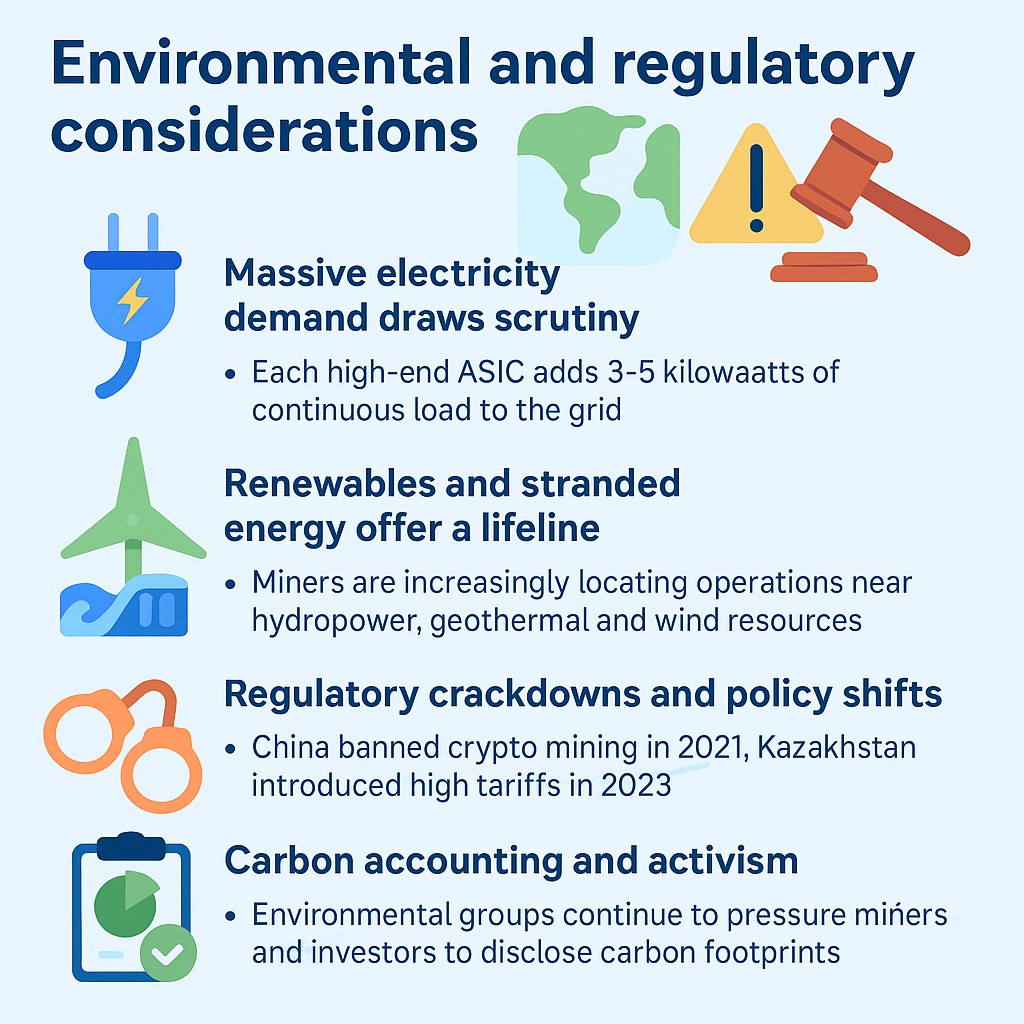
Massive electricity demand draws scrutiny. Each high‑end ASIC adds 3–5 kilowatts of continuous load to the grid. Governments worry about strain on infrastructure and carbon emissions. Regions like China banned industrial crypto mining in 2021, while Kazakhstan imposed high electricity tariffs and quotas in 2023 to curb consumption. Several U.S. states now require miners to disclose energy sources and pay higher rates during peak demand.
Renewables and stranded energy offer a lifeline. Miners are increasingly locating operations near hydropower, geothermal and wind resources. Iceland has become a hotspot thanks to its surplus of hydroelectric and geothermal energy and cool climate; miners tap into “non‑guaranteed power” unavailable to other consumers, consuming roughly 120 megawatts and making the island the most Bitcoin‑dense country per capita. Canada and parts of the Netherlands similarly attract miners seeking sustainable power. Though upfront costs are high, renewable sources reduce long‑term operating expenses and mitigate environmental backlash.
Regulatory crackdowns and policy shifts. China banned crypto mining in 2021, Kazakhstan introduced high tariffs in 2023, and several U.S. states now require miners to report energy sources or limit operations during peak demand. Similar policies are emerging worldwide as governments grapple with grid stress and carbon targets.
Carbon accounting and activism. Environmental groups continue to pressure miners and investors to disclose carbon footprints and adopt renewable energy. Miners are increasingly purchasing carbon offsets or investing in greener projects to maintain social licence.
Securing cheap renewable power and reducing geopolitical risks

Most beginners hear about ASIC mining and immediately think in terms of hardware efficiency or electricity bills. But in 2026, the real edge lies in energy sourcing contracts. Industrial miners are no longer just plugging into the grid; they’re negotiating long-term agreements with renewable producers, often at night-time or off-peak surplus rates. A beginner who learns to scout regions where solar or wind output regularly exceeds demand can tap into electricity at near-zero marginal cost. This flips the old mining math: instead of racing for the newest ASIC, the competitive advantage is securing energy that competitors overlook.
Another overlooked angle is geopolitical exposure. Countries hosting large mining pools, like Kazakhstan or Russia, have shown how quickly regulation, taxation, or energy price shifts can wipe out profitability overnight. In 2026, smaller but politically stable regions with favorable renewable subsidies are outperforming the usual mining hotspots. A beginner who maps out not just hardware specs but also jurisdictional risk, electricity grid stability, currency controls, or sudden tax reforms, will be miles ahead of those who still think mining is only about terahashes per second.
Conclusion
ASIC mining is an industrialized and competitive process driven by specialized hardware, requiring careful cost-benefit analysis. For both newcomers and seasoned traders, understanding the capabilities and limitations of ASIC technology is key to making informed decisions in a fast-evolving market.
FAQs
Can I run an ASIC miner in a residential home?
Yes, but it's not ideal. ASIC miners like the Antminer S19 Pro generate over 75 dB of noise and emit substantial heat, requiring ventilation, dedicated electrical capacity, and often causing disturbances to neighbors.
How long does an ASIC miner remain profitable?
On average, an ASIC miner remains profitable for 18–30 months, depending on electricity costs, network difficulty, and crypto prices. Regular upgrades may be required to stay competitive.
Are there risks of hardware failure with ASIC miners?
Yes. Continuous high-power operation leads to wear on fans, power supplies, and chips. Without proper cooling and maintenance, failure rates can increase significantly within 12–18 months.
Are there risks of hardware failure with ASIC miners?
Yes. Continuous high-power operation leads to wear on fans, power supplies, and chips. Without proper cooling and maintenance, failure rates can increase significantly within 12–18 months.
Editors' Top Picks and Insights





Related Articles
Team that worked on the article
Andrey Mastykin is an experienced author, editor, and content strategist who has been with Traders Union since 2020. As an editor, he is meticulous about fact-checking and ensuring the accuracy of all information published on the Traders Union platform.
Dan Blystone began his trading career in 1998 as an arbitrage clerk on the floor of the Chicago Mercantile Exchange (CME). He later traded bond and Eurex futures at proprietary firms such as Altea Trading, gaining valuable experience in high-frequency trading and risk management.
Chinmay Soni is a financial analyst with more than 5 years of experience in working with stocks, Forex, derivatives, and other assets. As a founder of a boutique research firm and an active researcher, he covers various industries and fields, providing insights backed by statistical data.
An investor is an individual, who invests money in an asset with the expectation that its value would appreciate in the future. The asset can be anything, including a bond, debenture, mutual fund, equity, gold, silver, exchange-traded funds (ETFs), and real-estate property.
Risk management is a risk management model that involves controlling potential losses while maximizing profits. The main risk management tools are stop loss, take profit, calculation of position volume taking into account leverage and pip value.
CFD is a contract between an investor/trader and seller that demonstrates that the trader will need to pay the price difference between the current value of the asset and its value at the time of contract to the seller.
Bitcoin is a decentralized digital cryptocurrency that was created in 2009 by an anonymous individual or group using the pseudonym Satoshi Nakamoto. It operates on a technology called blockchain, which is a distributed ledger that records all transactions across a network of computers.
Index in trading is the measure of the performance of a group of stocks, which can include the assets and securities in it.

-
 Afghanistan
-
 Albania
-
 Algeria
-
 Angola
-
 Argentina
-
 Armenia
-
 Australia
-
 Austria
-
 Azerbaijan
-
 Bahamas
-
 Bahrain
-
 Bangladesh
-
 Belarus
-
 Belgium
-
 Bolivia
-
 Botswana
-
 Brazil
-
 Brunei
-
 Bulgaria
-
 Cambodia
-
 Cameroon
-
 Canada
-
 Chile
Chile
-
 China
China
-
 Colombia
-
 Congo
Congo
-
 Costa Rica
-
 Cote d'Ivoire
-
 Croatia
-
 Cuba
Cuba
-
 Cyprus
-
 Czechia
-
 DR Congo
-
 Denmark
-
 Dominican Republic
-
 Ecuador
-
 Egypt
Egypt
-
 El Salvador
-
 Estonia
-
 Eswatini
-
 Ethiopia
-
 Finland
-
 France
-
 Georgia
-
 Germany
-
 Ghana
Ghana
-
 Greece
-
 Haiti
Haiti
-
 Hong Kong
-
 Hungary
-
 India
India
-
 Indonesia
-
 Iran, Islamic republic
-
 Iraq
Iraq
-
 Ireland
-
 Israel
-
 Italy
Italy
-
 Jamaica
-
 Japan
Japan
-
 Jordan
-
 Kazakhstan
-
 Kenya
Kenya
-
 Korea
Korea
-
 Kuwait
-
 Kyrgyzstan
-
 Laos
Laos
-
 Latvia
-
 Lebanon
-
 Lesotho
-
 Libya
Libya
-
 Lithuania
-
 Luxembourg
-
 Madagascar
-
 Malaysia
-
 Malta
Malta
-
 Mauritius
-
 Mexico
-
 Moldova
-
 Mongolia
-
 Montenegro
-
 Morocco
-
 Mozambique
-
 Myanmar
-
 Namibia
-
 Nepal
Nepal
-
 Netherlands
-
 New Zealand
-
 Nigeria
-
 North Macedonia
-
 Norway
-
 Oman
Oman
-
 Pakistan
-
 Palestine
-
 Panama
-
 Papua New Guinea
-
 Paraguay
-
 Peru
Peru
-
 Philippines
-
 Poland
-
 Portugal
-
 Puerto Rico
-
 Qatar
Qatar
-
 Reunion
-
 Romania
-
 Rwanda
-
 Saudi Arabia
-
 Serbia
-
 Singapore
-
 Slovakia
-
 Slovenia
-
 Somalia
-
 South Africa
-
 Spain
Spain
-
 Sri Lanka
-
 Sweden
-
 Switzerland
-
 Syria
Syria
-
 Taiwan
-
 Tajikistan
-
 Tanzania
-
 Thailand
-
 Trinidad and Tobago
-
 Tunisia
-
 Turkey
-
 UAE
UAE
-
 Uganda
-
 Ukraine
-
 United Kingdom
-
United States
-
 Uruguay
-
 Uzbekistan
-
 Venezuela
-
 Vietnam
-
 Yemen
Yemen
-
 Zambia
-
 Zimbabwe
- Forex
- Crypto












