
Could Silver Collapse The Dollar – A short Squeeze Threatens USD


Editorial Note: While we adhere to strict Editorial Integrity, this post may contain references to products from our partners. Here's an explanation for How We Make Money. None of the data and information on this webpage constitutes investment advice according to our Disclaimer.
Silver alone is unlikely to collapse the U.S. dollar, but a sharp and sustained rise in silver prices could signal deeper monetary stress. In theory, a silver short squeeze may pressure banks with large short positions, prompting liquidity injections by the Federal Reserve. If repeated money creation fuels inflation and undermines confidence in fiat currencies, silver’s repricing could amplify existing systemic risks rather than act as the sole cause of a dollar crisis.
This article outlines the basics of how a breakaway in silver prices could prove to be a catalyst that triggers runaway inflation, which then ultimately leads to the collapse of the U.S. dollar. The article points out how the Federal Reserve Bank may fall into a money-printing doom loop as it tries to prop up major banks that may be caught in a massive silver short squeeze. Silver’s unmatched position as an essential industrial metal makes it a critically important commodity.
Could silver trigger a dollar shock?
Is it possible that tiny little silver could collapse the U.S. dollar? – be the catalyst that fires up the destruction of the world’s #1 reserve currency? Well, boys and girls, stranger things have happened. And one thing I have learned in the financial markets is to never say something is impossible – because it’s often likely to happen just a few minutes after you say that.
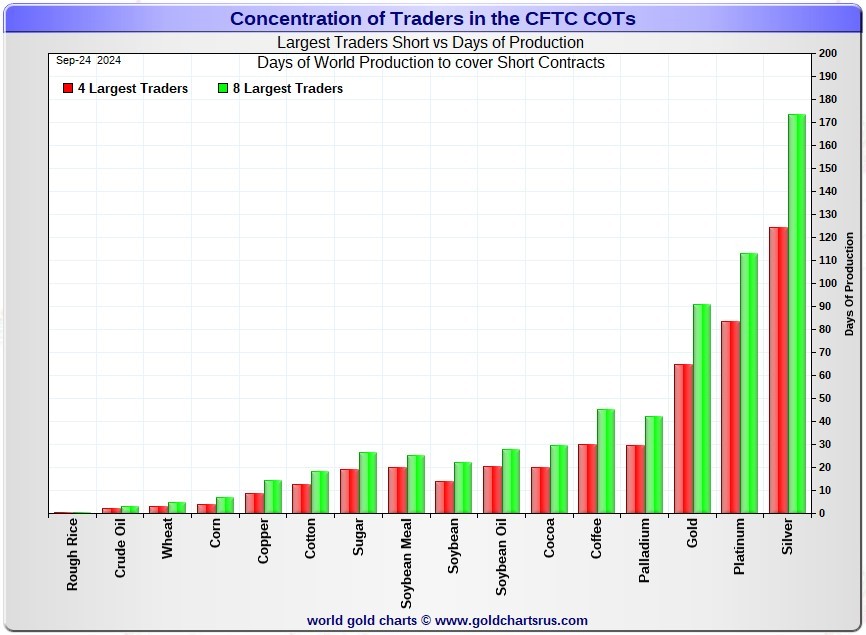
Don’t think silver is all that important? Take a look at this chart – it shows the days that would be required – versus production – for the biggest traders who are short silver to cover their short positions. One has to ask why little old silver (far right on the chart, in case you can’t read it) garners so much short sell attention from major traders, as compared to every other commodity on the board, including its sister metal, gold. Looks like some very major players consider silver to be very, very important.
On a Friday – near the end of the year, sandwiched between Christmas day and the weekend – what should have been a quiet day in the financial markets…BOOM! – Spot silver moonshots from $74 an ounce to $78 an ounce – up more than 5% in just one day. (And it’s still trading $5-$10 an ounce higher than that in Shanghai.) That sudden surge reignited a long-running debate across global markets about will silver hit $100 an ounce under sustained industrial demand, tightening supply, and shifting macroeconomic conditions.
On that same day, the Federal Reserve Bank of the U.S. stepped in to inject $17 billion into the repo market – the loan resource of last resort for major U.S. banks. (And the Fed would inject another helpful $34 billion into the repo market on the following Monday.) Did one of the major banks get caught short with their silver shorts and need some fast cash to cover a margin call?
Silver brings down the U.S. dollar
But how could silver bring down the mighty U.S. dollar? Okay – hang on tight while I try to explain that in just this brief blog post. The massive short sellers of silver over the years have, effectively, been defending the value of the U.S. dollar. Because what astronomically higher gold and silver prices reflect is, in part, the massive devaluation of USD – the fact that its lost roughly 99% of its purchasing power.
The Fed’s injection of $17 billion into the repo market is another instance, like QE, of printing cash out of thin air. And the Fed introducing more cash into the economy fuels the fires of inflation. (You might have noticed that, on the same day this big run up in gold and silver prices occurred, the U.S. dollar index dropped dramatically.)
But the Fed could be falling into a doom loop. Printing more money fuels inflation. Inflation fuels higher prices for hard physical assets such as gold and silver. Higher silver prices mean the major bullion banks getting squeezed tighter and tighter by their short positions. So, the Fed may have to inject more cash into the repo market to shore up the banks…and that more cash will fuel more inflation…which will fuel higher gold and silver prices…well, you get the idea. Eventually, inflation could blow up into hyperinflation that results in a collapse of the U.S. dollar.
Here's how financial contagion from the silver market to the U.S. dollar might unfold:
a major bullion bank’s huge short position in a runaway silver market causes it to default to the exchange clearinghouse;
the clearinghouse turns to the other major banks to supply the shortfall in capital;
all the major banks are counterparties to each other – JP Morgan to HSBC, HSBC to Citibank, etc.
The Domino effect could result, with one threatened major bank collapse after another. In the world of highly-leveraged derivative contracts, counterparty risk can spread like a wildfire.
How to prevent that collapse of dominos? Well, for a while anyway, it can be prevented by the Fed continuing to step in and print more billions in cash to save those “too big to fail” financial institutions. And that appears to be what the Fed is signaling it will do. (It shouldn’t really be a surprise that the Federal Reserve Bank – an entity created by a bunch of bank tycoons – has a stronger allegiance to major banks than it does to the U.S. dollar.)
But here’s the thing: It’s unlikely that the U.S. dollar – or any other major currency – can survive another round of unlimited money printing. You can debase your currency for a while, but you can’t debase it forever. Eventually, inflation becomes hyperinflation, and hyperinflation becomes the death knell for your fiat currency.
Who’s buying all the silver?
It’s worth paying attention to who the buyers of silver are. The big buyers of silver aren’t little retail investors. They aren’t even large institutional investors such as pension funds and hedge funds. No – rather, they’re the gigantic international corporations such as Apple, Samsung, Tesla, and Intel that absolutely have to have silver to manufacture their products. They’re sovereign wealth funds and central banks from every corner of the globe. And they’re the military industrial complex of every major world power, where silver is a large and critical ingredient in making weapons such as Tomahawk cruise missiles (500 ounces of silver in the head of every single one of them).
What happens when all those big buyers, greedily grabbing up every ounce of silver they can get their hands on, start to squeeze out slightly smaller industries that also desperately need tons of silver every month…such as the medical industry?
Well, that’s just one more way of possible financial contagion spreading from the price of silver finally breaking free of the massive suppression by bullion banks that has held it down for decades. The artificial suppression of silver prices is one of the last lines of defense for the fiat currency, USD.
The answer that is most commonly given to this question is that, on the Shanghai metals exchange, unlike on the London and New York exchanges, there is no concerted effort by major banks to suppress the price of silver. Therefore, silver trades closer to its real value in Shanghai.
If silver is indeed acting as a monetary pressure gauge, then access to the right trading infrastructure becomes critical. During sharp repricing phases, spreads widen and execution risk increases – which makes broker selection more important than entry timing.
| Plus500 | OANDA | FOREX.com | IG Markets | Interactive Brokers | |
|---|---|---|---|---|---|
|
Min. deposit, $ |
100 | No | 100 | 1 | No |
|
Tradable assets |
2800 | 129 | 5500 | 20000 | 30000 |
|
Max. leverage |
1:300 | 1:200 | 1:50 | 1:200 | 1:30 |
|
Max. Regulation Level |
Tier-1 | Tier-1 | Tier-1 | Tier-1 | Tier-1 |
|
TU overall score |
6.67 | 6.63 | 6.47 | 6.38 | 6.37 |
|
Open an account |
Go to broker 81% of retail CFD accounts lose money. |
Go to broker Your capital is at risk. |
Study review | Study review | Study review |
XAG/USD News

Tungsten West secures UK backing for Devon mine restart
When silver reprices, monetary stress is already present

Watching commodity markets and monetary policy cycles, silver tends to send signals long before they become obvious in currency markets. I don’t view silver as a trigger on its own, but rather as a pressure gauge. When stress builds in financial plumbing – liquidity shortages, leverage imbalances, confidence gaps – silver often reacts earlier than most assets because it sits at the intersection of industry, investment, and monetary psychology.
What concerns me most is not the price of silver in isolation, but the environment in which a sharp repricing could occur. If higher silver prices coincide with aggressive liquidity injections, rising counterparty risk, and constrained physical supply, the impact would likely extend well beyond metals markets. In such scenarios, currency stability becomes a secondary objective to systemic containment.
For investors, the practical takeaway is not to expect sudden collapse scenarios, but to recognize silver’s role as a strategic hedge rather than a speculative trade. Allocations should be sized conservatively, held patiently, and viewed as protection against policy risk rather than a bet on timing. History shows that monetary stress rarely announces itself clearly – it accumulates, then surfaces through assets that are hardest to replace. Silver is one of them.
In my view, the question is not whether silver alone can undermine fiat currencies, but whether prolonged monetary intervention leaves enough room for confidence to recover once tangible assets begin to reprice. That is where long-term risk management matters more than short-term forecasts.
Conclusion
While silver alone is unlikely to collapse the US dollar, its role as a strategic pressure gauge in times of monetary stress cannot be underestimated. A sharp and sustained rise in silver prices, especially under conditions like a short squeeze, could expose the fragility of over-leveraged financial institutions and force the Federal Reserve into repeated money printing, fueling inflation. The increasing demand from technology giants, central banks, and the military only amplifies silver's importance as both an industrial and monetary asset. Ultimately, when tangible assets like silver begin to sharply reprice, it signals deeper cracks in fiat currency systems—reminding investors that the loss of confidence in money almost always starts with assets that cannot be easily replaced.
FAQs
How does ongoing silver price suppression relate to the stability of the US dollar?
What is the risk of hyperinflation if the Federal Reserve repeatedly intervenes during silver market disruptions?
How does industrial demand for silver differ from traditional investment demand, and why is it important?
Can buying trends in other commodities signal similar monetary risks as seen with silver?
Editors' Top Picks and Insights





Related Articles
Team that worked on the article
Johnathan M. is a U.S.-based writer and investor, a contributor to the Traders Union website.
Dan Blystone began his trading career in 1998 as an arbitrage clerk on the floor of the Chicago Mercantile Exchange (CME). He later traded bond and Eurex futures at proprietary firms such as Altea Trading, gaining valuable experience in high-frequency trading and risk management.
Chinmay Soni is a financial analyst with more than 5 years of experience in working with stocks, Forex, derivatives, and other assets. As a founder of a boutique research firm and an active researcher, he covers various industries and fields, providing insights backed by statistical data.
Ethereum is a decentralized blockchain platform and cryptocurrency that was proposed by Vitalik Buterin in late 2013 and development began in early 2014. It was designed as a versatile platform for creating decentralized applications (DApps) and smart contracts.
The CFTC protects the public from fraud, manipulation, and abusive practices related to the sale of commodity and financial futures and options, and to fosters open, competitive, and financially sound futures and option markets.
A short squeeze is a situation in which short sellers are forced to close their positions at a loss, which leads to a sharp rise in the price of an asset.
CFD is a contract between an investor/trader and seller that demonstrates that the trader will need to pay the price difference between the current value of the asset and its value at the time of contract to the seller.
A margin call is a demand made by a broker or a financial institution to a trader or investor who is using margin (borrowed funds) to cover potential losses in a trading account. It occurs when the value of the securities or assets held in the account falls below a certain threshold, known as the maintenance margin or margin requirement, as specified by the broker.

-
 Afghanistan
-
 Albania
-
 Algeria
-
 Angola
-
 Argentina
-
 Armenia
-
 Australia
-
 Austria
-
 Azerbaijan
-
 Bahamas
-
 Bahrain
-
 Bangladesh
-
 Belarus
-
 Belgium
-
 Bolivia
-
 Botswana
-
 Brazil
-
 Brunei
-
 Bulgaria
-
 Cambodia
-
 Cameroon
-
 Canada
-
 Chile
Chile
-
 China
China
-
 Colombia
-
 Congo
Congo
-
 Costa Rica
-
 Cote d'Ivoire
-
 Croatia
-
 Cuba
Cuba
-
 Cyprus
-
 Czechia
-
 DR Congo
-
 Denmark
-
 Dominican Republic
-
 Ecuador
-
 Egypt
Egypt
-
 El Salvador
-
 Estonia
-
 Eswatini
-
 Ethiopia
-
 Finland
-
 France
-
 Georgia
-
 Germany
-
 Ghana
Ghana
-
 Greece
-
 Haiti
Haiti
-
 Hong Kong
-
 Hungary
-
 India
India
-
 Indonesia
-
 Iran, Islamic republic
-
 Iraq
Iraq
-
 Ireland
-
 Israel
-
 Italy
Italy
-
 Jamaica
-
 Japan
Japan
-
 Jordan
-
 Kazakhstan
-
 Kenya
Kenya
-
 Korea
Korea
-
 Kuwait
-
 Kyrgyzstan
-
 Laos
Laos
-
 Latvia
-
 Lebanon
-
 Lesotho
-
 Libya
Libya
-
 Lithuania
-
 Luxembourg
-
 Madagascar
-
 Malaysia
-
 Malta
Malta
-
 Mauritius
-
 Mexico
-
 Moldova
-
 Mongolia
-
 Montenegro
-
 Morocco
-
 Mozambique
-
 Myanmar
-
 Namibia
-
 Nepal
Nepal
-
 Netherlands
-
 New Zealand
-
 Nigeria
-
 North Macedonia
-
 Norway
-
 Oman
Oman
-
 Pakistan
-
 Palestine
-
 Panama
-
 Papua New Guinea
-
 Paraguay
-
 Peru
Peru
-
 Philippines
-
 Poland
-
 Portugal
-
 Puerto Rico
-
 Qatar
Qatar
-
 Reunion
-
 Romania
-
 Rwanda
-
 Saudi Arabia
-
 Serbia
-
 Singapore
-
 Slovakia
-
 Slovenia
-
 Somalia
-
 South Africa
-
 Spain
Spain
-
 Sri Lanka
-
 Sweden
-
 Switzerland
-
 Syria
Syria
-
 Taiwan
-
 Tajikistan
-
 Tanzania
-
 Thailand
-
 Trinidad and Tobago
-
 Tunisia
-
 Turkey
-
 UAE
UAE
-
 Uganda
-
 Ukraine
-
 United Kingdom
-
United States
-
 Uruguay
-
 Uzbekistan
-
 Venezuela
-
 Vietnam
-
 Yemen
Yemen
-
 Zambia
-
 Zimbabwe
- Forex
- Crypto












