
How Much Do Gold Traders Make In 2026?



Editorial Note: While we adhere to strict Editorial Integrity, this post may contain references to products from our partners. Here's an explanation for How We Make Money. None of the data and information on this webpage constitutes investment advice according to our Disclaimer.
Gold traders earn between $1,000 and over $300,000 per year, depending on experience, capital access, and trading model. Retail traders usually make modest returns, often under $15,000 annually. Profitable prop firm traders may earn $5,000 to $10,000 per month. At banks and commodity firms, gold traders earn a salary of roughly $150,000 to $300,000 per year when base pay and bonuses are combined. Whether gold trading is profitable depends on risk control, discipline, and consistency.
Gold trading continues to attract a wide range of market participants, from hedge funds to at-home investors. But the question many are asking remains: how much do gold traders make in today’s global markets? This guide provides a detailed picture of income levels across trading styles, risk tiers, and market access. Whether you're considering a career shift or looking to expand into commodities, you'll find actionable insights here.
Gold trading market overview
Gold trading operates within one of the most liquid and globally connected financial markets. Unlike many assets that trade within limited hours or regions, gold is priced and traded almost continuously across major financial centers, making it accessible to traders worldwide.
At the core of the global gold market are large institutional venues that set benchmark prices. Futures trading is dominated by COMEX, part of the CME Group, which provides standardized contracts and transparent price discovery. These futures prices often serve as reference points for traders, funds, and central banks.
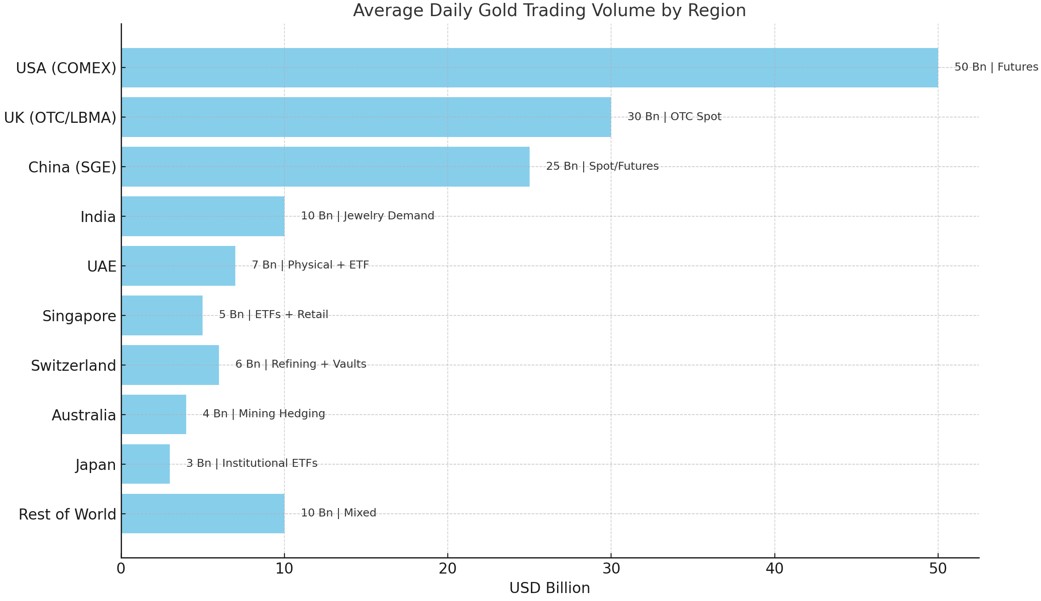
Alongside futures markets, a significant portion of gold trading takes place over the counter. The London Bullion Market Association facilitates large scale physical gold transactions between banks, bullion dealers, and institutions. This market plays a critical role in global liquidity, even though it operates with less public transparency than exchanges.
In Asia, the Shanghai Gold Exchange reflects growing regional influence in gold demand and pricing. Strong participation from China, along with demand from India and other emerging markets, ensures that gold trading activity spans multiple time zones and economic cycles.
Retail traders interact with this ecosystem indirectly. Most individuals trade gold through derivatives such as CFDs, futures, or exchange-traded funds offered by online brokers. These instruments allow traders to speculate on price movements without owning physical gold, lowering entry barriers and increasing participation.
This layered market structure is what makes gold attractive to different types of traders. High liquidity supports short-term strategies, while global participation and macroeconomic sensitivity make gold suitable for long term positioning and hedging. Understanding this foundation is essential before evaluating who trades gold and how income differs across trader types.
Types of gold traders and how they operate
Gold trading attracts very different participants, each operating under distinct constraints, capital levels, and income models. Understanding who trades gold, and how they do it, is essential before comparing earnings or profitability.
Institutional gold traders
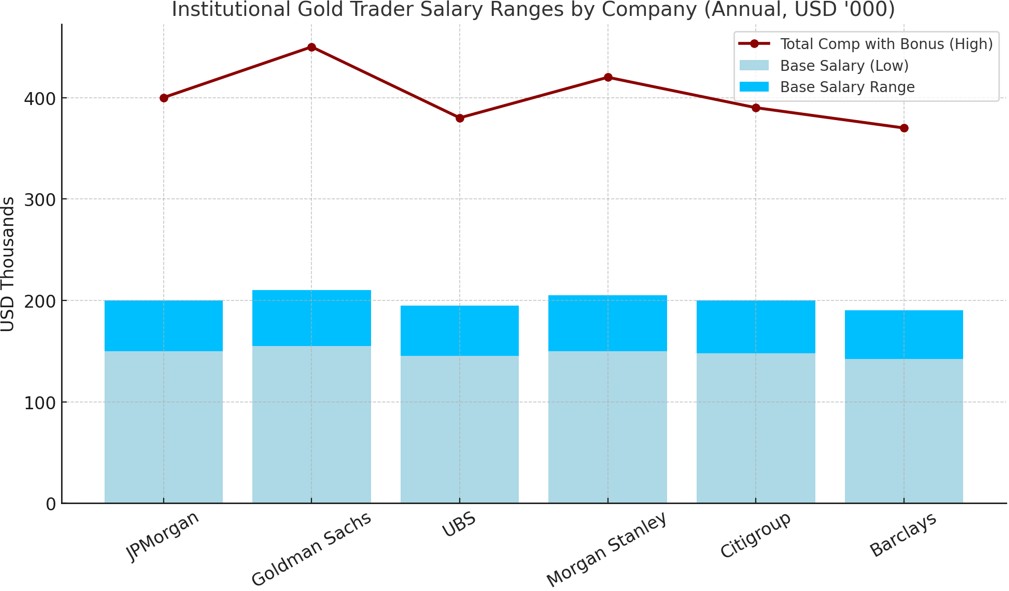
Institutional traders work for investment banks, hedge funds, asset managers, and commodities trading firms. They trade gold as part of broader macro or commodities portfolios, often using futures, options, and structured products. Positions are typically large, highly regulated, and subject to strict risk limits.
These traders rely on deep market access, proprietary research, and real-time data. Their decisions are influenced by interest rate policy, inflation expectations, currency movements, and geopolitical developments. While institutional traders benefit from scale and low transaction costs, they also face intense performance pressure and limited flexibility due to compliance rules.
Retail gold traders
Retail traders operate independently through online brokers. Most trade gold via CFDs, spot contracts, or exchange-traded funds rather than physical bullion. Account sizes are usually small to mid-range, which makes retail traders more sensitive to spreads, slippage, and leverage.
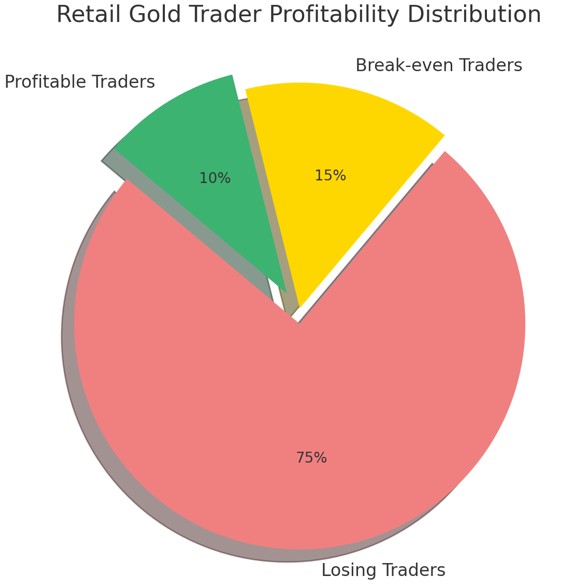
Many retail traders focus on technical analysis, short-term price patterns, and economic news. However, outcomes vary widely. Without structured risk management, volatility and leverage can quickly erode capital. For this group, success depends far more on discipline and consistency than on market access.
Prop firm traders
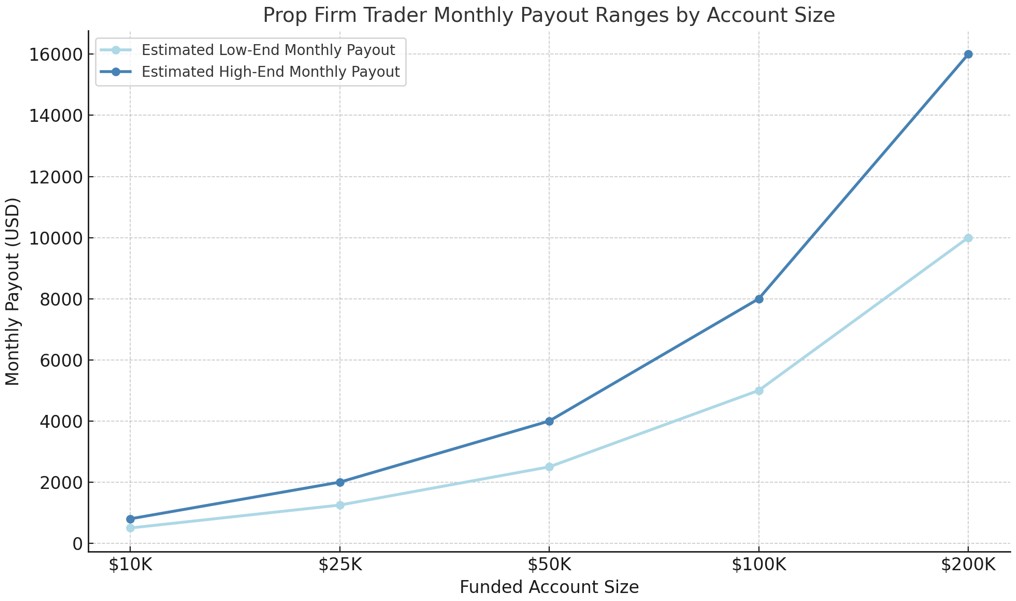
These individuals trade gold using capital provided by proprietary trading firms, often after passing a qualification phase or simulated challenge. Prop firms like FTMO offer funded accounts ranging from $10,000 to $200,000. Traders typically keep 70 to 80% of the profits, while the firm covers losses beyond a set risk threshold.
Earnings vary based on performance and risk limits, but skilled gold-focused traders can make $5,000-$10,000/month, especially during periods of high volatility like inflation releases or Fed policy meetings. Prop firms often require daily or weekly drawdown limits, encouraging professional discipline. This model is especially attractive to skilled traders without large personal capital but who seek access to institutional-grade resources and account scaling.
Key earning scenarios in gold trading
Earnings from gold trading vary widely depending on how the market is approached, the capital involved, and how consistently risk is managed. These scenarios illustrate how trading in gold can generate income under different conditions, without assuming guaranteed profitability.
Gold futures trading and structured strategies
Professional traders who focus on gold futures usually operate on regulated exchanges and follow structured systems based on order flow, volume analysis, or macroeconomic positioning. In this form of gold trading, results are shaped more by execution discipline than by predicting large price moves.
When risk is controlled and leverage is moderate, this approach can produce steady annual returns in the range of $40,000 to $60,000. In practice, gold becomes profitable only when losses are limited and capital drawdowns are kept small over time.
Spot gold trading through Forex brokers
Many individual traders access gold through spot contracts such as XAU/USD offered by online brokers. This is one of the most common ways of trading in gold at the retail level because entry costs are relatively low and position sizes are flexible.
With smaller accounts, income expectations should remain modest. Traders who apply consistent risk rules and avoid overleveraging may generate supplementary income rather than a full salary. Profitability in this case depends on cost control, discipline, and the ability to adapt to changing market conditions.
Short-term and intraday gold trading
Some traders attempt to profit from short-term gold price movements driven by intraday volatility and news events. This approach demands constant monitoring and fast decision making. While gains can occur quickly, losses can accumulate just as fast.
Over longer periods, sustaining income from frequent gold trades is difficult for most participants. Success depends on emotional control, strict trade limits, and the ability to avoid overtrading. For many traders, longer holding periods and fewer decisions prove more sustainable than constant intraday activity.
Is day trading gold profitable?
Day trading gold can be profitable, but it is also risky. Gold is highly liquid and reacts strongly to economic data, interest rate changes, and geopolitical news, which creates short-term trading opportunities. However, price swings can be sharp and unpredictable. Success depends on strong risk management, discipline, and experience. Most beginners lose money at first, while consistent profits are more common among skilled, well-prepared traders.
Factors that influence gold trading income
Income from gold trading is not random. It is shaped by a set of structural and behavioral factors that determine whether trading in gold remains sustainable over time or breaks down during difficult market conditions.
Capital size and access. Traders with larger capital bases or access to firm funding can absorb drawdowns more effectively and scale positions without increasing relative risk.
Risk management discipline. Limiting losses per trade, respecting drawdown rules, and maintaining consistent position sizing has a greater impact on long-term results than entry timing.
Strategy complexity. Simpler approaches often generate smaller but steadier returns, while complex strategies can produce higher volatility and wider income swings.
Market environment. Gold behaves differently during inflationary periods, tightening cycles, or geopolitical stress. Traders who adapt to changing regimes perform better than those using fixed assumptions.
Time commitment. Active short-term trading requires constant attention, while swing or position based approaches demand less screen time but greater patience.
Cost structure. Spreads, commissions, financing fees, and slippage can quietly erode returns, especially for high frequency gold traders.
Psychological control. Emotional decision making, revenge trading, and overconfidence are common reasons income becomes inconsistent even with a sound strategy.
Taken together, these factors explain why outcomes in gold trading vary so widely. Profitability is less about predicting gold prices and more about controlling risk, behavior, and exposure across different market phases.
Gold trader salary ranges by profile
Income from gold trading varies widely depending on whether a trader is employed, performance based, or self funded. To avoid confusion, it is important to distinguish between salary, earnings, and trading income, as these terms are often used interchangeably but mean very different things in practice.
Institutional gold traders (salaried roles)
Institutional gold traders are full time employees of banks, hedge funds, asset managers, or large commodities trading firms. In these roles, traders receive a fixed base salary combined with performance bonuses linked to desk or portfolio results.
In the United States and Europe, entry level and mid-level gold traders typically earn a base salary between $90,000 and $150,000 per year. With bonuses included, total compensation often rises to $180,000–$250,000 annually. Senior traders and desk heads managing large books can earn well above $300,000 in strong years. This is the most stable income path in gold trading, but it also comes with strict risk limits, compliance oversight, and sustained performance pressure.
Proprietary trading firm traders (performance based)
Proprietary firm gold traders do not receive a fixed salary. Instead, they trade capital provided by the firm and earn a percentage of the profits they generate. Profit splits typically range from 70% to 80%, depending on the firm and account size.
For skilled traders who specialize in gold, monthly earnings can range from $5,000 to $10,000 during favorable market conditions. However, income is inconsistent and entirely dependent on performance. Violating drawdown rules or risk limits can result in account termination, making this model higher risk but potentially higher reward than salaried roles.
Retail gold traders (self funded income)
Retail traders do not earn a salary from trading in gold. They trade their own capital and keep all profits while absorbing all losses. Income levels in this group vary dramatically.
Most retail traders earn little or lose money, especially early on. In profitable cases, annual income often falls between $1,200 and $15,000 unless significant capital and experience are involved. While higher returns are possible, they are rare and usually require years of discipline, conservative risk management, and emotional control.
Is gold trading profitable in the long term?
Whether gold trading remains profitable over the long term depends far more on structure and discipline than on market direction. Gold offers frequent trading opportunities, but opportunity alone does not translate into sustainable income. Many traders experience short periods of success, only to give back gains when conditions change.
For professional traders, long term profitability comes from operating within clearly defined risk frameworks. These traders limit losses per trade, adapt strategies to changing market regimes, and treat trading in gold as a repeatable process rather than a series of isolated bets. Over time, this approach allows returns to compound while keeping drawdowns manageable.
For retail participants, the picture is more mixed. While some individuals do manage to stay profitable, most struggle with volatility, leverage, and emotional decision making. In this group, the question of whether trading gold is profitable depends on patience, capital preservation, and the ability to avoid overtrading. Short-term success does not guarantee long term survival.
Day trading gold presents additional challenges. Frequent execution increases transaction costs and psychological pressure. For many traders, sustained income from intraday gold trading proves difficult to maintain over multiple market cycles. This is why discussions around whether day trading gold is profitable often highlight consistency and risk control rather than raw returns.
In practical terms, long term success in gold trading is achievable, but rare. Those who succeed treat it like a business, not a shortcut to fast income. Profitability comes from disciplined execution, adaptability, and respect for risk, not from predicting every move in the gold market.
Before any income expectations become realistic, gold trading has to be placed in the right environment. Using a broker that consistently offers access to gold markets helps ensure smoother execution and fewer avoidable issues as strategies are applied. The table below highlights some of the best brokers that offer gold trading, giving readers a practical reference point alongside the income scenarios discussed above.
| Plus500 | OANDA | FOREX.com | IG Markets | Interactive Brokers | |
|---|---|---|---|---|---|
|
Gold |
Yes | Yes | Yes | Yes | Yes |
|
XAU/USD spread, pips |
45 | 30 | 35 | 30 | 15 |
|
XAU/USD commission, $ |
3 | 3 | 2.5 | No | 2 |
|
Min. deposit, $ |
100 | No | 100 | 1 | No |
|
Regulation |
CySEC, FCA, ASIC, FMA, FSCA, FSA Seychelles, EFSA, MAS, DFSA, SCB | FSC (BVI), ASIC, IIROC, FCA, CFTC, NFA | CIMA, FCA, FSA (Japan), NFA, IIROC, ASIC, CFTC | FCA, BaFin, ASIC, MAS, CySec, FINMA, BMA, CFTC, NFA | SEC, FINRA, SIPC, FCA, NSE, BSE, SEBI, SEHK, HKFE, IIROC, ASIC, CFTC, NFA |
|
TU overall score |
8.45 | 7.02 | 6.88 | 6.86 | 6.85 |
|
Open an account |
Go to broker 80% of retail CFD accounts lose money. |
Go to broker Your capital is at risk. |
Study review | Study review | Study review |
Gold News and Precious Metal & Commodity Market Updates

US halts Israel–Iran escalation, lowers safe-haven demand for Gold

RBI announces premature redemption price for Sovereign Gold Bond 2019-20 Series VII

Gold holds steady as softer oil prices support safe haven demand

Gold consolidates as China central bank gold accumulation continues

Gold holds steady as large gold ETF subscription limits are imposed

U.S. senators urge Treasury to halt Trump gold coin production
Consistency matters more than prediction

When people ask me whether gold trading can provide reliable income, my answer is always the same: only with structure and restraint. Gold rewards traders who respect its volatility and punishes those who treat it as a quick profit tool. The market offers opportunity, but it does not forgive poor risk decisions.
In my experience, traders who succeed over time approach trading in gold with clear rules and modest expectations. They focus on protecting capital first, adapting to changing market conditions, and reviewing performance regularly. Profitability is built through consistency, not prediction.
Conclusion
Gold trading in 2026 offers lucrative opportunities for both retail and professional traders, but success hinges on disciplined strategies and a keen understanding of market dynamics. While salary ranges vary widely—with entry-level retail traders earning modest sums and experienced professionals commanding six-figure incomes—the most consistent earners combine technical analysis with prudent risk management. For instance, traders utilizing automated systems or hedging techniques often outperform those relying solely on speculation. Ultimately, the profitability of gold trading is not guaranteed, but those who prioritize learning and adaptability stand to reap substantial rewards. In the ever-shifting gold market, strategic agility is the true currency of success.
FAQs
How does the choice between physical gold and derivative instruments impact gold trading salary prospects?
What role does market volatility play in determining the returns of different gold trading strategies?
Are there seasonal or economic periods when gold trading salaries tend to be higher?
Which skills are most critical for traders seeking to increase their long-term gold trading income?
Editors' Top Picks and Insights

Crypto on the court: How NBA Finals became a showcase for Ledger

How to build wealth from scratch in 3 practical steps

Kospi Index crash: Why South Korean market fell alongside AI stocks

Bitcoin or Ferrari: Which investment is better?

Strategy sells Bitcoin: Small sale tests market confidence

Ledger vs. Trezor: Search for ideal crypto wallet
Related Articles
Team that worked on the article
Aleksandra Chaikina has been a contributor to Traders Union since 2021. With over 15 years of experience in copywriting and more than 5 years focused on financial content, she specializes in producing detailed guides, analytics, and comparative reviews across various sectors, including cryptocurrencies, Forex, investment strategies, and financial technologies.
Dan Blystone began his trading career in 1998 as an arbitrage clerk on the floor of the Chicago Mercantile Exchange (CME). He later traded bond and Eurex futures at proprietary firms such as Altea Trading, gaining valuable experience in high-frequency trading and risk management.
Chinmay Soni is a financial analyst with more than 5 years of experience in working with stocks, Forex, derivatives, and other assets. As a founder of a boutique research firm and an active researcher, he covers various industries and fields, providing insights backed by statistical data.
Forex leverage is a tool enabling traders to control larger positions with a relatively small amount of capital, amplifying potential profits and losses based on the chosen leverage ratio.
Proprietary trading (prop trading) is a financial trading strategy where a financial firm or institution uses its own capital to trade in various financial markets, such as stocks, bonds, commodities, or derivatives, with the aim of generating profits for the company itself. Prop traders typically do not trade on behalf of clients but instead trade with the firm's money, taking on the associated risks and rewards.
Overtrading is a phenomenon where a trader executes too many transactions in the market, surpassing their strategy and trading more frequently than planned. It's a common mistake that can lead to financial losses.
Cross trading is a unique type of broker-side trade where they buy and sell an underlying at the same time, in a manner that both transactions offset each other. Such transactions are not recorded on the exchange, leaving non-participants unaware of their existence.
Day trading involves buying and selling financial assets within the same trading day, with the goal of profiting from short-term price fluctuations, and positions are typically not held overnight.


-
 Afghanistan
-
 Albania
-
 Algeria
-
 Angola
-
 Argentina
-
 Armenia
-
 Australia
-
 Austria
-
 Azerbaijan
-
 Bahamas
-
 Bahrain
-
 Bangladesh
-
 Belarus
-
 Belgium
-
 Bolivia
-
 Botswana
-
 Brazil
-
 Brunei
-
 Bulgaria
-
 Cambodia
-
 Cameroon
-
 Canada
-
 Chile
Chile
-
 China
China
-
 Colombia
-
 Congo
Congo
-
 Costa Rica
-
 Cote d'Ivoire
-
 Croatia
-
 Cuba
Cuba
-
 Cyprus
-
 Czechia
-
 DR Congo
-
 Denmark
-
 Dominican Republic
-
 Ecuador
-
 Egypt
Egypt
-
 El Salvador
-
 Estonia
-
 Eswatini
-
 Ethiopia
-
 Finland
-
 France
-
 Georgia
-
 Germany
-
 Ghana
Ghana
-
 Greece
-
 Haiti
Haiti
-
 Hong Kong
-
 Hungary
-
 India
India
-
 Indonesia
-
 Iran, Islamic republic
-
 Iraq
Iraq
-
 Ireland
-
 Israel
-
 Italy
Italy
-
 Jamaica
-
 Japan
Japan
-
 Jordan
-
 Kazakhstan
-
 Kenya
Kenya
-
 Korea
Korea
-
 Kuwait
-
 Kyrgyzstan
-
 Laos
Laos
-
 Latvia
-
 Lebanon
-
 Lesotho
-
 Libya
Libya
-
 Lithuania
-
 Luxembourg
-
 Madagascar
-
 Malaysia
-
 Malta
Malta
-
 Mauritius
-
 Mexico
-
 Moldova
-
 Mongolia
-
 Montenegro
-
 Morocco
-
 Mozambique
-
 Myanmar
-
 Namibia
-
 Nepal
Nepal
-
 Netherlands
-
 New Zealand
-
 Nigeria
-
 North Macedonia
-
 Norway
-
 Oman
Oman
-
 Pakistan
-
 Palestine
-
 Panama
-
 Papua New Guinea
-
 Paraguay
-
 Peru
Peru
-
 Philippines
-
 Poland
-
 Portugal
-
 Puerto Rico
-
 Qatar
Qatar
-
 Reunion
-
 Romania
-
 Rwanda
-
 Saudi Arabia
-
 Serbia
-
 Singapore
-
 Slovakia
-
 Slovenia
-
 Somalia
-
 South Africa
-
 Spain
Spain
-
 Sri Lanka
-
 Sweden
-
 Switzerland
-
 Syria
Syria
-
 Taiwan
-
 Tajikistan
-
 Tanzania
-
 Thailand
-
 Trinidad and Tobago
-
 Tunisia
-
 Turkey
-
 UAE
UAE
-
 Uganda
-
 Ukraine
-
 United Kingdom
-
United States
-
 Uruguay
-
 Uzbekistan
-
 Venezuela
-
 Vietnam
-
 Yemen
Yemen
-
 Zambia
-
 Zimbabwe
- Forex
- Crypto












