
Gold Trading: How To Calculate Pips In XAU/USD



Editorial Note: While we adhere to strict Editorial Integrity, this post may contain references to products from our partners. Here's an explanation for How We Make Money. None of the data and information on this webpage constitutes investment advice according to our Disclaimer.
In XAU/USD trading, a pip represents a price movement of 0.01. To calculate the monetary value of a pip, multiply 0.01 by your lot size. For example, with a standard lot of 100 ounces, one pip equates to $1.
Trading gold (XAU/USD) requires a precise understanding of price movements, including the calculation of pips, the smallest price change. Unlike currency pairs, where a pip is usually 0.0001, in XAU/USD one pip is equal to 0.01. Knowing the correct pip value helps traders estimate potential profits and losses, as well as manage risks effectively. Here, we will look at how a pip is calculated in XAU/USD, what factors affect its value, and how to use this knowledge in trading. The formulas and examples provided will help you quickly master the calculations and apply them in practice.
What are pips and how do they work in XAU/USD
In Forex trading, a pip (percentage in point) represents the smallest price movement in a currency pair. For most currency pairs, one pip equals a price change of 0.0001. However, when trading gold against the US dollar (XAU/USD), the definition differs due to the way gold prices are quoted.
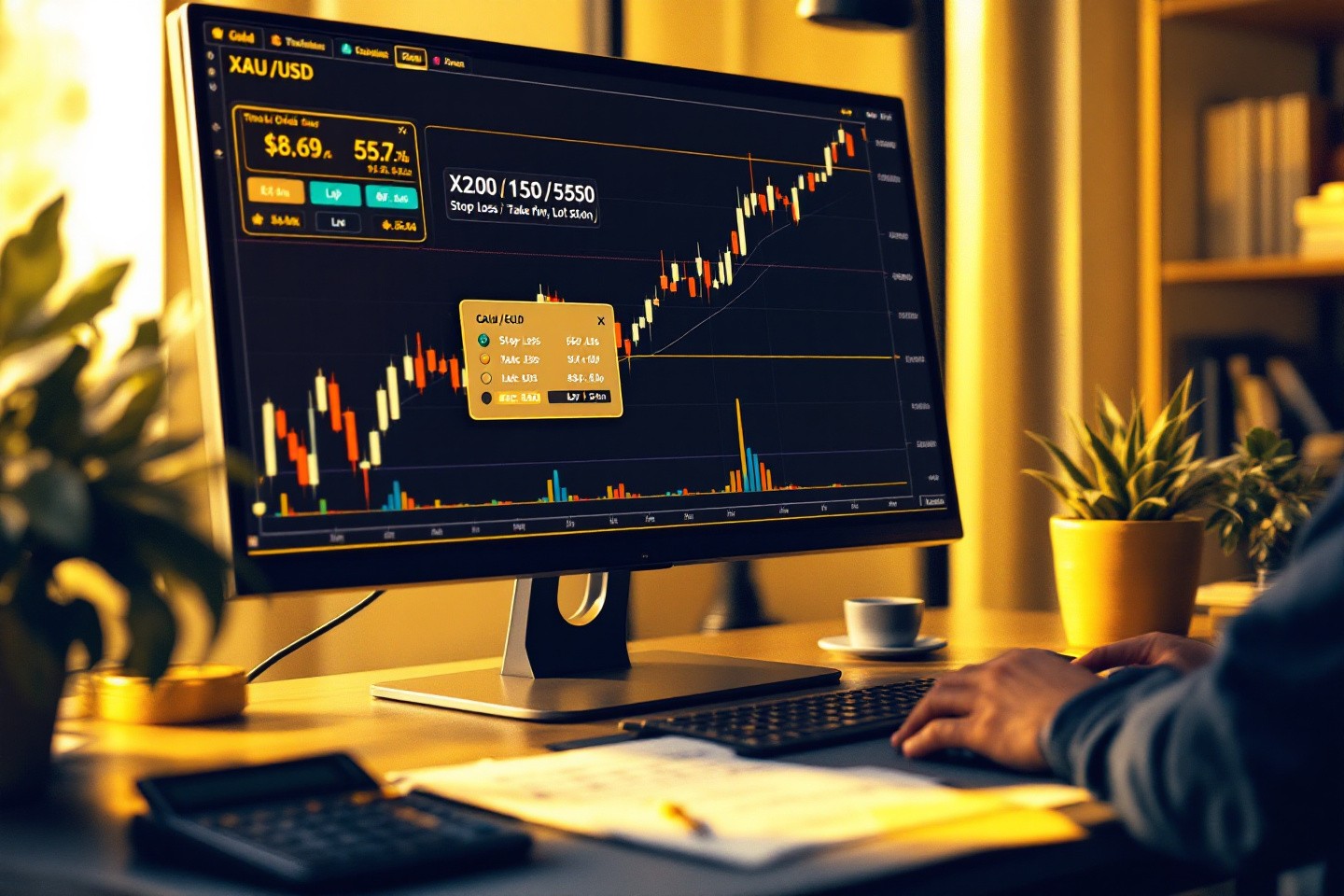
Pip definition in XAU/USD
Gold prices are usually quoted with two decimal places. In the context of XAU/USD, one pip is equal to a price movement of 0.01. For example, if the price of gold rises from 1800.00 to 1800.01, this 0.01 increase represents a one-pip movement.
Calculating pip value in XAU/USD
The monetary value of a pip in XAU/USD depends on the size of the trading position.
Standard lot (100 ounces). A one-pip movement (0.01) results in a $1 change in the position's value.
Mini lot (10 ounces). A one-pip movement equates to a $0.10 change.
Micro lot (1 ounce). Each pip movement corresponds to a $0.01 change.
For instance, trading a standard lot means that a $1 price movement in gold (equivalent to 100 pips) would result in a $100 profit or loss.
Importance of understanding pip value in gold trading
Grasping the concept of pips and their value is crucial for effective risk management in gold trading. Given gold's volatility, even minor price fluctuations can significantly impact trading accounts, especially when leverage is used. By understanding pip values, traders can:
Estimate potential profit and loss. Knowing the pip value allows traders to calculate potential gains or losses before entering a trade.
Set appropriate stop-loss and take-profit levels. Accurate pip valuation aids in placing stop-loss and take-profit orders at levels that align with risk tolerance and trading strategies.
Determine optimal position sizes. Understanding pip values helps in sizing positions correctly to manage risk effectively.
Utilizing pip calculators can simplify these calculations, ensuring precise risk assessment and trade planning.
How to calculate pips in XAU/USD
In XAU/USD (gold to US dollar) one pip represents a 0.01 price change. The pip value depends on the trade size (lot size) and is calculated using the formula:
Pip value = Lot size (in ounces) × Price change per pip
Since the price change per pip for gold is 0.01, the formula simplifies to:
Pip value = Lot size (in ounces) × 0.01
Examples of pip calculations for standard, mini, and micro lots
Standard lot: 100 ounces - Pip value = 100 × 0.01 = $1 per pip
Mini lot: 10 ounces - Pip value = 10 × 0.01 = $0.10 per pip
Micro lot: 1 ounce - Pip value = 1 × 0.01 = $0.01 per pip
Thus, when the gold price changes by 1 pip (0.01), the position value changes by $1 for a standard lot, $0.10 for a mini lot, and $0.01 for a micro lot.
Online calculators for quick pip value computation
To simplify pip value calculations, traders can use online pip calculators:
Myfxbook: provides a pip calculator to determine pip values for various account types and lot sizes.
CashbackForex: offers a pip value calculator that helps quickly determine pip values for different instruments and trade sizes.
What affects the pip value in XAU/USD
Trade volume and its impact on pip value
The pip value in XAU/USD is directly proportional to the trade volume. As the position size increases, the monetary value of each pip also rises.
Standard lot (100 ounces). A 1 pip (0.01) movement results in a $1 change in the position's value.
Mini lot (10 ounces). A 1 pip move equates to a $0.10 change.
Micro lot (1 ounce). Each pip movement corresponds to a $0.01 change.
For instance, trading a standard lot means that a $1 price movement in gold (equivalent to 100 pips) would result in a $100 profit or loss.
The role of leverage and volatility
Leverage. While leverage doesn't alter the actual pip value, it amplifies the potential profit or loss associated with each pip movement. Higher leverage allows traders to control larger positions with a smaller capital investment, increasing both potential returns and risks.
Market volatility. Gold prices are sensitive to various economic indicators, geopolitical events, and market sentiment. Increased volatility can lead to rapid and significant price movements, affecting the overall impact of pip fluctuations on a trader's position.
Differences in pip calculations across brokers
While the standard definition of a pip in XAU/USD is consistent, brokers may differ in their pricing models, which can influence trading costs.
Pricing models. Some brokers offer four-digit pricing, while others use five-digit pricing, introducing fractional pips or "pipettes." This variation can affect the precision of pip value calculations.
Spreads and commissions. The cost of trading, including spreads (the difference between bid and ask prices) and commissions, varies between brokers. These costs impact the overall profitability of trades and should be considered when calculating potential gains or losses.
Practical application: how to consider pips when trading gold
Risk assessment per trade based on pip value
Pip value in XAU/USD depends on position size. One pip equals a 0.01 price movement. For a standard lot (100 ounces), a 1-pip movement equals $1. For a mini lot (10 ounces), 1 pip equals $0.10, and for a micro lot (1 ounce), 1 pip equals $0.01.
Examples of risk management in XAU/USD trading
Effective risk management involves defining an acceptable risk per trade. A common recommendation is to risk no more than 1-2% of total capital per trade. For example, with a $10,000 account and a 1% risk, the maximum loss per trade should be $100.
Position size calculation:
Determine the stop-loss in pips. Example: 50 pips.
Calculate pip value for 1 ounce:$0.01 per pip.
Find the position size: $100 risk / (50 pips × $0.01 per pip) = 200 ounces.
Thus, for this example, the optimal position size is 2 standard lots.
Using pips in trading strategies
Scalping. A short-term strategy focused on capturing small price movements throughout the day. Accurate pip value calculations help scalpers quickly assess profit and loss potential.
Day trading. Opening and closing positions within the same trading session. Understanding pip value allows traders to set reasonable stop-loss and take-profit levels, improving risk control.
Long-term investments. Holding positions for an extended period. While pips are less significant in the long run, tracking pip value helps investors evaluate the impact of short-term fluctuations on overall returns.
| OANDA | FOREX.com | Plus500 | Trading.com USA | ZForex | |
|---|---|---|---|---|---|
|
Min. deposit, $ |
No | 100 | 100 | 50 | 10 |
|
Gold |
Yes | Yes | Yes | No | Yes |
|
Stop Out level |
50 | 10 | 50 | 100 | 30 |
|
XAU/USD spread, pips |
30 | 35 | 45 | No | No |
|
XAU/USD commission, $ |
3 | 2.5 | 3 | No | No |
|
Regulation Level |
Tier-1 | Tier-1 | Tier-1 | Tier-1 | Not regulated |
|
TU overall score |
6.85 | 6.82 | 7.55 | 8.8 | 7.89 |
|
Open an account |
Go to broker Your capital is at risk. |
Study review | Go to broker 80% of retail CFD accounts lose money. |
Go to broker Your capital is at risk. |
Go to broker Your capital is at risk.
|
Why trust us
15+ years of independent market analysis
140+ evaluation criteria, reviewed by 50+ experts
Data-driven reviews of 200+ platforms, updated regularly
20+ industry awards & a wide network of global media partners
Learn more about our methodology and editorial policies.


Hidden factors to consider when calculating pip value in XAU/USD

Most traders think the pip value in XAU/USD is always the same, but there’s a sneaky detail they don’t consider — brokers change margin requirements based on market volatility. When gold prices swing wildly, some brokers increase the required margin without much warning. This means you could open a trade expecting each pip to be worth $1 on a standard lot, but if the broker doubles the margin requirement, your risk is now twice what you planned. This can catch traders off guard, leading to margin calls or unexpected position liquidations. The best move? Check your broker’s margin policy during high-impact events and adjust your trade size so that sudden changes don’t wreck your account.
Another sneaky cost traders miss is how overnight swap rates mess with pip calculations. Gold trades come with swap fees — sometimes you pay to hold a trade overnight, and sometimes you earn from it, depending on whether you’re long or short. If you’re long on XAU/USD, your pip gains might slowly disappear because of negative swap charges, even if the price stays the same. Meanwhile, short traders could be collecting extra profits just from holding the position. That’s why it’s smart to check swap rates before leaving a trade open overnight — if the swap cost is high, closing before the end of the trading day might save you more than a few pips.
Conclusion
Understanding how to calculate pip value in XAU/USD is essential for every gold trader aiming to manage risk and maximize potential profits. The article makes it clear that accurate pip calculations—whether using standard, mini, or micro lots—directly influence trading outcomes. For example, knowing that one pip is typically a $0.01 movement and how that translates to dollars per lot helps traders set appropriate stop-losses and take-profit levels. Ultimately, mastering pip values not only sharpens your trading strategies but also fortifies your confidence in the dynamic gold market.
FAQs
What is the difference between pip calculations in XAU/USD and typical currency pairs?
How do spreads and commissions affect the actual profit or loss per pip in gold trading?
Why is it important to consider broker quoting models when calculating pip values in XAU/USD?
How does leverage influence risk but not pip value in XAU/USD trading?
Editors' Top Picks and Insights

Toncoin becomes Gram: Why Durov restored token's original name

Why Tether flipping Ethereum is a pivotal moment for crypto

MiCA deadline: Why crypto companies are leaving Europe

From “Holy Trinity” to WLD crash: How Arthur Hayes became a market-moving seller

The world's first trillionaire: How Musk built his fortune on electric cars, space and AI

How precious-metals mining revival is reshaping portfolios in 2026
Related Articles
Team that worked on the article
Maxim Nechiporenko has been a contributor to Traders Union since 2023. He started his professional career in the media in 2006.
Dan Blystone began his trading career in 1998 as an arbitrage clerk on the floor of the Chicago Mercantile Exchange (CME). He later traded bond and Eurex futures at proprietary firms such as Altea Trading, gaining valuable experience in high-frequency trading and risk management.
Chinmay Soni is a financial analyst with more than 5 years of experience in working with stocks, Forex, derivatives, and other assets. As a founder of a boutique research firm and an active researcher, he covers various industries and fields, providing insights backed by statistical data.
Ethereum is a decentralized blockchain platform and cryptocurrency that was proposed by Vitalik Buterin in late 2013 and development began in early 2014. It was designed as a versatile platform for creating decentralized applications (DApps) and smart contracts.
CFD is a contract between an investor/trader and seller that demonstrates that the trader will need to pay the price difference between the current value of the asset and its value at the time of contract to the seller.
Forex leverage is a tool enabling traders to control larger positions with a relatively small amount of capital, amplifying potential profits and losses based on the chosen leverage ratio.
An investor is an individual, who invests money in an asset with the expectation that its value would appreciate in the future. The asset can be anything, including a bond, debenture, mutual fund, equity, gold, silver, exchange-traded funds (ETFs), and real-estate property.
Volatility refers to the degree of variation or fluctuation in the price or value of a financial asset, such as stocks, bonds, or cryptocurrencies, over a period of time. Higher volatility indicates that an asset's price is experiencing more significant and rapid price swings, while lower volatility suggests relatively stable and gradual price movements.


-
 Afghanistan
-
 Albania
-
 Algeria
-
 Angola
-
 Argentina
-
 Armenia
-
 Australia
-
 Austria
-
 Azerbaijan
-
 Bahamas
-
 Bahrain
-
 Bangladesh
-
 Belarus
-
 Belgium
-
 Bolivia
-
 Botswana
-
 Brazil
-
 Brunei
-
 Bulgaria
-
 Cambodia
-
 Cameroon
-
 Canada
-
 Chile
Chile
-
 China
China
-
 Colombia
-
 Congo
Congo
-
 Costa Rica
-
 Cote d'Ivoire
-
 Croatia
-
 Cuba
Cuba
-
 Cyprus
-
 Czechia
-
 DR Congo
-
 Denmark
-
 Dominican Republic
-
 Ecuador
-
 Egypt
Egypt
-
 El Salvador
-
 Estonia
-
 Eswatini
-
 Ethiopia
-
 Finland
-
 France
-
 Georgia
-
 Germany
-
 Ghana
Ghana
-
 Greece
-
 Haiti
Haiti
-
 Hong Kong
-
 Hungary
-
 India
India
-
 Indonesia
-
 Iran, Islamic republic
-
 Iraq
Iraq
-
 Ireland
-
 Israel
-
 Italy
Italy
-
 Jamaica
-
 Japan
Japan
-
 Jordan
-
 Kazakhstan
-
 Kenya
Kenya
-
 Korea
Korea
-
 Kuwait
-
 Kyrgyzstan
-
 Laos
Laos
-
 Latvia
-
 Lebanon
-
 Lesotho
-
 Libya
Libya
-
 Lithuania
-
 Luxembourg
-
 Madagascar
-
 Malaysia
-
 Malta
Malta
-
 Mauritius
-
 Mexico
-
 Moldova
-
 Mongolia
-
 Montenegro
-
 Morocco
-
 Mozambique
-
 Myanmar
-
 Namibia
-
 Nepal
Nepal
-
 Netherlands
-
 New Zealand
-
 Nigeria
-
 North Macedonia
-
 Norway
-
 Oman
Oman
-
 Pakistan
-
 Palestine
-
 Panama
-
 Papua New Guinea
-
 Paraguay
-
 Peru
Peru
-
 Philippines
-
 Poland
-
 Portugal
-
 Puerto Rico
-
 Qatar
Qatar
-
 Reunion
-
 Romania
-
 Rwanda
-
 Saudi Arabia
-
 Serbia
-
 Singapore
-
 Slovakia
-
 Slovenia
-
 Somalia
-
 South Africa
-
 Spain
Spain
-
 Sri Lanka
-
 Sweden
-
 Switzerland
-
 Syria
Syria
-
 Taiwan
-
 Tajikistan
-
 Tanzania
-
 Thailand
-
 Trinidad and Tobago
-
 Tunisia
-
 Turkey
-
 UAE
UAE
-
 Uganda
-
 Ukraine
-
 United Kingdom
-
United States
-
 Uruguay
-
 Uzbekistan
-
 Venezuela
-
 Vietnam
-
 Yemen
Yemen
-
 Zambia
-
 Zimbabwe
- Forex
- Crypto












