
Review of the Best Forex Position Size Calculators


Editorial Note: While we adhere to strict Editorial Integrity, this post may contain references to products from our partners. Here's an explanation for How We Make Money. None of the data and information on this webpage constitutes investment advice according to our Disclaimer.
Top Position Size Calculators for Forex:
Myfxbook Position Size Calculator: an online tool for quickly determining position size based on account balance, risk percentage, and stop-loss level.
Position Size Calculator Indicator (MT4): a MetaTrader 4 indicator that automatically calculates the appropriate lot size according to specified risk parameters.
Forex Position Size Calculator App: a mobile application that allows traders to calculate position size directly from their smartphone.
Forex Position Size Calculator in Excel/Google Sheets: a customizable spreadsheet designed for independently calculating position size and monitoring account exposure.
One critical challenge traders face in the world of Forex trading is managing risk effectively while striving to maximize returns. This balancing act is fraught with complexities, often leading to the unnerving question: How much should I invest in a single trade? Without a clear answer, traders may either expose themselves to undue risk or hinder their potential for profit.
This article illuminates the path to prudent trading by introducing the concept of the Forex position size calculator, a pivotal tool for gauging the appropriate stake for each trade based on precise risk management strategies.
Risk warning: Forex trading carries high risks, with potential losses including your entire deposit. Market fluctuations, economic instability, and geopolitical factors impact outcomes. Studies show that 70-80% of traders lose money. Consult a financial advisor before trading.
Best Forex position size calculators review
At the heart of successful Forex trading lies the concept of risk management, with the position size calculator serving as its linchpin. These calculators enable traders to determine the optimal amount of currency units to buy or sell, ensuring that risk exposure is meticulously calibrated to individual risk tolerance and account size.
This equilibrium is crucial, it not only safeguards traders from devastating losses but also optimizes the growth potential of their portfolio.
Myfxbook position size calculator
When precision is paramount, the Myfxbook position size calculator stands out as a user-friendly tool that fortifies a trader's decision-making arsenal. This online calculator offers a straightforward interface for calculating the exact size of Forex positions, tailored to one's individual trading account and risk management strategy.
It's designed to take into account various crucial parameters that directly influence risk, including account size, risk ratio, stop-loss, and the specific currency pair being traded.
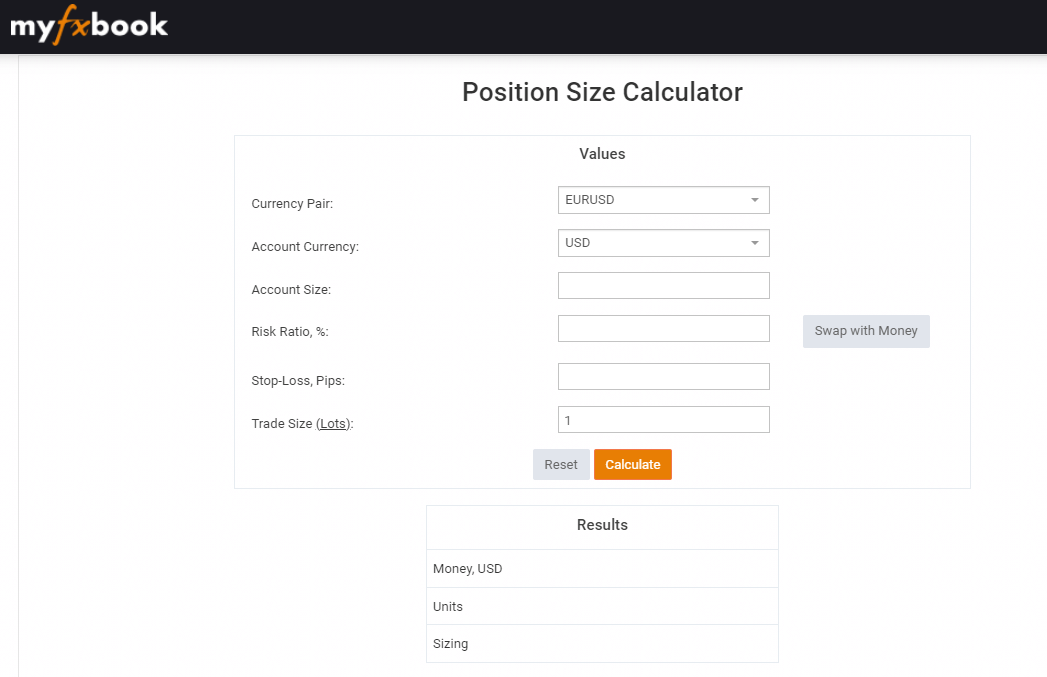
The Myfxbook position size calculator is remarkably intuitive. To leverage its capabilities, a trader begins by selecting their currency pair of interest, for instance, EUR/USD. Following this, they input the currency of their trading account, which, in many cases, may be USD. The next step involves entering the total equity of the trading account.
The risk ratio percentage is then specified, which represents the fraction of account equity the trader is willing to risk on a single trade.
The final key input is the stop-loss in pips, which safeguards against larger than expected losses. Upon filling in these details, setting the desired trade size in lots is optional. Traders can leave this as the default if they wish the calculator to determine the appropriate trade size based on the other parameters.
With a simple click on “Calculate,” the tool processes these inputs and reveals the precise position size, thus guiding traders to make measured and informed trades.
Indicator for position size calculation
For traders who utilize the MetaTrader 4 (MT4) platform, the challenge of calculating the correct lot size for each trade can be formidable, yet it is a pivotal element in effective money management. Recognizing this essential need, the Indicator for Position Size Calculation emerges as a crucial tool, specifically crafted for MT4, to assist traders in this task.
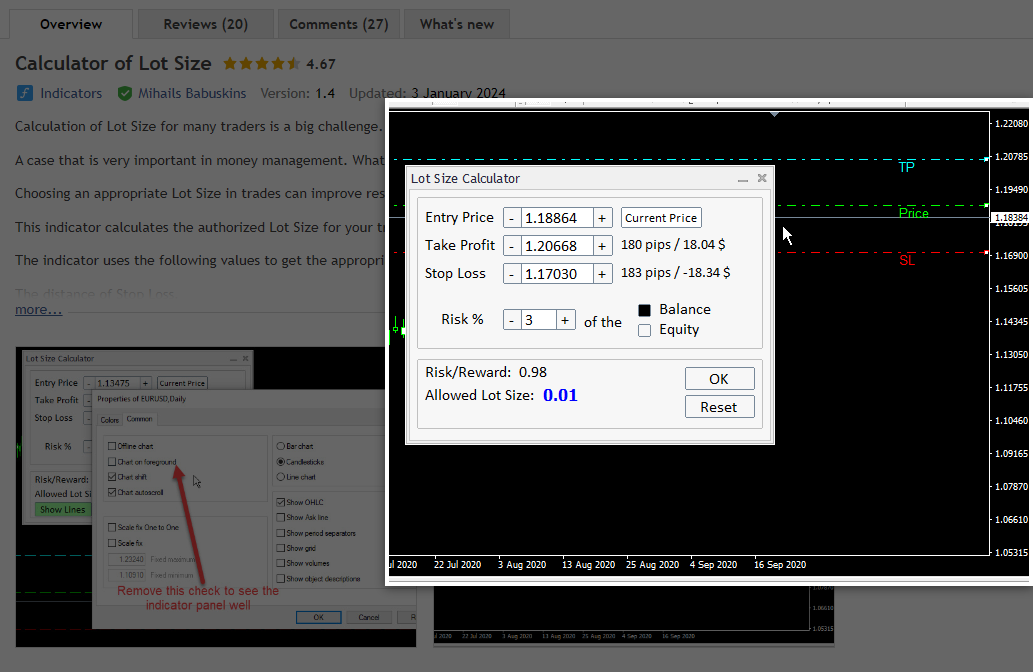
This MT4 indicator simplifies the lot size calculation process by incorporating several key trading parameters: Stop Loss distance, Pip Value, Risk Allowed for Each Trade, and Account Balance.
To use this tool, traders input the Entry Price, along with their intended Stop Loss and Take Profit levels for the position they plan to enter. The indicator then calculates the risk percentage of the account's equity that the trader specifies, and as a result, it presents the allowable lot size for the trade.
- Pros
- Cons
- User-Friendly: The indicator provides a straightforward interface that integrates seamlessly with MT4, making it accessible even for those new to trading
- Precise Money Management: By automating the calculation of lot size based on predefined risk parameters, the tool helps maintain consistent risk management across all trades
- Time-Efficient: It eliminates the need for manual calculations, thereby saving time and reducing the potential for human error
- Over-Reliance: Traders may become too dependent on the tool and overlook the importance of developing their own understanding of risk management principles
- Platform-Specific: Its utility is limited to users of the MT4 platform, leaving out traders who prefer other trading platforms
Go over our article Best MT4 Brokers (MetaTrader 4 Forex Platforms) for further insights.
Forex position size calculator app
In the hands of the mobile trader, the Forex Position Size Calculator App is a pivotal tool. Simplifying the trade setup process, it allows for swift calculation of position sizes aligned with risk management tactics.
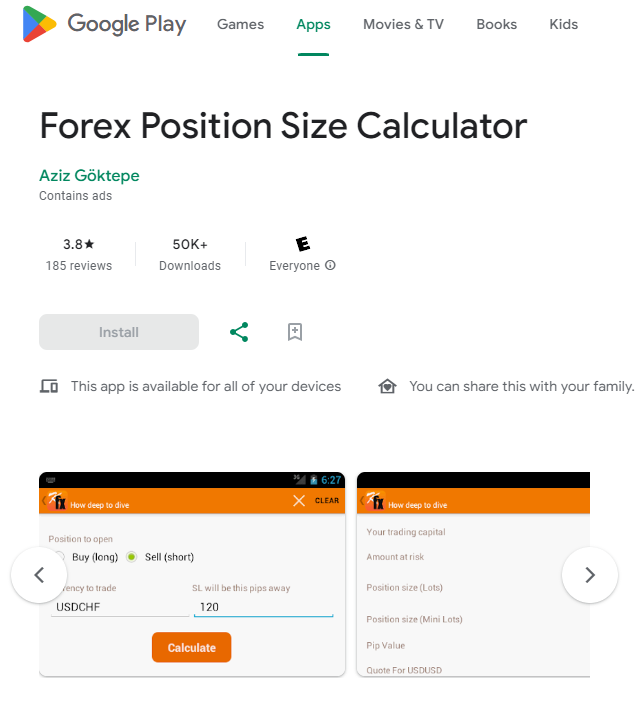
Traders specify their trade direction, currency pair, risk amount, and stop-loss in pips. The app computes the suitable lot size, streamlining the risk calculation process.
- Pros
- Cons
- Portability: Empowers traders to manage risk from anywhere, facilitating dynamic trade adjustments
- Intuitive Design: The straightforward layout minimizes the learning curve
- Efficiency: Provides expedited position size computations for prompt trading decisions
- Features: May offer fewer functionalities compared to comprehensive desktop calculators
- Device Dependence: Relies on the user's mobile device capabilities
- Advertisements: Includes ads which may disrupt the user experience
Forex position size calculator in Excel
Another tool for using a calculator in Excel, or Google Sheets. Any Forex trader can create a unique table to calculate a position based on their personal trading strategy.
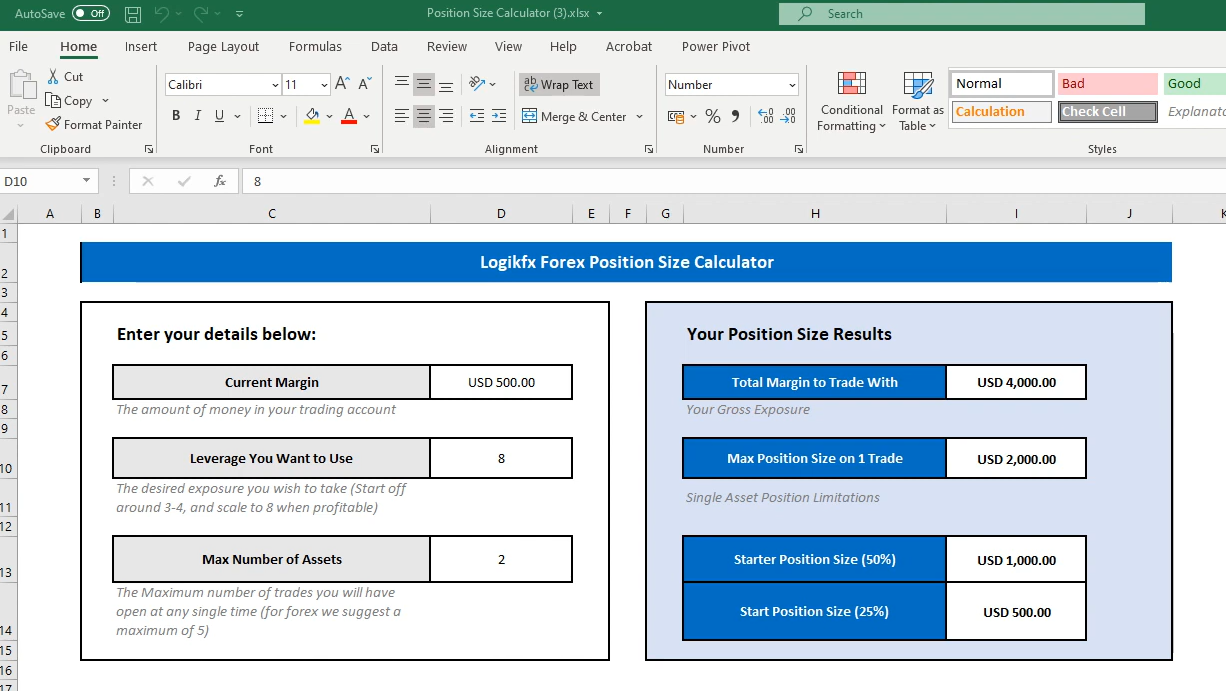
One example of such use of spreadsheets is shown above.
Traders input their current margin, desired leverage, and the maximum number of assets they plan to trade. The calculator then crunches these numbers to output a comprehensive risk assessment, including total margin available for trade, gross exposure, and maximum position size per trade. It even breaks down advisable starter position sizes as a percentage of the trader's capital.
- Pros
- Cons
- Customizability: Excel allows traders to tweak the calculator to their specific needs
- Detail-Oriented: Provides an extensive overview of potential risk and position sizes
- Control: Users maintain full control over their data and how it's processed
- Complexity: May be intimidating for Excel novices
- Manual Entry: Requires manual data input, which can be time-consuming and prone to errors
- No Real-Time Data: Unlike apps or MT4 indicators, it doesn’t offer real-time updates without additional programming
Can we do without a position size calculator?
Theoretically, yes. Traders could rely on gut feeling or simplistic percentage-based rules of thumb. However, such approaches lack the precision and personalization essential in the volatile Forex market. Without this tool, traders are essentially navigating a storm without a compass.
The foundational principle of a Forex position size calculator is the input of your risk level (usually a percentage of your account balance), stop-loss in pips, and the currency pair you wish to trade. This information calculates the exact lot size for your trade, tailored to the specific constraints and objectives of your trading strategy.
For example, if a trader's risk management policy allows for a risk of 2% per trade and has a $10,000 account, the calculator aids in determining the precise lot size that aligns with this risk threshold. This use case demonstrates the calculator's role in making informed, disciplined trading decisions.
Best Forex brokers
Before starting to trade Forex, it is important to recognize that choosing the right broker is a key element of a sound strategy. A reliable company provides access to risk management tools such as position size calculators, competitive spreads, regulatory protection, and efficient order execution. Below is a list of brokers with high ratings from Traders Union that support secure and effective trading in the dynamic currency market.
| Trading.com USA | Plus500 | OANDA | FOREX.com | IG Markets | |
|---|---|---|---|---|---|
|
Regulation Level |
Tier-1 | Tier-1 | Tier-1 | Tier-1 | Tier-1 |
|
Demo |
Yes | Yes | Yes | Yes | Yes |
|
Min. deposit, $ |
50 | 100 | No | 100 | 1 |
|
Deposit fee, % |
No | No | No | No | No |
|
Withdrawal fee, % |
No | No | No | No | No |
|
Negative balance protection |
Yes | Yes | Yes | Yes | Yes |
|
TU overall score |
6.88 | 7.7 | 6.63 | 6.47 | 6.38 |
|
Open an account |
Go to broker Your capital is at risk. |
Go to broker 81% of retail CFD accounts lose money. |
Go to broker Your capital is at risk. |
Study review | Study review |
Tips on money management in Forex trading
Effective money management is the backbone of any successful trading strategy. Here are key tips to help you maintain control over your financial risk in the Forex market
Set a Risk Percentage Per Trade: Decide on a fixed percentage of your account that you're willing to risk on each trade. This helps keep losses manageable. A common threshold is between 1% and 2%
Use Stop-Loss Orders: Always set a stop-loss order for every trade. It's a critical tool to limit potential losses if the market moves against you
Monitor Leverage Closely: Leverage can amplify gains, but it also increases risk. Use leverage judiciously and never overextend your positions
According to TU’s expert Matthew Du, diversification is also an important way to reduce risk in Forex. He said: Don't put all your capital into a single currency pair or trade. Spread your risk across different instruments to mitigate potential losses.
For more nuanced and detailed information, read our article Forex Trading Profit Calculator: Estimate Your Income.
When trading Forex, always calculate your position size

As a trader with experience in risk management, I can confidently say that using a position size calculator is not merely a convenience but a core element of disciplined trading. A tool such as the Myfxbook Position Size Calculator determines the appropriate position size based on your risk tolerance, account balance, and stop-loss level, eliminating guesswork and rough estimates that often lead to unnecessary losses.
This type of calculator is particularly valuable because it takes into account not only the risk percentage and stop-loss distance, but also the specifics of the currency pair. As a result, it delivers more accurate calculations, even when the account currency differs from the instrument’s quote currency.
Practical tips for use and risk management:
Define a fixed risk per trade (for example, 1% of your capital) and apply it consistently.
Always set a realistic stop-loss before calculating position size.
Recalculate position sizes regularly as your account balance changes.
Conclusion
Mastering risk management through precise position sizing is the foundation of enduring success in Forex trading. Utilizing a position size calculator, whether it’s Myfxbook’s online tool or an MT4 indicator, ensures your trades are systematically aligned with your risk tolerance and account balance. For example, by setting a fixed risk percentage and leveraging calculators, traders can avoid emotional decisions and maintain discipline during volatile market swings. Ultimately, relying on these tools transforms trading from guesswork into a strategy-driven pursuit where consistency conquers unpredictability.
FAQs
What are the main differences between online, indicator, app, and spreadsheet Forex position size calculators?
How does a position size calculator help traders avoid emotionally driven trading mistakes?
Are there any limitations associated with position size calculators for Forex trading?
What key inputs are typically required when using a Forex position size calculator?
Editors' Top Picks and Insights






Related Articles
Team that worked on the article
Vuk stands at the forefront of financial journalism, blending over six years of crypto investing experience with profound insights gained from navigating two bull/bear cycles. A dedicated content writer, Vuk has contributed to a myriad of publications and projects.
Dr. BJ Johnson is a PhD in English Language and an editor with over 15 years of experience. He earned his degree in English Language in the U.S and the UK.
Mirjan Hipolito is a journalist and news editor at Traders Union. She is an expert crypto writer with five years of experience in the financial markets.
Risk management in Forex involves strategies and techniques used by traders to minimize potential losses while trading currencies, such as setting stop-loss orders and position sizing, to protect their capital from adverse market movements.
Index in trading is the measure of the performance of a group of stocks, which can include the assets and securities in it.
Cryptocurrency is a type of digital or virtual currency that relies on cryptography for security. Unlike traditional currencies issued by governments (fiat currencies), cryptocurrencies operate on decentralized networks, typically based on blockchain technology.
CFD is a contract between an investor/trader and seller that demonstrates that the trader will need to pay the price difference between the current value of the asset and its value at the time of contract to the seller.
Forex trading, short for foreign exchange trading, is the practice of buying and selling currencies in the global foreign exchange market with the aim of profiting from fluctuations in exchange rates. Traders speculate on whether one currency will rise or fall in value relative to another currency and make trading decisions accordingly. However, beware that trading carries risks, and you can lose your whole capital.

-
 Afghanistan
-
 Albania
-
 Algeria
-
 Angola
-
 Argentina
-
 Armenia
-
 Australia
-
 Austria
-
 Azerbaijan
-
 Bahamas
-
 Bahrain
-
 Bangladesh
-
 Belarus
-
 Belgium
-
 Bolivia
-
 Botswana
-
 Brazil
-
 Brunei
-
 Bulgaria
-
 Cambodia
-
 Cameroon
-
 Canada
-
 Chile
Chile
-
 China
China
-
 Colombia
-
 Congo
Congo
-
 Costa Rica
-
 Cote d'Ivoire
-
 Croatia
-
 Cuba
Cuba
-
 Cyprus
-
 Czechia
-
 DR Congo
-
 Denmark
-
 Dominican Republic
-
 Ecuador
-
 Egypt
Egypt
-
 El Salvador
-
 Estonia
-
 Eswatini
-
 Ethiopia
-
 Finland
-
 France
-
 Georgia
-
 Germany
-
 Ghana
Ghana
-
 Greece
-
 Haiti
Haiti
-
 Hong Kong
-
 Hungary
-
 India
India
-
 Indonesia
-
 Iran, Islamic republic
-
 Iraq
Iraq
-
 Ireland
-
 Israel
-
 Italy
Italy
-
 Jamaica
-
 Japan
Japan
-
 Jordan
-
 Kazakhstan
-
 Kenya
Kenya
-
 Korea
Korea
-
 Kuwait
-
 Kyrgyzstan
-
 Laos
Laos
-
 Latvia
-
 Lebanon
-
 Lesotho
-
 Libya
Libya
-
 Lithuania
-
 Luxembourg
-
 Madagascar
-
 Malaysia
-
 Malta
Malta
-
 Mauritius
-
 Mexico
-
 Moldova
-
 Mongolia
-
 Montenegro
-
 Morocco
-
 Mozambique
-
 Myanmar
-
 Namibia
-
 Nepal
Nepal
-
 Netherlands
-
 New Zealand
-
 Nigeria
-
 North Macedonia
-
 Norway
-
 Oman
Oman
-
 Pakistan
-
 Palestine
-
 Panama
-
 Papua New Guinea
-
 Paraguay
-
 Peru
Peru
-
 Philippines
-
 Poland
-
 Portugal
-
 Puerto Rico
-
 Qatar
Qatar
-
 Reunion
-
 Romania
-
 Rwanda
-
 Saudi Arabia
-
 Serbia
-
 Singapore
-
 Slovakia
-
 Slovenia
-
 Somalia
-
 South Africa
-
 Spain
Spain
-
 Sri Lanka
-
 Sweden
-
 Switzerland
-
 Syria
Syria
-
 Taiwan
-
 Tajikistan
-
 Tanzania
-
 Thailand
-
 Trinidad and Tobago
-
 Tunisia
-
 Turkey
-
 UAE
UAE
-
 Uganda
-
 Ukraine
-
 United Kingdom
-
United States
-
 Uruguay
-
 Uzbekistan
-
 Venezuela
-
 Vietnam
-
 Yemen
Yemen
-
 Zambia
-
 Zimbabwe
- Forex
- Crypto












