
What Is Naked Trading? Price Action Strategies For Forex & Options



Editorial Note: While we adhere to strict Editorial Integrity, this post may contain references to products from our partners. Here's an explanation for How We Make Money. None of the data and information on this webpage constitutes investment advice according to our Disclaimer.
Naked trading is a strategy that relies solely on price action without using technical indicators. Traders make decisions based on raw price charts, support and resistance levels, and candlestick patterns.
Too many indicators can create noise and distract from what matters most: price behavior. Relying on constant confirmation from moving averages or oscillators often leads to hesitation and mixed signals. That’s why many traders turn to naked chart trading, which removes unnecessary clutter and puts the spotlight on raw market movement, structure, and key levels. While it requires more discipline and sharp observation, this method can help uncover what the market is really doing, without outside interference. It’s not just about simplifying your screen; it’s about sharpening your focus and taking full control of your decisions.
In this guide, we’ve put together everything you need to understand naked Forex trading — mastering the art of naked trading, from the core principles and chart-reading techniques to applying the method confidently and managing your risk effectively.
Risk warning: Forex trading carries high risks, with potential losses including your entire deposit. Market fluctuations, economic instability, and geopolitical factors impact outcomes. Studies show that 70-80% of traders lose money. Consult a financial advisor before trading.
What is naked trading and why it matters
Understanding what is naked trading requires looking beyond the surface definition of trading without indicators. At its core, naked trading is a disciplined price action methodology that focuses exclusively on raw candlestick patterns, market structure, and support-resistance zones - completely free of overlays or technical tools. This approach shifts the trader’s mindset from reacting to delayed signals to actively interpreting market behavior in real time.
| Core Element | Details & Insights |
|---|---|
| Price Action & Candle Analysis | Focus on pin bars, inside bars, engulfing patterns, and breakouts as primary entry triggers. - Wicks and rejection candles near round numbers or previous highs/lows often signal false breakouts or liquidity traps. |
| Support and Resistance Zones | Think in terms of zones, not fixed lines - these are areas of liquidity. - Use H4 or Daily charts to define zones; zoom into M15 or H1 for precise entries. |
| Market Context & Sessions | The London/New York overlap provides the clearest price action and volume. - Asian sessions tend to be slower and more range-bound, requiring more patience and conservative setups. |
How levels, candles, and price behavior work
Understanding price action in naked trading means reading the market like a language, without relying on cluttered indicators.
Watch where candles reject. Rejection wicks at round numbers or previous highs often signal trapped retail trades and incoming reversals.
Zoom out before zooming in. One of the core naked trading strategies is starting with the daily or H4 chart to find clean structure before trading lower time frames.
Fakeouts are gold setups. When price briefly breaks a level and snaps back, it often marks institutional stop hunts, a sweet spot in naked shorts trading.
Volume is hiding in candles. Even without a volume indicator, long-bodied candles after consolidation usually reflect hidden market commitment.
Mark liquidity zones, not just levels. Price rarely reacts at exact levels. Instead, look for zones where candles stall, spike, or flip, showing where orders likely cluster.
Ignore symmetrical patterns. Naked traders often lose money trying to trade triangles or flags. Focus on price reaction, not textbook shapes.
Track sessions to decode intent. London and New York overlap reveals the real story. Big moves before or after that often mean traps.
Let the wicks speak. Wicks stacking on one side of a range tell you where pressure is building, long before the breakout happens.
Naked trading strategies
When using naked trading strategies, traders typically rely on clean, uncluttered charts, especially during periods of market volatility. By removing indicators, they’re able to focus entirely on price action, key support and resistance zones, and how structure evolves in real time.
This approach is versatile and works well across different timeframes. Whether it's swing trading on daily charts or short-term setups on the 1-hour and 15-minute charts, the method remains effective. Beyond Forex, it's also applied to crypto, stocks, and indices. Many who follow naked Forex trading strategies prefer to trade high-impact news events by reading raw price behavior rather than depending on delayed indicator signals.
The strategies below illustrate how trading naked works in real market conditions:
| Strategy | Description | Timeframes | Best Use Case |
|---|---|---|---|
| Rejection at Key Levels | Wait for a pin bar or engulfing candle to form at a pre-marked support or resistance zone. This suggests a failed breakout and a potential reversal. | H1, H4, Daily | Trend reversals, fakeout detection |
| Breakout Trap Setup | Identify a breakout beyond a known level, then watch for a quick pullback. Enter once the price closes back inside the range, indicating stop-hunting. | M15, H1 | High-volatility sessions (e.g., NY/London) |
| Inside Bar Continuation | Trade inside bars as consolidation signals in a trending market. Entry is taken on breakout of the mother bar in trend direction. | H4, Daily | Trend continuation setups |
| Round Number Reversal | Round numbers like 1.1000 or 0.9500 act as psychological barriers. Look for long wicks or reversal candles rejecting these levels. | M30, H1 | News reactions, session opens |
| Session-Based Bias | Focus on price direction during the first 1–2 hours of the London session. Avoid trading naked during low-volume times like mid-Asia or late NY. | Intraday (M15-H1) | Day trading during peak liquidity |
These strategies work best when paired with a clean chart and a clear risk-reward framework. Since naked trading is based on what the market is actually doing - not what indicators say - it requires precision, patience, and solid journaling.
Naked trading in Forex
Naked trading in Forex is a clean-chart method where traders operate without indicators, relying solely on price action. This approach involves identifying market structure, candlestick behavior, and key support or resistance zones to make timely decisions.
Naked trading is based on what?
The method is rooted in live price interpretation. During volatile sessions (e.g., London–New York), traders look for momentum candles, wick rejections, and structural breakouts without waiting for signal confirmation from tools. Naked trading is based on price conviction - not lagging indicators.
Volatility and liquidity adjustments
In fast markets: traders widen zones and wait for decisive moves.
In low liquidity: they shift to higher timeframes (H4 or Daily) to reduce noise.
Ranging markets: focus on false breakouts and reaction wicks.
Indicators vs naked trading's success ratio
While indicators offer systemized signals, indicators vs naked trading's success ratio often favors naked setups in clean, liquid conditions. Indicators lag; price does not. That’s why traders seeking precision often strip down their charts for clearer signals.
| Feature | Naked Trading | Indicator-Based Trading |
|---|---|---|
| Tools Used | None (Price only) | RSI, MACD, MA, Bollinger |
| Reaction Speed | Faster (real-time) | Slower (lagging) |
| Learning Curve | Steep | Moderate |
| Signal Reliability | Context-based | System-based |
| Subjectivity | High | Medium |
| Common Markets | Forex, Crypto, Options | All |
How to learn - no courses needed
To get started, most self-taught traders recommend reading the naked Forex trading book by Alex Nekritin. From there:
Backtest setups manually across different market conditions.
Maintain a trading journal to track reactions and outcomes.
Observe how price responds to psychological levels or news-driven moves.
Over time, this hands-on process builds confidence and skill - no expensive mentorships required.
Naked trading in stocks and uncovered positions
Some trading systems permit sell orders even when the trader doesn’t currently own the asset. This is possible because of the delayed settlement cycle, which provides a window of time to acquire the asset after the trade is executed. A core concept in naked stock trading, this approach allows traders to initiate positions without first confirming access to the underlying shares. It's most commonly used in rapidly moving markets to avoid missing execution opportunities.
This isn’t considered a market flaw. Rather, it’s an accepted part of the trading framework, built around T+2 settlement timelines, margin requirements, and brokerage policies. In specific circumstances, like when market makers step in to support price stability and liquidity, it serves a practical role.
What does it mean to sell without owning the asset?
In naked shorts trading, the trader sells shares they haven’t borrowed or acquired. The assumption is that shares can be delivered by settlement time, but without a guaranteed source, there’s significant risk. If the delivery cannot be made before the settlement deadline, it results in a failure to deliver.
These failed settlements are tracked. If the frequency or volume crosses certain regulatory thresholds, it triggers consequences. Traders may face penalties like automatic position closures, tighter margin limits, or restrictions imposed by the broker. The issue isn't necessarily bad intent, it’s the risk that arises when obligations aren’t met, which breaks down the system’s reliability.
How it differs from a legal short
With a legal short, the process is more structured. The trader first borrows the shares, the broker confirms availability, and only then is the order placed. Since the shares are already secured, delivery within the settlement window is assured. This method is compliant with market regulations and poses less risk to the trading ecosystem.
But in naked chart trading, that borrowing step is skipped altogether. The trader submits an order to sell without lining up the actual shares, effectively bypassing a key part of the trade lifecycle. Regulatory agencies may permit this in limited roles like market making, but for regular participants, it’s a violation of trade compliance rules.
Naked option trading
Naked option trading refers to selling options without holding the underlying asset or a corresponding hedging position. This strategy is typically used by experienced traders aiming to profit from time decay or stable market conditions. For example, selling a naked call without owning the stock exposes the trader to potentially unlimited losses if the stock price surges.
There are several variations of this approach, depending on the market outlook:
Naked calls trading involves selling call options without owning the underlying shares, expecting the price to stay flat or decline.
Trading naked puts means selling put options without a short position or protective hedge, with the expectation that the asset will remain above the strike price.
Naked short trading is a broader term covering uncovered short positions, including options or stocks sold without confirmed access to the underlying asset.
Compared to covered strategies, trading naked options has distinct features:
No built-in hedge — the trader doesn't own the asset or hold an offsetting position.
Higher potential premiums — due to the elevated risk, buyers pay more for the options.
Stricter margin requirements — brokers demand additional capital to mitigate exposure.
Unlimited loss potential — particularly with naked call trading, where prices can rise indefinitely.
To manage risk when trading naked put options or engaging in naked call trading, traders often monitor market volatility and macro news closely, use stop-loss orders or automated exit strategies, stick to liquid, high-volume assets to ensure efficient execution.
Trading naked options can be profitable but carries elevated risk. Whether you're involved in naked put trading, naked short trading, or selling uncovered calls, success depends on timing, experience, and disciplined risk control.
Real-world applications of Naked trading
Naked chart trading thrives on simplicity and price clarity. Below are real-life scenarios that demonstrate how traders implement this approach using only price action and structural context - without indicators.
Example 1: Reversal trade from support level
A trader spots the EUR/USD pair approaching a clearly defined horizontal support zone on the daily chart, a level tested multiple times in the past.
Price action trigger. At the support zo ne, a dragonfly doji forms - a classic bullish reversal signal showing strong buyer defense.
Execution. The trader opens a long position immediately after the next bullish candle confirms upward momentum.
Risk management. Stop-loss: set just below the doji’s lower wick, under the support level. Take profit: placed at the nearest resistance level, previously marked on the chart.
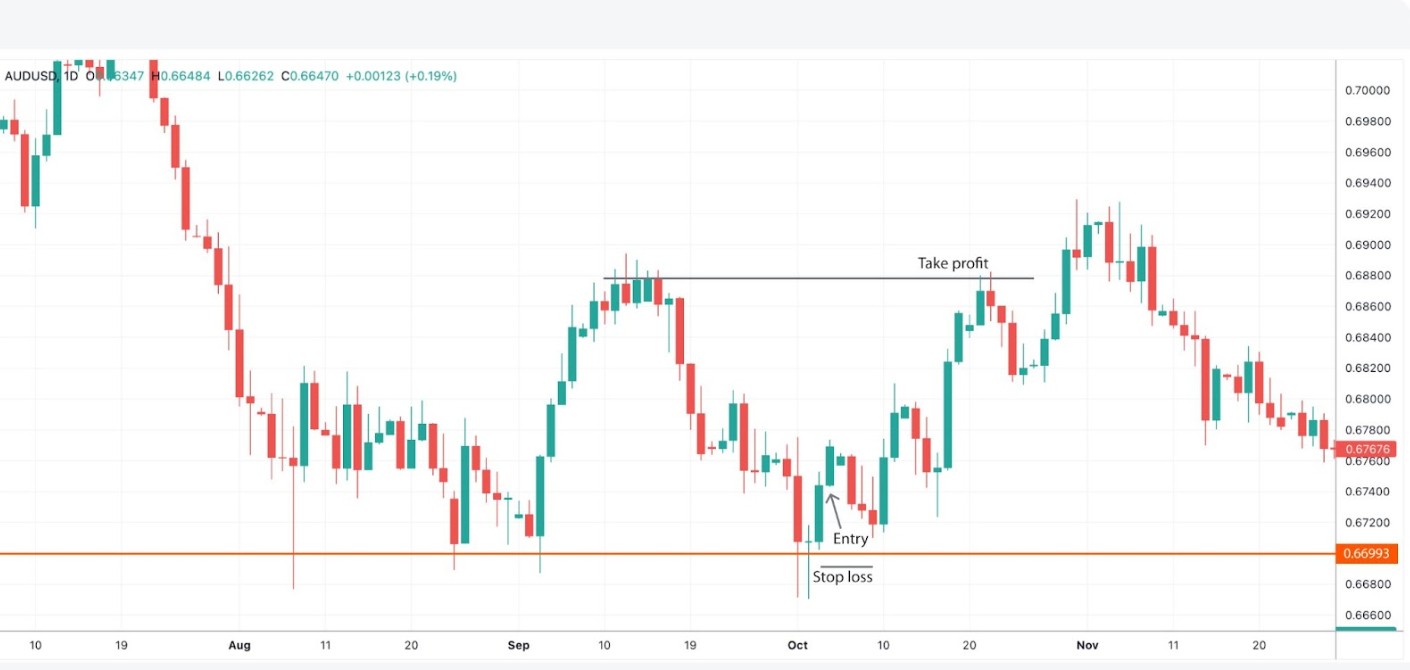
Why it works:
the clean rejection and candlestick confirmation allow a low-risk entry based on structure and crowd behavior - not indicators.
Example 2: Continuation setup in a downtrend
On the 1-hour chart, the GBP/JPY pair is trending down with lower highs and lower lows already established.
Price action trigger. The pair p ulls back to a descending trendline, aligning with a minor supply zone. A bearish engulfing pattern forms at this point.
Execution. The trader enters a short position immediately after the engulfing candle closes, anticipating trend continuation.
Risk management. Stop-loss: set just above the trendline and the high of the engulfing candle. Take profit: managed dynamically - since no recent swing lows exist, the trader uses a 1:2 risk-reward ratio or trails the stop as price moves down.
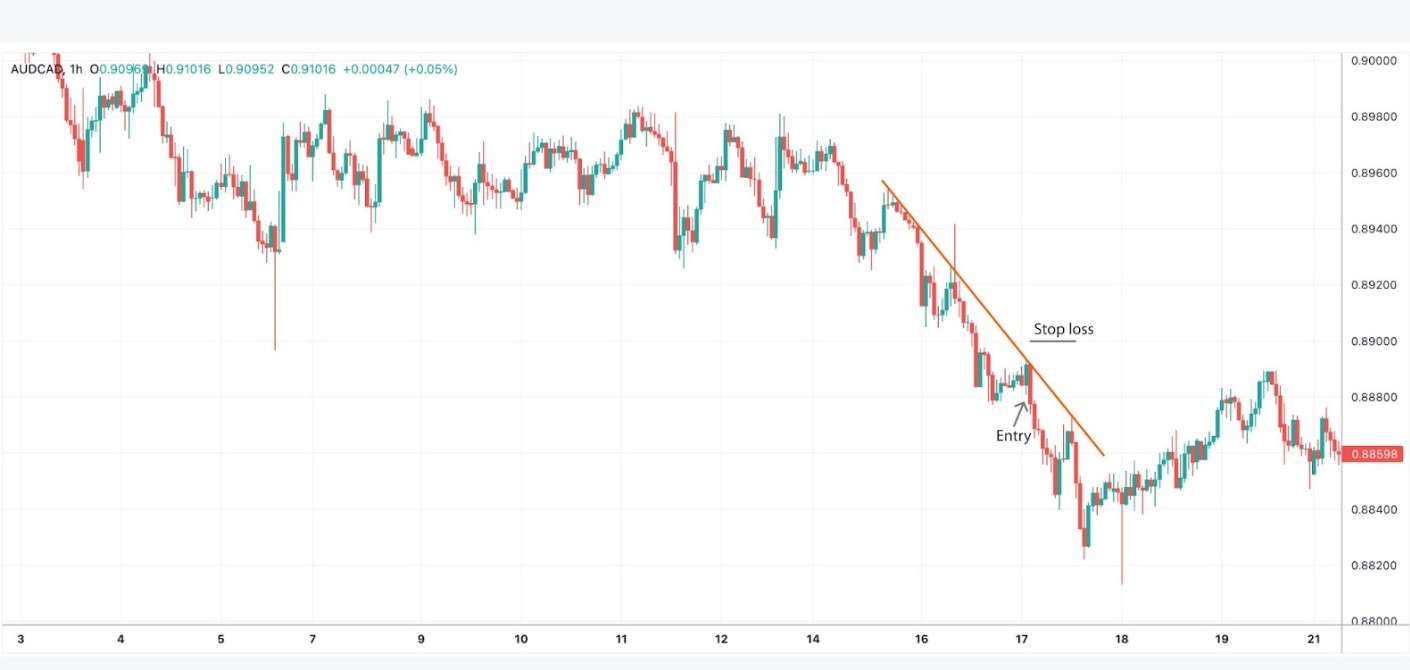
Why it works:
naked trading thrives on context and confluence - the trendline, bearish pattern, and price structure all point to continuation, despite the lack of a clear TP level.
If you’re interested in naked trading across a wide range of assets, consider opening an account with any of the following brokers. They are known for supporting different assets and provide features relevant for a better naked trading experience.
| zForex | Plus500 | OANDA | Trading.com USA | FOREX.com | |
|---|---|---|---|---|---|
|
Currency pairs |
50 | 60 | 68 | 69 | 80 |
|
Crypto |
Yes | Yes | Yes | No | Yes |
|
Stocks |
Yes | Yes | Yes | No | Yes |
|
Min. deposit, $ |
10 | 100 | No | 50 | 100 |
|
Max. leverage |
1:1000 | 1:300 | 1:200 | 1:50 | 1:50 |
|
Regulation |
No | CySEC, FCA, ASIC, FMA, FSCA, FSA Seychelles, EFSA, MAS, DFSA, SCB | FSC (BVI), ASIC, IIROC, FCA, CFTC, NFA | CFTC, NFA | CIMA, FCA, FSA (Japan), NFA, IIROC, ASIC, CFTC |
|
TU overall score |
8.05 | 7.57 | 6.89 | 6.15 | 6.87 |
|
Open an account |
Go to broker Your capital is at risk.
|
Go to broker 80% of retail CFD accounts lose money. |
Go to broker Your capital is at risk. |
Go to broker Your capital is at risk. |
Study review |
Use wick zones and volume voids to master naked trading entries and exits

One of the most overlooked tricks in naked trading is marking wick zones, areas where candles have long shadows but bodies don’t close. These zones, especially when formed during high volatility, often act like magnets for price to revisit. Beginners usually stare at support/resistance lines, but wick zones are like footprints left by institutional traders who had to exit in a rush. If you mark these zones on higher timeframes and watch how price reacts without indicators, your naked setups become sharper and more reliable.
Another high-impact move is studying volume voids, areas with unusually low volume between major moves. These gaps are often where price accelerates rapidly, and they create perfect "no-man’s land" zones for breakout or fake-out setups. When trading options naked, this helps you avoid theta burn in dead zones and time entries around volatility pockets. You don’t need 10 indicators to know when to enter or exit. Just learning to read where the market didn’t want to stay tells you more than any signal ever will.
Conclusion
Naked trading empowers traders to rely solely on price action and chart patterns, stripping away the noise of technical indicators for clearer decision-making. This approach encourages discipline and focus, as seen in successful Forex trades that capitalize on simple candlestick formations or breakouts, and in options trading where well-timed entries can yield substantial gains. However, the risks are real: without the safety net of indicators, overtrading and emotional decisions can threaten results. Ultimately, mastering naked trading means understanding that simplicity, not complexity, often leads to consistent performance. Remember, in the world of trading, sometimes less truly is more.
FAQs
How does naked trading differ from legal short selling and what are the implications?
What types of price action patterns are most effective for naked trading strategies?
Why is session timing important when implementing naked trading strategies?
What margin requirements and risks are associated with naked option trading?
Editors' Top Picks and Insights

Lindsey Graham death: U.S. senator’s crypto legacy

Tether under pressure: USDT in Europe, audit questions, and the fight for trust

Lean Ethereum: Why Buterin wants to rebuild the network

SK Hynix debuts on Nasdaq: Largest U.S. offering by foreign company

SpaceX falls out of orbit: Does anyone still want Musk’s stock?

The crypto IPO problem: How high-profile listings became investor traps
Related Articles
Team that worked on the article
Aleksandra Chaikina has been a contributor to Traders Union since 2021. With over 15 years of experience in copywriting and more than 5 years focused on financial content, she specializes in producing detailed guides, analytics, and comparative reviews across various sectors, including cryptocurrencies, Forex, investment strategies, and financial technologies.
Dan Blystone began his trading career in 1998 as an arbitrage clerk on the floor of the Chicago Mercantile Exchange (CME). He later traded bond and Eurex futures at proprietary firms such as Altea Trading, gaining valuable experience in high-frequency trading and risk management.
Chinmay Soni is a financial analyst with more than 5 years of experience in working with stocks, Forex, derivatives, and other assets. As a founder of a boutique research firm and an active researcher, he covers various industries and fields, providing insights backed by statistical data.
CFD is a contract between an investor/trader and seller that demonstrates that the trader will need to pay the price difference between the current value of the asset and its value at the time of contract to the seller.
Day trading involves buying and selling financial assets within the same trading day, with the goal of profiting from short-term price fluctuations, and positions are typically not held overnight.
Forex leverage is a tool enabling traders to control larger positions with a relatively small amount of capital, amplifying potential profits and losses based on the chosen leverage ratio.
Risk management is a risk management model that involves controlling potential losses while maximizing profits. The main risk management tools are stop loss, take profit, calculation of position volume taking into account leverage and pip value.
A long position in Forex, represents a positive outlook on the future value of a currency pair. When a trader assumes a long position, they are essentially placing a bet that the base currency in the pair will appreciate in value compared to the quote currency.

-
 Afghanistan
-
 Albania
-
 Algeria
-
 Angola
-
 Argentina
-
 Armenia
-
 Australia
-
 Austria
-
 Azerbaijan
-
 Bahamas
-
 Bahrain
-
 Bangladesh
-
 Belarus
-
 Belgium
-
 Bolivia
-
 Botswana
-
 Brazil
-
 Brunei
-
 Bulgaria
-
 Cambodia
-
 Cameroon
-
 Canada
-
 Chile
Chile
-
 China
China
-
 Colombia
-
 Congo
Congo
-
 Costa Rica
-
 Cote d'Ivoire
-
 Croatia
-
 Cuba
Cuba
-
 Cyprus
-
 Czechia
-
 DR Congo
-
 Denmark
-
 Dominican Republic
-
 Ecuador
-
 Egypt
Egypt
-
 El Salvador
-
 Estonia
-
 Eswatini
-
 Ethiopia
-
 Finland
-
 France
-
 Georgia
-
 Germany
-
 Ghana
Ghana
-
 Greece
-
 Haiti
Haiti
-
 Hong Kong
-
 Hungary
-
 India
India
-
 Indonesia
-
 Iran, Islamic republic
-
 Iraq
Iraq
-
 Ireland
-
 Israel
-
 Italy
Italy
-
 Jamaica
-
 Japan
Japan
-
 Jordan
-
 Kazakhstan
-
 Kenya
Kenya
-
 Korea
Korea
-
 Kuwait
-
 Kyrgyzstan
-
 Laos
Laos
-
 Latvia
-
 Lebanon
-
 Lesotho
-
 Libya
Libya
-
 Lithuania
-
 Luxembourg
-
 Madagascar
-
 Malaysia
-
 Malta
Malta
-
 Mauritius
-
 Mexico
-
 Moldova
-
 Mongolia
-
 Montenegro
-
 Morocco
-
 Mozambique
-
 Myanmar
-
 Namibia
-
 Nepal
Nepal
-
 Netherlands
-
 New Zealand
-
 Nigeria
-
 North Macedonia
-
 Norway
-
 Oman
Oman
-
 Pakistan
-
 Palestine
-
 Panama
-
 Papua New Guinea
-
 Paraguay
-
 Peru
Peru
-
 Philippines
-
 Poland
-
 Portugal
-
 Puerto Rico
-
 Qatar
Qatar
-
 Reunion
-
 Romania
-
 Rwanda
-
 Saudi Arabia
-
 Serbia
-
 Singapore
-
 Slovakia
-
 Slovenia
-
 Somalia
-
 South Africa
-
 Spain
Spain
-
 Sri Lanka
-
 Sweden
-
 Switzerland
-
 Syria
Syria
-
 Taiwan
-
 Tajikistan
-
 Tanzania
-
 Thailand
-
 Trinidad and Tobago
-
 Tunisia
-
 Turkey
-
 UAE
UAE
-
 Uganda
-
 Ukraine
-
 United Kingdom
-
United States
-
 Uruguay
-
 Uzbekistan
-
 Venezuela
-
 Vietnam
-
 Yemen
Yemen
-
 Zambia
-
 Zimbabwe
- Forex
- Crypto











