
Best Options Trading Apps For 2026


Editorial Note: While we adhere to strict Editorial Integrity, this post may contain references to products from our partners. Here's an explanation for How We Make Money. None of the data and information on this webpage constitutes investment advice according to our Disclaimer.

If you're too busy to read the entire article and want a quick answer, the best options trading app is Trading.com USA. Why? Here are its key advantages:
- Is legit in your country (Identified as United States
 )
) - Has a good user satisfaction score
- High leverage at low costs
- Variety of available assets
Best options trading apps are:
- eToro USA - A broker for U.S. investors licensed by the SEC and FINRA, offering access to trading stocks, ETFs, options, and cryptocurrencies, including CopyTrader.
- SpeedTrader - Broker focused on day-trading with 4500+ ticker short list and 25+ routes
- TradeZero International - U.S. equities trading with commission-free orders, leverage up to 1:6
- eOption - Zero-fee stock trading, no minimum deposit requirements for U.S. traders
- Interactive Brokers - Operates since 1977 and covers over 150 markets in 34 countries
In this article, we will look at the best apps that provide options trading and analyze options strategies that you can use to trade and lay down some tips to select the best options trading app in the market. Furthermore, we will give you some tips on how you can manage your risk effectively.
Best options trading apps
We have carefully selected a list of top brokers for options trading to help you trade confidently and efficiently.
| Demo | Account min. | Basic options fee | Min. options fee | Options | Android | Android | iOS | Signals (Alerts) | Research and data | Open an account | |
|---|---|---|---|---|---|---|---|---|---|---|---|
| Yes | 50 | No | No | Yes | Yes | Yes | Yes | Yes | Yes | Go to broker Your capital is at risk. |
|
| Yes | 2,500 | $0.25-$0.35 | $1 | Yes | Yes | Yes | Yes | Yes | Yes | Go to broker |
|
| Yes | 500 | $0.59 | Not specified | Yes | Yes | Yes | Yes | Yes | Yes | Go to broker Your capital is at risk. |
|
| Yes | No | $0.10 + $1.99 | $0.10 + $1.99 | Yes | Yes | Yes | Yes | Yes | Yes | Study review | |
| Yes | No | $0,65 | $1,00 | Yes | Yes | Yes | Yes | Yes | Yes | Study review |
How to choose the best options trading apps
When deciding on an options trading app, consider the following factors to ensure you make the right choice:
Cost and commissions
Try to opt for those apps that offer competitive or commission-free trading. An app with a high fee can eat into your profits, so choosing a platform that aligns with your budget and trading goals is very important.
User-friendly interface
Before trading, check if the app has an intuitive interface. A user-friendly app makes executing trades, research, and monitoring your portfolio easier.
Educational resources
An app offering options trading should offer educational content for beginner and advanced traders. This could include articles, videos, and webinars on complex options strategies.
Charting and analysis tools
Good charting features and options analysis tools like option chains and volatility calculators are important in making informed decisions.
Order execution
Always choose an app that has a reliable and fast order execution. A delay or an error in executing the trade can lead to missed opportunities or losses.
Mobile compatibility
In today’s remote and fast-paced world, every app should have its own mobile version so that you can trade on the go.
Variety of options
While selecting an app, make sure that the app provides a wide range of options contracts, and assets to trade. Diverse options allow you to tailor your strategy to different market conditions.
Demo аccounts
Some apps provide paper trading apps that allow you to practice trading with virtual funds in demo accounts. This is an excellent way to familiarize yourself with the platform and test different strategies before using real money.
Best options strategies
Covered call
A covered call is a way to earn additional yield on your shareholdings by risking the outcome of being forced to sell your shares. If you own shares in a company and think the price wouldn’t rise much, you can sell a call option on those shares, which would give others the right to buy your shares later at a set price. If the price stays below the agreed upon option exercise price, you get to keep the premium earned for that option. If it goes higher, the call option will get exercised and you will have to sell your shares.
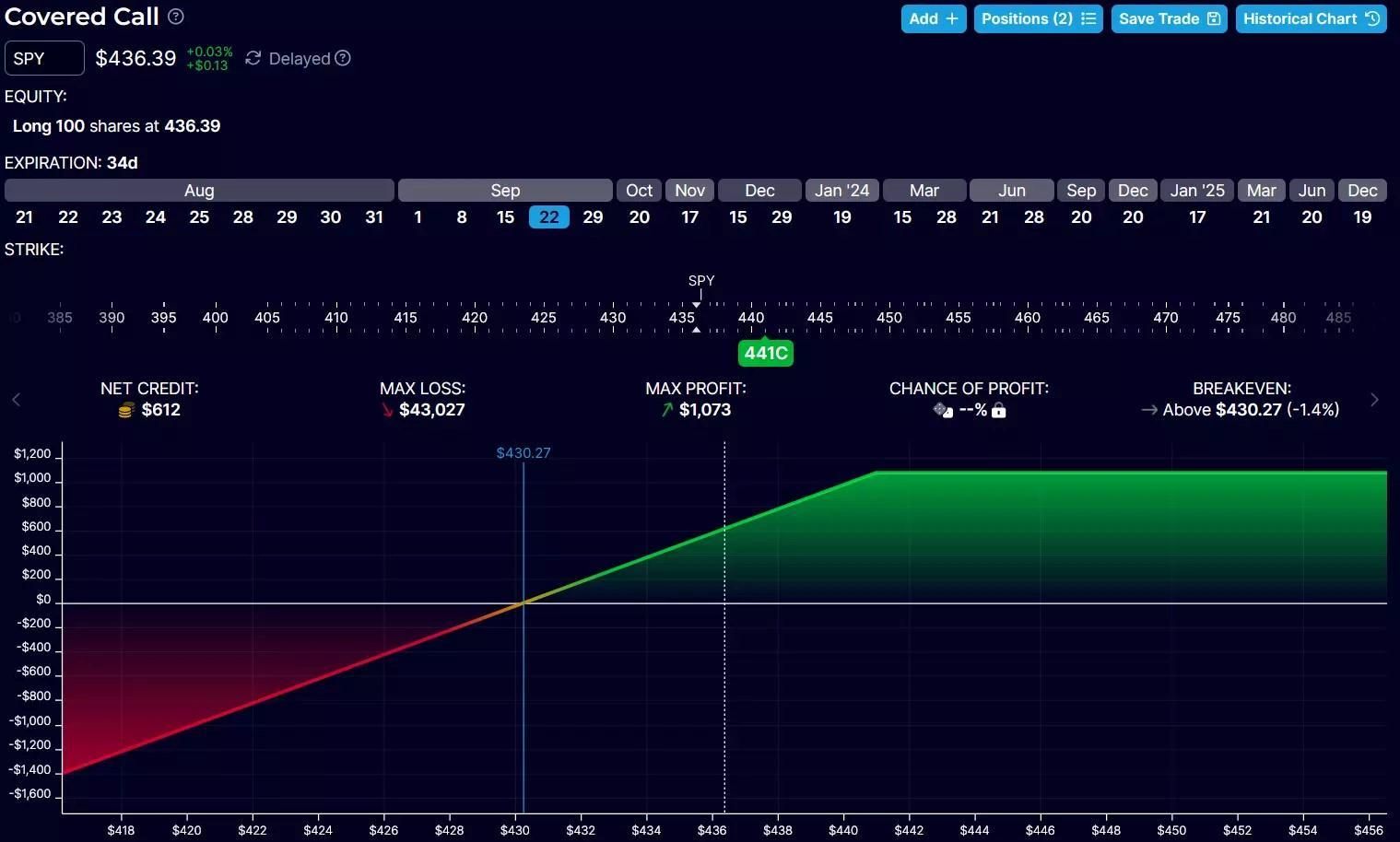
Consider this illustration, where an investor is long 100 $SPYETF shares at a price of $436.39 per share. They may write an out-of-the-money call option contract (of 100 shares) at exercise price of $441 and receive roughly $6.12 in premium income per share (total $612). Their net position will be safe as long as the price of $SPY does not fall below $430.27, which is the break even point. If the price closes below this point at expiry, the investor will book a loss equivalent to (loss on shares – total premium earned, i.e. $612). Moreover, they may earn a maximum profit of $1,074 ($612 + $462 price appreciation from current price of $436.39) if the price of $SPY closes at or above $441 at expiry.
Long call
A long call is like reserving a deal. You believe a company's stock will rise, so you pay a small fee to buy the right to purchase the shares at a set price later. If the shares rise, you buy at the lower price you reserved. If not, you only lose the fee.
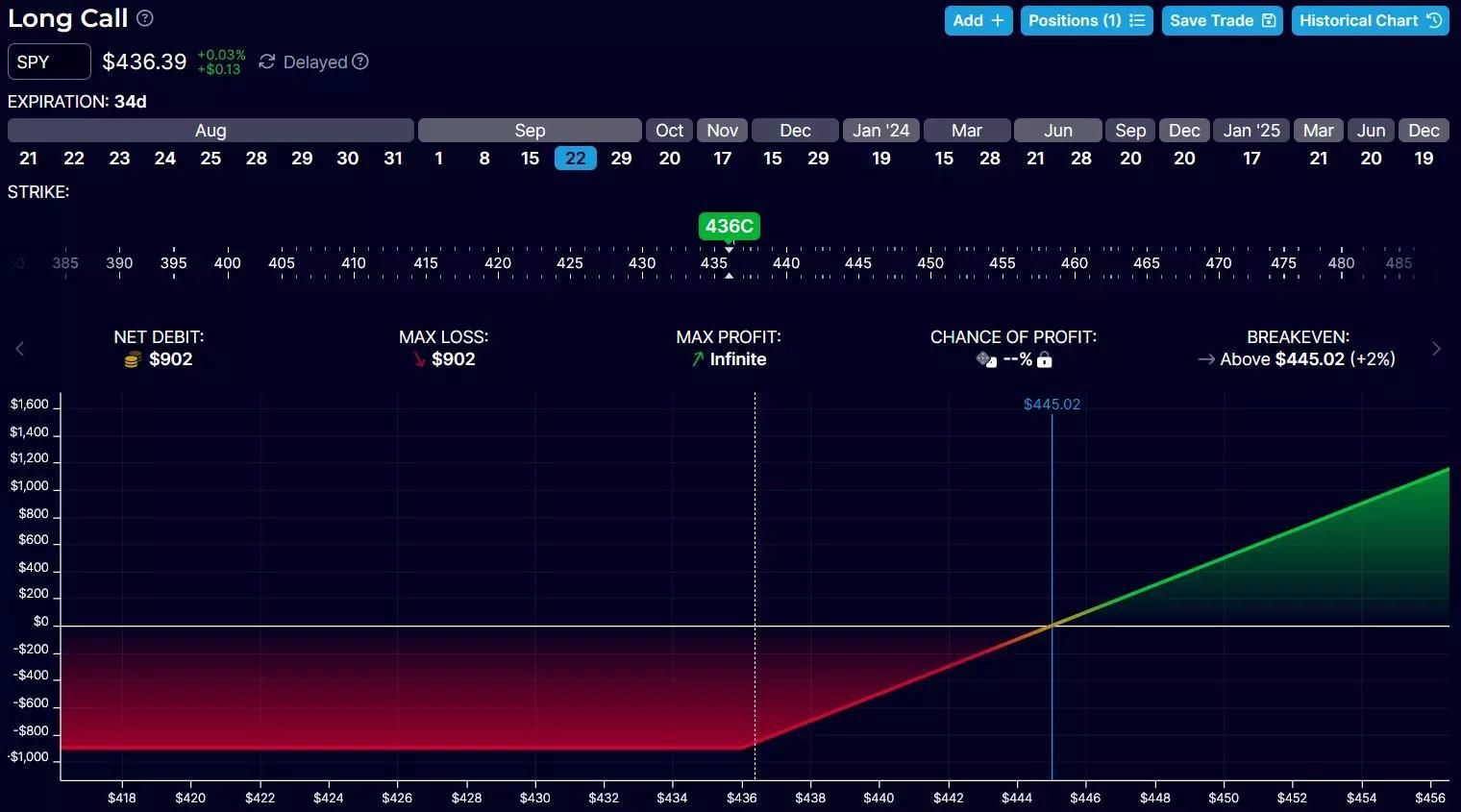
Consider this illustration, where an investor purchases a $436 strike call option on $SPY shares at a premium of $9.02 per share (total premium of $902). This gives them the right to buy 100 $SPY shares at a price of $436 per share at expiry. Their holding will turn profitable when $SPY crosses above $445.02, which is the breakeven point (Strike price of $436 + premium paid of $9.02). If the price closes below $436 at expiry, the option will expire worthless and the investor may face the maximum loss of $902 (which was the total premium paid). The maximum profit for the investor here is unlimited, given that share price can theoretically rise indefinitely.
Protective put
A protective put involves owning stock and purchasing a put option as insurance against price declines. If the stock price drops below the strike price, the investor can sell the shares at the strike price, limiting losses to the premium paid.
For example an investor holds 100 shares of a stock priced at $50 and buys a put option with a $45 strike price for $2 per share. If the stock drops to $40, the investor can sell at $45, limiting the loss to $7 per share ($5 from the stock price drop and $2 for the premium).
Long straddle
A long straddle strategy involves buying both a call and a put option with the same strike price and expiration. This is useful when expecting significant price movement but unsure of the direction. If the stock moves enough in either direction, profits can offset the combined premiums.
For example An investor buys a call and a put option for $5 each with a $100 strike price. If the stock rises to $110 or falls to $90, the option with value will yield a net profit of $5 per share after covering the premiums. If the stock stays at $100, both options expire worthless, and the loss is the combined premiums.
Iron condor
An iron condor involves selling a call and a put option at closer strike prices while buying a call and a put option at further strike prices. This strategy works well when expecting low volatility and a stable stock price within a specific range. The profit is limited to the premiums received, while losses are capped by the purchased options.
For example an investor sells a call with a $105 strike price and a put with a $95 strike price while buying a call at $110 and a put at $90. If the stock stays between $95 and $105, the investor keeps the premiums. If it moves beyond $90 or $110, the bought options limit losses.
How much money do you need for options trading?
The capital required for options trading varies significantly and depends on several factors, including your trading goals, risk tolerance, chosen trading strategy, and the type of underlying assets you plan to trade. Here's a closer look at these factors:
Trading goals
If you want to generate consistent income through options trading, you will need to start with a much larger capital. On the contrary, if you are aiming for occasional trades or speculative positions, you may require much less capital.
Risk tolerance
Options trading is inherently risky, and having a higher risk tolerance will allow you to deploy more capital to options trading. On the other hand, if you are risk averse, you can approach trading with a more conservative approach and take smaller positions.
Trading strategy
Different strategies have varying capital requirements. Strategies like covered calls or cash-secured puts typically require less capital as they involve hedging and conservative positions. More complex strategies like iron condors or straddles may require larger capital due to potential higher risks.
Underlying assets
Your capital needs and allocation depend on the type of assets that you’re willing to trade. You can trade options on individual stocks, ETFs, indices, or commodities, and each has its own different requirements.
Is options trading risky?
Yes, options trading carries inherent risks, but there are strategies you can employ to help reduce and manage these risks. Here's how to navigate options trading while minimizing potential downsides:
Educate yourself
To effectively manage your risk, understand the fundamentals first. Learn about the basics of options, their different strategies, and how they work. You can invest time and learn about market conditions, trends, and other factors that influence options prices.
Start small
Begin with a modest capital allocation. This minimizes potential losses while you're learning the ropes. As you gain experience and confidence, you can gradually increase your trading size.
Risk management
Use stop-loss orders to limit potential losses on individual trades. Determine the maximum percentage of your trading capital you're willing to risk on any given trade.
Choose conservative strategies
Strategies like covered calls and cash-secured puts are considered more conservative as they provide downside protection. They are suitable for traders seeking steady income while minimizing risk exposure.
Understand probabilities
Options trading involves assessing probabilities. Learn how to analyze option Greeks, like delta and theta, to gauge potential outcomes and risks.
Risk-reward ratio
Evaluate the potential risk and reward of each trade. Consider trades with a favorable risk-reward ratio, where potential gains outweigh potential losses.
Pick an app that tracks real-time changes in volatility and large trade volumes

When starting with options trading, pick an app that tracks real-time changes in volatility and large trade volumes, helping you identify when the market may offer promising opportunities. For beginners, this feature can highlight where experienced traders are focusing their trades, allowing you to gain insights without needing deep technical expertise.
Another essential step is to use apps that let you set specific price and risk alerts tailored to your goals. For instance, you can receive updates when an option reaches your desired price or when volatility spikes. This way, you stay informed without constantly checking the app. Additionally, practice in demo mode to refine your strategies in a safe, no-risk environment.
Methodology for compiling our ratings of Forex brokers
Traders Union applies a rigorous methodology to evaluate brokers using over 100 quantitative and qualitative criteria. Multiple parameters are given individual scores that feed into an overall rating.
Key aspects of the assessment include:
-
Regulation and safety. Brokers are evaluated based on the level/reputation of licenses and regulations they operate under.
-
User reviews. Client reviews and feedback are analyzed to determine customer satisfaction levels. Reviews are fact-checked and verified.
-
Trading instruments. Brokers are evaluated on the range of assets offered, as well as the breadth and depth of available markets.
-
Fees and commissions. All trading fees and commissions are analyzed comprehensively to determine overall costs for clients.
-
Trading platforms. Brokers are assessed based on the variety, quality, and features of platforms offered to clients.
-
Other factors like brand popularity, client support, and educational resources are also evaluated.
Find out more about the unique broker assessment methodology developed by Traders Union specialists.
Conclusion
In conclusion, choosing the best options trading app in 2026 comes down to aligning platform features with your personal trading goals. The top contenders stand out for their advanced analytical tools, competitive pricing, and intuitive interfaces, with apps like TradeTech Pro and OptimaX leading the pack for both beginners and experienced traders. As technology continues to evolve, the ability to execute complex strategies seamlessly and access real-time market data becomes increasingly vital. Ultimately, the smartest move for investors is to prioritize versatility and transparency—because in today’s dynamic markets, the right app isn’t just a tool, it’s your edge.
FAQs
What factors should be considered when comparing costs among the best options trading apps in 2026?
How does app interface design impact the experience of options trading in 2026?
What educational resources are most valuable for beginners using options trading apps?
Which options strategies are especially suitable for risk-averse traders in 2026?
Editors' Top Picks and Insights






Related Articles
Team that worked on the article
Parshwa is a content expert and finance professional possessing deep knowledge of stock and options trading, technical and fundamental analysis, and equity research. As a Chartered Accountant Finalist, Parshwa also has expertise in Forex, crypto trading, and personal taxation.
Chinmay Soni is a financial analyst with more than 5 years of experience in working with stocks, Forex, derivatives, and other assets. As a founder of a boutique research firm and an active researcher, he covers various industries and fields, providing insights backed by statistical data.
Mirjan Hipolito is a journalist and news editor at Traders Union. She is an expert crypto writer with five years of experience in the financial markets.
Cryptocurrency is a type of digital or virtual currency that relies on cryptography for security. Unlike traditional currencies issued by governments (fiat currencies), cryptocurrencies operate on decentralized networks, typically based on blockchain technology.
Crypto trading involves the buying and selling of cryptocurrencies, such as Bitcoin, Ethereum, or other digital assets, with the aim of making a profit from price fluctuations.
Fundamental analysis is a method or tool that investors use that seeks to determine the intrinsic value of a security by examining economic and financial factors. It considers macroeconomic factors such as the state of the economy and industry conditions.
Options trading is a financial derivative strategy that involves the buying and selling of options contracts, which give traders the right (but not the obligation) to buy or sell an underlying asset at a specified price, known as the strike price, before or on a predetermined expiration date. There are two main types of options: call options, which allow the holder to buy the underlying asset, and put options, which allow the holder to sell the underlying asset.
Yield refers to the earnings or income derived from an investment. It mirrors the returns generated by owning assets such as stocks, bonds, or other financial instruments.
-
 Afghanistan
-
 Albania
-
 Algeria
-
 Angola
-
 Argentina
-
 Armenia
-
 Australia
-
 Austria
-
 Azerbaijan
-
 Bahamas
-
 Bahrain
-
 Bangladesh
-
 Belarus
-
 Belgium
-
 Bolivia
-
 Botswana
-
 Brazil
-
 Brunei
-
 Bulgaria
-
 Cambodia
-
 Cameroon
-
 Canada
-
 Chile
Chile
-
 China
China
-
 Colombia
-
 Congo
Congo
-
 Costa Rica
-
 Cote d'Ivoire
-
 Croatia
-
 Cuba
Cuba
-
 Cyprus
-
 Czechia
-
 DR Congo
-
 Denmark
-
 Dominican Republic
-
 Ecuador
-
 Egypt
Egypt
-
 El Salvador
-
 Estonia
-
 Eswatini
-
 Ethiopia
-
 Finland
-
 France
-
 Georgia
-
 Germany
-
 Ghana
Ghana
-
 Greece
-
 Haiti
Haiti
-
 Hong Kong
-
 Hungary
-
 India
India
-
 Indonesia
-
 Iran, Islamic republic
-
 Iraq
Iraq
-
 Ireland
-
 Israel
-
 Italy
Italy
-
 Jamaica
-
 Japan
Japan
-
 Jordan
-
 Kazakhstan
-
 Kenya
Kenya
-
 Korea
Korea
-
 Kuwait
-
 Kyrgyzstan
-
 Laos
Laos
-
 Latvia
-
 Lebanon
-
 Lesotho
-
 Libya
Libya
-
 Lithuania
-
 Luxembourg
-
 Madagascar
-
 Malaysia
-
 Malta
Malta
-
 Mauritius
-
 Mexico
-
 Moldova
-
 Mongolia
-
 Montenegro
-
 Morocco
-
 Mozambique
-
 Myanmar
-
 Namibia
-
 Nepal
Nepal
-
 Netherlands
-
 New Zealand
-
 Nigeria
-
 North Macedonia
-
 Norway
-
 Oman
Oman
-
 Pakistan
-
 Palestine
-
 Panama
-
 Papua New Guinea
-
 Paraguay
-
 Peru
Peru
-
 Philippines
-
 Poland
-
 Portugal
-
 Puerto Rico
-
 Qatar
Qatar
-
 Reunion
-
 Romania
-
 Rwanda
-
 Saudi Arabia
-
 Serbia
-
 Singapore
-
 Slovakia
-
 Slovenia
-
 Somalia
-
 South Africa
-
 Spain
Spain
-
 Sri Lanka
-
 Sweden
-
 Switzerland
-
 Syria
Syria
-
 Taiwan
-
 Tajikistan
-
 Tanzania
-
 Thailand
-
 Trinidad and Tobago
-
 Tunisia
-
 Turkey
-
 UAE
UAE
-
 Uganda
-
 Ukraine
-
 United Kingdom
-
United States
-
 Uruguay
-
 Uzbekistan
-
 Venezuela
-
 Vietnam
-
 Yemen
Yemen
-
 Zambia
-
 Zimbabwe
- Forex
- Crypto











