
How To Start A Small Business At Home


Editorial Note: While we adhere to strict Editorial Integrity, this post may contain references to products from our partners. Here's an explanation for How We Make Money. None of the data and information on this webpage constitutes investment advice according to our Disclaimer.
To start a small business at home:
Choose a niche – focus on one clear service.
Validate demand – test the idea before building systems.
Get the first client – prioritize early revenue.
Set legal basics – register and check local rules.
Separate finances – use a dedicated business account.
Many reach a point where one source of income alone feels too volatile. Learning how to start a small business at home becomes a practical way to stabilize cash flow while staying close to familiar routines.
Home-based work is no longer unusual. Starting a small business from home is now a standard operating model for independent professionals. It offers lower fixed costs, tighter time control, and the flexibility to align business tasks with other commitments.
This guide explains how to start a small business from home in a structured way, including how to choose the right model, validate demand, handle legal basics, and balance routine life with running a business from home sustainably.
Risk warning: All investments carry risk, including potential capital loss. Economic fluctuations and market changes affect returns, and 40-50% of investors underperform benchmarks. Diversification helps but does not eliminate risks. Invest wisely and consult professional financial advisors.
How to start a business from home
To start a small business from home, structure matters more than enthusiasm. The process should be sequential and measurable.
Step 1: Choose a focused model
When deciding how to start a small business at home, avoid broad ideas. Choose one service that solves one clear problem.
For traders, this may include performance audits, risk reviews, or structured reporting. A narrow offer reduces complexity and makes it easier to start your own business from home without distraction.
Step 2: Validate before building
Before investing time into systems, confirm demand. This is essential when starting a business from home with no money, where time is your primary asset.
Have direct conversations. Present a clear outcome. Ask for commitment. Payment is proof. Interest is not.
Step 3: Secure the first paid client
Many traders delay the sales step. Revenue must come early.
Focus on:
clear positioning;
direct outreach;
simple pricing;
fast delivery.
The goal is not scale. The goal is validation.
Step 4: Handle legal basics
When starting up a business from home, basic compliance prevents future friction. Requirements vary by location, but common steps include:
registering the business entity if required;
understanding local home business rules;
setting up basic tax tracking.
Legal structure follows validation, not the other way around.
Step 5: Separate finances immediately
If you want to start a small business from home sustainably, financial clarity is essential. Open a separate account. Track income weekly. Keep trading and business capital independent.
Following these steps creates a controlled path for starting a small business from home without increasing stress or operational confusion.

How to start an online business from home for free
For beginners, the most practical way to grow is to start an online business from home rather than a location-dependent service. Online delivery removes geographic limits and reduces overhead.
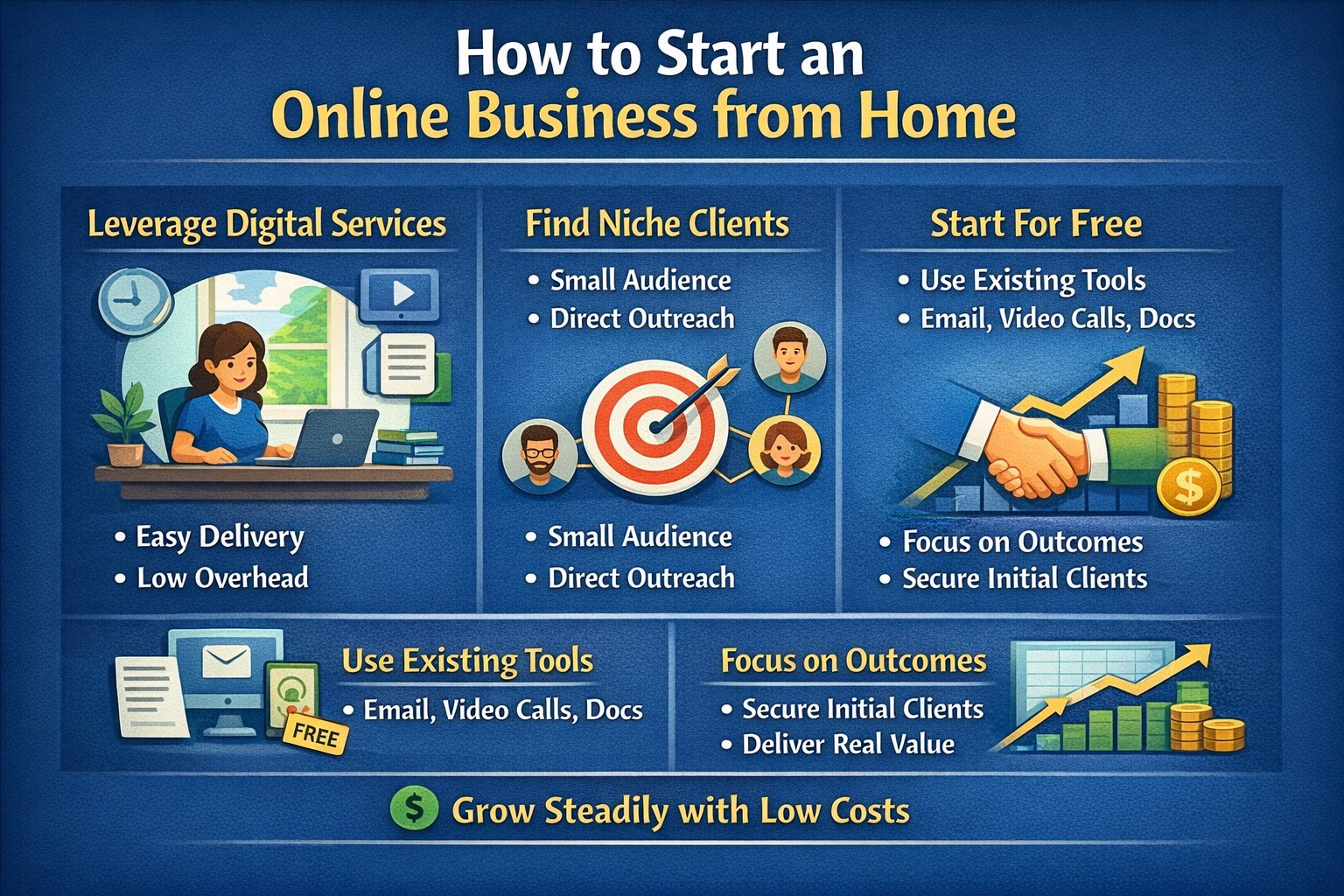
Focus on services that can be delivered digitally. This can include written analysis, recorded feedback, structured consultations, and downloadable tools. Physical products increase complexity and distract from trading priorities.
Also learn how to start an online business from home without building a large audience. This can be done through direct communication. You do not need thousands of followers. You need a clearly defined niche and structured outreach.
If capital is limited, it is possible to start an online business from home for free by using tools you already have. Email, video calls, and simple documents are enough in the early phase. Paid software and automation can wait until revenue becomes consistent.
Remember that visibility is not the first objective. Revenue is. Secure initial clients through targeted conversations. Deliver strong outcomes. Then expand gradually.
Starting a business from home with no money
It is possible to focus on starting a business from home with no money, but only if the model produces income before expenses appear.
Zero capital does not mean zero structure. It means replacing financial investment with skill, discipline, and direct outreach.
To start a home based business without spending upfront:
choose a service that uses knowledge you already have;
offer manual delivery instead of automated systems;
use direct conversations instead of paid marketing;
collect payment before expanding tools or infrastructure.
This approach makes it realistic to start a home business without loans or subscriptions. A laptop, stable internet connection, and defined working hours are usually enough in the beginning.
Many people researching how to start a small business from home assume they need branding, websites, or advanced software. In practice, those elements can wait. Early revenue matters more than presentation.
Can you run a business from home as a trader
You can run a business from home as a trader, but only if the structure protects trading performance. Many traders decide to start a business from home without defining how it will fit around market hours. When business tasks overlap with active trading sessions, focus drops and execution suffers.
The safest way to start business from home is to build around controlled scheduling. Trading requires high concentration during specific windows. A home business should not demand constant real-time interaction during those periods.
If you are starting a business from home, define your trading hours first. Those hours are fixed. Business tasks must be placed outside them. A stable approach is asynchronous delivery. Written analysis, structured reviews, templated feedback, and pre-recorded materials allow you to manage workload without interrupting live market activity.
Trading activity and broker selection for home-based traders
For traders who combine market activity with building a home-based business, trading should remain structured and independent from business operations. The goal is to avoid overlapping risks and prevent business tasks from interfering with decision-making during active market sessions.
When selecting a broker, traders should focus on availability of a wide range of assets regulation, execution quality, transparency of fees, and platform stability rather than promotional features. Reliable regulation and clear reporting help protect capital, while consistent execution reduces operational stress. Platform tools that support analysis, order management, and risk control are more important than advanced features that increase complexity.
| Trading.com USA | Plus500 | OANDA | FOREX.com | IG Markets | |
|---|---|---|---|---|---|
|
Currency pairs |
69 | 60 | 68 | 80 | 80 |
|
Crypto |
No | Yes | Yes | Yes | Yes |
|
Stocks |
No | Yes | Yes | Yes | Yes |
|
Min. deposit, $ |
50 | 100 | No | 100 | 1 |
|
Max. leverage |
1:50 | 1:300 | 1:200 | 1:50 | 1:200 |
|
Regulation |
CFTC, NFA | CySEC, FCA, ASIC, FMA, FSCA, FSA Seychelles, EFSA, MAS, DFSA, SCB | FSC (BVI), ASIC, IIROC, FCA, CFTC, NFA | CIMA, FCA, FSA (Japan), NFA, IIROC, ASIC, CFTC | FCA, BaFin, ASIC, MAS, CySec, FINMA, BMA, CFTC, NFA |
|
TU overall score |
6.88 | 6.67 | 6.63 | 6.47 | 6.38 |
|
Open an account |
Go to broker Your capital is at risk. |
Go to broker 81% of retail CFD accounts lose money. |
Go to broker Your capital is at risk. |
Study review | Study review |
Designing a trader-friendly home workspace
When running a business from home, the physical setup affects performance more than most traders expect. A poorly structured workspace increases distraction and reduces consistency.
If you plan to start a small business from home, separate business activity from trading activity as much as possible. Even in a single room, boundaries matter.
A practical setup includes:
Dedicated zones. One screen or desk area for trading and another for business tasks.
Fixed business hours. Scheduled blocks outside active market sessions.
Written procedures. Checklists for client delivery to reduce decision fatigue.
Clear onboarding steps. Standard communication templates for new clients.
This structure reinforces discipline in the long term. Clear environmental cues reduce mental switching costs between trading decisions and business execution.
A home office does not need to be expensive. It needs to be predictable. When the environment supports focus, it becomes far easier to run a business from home alongside active trading.
Balancing trading while running a business from home
The biggest risk when running a business from home as a trader is performance overlap. When business pressure increases, trading discipline often declines.
If you are starting a small business from home, define two separate performance systems:
trading metrics;
business metrics.
Traders who successfully start a business from home treat business activity like a structured system. That means:
fixed outreach targets per week;
defined delivery timelines;
weekly revenue review;
clear stop rules if trading performance drops.
This structure is especially important for anyone exploring how to start your own business from home while maintaining active market exposure.
Another overlooked factor is emotional spillover. A slow sales week should not influence trading decisions. Likewise, a losing trading streak should not trigger impulsive business changes. When both systems operate independently, it becomes sustainable to start a small business from home without increasing stress or cognitive overload.
Scaling after starting a business from home
Once you are comfortable, growth should come from simplification, not expansion. Many traders assume that to grow, they must add more services, more calls, and more complexity. In reality, sustainable scaling means refining what already works.
After you start a small business at home, focus on:
turning custom work into standardized packages;
increasing prices before increasing workload;
reducing one-off requests;
creating repeatable delivery frameworks.
If your goal is long-term stability, treat scaling as system improvement rather than volume expansion. That is how professionals successfully start a home business and keep it manageable.
Common mistakes when starting a business from home
Even experienced entrepreneurs make predictable errors when starting a business from home. Most problems do not come from lack of skill. They come from poor structure.
Overbuilding early. Creating branding, websites, or automation before securing revenue.
Skipping validation. Assuming demand exists without confirming willingness to pay.
Blurring schedules. Allowing business calls during other routine activities.
Mixing finances. Combining personal, trading, and business funds.
Scaling too fast. Adding volume before processes are standardized.
These mistakes often appear when someone decides to start a small business from home without defining boundaries first.
Build one focused home business without disrupting trading

I have seen many traders approach the idea of starting a small business from home with the same mindset they use when testing a new strategy. They overanalyze the setup and delay execution. In practice, the traders who succeed are the ones who simplify. They take one structured routine they already trust, such as performance review or risk tracking, and turn it into a clearly defined offer.
When I work with traders who want to start a small business at home, I always emphasize boundaries first. Trading hours remain protected. Business tasks are scheduled deliberately. Revenue is validated early. Once those foundations are stable, growth becomes a matter of refining systems rather than adding pressure. A home-based business should reduce volatility in your income, not increase volatility in your focus.
Conclusion
Starting a home-based business is not just a dream—it's a practical possibility when you follow proven models and commit to step-by-step execution. By leveraging low-cost methods and focusing on steady income streams, anyone can turn a passion or skill into a thriving enterprise from the comfort of their home. For instance, launching an online trading venture or offering freelance services are both accessible ways to build sustainable profit. The most powerful takeaway is that success hinges on consistent action and adaptation, rather than initial investment. Ultimately, building your own business at home opens doors to financial freedom and control over your future—it's up to you to walk through.
FAQs
How can you validate demand before fully committing to a home-based business idea?
What are the legal considerations when starting a home-based business?
How can you sustainably scale a home-based business without adding complexity?
What workspace setup is recommended for running a home-based business as a trader?
Editors' Top Picks and Insights






Related Articles
Team that worked on the article
Aleksandra Chaikina has been a contributor to Traders Union since 2021. With over 15 years of experience in copywriting and more than 5 years focused on financial content, she specializes in producing detailed guides, analytics, and comparative reviews across various sectors, including cryptocurrencies, Forex, investment strategies, and financial technologies.
Dan Blystone began his trading career in 1998 as an arbitrage clerk on the floor of the Chicago Mercantile Exchange (CME). He later traded bond and Eurex futures at proprietary firms such as Altea Trading, gaining valuable experience in high-frequency trading and risk management.
Chinmay Soni is a financial analyst with more than 5 years of experience in working with stocks, Forex, derivatives, and other assets. As a founder of a boutique research firm and an active researcher, he covers various industries and fields, providing insights backed by statistical data.
Forex leverage is a tool enabling traders to control larger positions with a relatively small amount of capital, amplifying potential profits and losses based on the chosen leverage ratio.
Risk management is a risk management model that involves controlling potential losses while maximizing profits. The main risk management tools are stop loss, take profit, calculation of position volume taking into account leverage and pip value.
Forex trading, short for foreign exchange trading, is the practice of buying and selling currencies in the global foreign exchange market with the aim of profiting from fluctuations in exchange rates. Traders speculate on whether one currency will rise or fall in value relative to another currency and make trading decisions accordingly. However, beware that trading carries risks, and you can lose your whole capital.
Ethereum is a decentralized blockchain platform and cryptocurrency that was proposed by Vitalik Buterin in late 2013 and development began in early 2014. It was designed as a versatile platform for creating decentralized applications (DApps) and smart contracts.
An investor is an individual, who invests money in an asset with the expectation that its value would appreciate in the future. The asset can be anything, including a bond, debenture, mutual fund, equity, gold, silver, exchange-traded funds (ETFs), and real-estate property.

-
 Afghanistan
-
 Albania
-
 Algeria
-
 Angola
-
 Argentina
-
 Armenia
-
 Australia
-
 Austria
-
 Azerbaijan
-
 Bahamas
-
 Bahrain
-
 Bangladesh
-
 Belarus
-
 Belgium
-
 Bolivia
-
 Botswana
-
 Brazil
-
 Brunei
-
 Bulgaria
-
 Cambodia
-
 Cameroon
-
 Canada
-
 Chile
Chile
-
 China
China
-
 Colombia
-
 Congo
Congo
-
 Costa Rica
-
 Cote d'Ivoire
-
 Croatia
-
 Cuba
Cuba
-
 Cyprus
-
 Czechia
-
 DR Congo
-
 Denmark
-
 Dominican Republic
-
 Ecuador
-
 Egypt
Egypt
-
 El Salvador
-
 Estonia
-
 Eswatini
-
 Ethiopia
-
 Finland
-
 France
-
 Georgia
-
 Germany
-
 Ghana
Ghana
-
 Greece
-
 Haiti
Haiti
-
 Hong Kong
-
 Hungary
-
 India
India
-
 Indonesia
-
 Iran, Islamic republic
-
 Iraq
Iraq
-
 Ireland
-
 Israel
-
 Italy
Italy
-
 Jamaica
-
 Japan
Japan
-
 Jordan
-
 Kazakhstan
-
 Kenya
Kenya
-
 Korea
Korea
-
 Kuwait
-
 Kyrgyzstan
-
 Laos
Laos
-
 Latvia
-
 Lebanon
-
 Lesotho
-
 Libya
Libya
-
 Lithuania
-
 Luxembourg
-
 Madagascar
-
 Malaysia
-
 Malta
Malta
-
 Mauritius
-
 Mexico
-
 Moldova
-
 Mongolia
-
 Montenegro
-
 Morocco
-
 Mozambique
-
 Myanmar
-
 Namibia
-
 Nepal
Nepal
-
 Netherlands
-
 New Zealand
-
 Nigeria
-
 North Macedonia
-
 Norway
-
 Oman
Oman
-
 Pakistan
-
 Palestine
-
 Panama
-
 Papua New Guinea
-
 Paraguay
-
 Peru
Peru
-
 Philippines
-
 Poland
-
 Portugal
-
 Puerto Rico
-
 Qatar
Qatar
-
 Reunion
-
 Romania
-
 Rwanda
-
 Saudi Arabia
-
 Serbia
-
 Singapore
-
 Slovakia
-
 Slovenia
-
 Somalia
-
 South Africa
-
 Spain
Spain
-
 Sri Lanka
-
 Sweden
-
 Switzerland
-
 Syria
Syria
-
 Taiwan
-
 Tajikistan
-
 Tanzania
-
 Thailand
-
 Trinidad and Tobago
-
 Tunisia
-
 Turkey
-
 UAE
UAE
-
 Uganda
-
 Ukraine
-
 United Kingdom
-
United States
-
 Uruguay
-
 Uzbekistan
-
 Venezuela
-
 Vietnam
-
 Yemen
Yemen
-
 Zambia
-
 Zimbabwe
- Forex
- Crypto










- How to start a business from home
- How to start an online business from home for free
- Starting a business from home with no money
- Can you run a business from home as a trader
- Trading activity and broker selection for home-based traders
- Designing a trader-friendly home workspace
- Balancing trading while running a business from home
- Scaling after starting a business from home
- Common mistakes when starting a business from home
- Expert opinion
- Conclusion
- FAQs


