
Smart Contract Use Cases


Editorial Note: While we adhere to strict Editorial Integrity, this post may contain references to products from our partners. Here's an explanation for How We Make Money. None of the data and information on this webpage constitutes investment advice according to our Disclaimer.
Smart contracts are used today for stablecoin Forex swaps on Curve, real estate tokenization on RealT, automated insurance through Etherisc, NFT royalty payouts on Zora, lending by Aave, and governance systems such as MakerDAO. These examples show how smart contracts automate trading, payments, and asset management without intermediaries.
Smart contracts now power real-world systems that run without banks or other central intermediaries. These programs follow coded rules and complete actions the moment conditions are met. What are some real-world applications of smart contracts? This guide answers that question by giving you a clear breakdown of smart contract use cases across finance, trading, and automation. It helps both new users and traders understand how these smart contract blockchain examples support lending, swaps, asset management, and on-chain execution.
Risk warning: Cryptocurrency markets are highly volatile, with sharp price swings and regulatory uncertainties. Research indicates that 75-90% of traders face losses. Only invest discretionary funds and consult an experienced financial advisor.
DeFi lending with Aave
Aave is one of the most common smart contract applications in decentralized lending. It works as a non custodial system where users deposit or borrow assets through code instead of banks. This smart contract example shows how deposits, interest updates, collateral checks, and liquidations happen automatically. Traders use Aave as a real world example of smart contracts that remove intermediaries and enforce the rules on-chain.
This is a verified blockchain smart contract example, where all loan operations, deposits, interest accrual, collateral enforcement, and liquidations, are handled entirely through code.
How the Aave smart contract works
Collateral deposit. A user links a wallet and deposits assets such as ETH or wBTC into Aave. The smart contract then issues aTokens that show the size of the deposit. These tokens rise in value as interest builds over time.
Loan origination. Users can borrow assets like USDC or DAI up to a set loan to value level. The smart contract updates interest rates based on how much of the pool is used.
Risk management and liquidation. If collateral value falls and the position becomes unsafe, the smart contract starts liquidation. It sells part of the collateral to cover the loan and applies a penalty.
No manual intervention. All actions run through code with no manual review. This application of smart contract logic is one of the clearest smart contracts in blockchain examples for lending and risk control.

Stablecoin Forex swaps on Curve Finance
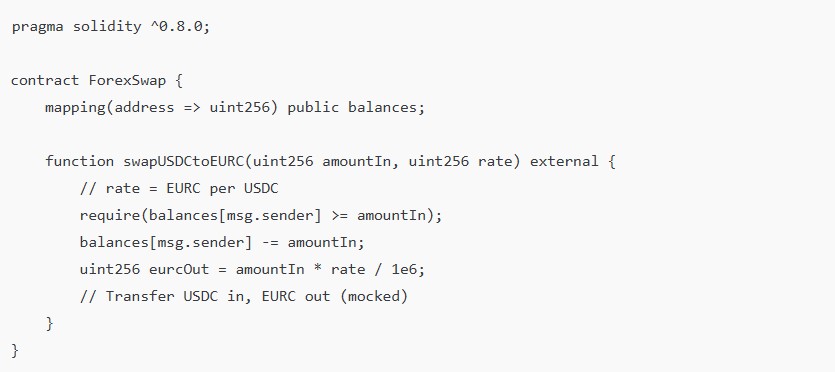
Curve Finance shows one of the clearest use cases of smart contracts in cross border Forex. It lets users swap stablecoins such as EURC, USDC, USDT, and DAI directly on-chain. This setup avoids slow banking systems and supports fast and low cost currency conversion. It is a strong example of smart contract use in blockchain for everyday trading.
How the smart contract works
Liquidity pool architecture. Curve uses large pools of stablecoins supplied by liquidity providers. Its AMM design helps keep price slippage low when users swap assets with similar values.
Swap execution. When a trader swaps tokens, the smart contract finds the best route, applies the set fee, and completes the trade in one blockchain action.
Settlement and fee allocation. The swapped stablecoin goes to the user’s wallet within seconds. The fee is shared with liquidity providers. No central party handles clearing. This makes Curve a strong smart contract use case for fast and low cost Forex activity.
This is a textbook example of smart contract in blockchain providing a high-frequency, low-cost alternative to traditional foreign exchange pathways.
Tokenized real estate: RealT
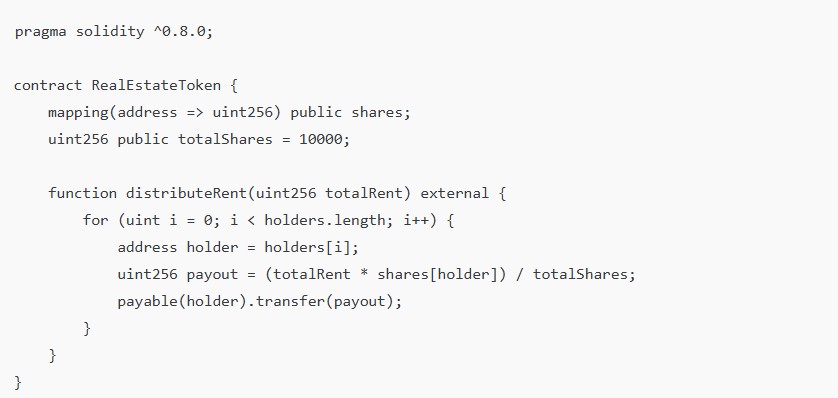
RealT is a strong application of smart contracts in blockchain because it turns real estate into digital tokens that represent ownership. Users can buy small shares of U.S. rental homes through Ethereum based tokens. The smart contract replaces tasks that normally need title agents, rent processors, or escrow teams. This is one of the most practical real world examples of smart contracts in property investing.
How the smart contract works
Property tokenization. Each property is placed in an LLC. The LLC ownership is split into ERC20 tokens. Every token shows a fractional share tied to the real asset through legal documents.
On-chain ownership recording. All token transfers are recorded on Ethereum. Anyone can view and verify ownership, which adds transparency.
Rental income distribution. Rental income is turned into stablecoins such as USDC. The smart contract sends weekly payouts to each holder based on the number of tokens they own. No manual review is needed.
Secondary transfers. Holders can sell their tokens on approved markets. The smart contract checks whitelisted wallets to support KYC and AML rules.
Automated insurance with Etherisc
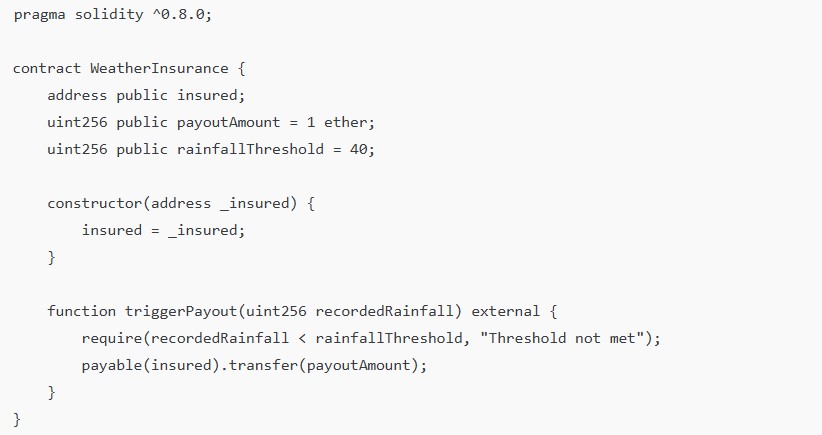
Etherisc shows one of the most useful use cases of smart contracts in the insurance sector. It offers parametric insurance, where payouts are based on data rather than manual reviews. When weather data from trusted oracles meets a set condition, the smart contract sends the payout automatically. This is a clear example of smart contracts in real world services that need fast and fair settlement.
How the smart contract works
Policy purchase. A user buys a policy with stablecoins and chooses a trigger, such as low rainfall over a set period. The smart contract holds the coverage funds in escrow.
Data integration via oracles. Weather oracles like Chainlink send data from trusted sources to the smart contract. This can include rainfall, temperature, or wind levels.
Trigger and payout logic. If the data shows that the trigger condition has been met, the smart contract pays the user right away. There is no claim filing or adjuster process. This is a strong application of smart contract design for fast and automatic insurance payouts.
NFT royalties with Zora
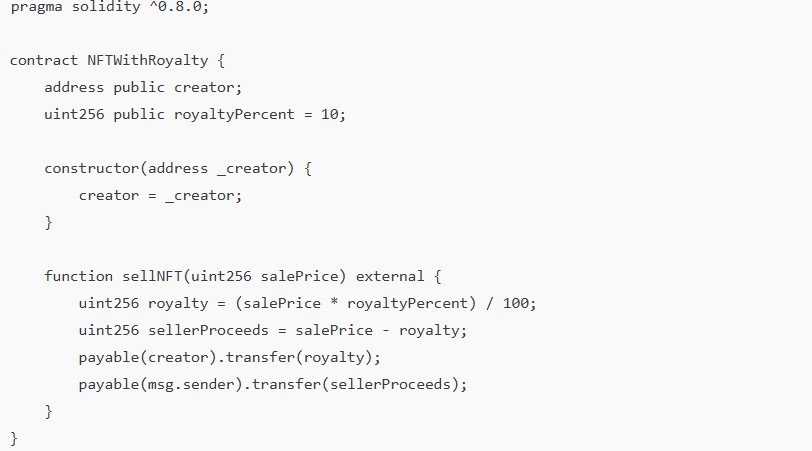
Zora offers one of the best examples of smart contracts in digital art and collectibles. The smart contract ensures that creators receive a set royalty each time an NFT is resold. This payment is enforced by code, not by the marketplace. It is a practical smart contract example that removes the need for manual tracking or third party payouts.
How the smart contract works
Minting and royalty setting. Zora uses ERC721 and ERC1155 standards with added royalty features. When the creator mints an NFT, they set a royalty rate such as 10 percent. This rate is written into the contract metadata.
Resale execution. When the NFT is sold again, the smart contract calculates the royalty and splits the payment between the seller and the creator.
Settlement and finalization. The payment is sent instantly to both parties. There is no manual review or platform approval. This application of smart contract logic shows how blockchain can automate revenue distribution for creators.
This is a clear example of a smart contract in blockchain performing automated revenue distribution on-chain.
Governance and treasury disbursement in MakerDAO
MakerDAO is one of the strongest smart contract applications in decentralized governance. It shows how voting and treasury payments can run on-chain with no central team handling approvals. This is a leading smart contract use case where funding decisions are made by token holders and executed by code.
How the smart contract works
MakerDAO governance uses a multi-stage, code-enforced system that includes proposal submission, vote casting, and treasury disbursement. The key steps are:
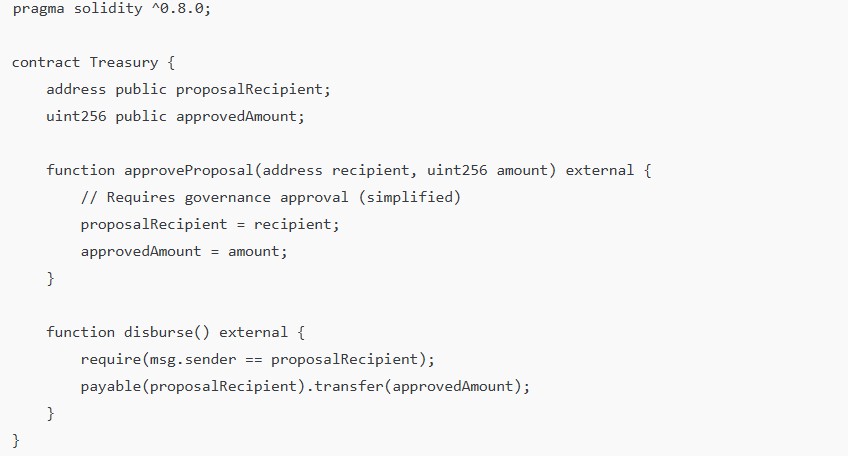
Proposal creation. Members create governance proposals called MIPs. These outline the payment amount, purpose, recipient wallet, and timing.
On-chain voting. MKR token holders vote on each proposal. Smart contracts count votes, check quorum, and confirm the result.
Disbursement execution. When a proposal passes, the smart contract releases the funds, often in DAI, to the chosen wallet. No central authority approves the payment.
Auditing and record-keeping. All steps take place on-chain and can be reviewed by anyone. This makes MakerDAO a clear example of smart contracts in real world governance.
Legal contracts and service payments: OpenLaw
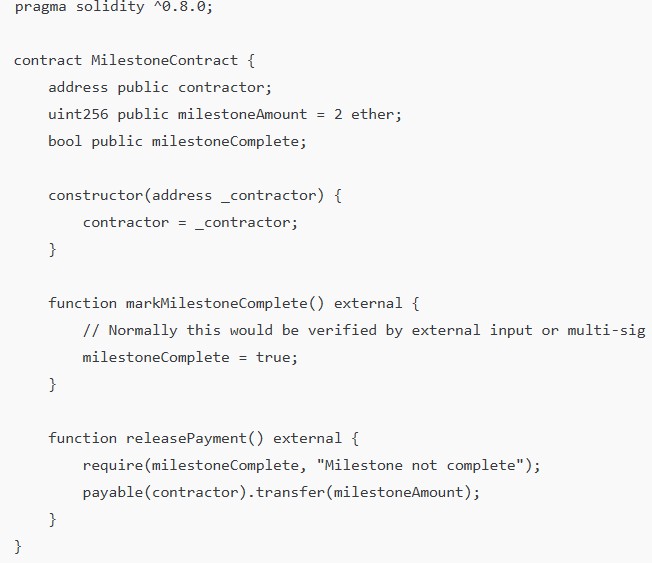
OpenLaw is a smart contract application for legal and service agreements. It combines legal text with blockchain code so both sides can set rules for payments, milestones, and deadlines. The smart contract enforces these rules without manual checks or escrow teams. This makes OpenLaw one of the practical examples of smart contracts used in real commercial work.
How the smart contract works
Agreement structuring. The agreement is written with OpenLaw’s system, which mixes legal clauses with code rules like payment terms and deadlines. Both parties sign it digitally, and the signature links the terms to the smart contract.
Smart contract deployment. After signing, the smart contract is deployed on Ethereum. Funds such as ETH or USDC can be locked in escrow inside the contract.
Condition monitoring and execution. After signing, the smart contract is deployed on Ethereum. Funds such as ETH or USDC can be locked in escrow inside the contract.
Derivatives and risk management: Opyn
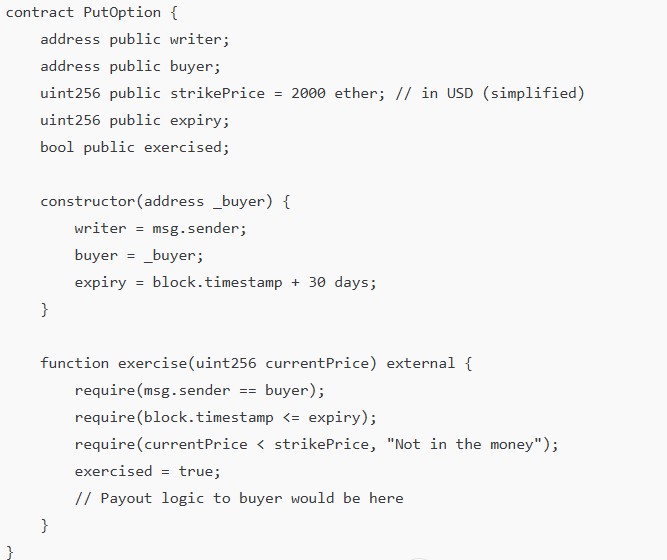
Opyn is one of the most advanced smart contracts applications for traders. It allows users to create, buy, and settle options fully on-chain with no clearinghouse or broker. It is a strong smart contract use case for hedging and managing market risk.
How the smart contract works
Options creation ("Writing"). A trader creates a put or call option by locking collateral such as ETH or USDC inside the contract. The smart contract then mints an oToken that represents the option.
Market participation. Buyers can purchase oTokens on DEXs like Uniswap or on Opyn’s own interface. Holding the oToken gives the buyer the right to exercise the option.
Settlement and payout. At expiry, the smart contract checks the asset price through an oracle such as Chainlink. If the strike condition is met, the buyer can redeem the oToken for a payout from the locked collateral. The contract handles expiry, price checks, and collateral release with no manual review. This is a clean example of smart contract logic used for trading and risk control.
Logistics and supply chain: IBM food trust
In logistics, use cases of smart contracts include automating shipping verification and payment processes.
a shipment is tracked via IoT devices;
upon confirmed delivery, a smart contract releases payment;
reduces delays and errors in international trade.
This provides a verifiable smart contract application where external data initiates fund transfer with no human confirmation needed.
| Sector | Platform | Smart contract role | What it does | User benefit |
|---|---|---|---|---|
| Lending | Aave | Collateral + liquidation logic | Manages deposits, loans, and LTV rules | Borrow without intermediaries; access liquidity while holding assets |
| Forex | Curve | Stablecoin swap AMMs | Executes EURC↔USDC swaps via on-chain pools | Instant low-cost FX trades instead of multi-day bank transfers |
| Real Estate | RealT | Tokenized ownership + rent payout | Splits rental income to token holders automatically | Easy entry into property markets with programmable passive income |
| Insurance | Etherisc | Weather-index payout | Uses oracle data to auto-trigger claims | Fast, dispute-free insurance settlements |
| NFTs | Zora | Automated royalties | Sends creator royalties on each resale | Guaranteed creator income; transparent fees for traders |
| Governance | MakerDAO | DAO vote execution | Releases funds or changes parameters after votes | Fully auditable, rules-based governance for protocol participants |
| Legal | OpenLaw | Milestone-based payments | Pays automatically when work milestones are met | Low-risk contracting without third-party arbitration |
| Derivatives | Opyn | On-chain options settlement | Enforces strike, premium, and expiry terms | Non-custodial hedging and volatility trading |
| Logistics | IBM Food Trust | Delivery-verified settlement | Releases payment after GPS/IoT delivery confirmation | Faster, trusted settlement in supply and commodity flows |
If you’re exploring how smart contracts operate in real markets, it also helps to see where these assets are traded. Checking the best crypto exchanges in your region can guide you toward trusted platforms that support tokens built on smart contracts, making it easier to observe, trade, and learn from real-world blockchain activity safely.
| Crypto | Foundation year | Min. Deposit, $ | Coins Supported | Spot Taker fee, % | Spot Maker Fee, % | Alerts | Copy trading | Tier-1 regulation | TU overall score | Open an account | |
|---|---|---|---|---|---|---|---|---|---|---|---|
| Yes | 2012 | 10 | 400+ | 0.5 | 0.5 | Yes | No | Yes | 8.5 | Go to broker Your capital is at risk. |
|
| Yes | 2017 | 10 | 600+ | 0.1 | 0.08 | Yes | Yes | No | 8.46 | Go to broker Your capital is at risk. |
|
| Yes | 2011 | 10 | 399 | 0.3 | 0.2 | No | Yes | Yes | 8.08 | Go to broker Your capital is at risk.
|
|
| Yes | 2018 | No | 1000 | 0 | 0 | Yes | Yes | No | 7.8 | Go to broker Your capital is at risk. |
|
| Yes | 2016 | 1 | 400+ | 0.5 | 0.25 | Yes | No | Yes | 7.76 | Go to broker Your capital is at risk. |
Smart contracts work best when tied to real cash flows

From my experience watching these systems operate in real market conditions, the smart contracts worth trusting are the ones that remove friction and protect value with clear rules. I have seen traders jump into new platforms without checking how payouts, liquidations, or collateral logic actually work, and that is usually where losses begin. Lending tools such as Aave give you predictable access to capital when you need it, while Curve’s stablecoin swaps prevent delays that often come with traditional banking.
Insurance platforms like Etherisc help because payouts depend on weather data, not on a long claims process. RealT shows how smart contracts can send income on time, which is something many rental systems still fail to do. When I look at smart contract use cases, I focus on the simple question: how does this system handle money when things go wrong? If you can answer that, you can avoid hype and build steady, long term strategies that match your risk level.
Conclusion
The rapid growth of smart contracts has already transformed multiple industries by automating trust, enforcing rules, and enabling new financial possibilities without intermediaries. From Aave’s decentralized lending to RealT’s automated real estate income, these applications consistently prove that reliable code can replace manual processes in critical sectors. What stands out most is how smart contracts, when integrated with real-world data or assets, deliver speed, transparency, and efficiency that traditional systems struggle to match. The real power of smart contracts lies in their ability to make markets and agreements fairer, faster, and more accessible for everyone willing to embrace the future.
FAQs
What role do oracles play in smart contract examples and real world applications?
How do smart contracts automate risk management in financial use cases?
Can smart contracts be used for automating supply chain and logistics processes?
How do smart contracts support decentralized governance and treasury management?
Editors' Top Picks and Insights




Related Articles
Team that worked on the article
Aleksandra Chaikina has been a contributor to Traders Union since 2021. With over 15 years of experience in copywriting and more than 5 years focused on financial content, she specializes in producing detailed guides, analytics, and comparative reviews across various sectors, including cryptocurrencies, Forex, investment strategies, and financial technologies.
Dan Blystone began his trading career in 1998 as an arbitrage clerk on the floor of the Chicago Mercantile Exchange (CME). He later traded bond and Eurex futures at proprietary firms such as Altea Trading, gaining valuable experience in high-frequency trading and risk management.
Chinmay Soni is a financial analyst with more than 5 years of experience in working with stocks, Forex, derivatives, and other assets. As a founder of a boutique research firm and an active researcher, he covers various industries and fields, providing insights backed by statistical data.
CFD is a contract between an investor/trader and seller that demonstrates that the trader will need to pay the price difference between the current value of the asset and its value at the time of contract to the seller.
Copy trading is an investing tactic where traders replicate the trading strategies of more experienced traders, automatically mirroring their trades in their own accounts to potentially achieve similar results.
Volatility refers to the degree of variation or fluctuation in the price or value of a financial asset, such as stocks, bonds, or cryptocurrencies, over a period of time. Higher volatility indicates that an asset's price is experiencing more significant and rapid price swings, while lower volatility suggests relatively stable and gradual price movements.
Ethereum is a decentralized blockchain platform and cryptocurrency that was proposed by Vitalik Buterin in late 2013 and development began in early 2014. It was designed as a versatile platform for creating decentralized applications (DApps) and smart contracts.
Cryptocurrency is a type of digital or virtual currency that relies on cryptography for security. Unlike traditional currencies issued by governments (fiat currencies), cryptocurrencies operate on decentralized networks, typically based on blockchain technology.

-
 Afghanistan
-
 Albania
-
 Algeria
-
 Angola
-
 Argentina
-
 Armenia
-
 Australia
-
 Austria
-
 Azerbaijan
-
 Bahamas
-
 Bahrain
-
 Bangladesh
-
 Belarus
-
 Belgium
-
 Bolivia
-
 Botswana
-
 Brazil
-
 Brunei
-
 Bulgaria
-
 Cambodia
-
 Cameroon
-
 Canada
-
 Chile
Chile
-
 China
China
-
 Colombia
-
 Congo
Congo
-
 Costa Rica
-
 Cote d'Ivoire
-
 Croatia
-
 Cuba
Cuba
-
 Cyprus
-
 Czechia
-
 DR Congo
-
 Denmark
-
 Dominican Republic
-
 Ecuador
-
 Egypt
Egypt
-
 El Salvador
-
 Estonia
-
 Eswatini
-
 Ethiopia
-
 Finland
-
 France
-
 Georgia
-
 Germany
-
 Ghana
Ghana
-
 Greece
-
 Haiti
Haiti
-
 Hong Kong
-
 Hungary
-
 India
India
-
 Indonesia
-
 Iran, Islamic republic
-
 Iraq
Iraq
-
 Ireland
-
 Israel
-
 Italy
Italy
-
 Jamaica
-
 Japan
Japan
-
 Jordan
-
 Kazakhstan
-
 Kenya
Kenya
-
 Korea
Korea
-
 Kuwait
-
 Kyrgyzstan
-
 Laos
Laos
-
 Latvia
-
 Lebanon
-
 Lesotho
-
 Libya
Libya
-
 Lithuania
-
 Luxembourg
-
 Madagascar
-
 Malaysia
-
 Malta
Malta
-
 Mauritius
-
 Mexico
-
 Moldova
-
 Mongolia
-
 Montenegro
-
 Morocco
-
 Mozambique
-
 Myanmar
-
 Namibia
-
 Nepal
Nepal
-
 Netherlands
-
 New Zealand
-
 Nigeria
-
 North Macedonia
-
 Norway
-
 Oman
Oman
-
 Pakistan
-
 Palestine
-
 Panama
-
 Papua New Guinea
-
 Paraguay
-
 Peru
Peru
-
 Philippines
-
 Poland
-
 Portugal
-
 Puerto Rico
-
 Qatar
Qatar
-
 Reunion
-
 Romania
-
 Rwanda
-
 Saudi Arabia
-
 Serbia
-
 Singapore
-
 Slovakia
-
 Slovenia
-
 Somalia
-
 South Africa
-
 Spain
Spain
-
 Sri Lanka
-
 Sweden
-
 Switzerland
-
 Syria
Syria
-
 Taiwan
-
 Tajikistan
-
 Tanzania
-
 Thailand
-
 Trinidad and Tobago
-
 Tunisia
-
 Turkey
-
 UAE
UAE
-
 Uganda
-
 Ukraine
-
 United Kingdom
-
United States
-
 Uruguay
-
 Uzbekistan
-
 Venezuela
-
 Vietnam
-
 Yemen
Yemen
-
 Zambia
-
 Zimbabwe
- Forex
- Crypto










- DeFi lending with Aave
- Stablecoin Forex swaps on Curve Finance
- Tokenized real estate: RealT
- Automated insurance with Etherisc
- NFT royalties with Zora
- Governance and treasury disbursement in MakerDAO
- Legal contracts and service payments: OpenLaw
- Derivatives and risk management: Opyn
- Logistics and supply chain: IBM food trust
- Expert opinion
- Conclusion
- FAQs


