
Pharos Testnet: All You Need To Know


Editorial Note: While we adhere to strict Editorial Integrity, this post may contain references to products from our partners. Here's an explanation for How We Make Money. None of the data and information on this webpage constitutes investment advice according to our Disclaimer.
The Pharos network testnet lets users and developers test real-world asset tools in a fast, low-cost environment. You can connect through RPC, claim test tokens, explore transactions, and deploy smart contracts. Active participation may also help users qualify for future airdrop rewards, depending on activity and program rules.
Pharos is designed as a fast and compliant platform for testing real-world asset applications. It connects traditional finance and on-chain tools through a simple testnet environment that supports wallets, smart contracts, and developers. The testnet has shown strong performance in speed, stability, and regulatory features, giving users a clear view of how the mainnet may operate.
Risk warning: Cryptocurrency markets are highly volatile, with sharp price swings and regulatory uncertainties. Research indicates that 75-90% of traders face losses. Only invest discretionary funds and consult an experienced financial advisor.
What is Pharos Testnet?
Pharos Testnet is a test network of the new Pharos Network blockchain platform, created for tokenization of real assets (Real World Assets) and integration with decentralized applications. It implements a unique GPU-like architecture to achieve high speed and scalability.
Extreme throughput and architecture
The testnet supports more than 30,000 TPS and finalizes most blocks in about one second. This gives users and developers a clear view of expected mainnet performance. The Pharos testnet RPC provides stable access for wallets and contract tools. Its modular design supports parallel processing and horizontal scaling, which improves both transaction speed and energy efficiency.
Built‑in compliance and enterprise trust
The network uses built-in tools for KYC and AML testing, which help users understand how regulated applications may work on-chain. These features allow privacy-preserving checks without exposing personal data. Activity on the Pharos testnet explorer shows how contracts, wallets, and attestations are verified in real time, which increases trust for institutional users.

Pharos Testnet in action: what you can do
For devs and builders
Developers can review sample deployments through the publicly available Pharos testnet contract address registry. The Testnet supports both EVM tools such as Hardhat and Foundry, along with Rust SDKs. Contract activity is easy to track through Pharos testnet Scan, which displays gas use, call traces, and transaction history.
To begin testing, developers can request tokens from the Pharos testnet faucet, available through the official dashboard or community channels. These tokens allow you to deploy contracts, test functions, and confirm network performance without real costs.
For traders and early adopters
Traders can connect MetaMask or Keplr by adding the Pharos testnet RPC. After setup, they can request tokens from the Pharos network testnet faucet to begin testing. These tokens allow users to try swaps, add liquidity, delegate stake, and explore other Testnet features.
Early activity may also help users qualify for the Pharos testnet airdrop, depending on interaction count, transaction volume, governance participation, and quest completion. Eligibility can be checked through dashboards linked to airdrop scoring tools.
Performance and real use cases
Dozens of dApp projects are already being actively developed on the basis of Pharos Testnet. These solutions demonstrate how tokenization of real assets, decentralized finance and Web3 tools can work in practice. Interaction with these applications allows users not only to get acquainted with the ecosystem, but also to earn XP and NFT.
The largest projects already launched in the Pharos test network:
Zenith Swap is a decentralized exchange with minimal commissions, which implements the functions of exchange, farming and liquidity provision. Supports interaction with the main tokens of the testnet.
Nextmate.AI is an AI platform built on Pharos that allows users to interact with decentralized intelligent agents. The focus is on confidentiality and modularity.
ELFi is a credit protocol that provides loans based on tokenized RWA. The uniqueness is in real equipment and integration with DID verification.
Faroswap is a simple and intuitive DEX platform with the opportunity to participate in missions, swaps and XP challenges. Suitable for both beginners and experienced testers.
Buzzing Club is a social Web3 project in which users earn rewards for activity in the community. Integrated with Twitter, Discord and the NFT system.
R2 is a tool for creating and trading tokenized shares of real assets. One of the first to offer a chain of transactions with on-chain confirmation.
OpenFi is an aggregator of decentralized financial protocols, including those compatible with Pharos DID and KYC. Offers flexible liquidity management products.
Hemera is a prediction platform with the ability to bet on the outcomes of events through smart contracts.
Blocksense is a tool for analyzing and monitoring smart contracts on Pharos. Simplifies debugging and audit of network interactions.
Supra is an integration add-on for cross-network interaction, providing cross-chain compatibility with other L1 and L2.
These applications show the real viability of the network and its orientation towards practical application. By participating in their testing, users not only receive rewards, but also become part of technological progress.
Compliance tech: a real differentiator
The Pharos network testnet includes built-in tools for KYC and AML checks, which help developers test regulated financial workflows. These checks use zero-knowledge proofs to confirm identity or wallet history without exposing personal data.
Attestations are stored inside transaction metadata and can be viewed through the Pharos testnet explorer or Pharos testnet scan. This design supports use cases that require clear audit trails, digital ID verification, or controlled access to DeFi products.
Developers on the Pharos protocol testnet can simulate features such as age-restricted access, investor whitelists, or institution-level permissions. More than 27,000 test attestations have been issued so far, showing the system can scale while maintaining strong privacy.
How to get started with Pharos
This guide helps users join the Pharos network testnet and begin testing key tools such as the Pharos testnet RPC, Pharos testnet faucet, and contract features. The steps below work for both beginners and advanced users.
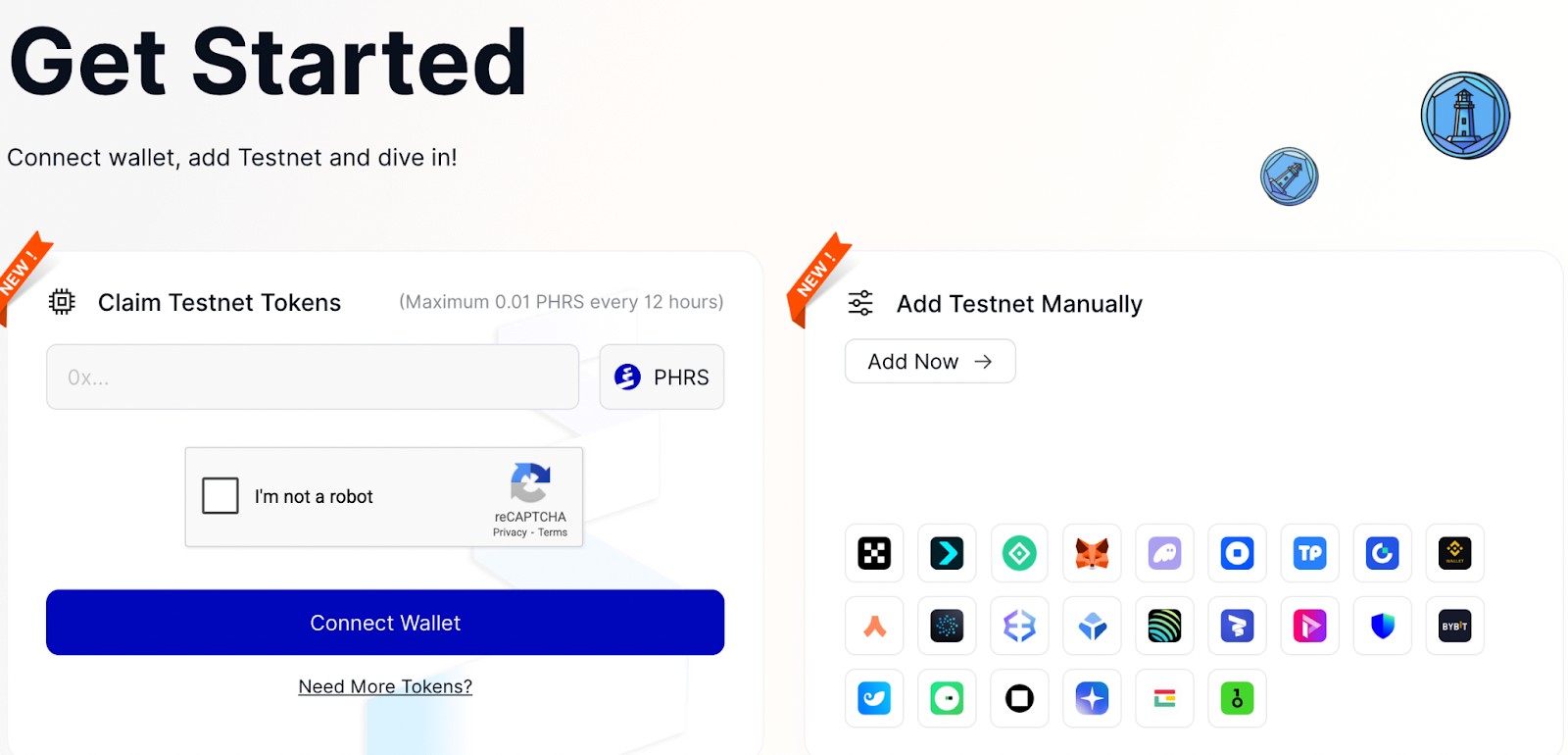
Add the Pharos testnet RPC to MetaMask or Keplr. The RPC supports high daily traffic and is designed for stable contract deployments.
Request tokens from the Pharos testnet faucet. The faucet usually sends up to five test tokens per request within about 30 seconds.
Send a simple transaction from your testnet wallet to confirm syncing and gas fee simulation.
Deploy or interact with a smart contract using public testnet addresses. Thousands of deployments have already been completed by developers.
Track your wallet activity on dashboards or on the Pharos testnet explorer to confirm stable execution and data flow.

Risks, limitations and what to watch
The Pharos network testnet experience provides valuable testing ground, but users should be aware of key risks:
Token distribution delays. The faucet may be slow during peak hours.
Explorer indexing issues. Transactions may not appear immediately.
RPC instability. Network resets or sync problems can affect usability.
Data lag. Dashboard updates from testnet activity may be delayed.
Testnet resets. Full chain resets may erase testing progress.
Contract reliability. Deployed contracts might fail or deprecate.
While interacting with the Pharos testnet faucet can support airdrop eligibility, any tokens earned are speculative and not guaranteed to have market value.
Outlook: what’s next
The Pharos network testnet is expanding with new tools that users can already preview through the Pharos testnet explorer, Pharos testnet RPC, and Pharos testnet scan. The roadmap includes Bitcoin bridging for cross-chain liquidity tests, zkML smart contracts for private machine learning, SmartCogent agents for automated governance, and more verified contract addresses. Most upgrades are expected to reach mainnet by early 2026, giving early Testnet users a valuable head start.
What will be the impact of Pharos' testnet launch on traditional finance stocks?
The launch of the Pharos testnet is a blockchain infrastructure event aimed at supporting real-world asset tokenization and scalable financial applications by bridging traditional finance and Web3. While this can boost optimism around blockchain adoption, it is unlikely to directly move major traditional finance stocks in the short term because those markets respond more to interest rates, earnings, and economic data than to crypto testnets.
However, companies tied to blockchain, tokenization, or strategic partnerships with projects like Pharos could see positive sentiment or niche gains, especially if they signal future innovation or revenue streams. Any broader impact on mainstream financial stocks would depend on regulatory clarity and institutional adoption of tokenized assets over time, not just the testnet launch itself.
As the Pharos network testnet grows and prepares for its mainnet phase, many users are already planning where they will eventually hold or trade any live tokens that may emerge. This makes it a good moment to explore the best crypto exchanges in your region so you are ready to move smoothly when Pharos expands beyond testing and its ecosystem starts listing assets on regulated platforms.
| OKX | Coinbase | Crypto.com | Cryptohopper | BTCC | |
|---|---|---|---|---|---|
|
Min. Deposit, $ |
10 | 10 | 1 | No | 10 |
|
Coins Supported |
600+ | 400+ | 400+ | 1000 | 399 |
|
Spot Taker fee, % |
0.1 | 0.5 | 0.5 | 0 | 0.3 |
|
Spot Maker Fee, % |
0.08 | 0.5 | 0.25 | 0 | 0.2 |
|
Alerts |
Yes | Yes | Yes | Yes | No |
|
Copy trading |
Yes | No | No | Yes | Yes |
|
TU overall score |
8.48 | 7.84 | 7.8 | 7.76 | 7.6 |
|
Open an account |
Go to broker Your capital is at risk. |
Go to broker Your capital is at risk. |
Go to broker Your capital is at risk. |
Go to broker Your capital is at risk. |
Go to broker Your capital is at risk.
|
Treat the testnet as practice for real RWA use

From what I have seen across many Testnet cycles, the Pharos network testnet stands out because it encourages users to learn real workflows instead of only farming rewards. The tools are stable, the Explorer gives clear insight into on-chain activity, and the Pharos testnet RPC handles contract calls with fewer interruptions than most early networks. I think traders and developers should treat this Testnet as a chance to build familiarity with RWA mechanics, compliance features, and cross-chain functions before they reach the mainnet.
If you want a long-term advantage, spend time testing smart contract actions, monitoring gas patterns, and following early DApp traction through Pharos testnet scan. These steps help you understand the network in a deeper way and often matter more than simple faucet claims when airdrop reviews are done. I view Testnets like this as training grounds. The more carefully you use the tools, the better prepared you will be when real liquidity arrives.
Conclusion
Participating in the Pharos testnet offers forward-thinking users a valuable opportunity to engage with a cutting-edge blockchain ecosystem ahead of its official launch. By leveraging faucet tokens and connecting via RPC, early adopters can meaningfully interact with network features and potentially position themselves for the anticipated 2026 airdrop. For instance, testing dApps or deploying smart contracts on the testnet can demonstrate active participation crucial for reward eligibility. Ultimately, the Pharos testnet experience symbolizes the growing importance of early involvement in web3 communities—where hands-on engagement now may translate to significant advantages later.
FAQs
What steps are involved in connecting a wallet to Pharos Testnet and claiming test tokens?
How does Pharos Testnet incorporate compliance features such as KYC and AML checks?
What types of real-world asset applications can be tested on the Pharos Testnet?
What potential risks or limitations should participants be aware of when using Pharos Testnet?
Editors' Top Picks and Insights



Related Articles
Team that worked on the article
Aleksandra Chaikina has been a contributor to Traders Union since 2021. With over 15 years of experience in copywriting and more than 5 years focused on financial content, she specializes in producing detailed guides, analytics, and comparative reviews across various sectors, including cryptocurrencies, Forex, investment strategies, and financial technologies.
Dan Blystone began his trading career in 1998 as an arbitrage clerk on the floor of the Chicago Mercantile Exchange (CME). He later traded bond and Eurex futures at proprietary firms such as Altea Trading, gaining valuable experience in high-frequency trading and risk management.
Chinmay Soni is a financial analyst with more than 5 years of experience in working with stocks, Forex, derivatives, and other assets. As a founder of a boutique research firm and an active researcher, he covers various industries and fields, providing insights backed by statistical data.
CFD is a contract between an investor/trader and seller that demonstrates that the trader will need to pay the price difference between the current value of the asset and its value at the time of contract to the seller.
Yield refers to the earnings or income derived from an investment. It mirrors the returns generated by owning assets such as stocks, bonds, or other financial instruments.
Risk management is a risk management model that involves controlling potential losses while maximizing profits. The main risk management tools are stop loss, take profit, calculation of position volume taking into account leverage and pip value.
An investor is an individual, who invests money in an asset with the expectation that its value would appreciate in the future. The asset can be anything, including a bond, debenture, mutual fund, equity, gold, silver, exchange-traded funds (ETFs), and real-estate property.
Forex trading, short for foreign exchange trading, is the practice of buying and selling currencies in the global foreign exchange market with the aim of profiting from fluctuations in exchange rates. Traders speculate on whether one currency will rise or fall in value relative to another currency and make trading decisions accordingly. However, beware that trading carries risks, and you can lose your whole capital.

-
 Afghanistan
-
 Albania
-
 Algeria
-
 Angola
-
 Argentina
-
 Armenia
-
 Australia
-
 Austria
-
 Azerbaijan
-
 Bahamas
-
 Bahrain
-
 Bangladesh
-
 Belarus
-
 Belgium
-
 Bolivia
-
 Botswana
-
 Brazil
-
 Brunei
-
 Bulgaria
-
 Cambodia
-
 Cameroon
-
 Canada
-
 Chile
Chile
-
 China
China
-
 Colombia
-
 Congo
Congo
-
 Costa Rica
-
 Cote d'Ivoire
-
 Croatia
-
 Cuba
Cuba
-
 Cyprus
-
 Czechia
-
 DR Congo
-
 Denmark
-
 Dominican Republic
-
 Ecuador
-
 Egypt
Egypt
-
 El Salvador
-
 Estonia
-
 Eswatini
-
 Ethiopia
-
 Finland
-
 France
-
 Georgia
-
 Germany
-
 Ghana
Ghana
-
 Greece
-
 Haiti
Haiti
-
 Hong Kong
-
 Hungary
-
 India
India
-
 Indonesia
-
 Iran, Islamic republic
-
 Iraq
Iraq
-
 Ireland
-
 Israel
-
 Italy
Italy
-
 Jamaica
-
 Japan
Japan
-
 Jordan
-
 Kazakhstan
-
 Kenya
Kenya
-
 Korea
Korea
-
 Kuwait
-
 Kyrgyzstan
-
 Laos
Laos
-
 Latvia
-
 Lebanon
-
 Lesotho
-
 Libya
Libya
-
 Lithuania
-
 Luxembourg
-
 Madagascar
-
 Malaysia
-
 Malta
Malta
-
 Mauritius
-
 Mexico
-
 Moldova
-
 Mongolia
-
 Montenegro
-
 Morocco
-
 Mozambique
-
 Myanmar
-
 Namibia
-
 Nepal
Nepal
-
 Netherlands
-
 New Zealand
-
 Nigeria
-
 North Macedonia
-
 Norway
-
 Oman
Oman
-
 Pakistan
-
 Palestine
-
 Panama
-
 Papua New Guinea
-
 Paraguay
-
 Peru
Peru
-
 Philippines
-
 Poland
-
 Portugal
-
 Puerto Rico
-
 Qatar
Qatar
-
 Reunion
-
 Romania
-
 Rwanda
-
 Saudi Arabia
-
 Serbia
-
 Singapore
-
 Slovakia
-
 Slovenia
-
 Somalia
-
 South Africa
-
 Spain
Spain
-
 Sri Lanka
-
 Sweden
-
 Switzerland
-
 Syria
Syria
-
 Taiwan
-
 Tajikistan
-
 Tanzania
-
 Thailand
-
 Trinidad and Tobago
-
 Tunisia
-
 Turkey
-
 UAE
UAE
-
 Uganda
-
 Ukraine
-
 United Kingdom
-
United States
-
 Uruguay
-
 Uzbekistan
-
 Venezuela
-
 Vietnam
-
 Yemen
Yemen
-
 Zambia
-
 Zimbabwe
- Forex
- Crypto












