


Editorial Note: While we adhere to strict Editorial Integrity, this post may contain references to products from our partners. Here's an explanation for How We Make Money. None of the data and information on this webpage constitutes investment advice according to our Disclaimer.
The Plume Testnet is a fast, modular Layer 2 where users can test real-world asset apps at no cost. You can claim tokens through the Plume Testnet faucet, connect with the Plume Testnet RPC URL, and track activity in the Plume Testnet explorer. It offers safe testing, smooth onboarding, and potential airdrop opportunities.
The Plume Testnet is a modular Layer 2 built for testing real-world asset apps. It offers a simple and low cost way to try Web3 tools, deploy contracts, and complete quests. Backed by $10 million in seed funding, it supports more than 80 RWA projects and has processed over 265 million transactions. With millions of active wallets, the Plume Testnet gives traders and developers a real environment to test ideas without spending real funds.
Risk warning: Cryptocurrency markets are highly volatile, with sharp price swings and regulatory uncertainties. Research indicates that 75-90% of traders face losses. Only invest discretionary funds and consult an experienced financial advisor.
Why Plume Network Testnet matters
The Plume Network Testnet gives users a safe place to test real-world asset tools. It is fast, low cost, and compatible with major EVM wallets. The chain uses modular tech to keep fees near zero and supports strict compliance standards needed for RWA apps. This makes the Plume Testnet useful for both everyday users and developers who need a stable place to build and test on-chain products.

Plume Testnet architecture
The Plume Testnet uses a modular setup that combines speed, low fees, and strong verification tools. Its design supports heavy activity and gives developers a stable place to test new ideas.
Key aspects:
Modular EVM design. The Plume Testnet uses the Arbitrum Nitro stack for fast execution and Celestia for data availability.
High performance with smooth user flow. The Plume Testnet RPC supports quick finality and low latency even under load.
Built for compliance. Support for Ethereum Attestation Service helps RWA apps meet verification needs.
| Parameter | Value |
|---|---|
| Chain Name | Plume Testnet |
| Chain ID | 98867 |
| Currency Symbol | PLUME (testnet token) |
| RPC URL | https://testnet-rpc.plume.org |
| Block Explorer | Plume Explorer |
| Faucet | Plume Faucet |
| Bridge | Bridge to Sepolia |
You can add the Plume Testnet RPC URL to MetaMask manually or use a site like ChainList for quick setup. These details also work with tools such as Foundry, Hardhat, and Remix.
Plume Testnet rewards mechanics
The Plume Testnet uses a campaign system that rewards users for regular on-chain activity. The goal is to help new users explore the network and to highlight engaged wallets for future reward programs. Miles are the main scoring unit, and they track your progress across tasks and seasons.
Miles and NFT passports. Every wallet receives an NFT passport that stores earned Miles. These points come from simple actions such as swaps, mints, or contract calls.
Daily transaction bonuses. You earn extra Miles for your first transaction of the day, which encourages consistent activity.
Task variety. Users can complete quests through dApps, projects in the ecosystem, or the Plume Testnet bridge when moving assets from Sepolia to Plume.
Airdrop relevance. Higher Miles scores and steady activity may improve your position for future reward programs linked to the Plume Testnet.
This combined structure gives users a clear view of how the campaign works, how Miles are earned, and why the process matters for future drops.
Plume Testnetfaucet
You need test tokens before you can interact with the Plume Testnet. The official Plume Testnet faucet sends free $PLUME for gas. The process is simple and takes only a few seconds.
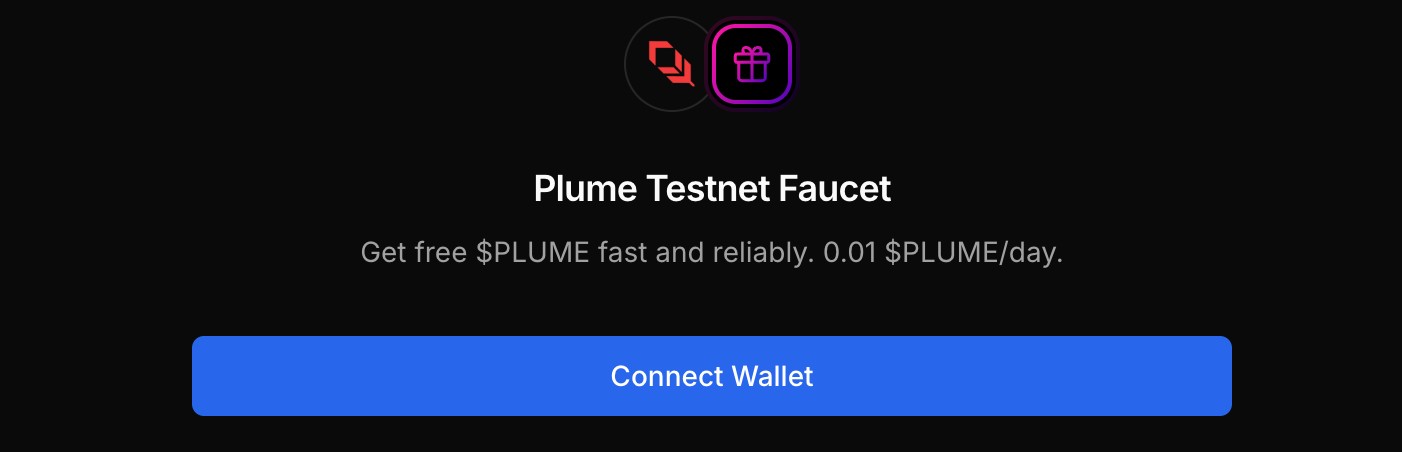
How to claim. Connect your MetaMask wallet to the faucet site, select your address, and click Claim. Tokens arrive almost instantly. You can claim again after 24 hours.
If the main faucet is busy. High demand can slow down claims. In these cases, you can try verified community mirrors, Discord faucet bots, or developer faucets built into tools like Remix that use the Plume Testnet RPC URL.
Safety check. Use only official Plume links and always confirm you are on the plume.org domain before connecting your wallet.
How to get started with Plume Testnet
The Plume Testnet is easy to set up and gives you all the tools needed to test dApps, track activity, and join campaigns. The process includes adding the network, claiming tokens, and using the explorer to view your on-chain actions. Here’s how to get started with it:
Add Plume Testnet to MetaMask. Open MetaMask and select Add Network. Enter the Chain ID (98867) and the Plume Testnet RPC URL. You can also use ChainList for one-click setup. Once saved, Plume Testnet appears as a selectable network.
Claim test tokens for gas and quests. Visit the official Plume Testnet faucet, connect your wallet, and claim test ETH and GOON tokens. Tokens usually arrive in seconds, and you can claim again after 24 hours. Backup faucets through Discord bots or verified mirrors are available during high demand.
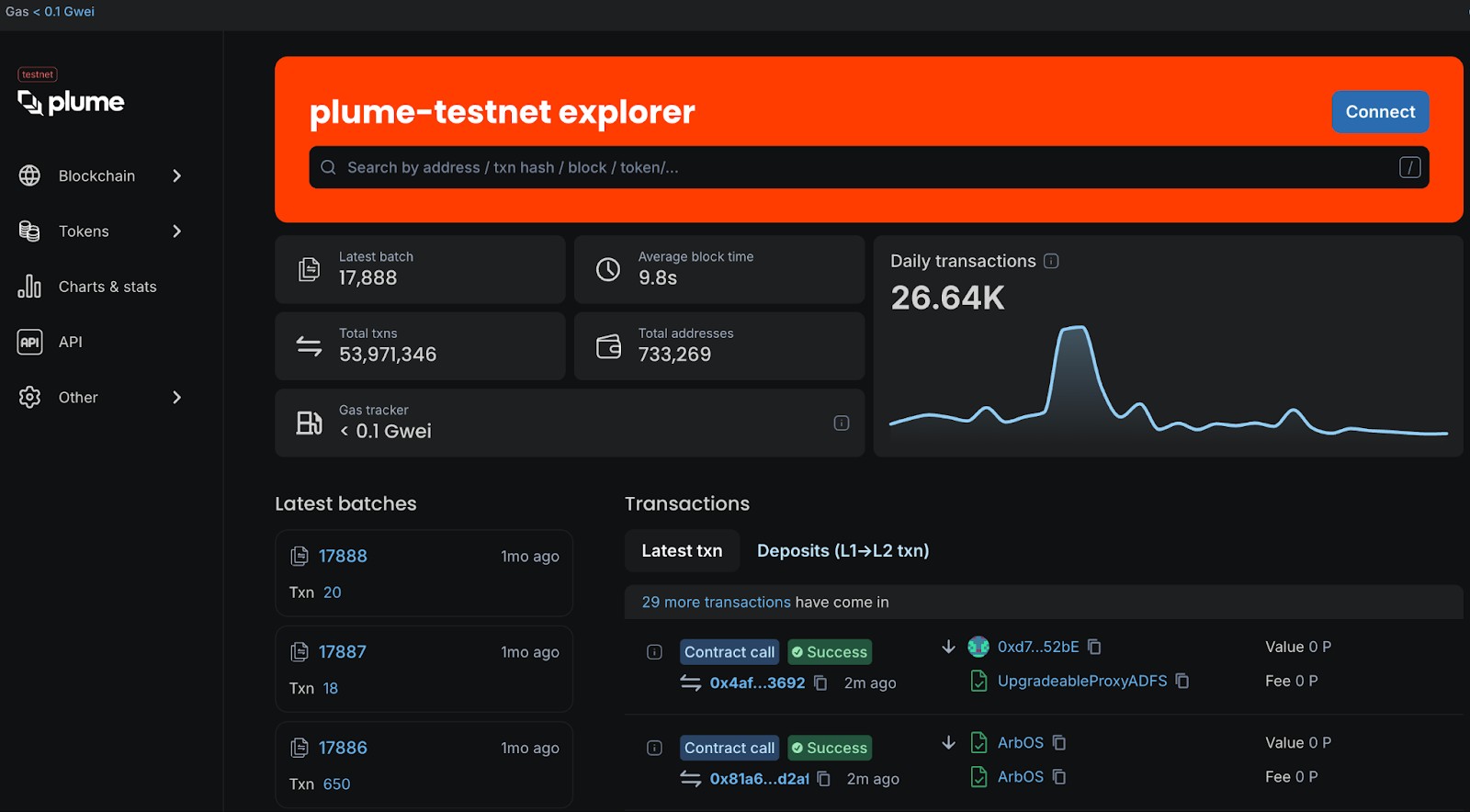
Use the explorer to track activity. The Plume Testnet explorer shows all of your transactions, contract calls, gas details, and block confirmations. It works like Etherscan but is customized for Plume.
Check advanced data on Plume Testnet Scan. Developers and traders can use scan dashboards to view network load, gas trends, faucet usage, and wallet rankings. These tools help test contracts, debug steps, and improve trading or automation flows.
Connect development tools. Platforms such as Remix, Foundry, or Hardhat work smoothly with the Plume Testnet RPC, allowing you to deploy and test smart contracts with low fees and quick execution.
Performance metrics and on-chain data
The Plume Testnet is designed to handle heavy activity while keeping transactions smooth and low cost. This performance makes it reliable for traders testing strategies and for developers running frequent contract calls.
Fast execution through the Plume Testnet RPC. Transactions confirm quickly even during peak hours, and latency stays low across most dApps.
Stable block usage. Data from Plume Testnet Scan shows average block utilization between 22 and 30 percent, which leaves room for high-volume testing.
Low gas fees. Costs are far below mainnet Ethereum, allowing users to test swaps, mints, and automation scripts without worrying about fees.
Reliable environment for stress testing. The network’s consistency helps traders model fast loops, bots, and high-frequency actions without delays.
Plume vs Ethereum vs Arbitrum
The Plume Testnet offers much lower costs than Ethereum and Arbitrum, which makes it ideal for testing. While Ethereum can become expensive during high activity, and Arbitrum reduces fees but still carries noticeable costs, Plume keeps transactions close to zero. Here are key aspects of comparison:
Lower fees. A typical action on the Plume Testnet costs only a small fraction of a cent, which lets users test freely.
Faster confirmations. Plume’s modular design leads to faster block times compared with Ethereum and even some Layer 2 options.
Better for experiments. Because it is inexpensive and fast, traders can test high-frequency loops, bots, and strategy flows without financial risk.
Strategic opportunities for traders
The Plume Testnet gives traders a safe place to test ideas, learn on-chain tools, and refine strategies without spending real funds. It supports simple tasks for beginners and also offers the speed needed for advanced testing.
The Plume Testnet is a simple and safe starting point for new users. You can learn how wallets, gas fees, and transactions work without using real money. Daily tokens from the Plume Testnet faucet let beginners:
swap assets on DEX interfaces;
mint and trade NFTs;
interact with smart contracts;
track their performance via on-chain explorers.
Experienced traders can use the Plume Testnet as a performance lab for strategy testing. The low fees and fast confirmations help model high-frequency or automated systems. You can test:
arbitrage loops using the Plume Testnet bridge;
slippage settings across different contract calls;
bot-based trading and automation flows;
gas optimization and timing behavior.
Tools like Plume Testnet Scan reveal activity trends and block data, which help refine strategies before using real assets.
Plume testnet ecosystem and use cases
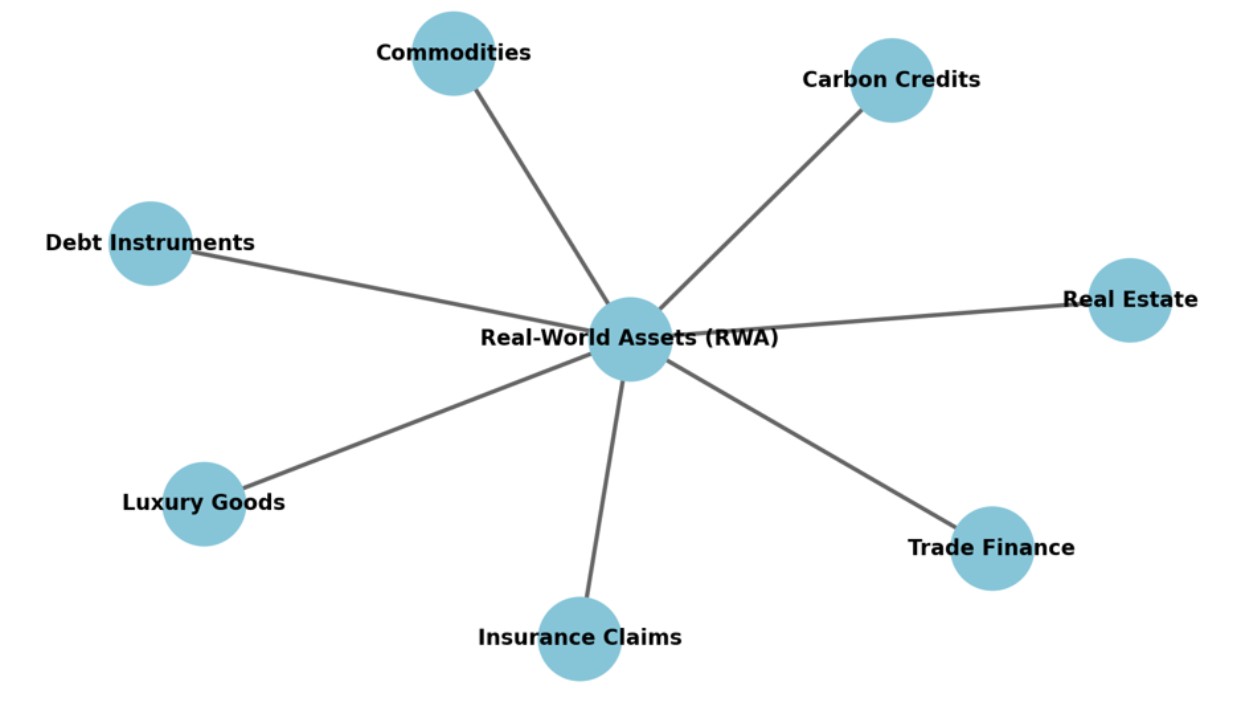
The Plume Network testnet hosts over 180 projects across tokenized real estate, synthetic Forex markets, and invoice factoring. Some are building trading platforms that mimic Forex-style mechanics using tokenized yield-bearing assets, while others explore NFT-backed lending.
Risks and caveats
The Plume Testnet is reliable, but users should be aware of several limits and technical points. These do not stop you from testing, but they help you plan smoother workflows.
RPC load spikes. The Plume Testnet RPC may slow during peak campaign hours. If this happens, retry the action or switch to a backup endpoint.
Faucet delays. The Plume Testnet faucet only allows one claim every 24 hours. Heavy traffic can pause new requests. Keep verified faucet sources as backups.
Solidity version notes. Some Solidity 0.8.20 features are not fully supported. For safer testing, compile with 0.8.19 or check opcode compatibility.
Indexing delays in the explorer. New contracts may take time to appear in the Plume Testnet explorer. You can still use the deployed address even if indexing is slow.
Bridge recovery steps. If a Plume Testnet bridge transfer does not finalize, save the transaction hash and contact support with details.
These points help both traders and developers run more stable tests during active periods.
What's ahead for Plume
Plume is now moving from testnet growth to full mainnet development. New tools, governance features, and expanded RWA support will shape how users interact with the network in the long term.
Mainnet and token distribution
The $PLUME token launched in early 2025 and rewarded active testnet users. Wallets with steady activity, completed quests, and higher Miles scores received priority. Data from the Plume Testnet explorer and use of the Plume Testnet bridge were part of eligibility checks.
Recipients could unlock part of their tokens right away or choose longer staking plans with higher reward rates.
Feature roadmap
Plume’s roadmap focuses on scale, governance, and better tools for real-world assets. Planned upgrades include:
a DAO portal for voting and protocol decisions;
live Forex data feeds for building synthetic markets;
a unified dashboard that combines Plume Testnet Scan data, wallet summaries, faucet status, and campaign progress.
These improvements aim to support both everyday users and large RWA platforms building on Plume.
When $PLUME lists on major exchanges, it's an excellent opportunity for traders to transition from testnet to mainnet with confidence. In the meantime, it's helpful to explore the best crypto exchanges in your region to ensure you're ready to manage your assets and take advantage of future market opportunities effectively.
| Kraken | OKX | BTCC | Coinbase | Nebeus | |
|---|---|---|---|---|---|
|
Min. Deposit, $ |
10 | 10 | 10 | 10 | 5 |
|
Coins Supported |
278 | 329 | 399 | 249 | 30 |
|
Spot Taker fee, % |
0.4 | 0.1 | 0.3 | 0.5 | Not available |
|
Spot Maker Fee, % |
0.25 | 0.08 | 0.2 | 0.5 | Not available |
|
Alerts |
Yes | Yes | No | Yes | No |
|
Copy trading |
Yes | Yes | Yes | No | No |
|
TU overall score |
9.2 | 8.9 | 7.84 | 7.68 | 7.6 |
|
Open an account |
Go to broker Your capital is at risk. |
Go to broker Your capital is at risk. |
Go to broker Your capital is at risk.
|
Go to broker Your capital is at risk. |
Go to broker Your capital is at risk.
|
Use Plume to refine real trading processes

I have spent a lot of time testing strategies across different chains, and the Plume Testnet stands out because it gives you room to experiment without worrying about cost or risk. Many users join for the chance of an airdrop, but the real value shows when you treat this network as a training ground. With the low fees and fast confirmations, I can run the same loops I use on mainnet and study how they behave under different conditions.
I rely on the Plume Testnet RPC to check execution times and I use the bridge tools to model cross-network flows. This helps me adjust position sizing, timing windows, and slippage limits before I use real capital. If you take the time to run repeated tests and track the outcomes, you will build a stronger trading process that carries over to live markets. The testnet is free, but the lessons you gain can shape the decisions you make later when the stakes are higher.
Conclusion
Mastering the Plume Testnet is crucial for traders aiming to stay ahead in the evolving blockchain landscape. By leveraging the faucet to obtain test tokens, seamlessly connecting to the network via the RPC URL, and tracking transactions through the explorer, users can familiarize themselves with Plume’s infrastructure and gain hands-on experience. Such proactive engagement not only prepares participants for seamless mainnet interaction but also increases their eligibility for lucrative future airdrops. Ultimately, getting involved early positions traders to capitalize on opportunities others may overlook. In Web3, those who act first often reap the greatest rewards.
FAQs
What types of projects and use cases are being tested on the Plume Testnet?
How does the Plume Testnet's Miles system work for user rewards and airdrops?
What steps should users take if a Plume Testnet bridge transfer does not finalize?
Are there any Solidity version compatibility concerns when developing on the Plume Testnet?
Editors' Top Picks and Insights

Lindsey Graham death: U.S. senator’s crypto legacy

Tether under pressure: USDT in Europe, audit questions, and the fight for trust

Lean Ethereum: Why Buterin wants to rebuild the network

SK Hynix debuts on Nasdaq: Largest U.S. offering by foreign company

SpaceX falls out of orbit: Does anyone still want Musk’s stock?

The crypto IPO problem: How high-profile listings became investor traps
Related Articles
Team that worked on the article

Aleksandra Chaikina has been a contributor to Traders Union since 2021. With over 15 years of experience in copywriting and more than 5 years focused on financial content, she specializes in producing detailed guides, analytics, and comparative reviews across various sectors, including cryptocurrencies, Forex, investment strategies, and financial technologies.
Dan Blystone began his trading career in 1998 as an arbitrage clerk on the floor of the Chicago Mercantile Exchange (CME). He later traded bond and Eurex futures at proprietary firms such as Altea Trading, gaining valuable experience in high-frequency trading and risk management.
Chinmay Soni is a financial analyst with more than 5 years of experience in working with stocks, Forex, derivatives, and other assets. As a founder of a boutique research firm and an active researcher, he covers various industries and fields, providing insights backed by statistical data.
Risk management is a risk management model that involves controlling potential losses while maximizing profits. The main risk management tools are stop loss, take profit, calculation of position volume taking into account leverage and pip value.
Index in trading is the measure of the performance of a group of stocks, which can include the assets and securities in it.
Xetra is a German Stock Exchange trading system that the Frankfurt Stock Exchange operates. Deutsche Börse is the parent company of the Frankfurt Stock Exchange.
Copy trading is an investing tactic where traders replicate the trading strategies of more experienced traders, automatically mirroring their trades in their own accounts to potentially achieve similar results.
Cryptocurrency is a type of digital or virtual currency that relies on cryptography for security. Unlike traditional currencies issued by governments (fiat currencies), cryptocurrencies operate on decentralized networks, typically based on blockchain technology.

-
 Afghanistan
-
 Albania
-
 Algeria
-
 Angola
-
 Argentina
-
 Armenia
-
 Australia
-
 Austria
-
 Azerbaijan
-
 Bahamas
-
 Bahrain
-
 Bangladesh
-
 Belarus
-
 Belgium
-
 Bolivia
-
 Botswana
-
 Brazil
-
 Brunei
-
 Bulgaria
-
 Cambodia
-
 Cameroon
-
 Canada
-
 Chile
Chile
-
 China
China
-
 Colombia
-
 Congo
Congo
-
 Costa Rica
-
 Cote d'Ivoire
-
 Croatia
-
 Cuba
Cuba
-
 Cyprus
-
 Czechia
-
 DR Congo
-
 Denmark
-
 Dominican Republic
-
 Ecuador
-
 Egypt
Egypt
-
 El Salvador
-
 Estonia
-
 Eswatini
-
 Ethiopia
-
 Finland
-
 France
-
 Georgia
-
 Germany
-
 Ghana
Ghana
-
 Greece
-
 Haiti
Haiti
-
 Hong Kong
-
 Hungary
-
 India
India
-
 Indonesia
-
 Iran, Islamic republic
-
 Iraq
Iraq
-
 Ireland
-
 Israel
-
 Italy
Italy
-
 Jamaica
-
 Japan
Japan
-
 Jordan
-
 Kazakhstan
-
 Kenya
Kenya
-
 Korea
Korea
-
 Kuwait
-
 Kyrgyzstan
-
 Laos
Laos
-
 Latvia
-
 Lebanon
-
 Lesotho
-
 Libya
Libya
-
 Lithuania
-
 Luxembourg
-
 Madagascar
-
 Malaysia
-
 Malta
Malta
-
 Mauritius
-
 Mexico
-
 Moldova
-
 Mongolia
-
 Montenegro
-
 Morocco
-
 Mozambique
-
 Myanmar
-
 Namibia
-
 Nepal
Nepal
-
 Netherlands
-
 New Zealand
-
 Nigeria
-
 North Macedonia
-
 Norway
-
 Oman
Oman
-
 Pakistan
-
 Palestine
-
 Panama
-
 Papua New Guinea
-
 Paraguay
-
 Peru
Peru
-
 Philippines
-
 Poland
-
 Portugal
-
 Puerto Rico
-
 Qatar
Qatar
-
 Reunion
-
 Romania
-
 Rwanda
-
 Saudi Arabia
-
 Serbia
-
 Singapore
-
 Slovakia
-
 Slovenia
-
 Somalia
-
 South Africa
-
 Spain
Spain
-
 Sri Lanka
-
 Sweden
-
 Switzerland
-
 Syria
Syria
-
 Taiwan
-
 Tajikistan
-
 Tanzania
-
 Thailand
-
 Trinidad and Tobago
-
 Tunisia
-
 Turkey
-
 UAE
UAE
-
 Uganda
-
 Ukraine
-
 United Kingdom
-
United States
-
 Uruguay
-
 Uzbekistan
-
 Venezuela
-
 Vietnam
-
 Yemen
Yemen
-
 Zambia
-
 Zimbabwe
- Forex
- Crypto










- Why Plume Network Testnet matters
- Plume Testnet rewards mechanics
- How to get started with Plume Testnet
- Performance metrics and on-chain data
- Plume vs Ethereum vs Arbitrum
- Strategic opportunities for traders
- Plume testnet ecosystem and use cases
- Risks and caveats
- What's ahead for Plume
- Expert opinion
- Conclusion
- FAQs


