
How To Earn On Testnet: Best Methods


Editorial Note: While we adhere to strict Editorial Integrity, this post may contain references to products from our partners. Here's an explanation for How We Make Money. None of the data and information on this webpage constitutes investment advice according to our Disclaimer.
How to earn on testnet:
In crypto, one of the easiest ways to start earning without investment is by using a testnet. A testnet is a safe environment where users test blockchain features and may receive tokens, points, or NFTs as rewards. Participation is free, but it requires consistency, attention, and a basic understanding of how the network works.
In this guide, we explain how to earn on a testnet, what methods can lead to higher earnings on a testnet, and how to improve your chances of future rewards from a testnet. You will learn where to begin, what matters most, and how to avoid common mistakes.
Risk warning: Cryptocurrency markets are highly volatile, with sharp price swings and regulatory uncertainties. Research indicates that 75-90% of traders face losses. Only invest discretionary funds and consult an experienced financial advisor.
Main methods to earn on a testnet
Participating in a testnet can help you qualify for airdrops, gain roles, or receive tokens for your activity. Timing and consistency matter. Below are the six main ways users can earn on testnet and increase their chances of future testnet earnings.
Completing tasks and activities in the testnet

The simplest way to earn money on a testnet is by completing tasks. You follow basic instructions, test features, and help developers confirm that everything works correctly. No coding or technical setup is required; you only need a browser, a wallet, and attention to detail.
Where to find such tasks
Galxe offers quests and activity campaigns;
Layer3 provides structured tasks with automatic tracking;
Zealy adds gamified missions with levels and points;
Discord servers share updated instructions and deadlines.
Examples of successful cases
Starknet rewarded users who interacted with dApps during testing;
Zksync Era gave airdrop eligibility to testnet participants;
Many networks now track testnet activity to reward early supporters.
Participating in bounty programs

Bounty programs let users earn by completing tasks that support development, testing, or promotion. These programs suit people who write, test interfaces, help communities, or stay active on social media. They offer flexible ways to contribute and can generate steady earnings if you participate consistently on a testnet.
Where such campaigns are published
Zealy provides missions with point-based systems;
Galxe features social and activity-based bounties;
Discord and Telegram channels often list tasks in sections like #bounty or #missions.
What you can earn for participating
NFT badges that unlock roles or whitelist access;
testnet or real tokens after campaign completion;
community ranks like Ambassador, OG, or Hunter;
monetary rewards in USDT or tokens for strong work.
Running a validation node

Running a node is one of the most advanced ways to earn money in a testnet. It suits users who can manage servers, follow technical instructions, and maintain uptime. By operating a validator or archive node, you support the network’s stability and may qualify for rewards during or after the testnet phase.
Popular projects with validator testnets
Sei Network Active testnet validators received a $SEI token airdrop.
Celestia. Running a node in the TIA testnet led to inclusion in the Genesis list.
IronFish. Generous retroactive drops for stable node performance.
Massa. Bounty program with token rewards for uptime.
Nibiru, Kujira, Quicksilver. Cosmos SDK–based projects that regularly launch validator phases.
What you can get
project tokens given as fixed or contribution-based rewards;
Genesis validator status on the mainnet;
NFT badges tied to early staking rights;
public recognition in project credits or partner lists.
Delegating test tokens

Delegation is a simple, low-effort way to earn in a testnet. Instead of running your own node, you delegate testnet tokens to an active validator. This supports network decentralization and can qualify you for future testnet earnings without dealing with servers or technical setup. It is ideal for users who want passive participation.
Projects that support delegation in testnets
Sei Network. Both validators and delegators received airdrops.
Massa. Rewarded participants with points and NFTs for delegation.
Celestia. Encouraged activity in its staking pool.
Nibiru and Quicksilver. Cosmos-based chains with a delegation model.
What you can get
testnet or real tokens during future airdrops;
NFT badges or points from staking challenges;
reputation as an active ecosystem supporter;
governance rights in testnet voting modules.
Supporting ecosystem dApps

Testing ecosystem dApps is another practical way to earn money in a testnet. These include DEXs, lending platforms, NFT marketplaces, wallets, and governance tools. By interacting with these applications, you help developers refine user flows and improve performance. Many projects reward early activity with testnet rewards or priority in future campaigns.
Types of ecosystem dApps you can test
DEXs (decentralized exchanges). Uniswap, Mantiswap, zkLink, Wagmi.
Lending and farming platforms. Aave, Omni, IronBank, Tsunami.
NFT marketplaces. OpenSea test clones, zkPets, Galxe NFT.
Wallets and interfaces. Leap, Keplr, MetaMask Snaps.
Governance protocols. Voting via Snapshot or on-chain modules.
Examples of successful projects and rewards
ZkLink Nova granted NFT badges for testing dApp features;
Omni Network offered quests for lending, swapping, and staking;
Scroll rewarded testnet users with priority in later events;
Galxe issued points and NFTs for testing integrations.
Content, media, and community participation
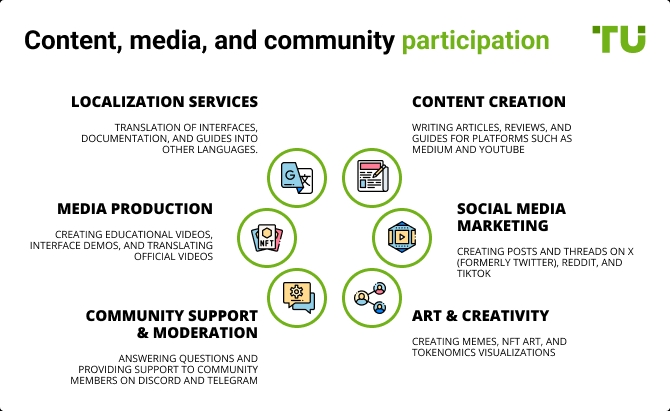
Creating content or supporting the community is a flexible way to earn in a testnet without technical skills. Many projects reward users who write guides, translate posts, record videos, design memes, or assist newcomers. Consistent contributions can increase visibility and improve your chances of receiving testnet rewards or future airdrops.
Platforms and participation formats
Galxe. Often features campaigns with content creation tasks.
Zealy (formerly Crew3). Gamified missions for reposts, threads, and videos.
Discord. Dedicated channels such as #content-bounty, #ambassadors, #translations.
Twitter (X). Official hashtags and “create & earn” campaigns.
YouTube. Walkthroughs, interface reviews, task completions, and tutorials.
What you can earn
retroactive drops for strong community contributions;
NFTs and badges for creativity and engagement;
points and roles that unlock access to closed testing;
tokens through ambassador programs or content bounties.
How does a testnet work?
A testnet is a separate version of a blockchain that runs in a safe, simulated environment. It includes its own nodes, test tokens, and infrastructure that mirrors a mainnet. Users can interact with it without financial risk, making it the ideal place to learn, explore features, and qualify for future rewards or other testnet earning opportunities.
Most major blockchains run their own testnets, including Ethereum (Goerli), Polygon (Mumbai), Avalanche (Fuji), Solana (testnet and Devnet), Starknet, Sui, Sei, and Celestia. Regular interaction with these networks not only helps users understand how new blockchains function in practice but also increases the chances of qualifying for the best testnet airdrops, which are typically distributed to early and active participants.
Core components of a testnet
Blockchain network. With nodes and consensus mechanisms similar to the mainnet.
Faucets. Special services for receiving free test tokens.
Wallets. MetaMask, Keplr, Leap, and others, configured for the testnet.
Smart contracts. Deployed copies or test versions of future protocols.
dApps. Test interfaces for exchanges, lending platforms, NFT marketplaces.
RPC servers. Connection points for wallets and applications.
Explorers. Block explorers like Etherscan, but for testnets (e.g., GoerliScan).
Types of testnets
There are several types of test networks. We've prepared a comparison table of testnets so you can clearly understand the differences between them.
| Type of testnet | Access | Purpose | Rewards | Example projects |
|---|---|---|---|---|
| Public | Open to everyone | Mass testing of features | Sometimes (team decision) | Goerli (Ethereum), Fuji (Avalanche), Starknet |
| Private | By application/invitation | Testing new logic with a limited group | Often OG (Original Gangster) status, whitelist access | Starknet early devnet, LayerZero closed beta |
| Devnet | Developers only | Internal testing, protocol debugging | None | Aptos Devnet, Sui Devnet |
| Incentivized | Partially open | Testing with rewards as motivation | Tokens, NFTs, points | Sei testnet, IronFish, Massa |
| Canary Network | Separate network with its token | Fully functioning blockchain | Tokens, governance | Kusama (for Polkadot), Songbird (for Flare) |
Why is a testnet needed?
A testnet is a critical stage in blockchain development. It allows teams to test features, identify bugs, and prepare the network for a stable mainnet launch. It also gives users, validators, and partners a safe place to learn, experiment, and potentially qualify for future rewards. Every group involved in a blockchain benefits from an active and well-run testnet.
| Who needs a testnet | Why they need it |
|---|---|
| Developers | Testing smart contracts, bug discovery, scalability and security checks |
| Testers and auditors | Monitoring stability, identifying vulnerabilities, network stress testing |
| Validators / Node operators | Infrastructure testing, participating in consensus, preparing for mainnet roles |
| Regular users | Exploring the project, learning, testing features, engaging for future rewards |
| Community / Ambassadors | Creating guides, translations, videos; helping users; spreading awareness |
| Investors and analysts | Evaluating project maturity, analyzing activity, preparing for potential listing/investment |
| Partners and integrators | Compatibility checks, integration testing, preparing DeFi product launches |
| dApp developers | Testing their own apps, integrating with the new network, debugging user flows |
Thus, a testnet is a blockchain testing tool that every stakeholder needs, and each participant plays an important role. A successful testnet is the foundation of a successful mainnet launch.
Alternatives to testnets: other ways to earn with crypto
If you decide that testnet participation is not for you, there are several other ways to earn in the crypto market. These methods work for different levels of experience and can help you build income without relying on testnet earnings. Some options require an initial investment, while others focus on long-term growth or passive returns. Below are four established alternatives you can explore.
Buy and hold (HODL)
The buy and hold strategy is one of the most common ways to earn in crypto. You purchase an asset and hold it for months or years, expecting long-term price growth. This method does not require daily monitoring or advanced skills. It is best suited for users who believe in the future of a specific blockchain or token and prefer a simple, passive approach.
Staking
Staking allows users to lock tokens in a Proof-of-Stake network to help secure the blockchain. In return, the network distributes rewards, typically between 4 and 15 percent APY. Staking is passive, predictable, and requires no trading activity. It works well for long-term investors who want steady growth while supporting the network.
Copy trading
Automatically copying the trades of successful traders, without doing complex market analysis. You choose a trader and mirror their positions. It’s convenient for beginners and anyone looking for a hands-off trading approach.
Yield farming
Yield farming involves providing liquidity or assets to DeFi protocols such as DEXs, lending platforms, or staking pools. In return, you receive rewards in the form of tokens or interest. Profitability can be higher than traditional staking, but it also carries higher risks linked to volatility and smart-contract security. This method is suitable for users who want more active participation in the DeFi ecosystem.
To earn through any of these methods, you’ll need an account with a cryptocurrency exchange. Our rankings include exchanges with high reliability and attractive terms. You can go through it below:
| OKX | Coinbase | Crypto.com | Cryptohopper | BTCC | |
|---|---|---|---|---|---|
|
Foundation year |
2017 | 2012 | 2016 | 2018 | 2011 |
|
Min. Deposit, $ |
10 | 10 | 1 | No | 10 |
|
Coins Supported |
600+ | 400+ | 400+ | 1000 | 399 |
|
Spot Taker fee, % |
0.1 | 0.5 | 0.5 | 0 | 0.3 |
|
Spot Maker Fee, % |
0.08 | 0.5 | 0.25 | 0 | 0.2 |
|
Alerts |
Yes | Yes | Yes | Yes | No |
|
Copy trading |
Yes | No | No | Yes | Yes |
|
Tier-1 regulation |
No | Yes | Yes | No | Yes |
|
TU overall score |
8.48 | 7.84 | 7.8 | 7.76 | 7.6 |
|
Open an account |
Go to broker Your capital is at risk. |
Go to broker Your capital is at risk. |
Go to broker Your capital is at risk. |
Go to broker Your capital is at risk. |
Go to broker Your capital is at risk.
|
Risks and warnings
Even though testnets do not require financial investment, they still involve real risks. Users often underestimate the importance of security, proper wallet setup, and attention to instructions. Mistakes can lead to lost progress, exposure of sensitive data, or participation in low-quality projects that never distribute rewards. Understanding these risks will help you manage your time better and avoid unnecessary problems.
using your primary wallet can expose real funds if a private key is compromised;
some projects do not pay out or turn out to be low-quality or abandoned;
participating in too many testnets may lead to burnout and reduced motivation;
phishing sites may imitate faucets, forms, or official announcements;
technical tasks like node setup can lead to wasted time if done incorrectly.
Use a separate wallet for testnet activity, verify all links carefully, and record your actions. This reduces the risk of data leaks and helps you confirm participation in future reward checks.
Focus on a few projects, stay organized, and learn by doing

From my experience, the best way to approach testnets is to treat them as learning tools that can also lead to rewards. Over the last few years, testnets have become a solid way to earn early roles, points, and tokens, especially before a project launches its mainnet. I suggest starting with simple campaigns on Galxe, Zealy, or Layer3 because these platforms guide you step by step and do not require technical skills.
As you gain confidence, explore node operation or delegation to increase your chances of long-term testnet rewards. Choose only a few promising projects instead of trying everything at once. Follow updates closely and meet deadlines. Keep screenshots or short videos of your activity in case projects request proof. Most important of all, stay cautious. Not every testnet pays out, but the skills and experience you gain will help you grow inside the Web3 community and improve your future testnet earnings opportunities.
Conclusion
Participating in testnets is one of the most accessible ways to earn early roles, tokens, and community recognition in the crypto world without a financial investment. Whether completing simple tasks on platforms like Galxe and Zealy or running a validation node for projects such as Sei or Celestia, your consistent involvement can pay off handsomely through airdrops or exclusive NFT rewards. The real value, however, lies not just in the rewards but in the hands-on experience and deep understanding you gain by engaging with emerging blockchain technologies. Treat each testnet as both an opportunity and a learning journey, because the skills you develop today can become your competitive edge in tomorrow’s Web3 ecosystem.
FAQs
What precautions should you take to protect your funds and data when earning on testnets?
Are there risks associated with dedicating time to testnet activities, and how can you minimize them?
How does running a validation node on a testnet differ from simply delegating test tokens?
Can testnet experience help users prepare for earning opportunities on blockchain mainnets?
Editors' Top Picks and Insights






Related Articles
Team that worked on the article
Oleg Tkachenko is an economic analyst and risk manager having more than 14 years of experience in working with systemically important banks, investment companies, and analytical platforms. He has been a Traders Union analyst since 2018.
Dan Blystone began his trading career in 1998 as an arbitrage clerk on the floor of the Chicago Mercantile Exchange (CME). He later traded bond and Eurex futures at proprietary firms such as Altea Trading, gaining valuable experience in high-frequency trading and risk management.
Chinmay Soni is a financial analyst with more than 5 years of experience in working with stocks, Forex, derivatives, and other assets. As a founder of a boutique research firm and an active researcher, he covers various industries and fields, providing insights backed by statistical data.
Index in trading is the measure of the performance of a group of stocks, which can include the assets and securities in it.
Cryptocurrency is a type of digital or virtual currency that relies on cryptography for security. Unlike traditional currencies issued by governments (fiat currencies), cryptocurrencies operate on decentralized networks, typically based on blockchain technology.
Bitcoin is a decentralized digital cryptocurrency that was created in 2009 by an anonymous individual or group using the pseudonym Satoshi Nakamoto. It operates on a technology called blockchain, which is a distributed ledger that records all transactions across a network of computers.
Yield refers to the earnings or income derived from an investment. It mirrors the returns generated by owning assets such as stocks, bonds, or other financial instruments.
An investor is an individual, who invests money in an asset with the expectation that its value would appreciate in the future. The asset can be anything, including a bond, debenture, mutual fund, equity, gold, silver, exchange-traded funds (ETFs), and real-estate property.

-
 Afghanistan
-
 Albania
-
 Algeria
-
 Angola
-
 Argentina
-
 Armenia
-
 Australia
-
 Austria
-
 Azerbaijan
-
 Bahamas
-
 Bahrain
-
 Bangladesh
-
 Belarus
-
 Belgium
-
 Bolivia
-
 Botswana
-
 Brazil
-
 Brunei
-
 Bulgaria
-
 Cambodia
-
 Cameroon
-
 Canada
-
 Chile
Chile
-
 China
China
-
 Colombia
-
 Congo
Congo
-
 Costa Rica
-
 Cote d'Ivoire
-
 Croatia
-
 Cuba
Cuba
-
 Cyprus
-
 Czechia
-
 DR Congo
-
 Denmark
-
 Dominican Republic
-
 Ecuador
-
 Egypt
Egypt
-
 El Salvador
-
 Estonia
-
 Eswatini
-
 Ethiopia
-
 Finland
-
 France
-
 Georgia
-
 Germany
-
 Ghana
Ghana
-
 Greece
-
 Haiti
Haiti
-
 Hong Kong
-
 Hungary
-
 India
India
-
 Indonesia
-
 Iran, Islamic republic
-
 Iraq
Iraq
-
 Ireland
-
 Israel
-
 Italy
Italy
-
 Jamaica
-
 Japan
Japan
-
 Jordan
-
 Kazakhstan
-
 Kenya
Kenya
-
 Korea
Korea
-
 Kuwait
-
 Kyrgyzstan
-
 Laos
Laos
-
 Latvia
-
 Lebanon
-
 Lesotho
-
 Libya
Libya
-
 Lithuania
-
 Luxembourg
-
 Madagascar
-
 Malaysia
-
 Malta
Malta
-
 Mauritius
-
 Mexico
-
 Moldova
-
 Mongolia
-
 Montenegro
-
 Morocco
-
 Mozambique
-
 Myanmar
-
 Namibia
-
 Nepal
Nepal
-
 Netherlands
-
 New Zealand
-
 Nigeria
-
 North Macedonia
-
 Norway
-
 Oman
Oman
-
 Pakistan
-
 Palestine
-
 Panama
-
 Papua New Guinea
-
 Paraguay
-
 Peru
Peru
-
 Philippines
-
 Poland
-
 Portugal
-
 Puerto Rico
-
 Qatar
Qatar
-
 Reunion
-
 Romania
-
 Rwanda
-
 Saudi Arabia
-
 Serbia
-
 Singapore
-
 Slovakia
-
 Slovenia
-
 Somalia
-
 South Africa
-
 Spain
Spain
-
 Sri Lanka
-
 Sweden
-
 Switzerland
-
 Syria
Syria
-
 Taiwan
-
 Tajikistan
-
 Tanzania
-
 Thailand
-
 Trinidad and Tobago
-
 Tunisia
-
 Turkey
-
 UAE
UAE
-
 Uganda
-
 Ukraine
-
 United Kingdom
-
United States
-
 Uruguay
-
 Uzbekistan
-
 Venezuela
-
 Vietnam
-
 Yemen
Yemen
-
 Zambia
-
 Zimbabwe
- Forex
- Crypto












