
Nvidia stock trades below $187 as Chinese AI developers eye cloud rental of Rubin chips
As of January 19, Nvidia stock is trading at $186.25, down 0.4% over the past 24 hours. The price remains in a broad consolidation range following a period of strong performance in late 2025. The stock is hovering below the 52-week high of $212.19.
Highlights
- Nvidia stock remains below key resistance at $212, consolidating near $187 amid geopolitical and regulatory pressures.
- Chinese AI developers are reportedly exploring cloud-based rentals of Nvidia’s next-gen Rubin chips, signaling strong demand despite direct export bans.
- U.S. policymakers are moving to tighten controls on such workarounds, adding uncertainty to Nvidia’s access to the Chinese market.
Short-term technical indicators show weakening bullish momentum. The 21-day moving average has dipped slightly below the 50-day moving average, forming a minor bearish crossover that suggests buyers are stepping back. Volume has also declined during recent rallies, reflecting a lack of conviction among bulls to push the stock above critical levels. Momentum indicators such as the RSI are hovering near neutral territory (around 52), indicating a sideways trend rather than overbought or oversold conditions.
On the downside, Nvidia has found repeated support in the $175–$180 range, an area that held firm during multiple intraday pullbacks over the past month. If this support breaks, the next key level is around $160, where the stock found buying interest during broader tech sector corrections in Q4 2025.
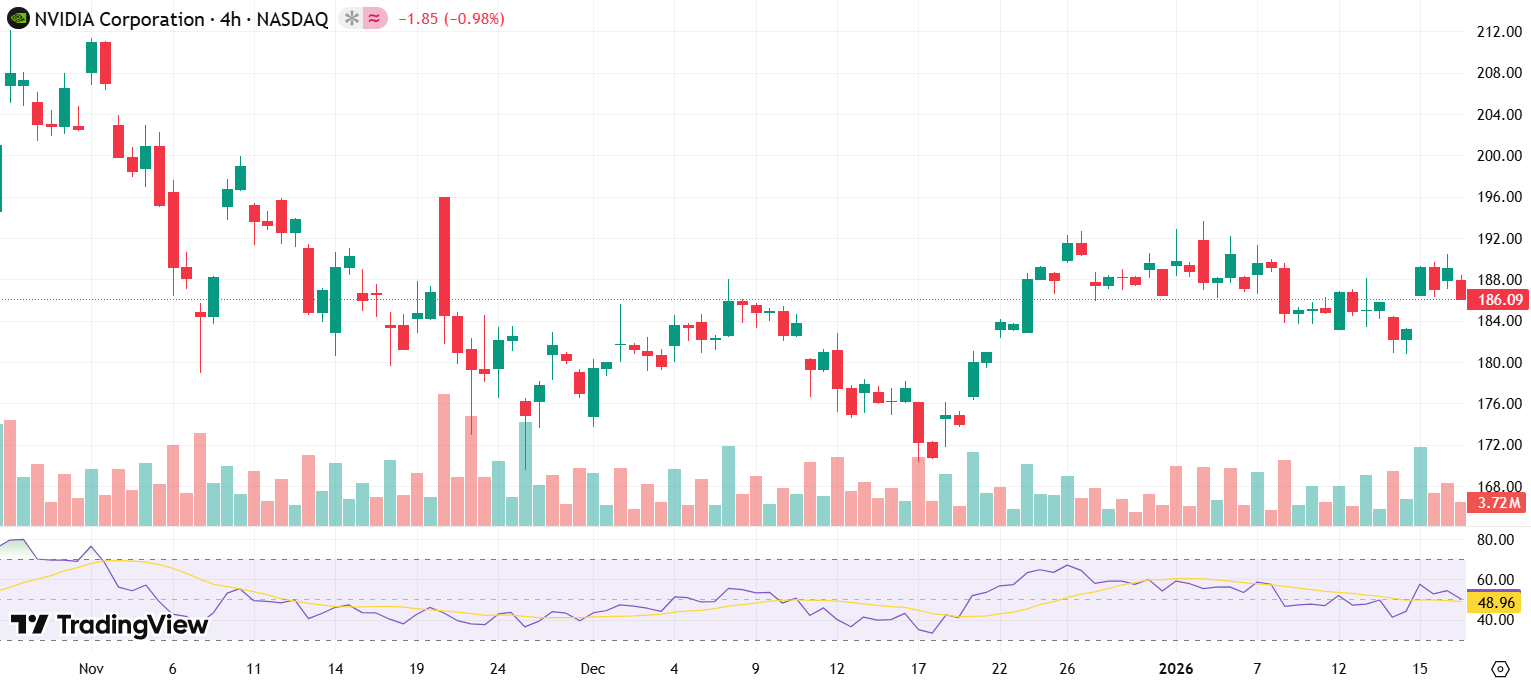
Nvidia stock price dynamics (November 2025 - January 2025). Source: TradingView
Overall, Nvidia is trading in a tightening range, with the short-term setup reflecting consolidation rather than a continuation of its earlier uptrend. A confirmed breakout above $212, accompanied by volume expansion, would likely signal the start of a new upward leg. Until then, the stock remains vulnerable to swings driven by macro events and sector rotation.
China's export loophole and AI demand shape the outlook
Recent developments from China have introduced new uncertainty into Nvidia’s growth outlook, particularly surrounding access to high-end AI chips. Chinese AI developers are exploring ways to rent Nvidia's most advanced GPUs via offshore cloud services. These efforts are aimed at circumventing U.S. export restrictions that prohibit the direct sale of cutting-edge AI chips like the H100, H200, and upcoming Rubin series to China.
This workaround illustrates the persistent demand for Nvidia's AI products in the Chinese market, even as direct shipments have largely halted. However, the U.S. government is moving quickly to close this gap. The House of Representatives recently passed legislation aimed at blocking Chinese firms from accessing U.S. AI chips through remote cloud rentals, effectively extending export controls to the cloud infrastructure layer.
Compounding the issue, reports also indicate that Chinese customs officials have blocked imports of Nvidia's H200 chip, despite the U.S. Commerce Department having cleared it for sale under modified performance specs. These restrictions are further reducing visibility into Nvidia’s potential revenue contribution from China, a market that once accounted for over 20% of its data center sales.
Watching breakout zones and policy risks
In the bullish scenario, a sustained breakout above $212 could trigger a rally toward the $230–$250 zone within the next 6–8 weeks. This would likely be fueled by strong quarterly earnings, further expansion of enterprise AI deployments, or a diplomatic easing in U.S.–China tech tensions. A breakout would also likely re-engage institutional momentum traders, adding fuel to an upside move toward new all-time highs.
The base-case scenario, however, is continued sideways movement. Traders are watching for clearer signals on U.S. export policies and the real impact of workaround demand from Chinese firms. While the long-term AI thesis remains intact, near-term price action is likely to be range-bound as geopolitical risk premiums remain elevated. In this environment, options strategies like iron condors or covered calls may appeal to investors expecting low volatility.
Nvidia has announced a $1 billion strategic partnership with Eli Lilly to develop an AI-driven drug discovery lab in Silicon Valley. The initiative will combine Nvidia’s BioNeMo platform and computing hardware with Lilly’s pharmaceutical expertise to enhance molecular simulation and clinical trial optimization.







-
 Afghanistan
-
 Albania
-
 Algeria
-
 Angola
-
 Argentina
-
 Armenia
-
 Australia
-
 Austria
-
 Azerbaijan
-
 Bahamas
-
 Bahrain
-
 Bangladesh
-
 Belarus
-
 Belgium
-
 Bolivia
-
 Botswana
-
 Brazil
-
 Brunei
-
 Bulgaria
-
 Cambodia
-
 Cameroon
-
 Canada
-
 Chile
Chile
-
 China
China
-
 Colombia
-
 Congo
Congo
-
 Costa Rica
-
 Cote d'Ivoire
-
 Croatia
-
 Cuba
Cuba
-
 Cyprus
-
 Czechia
-
 DR Congo
-
 Denmark
-
 Dominican Republic
-
 Ecuador
-
 Egypt
Egypt
-
 El Salvador
-
 Estonia
-
 Eswatini
-
 Ethiopia
-
 Finland
-
 France
-
 Georgia
-
 Germany
-
 Ghana
Ghana
-
 Greece
-
 Haiti
Haiti
-
 Hong Kong
-
 Hungary
-
 India
India
-
 Indonesia
-
 Iran, Islamic republic
-
 Iraq
Iraq
-
 Ireland
-
 Israel
-
 Italy
Italy
-
 Jamaica
-
 Japan
Japan
-
 Jordan
-
 Kazakhstan
-
 Kenya
Kenya
-
 Korea
Korea
-
 Kuwait
-
 Kyrgyzstan
-
 Laos
Laos
-
 Latvia
-
 Lebanon
-
 Lesotho
-
 Libya
Libya
-
 Lithuania
-
 Luxembourg
-
 Madagascar
-
 Malaysia
-
 Malta
Malta
-
 Mauritius
-
 Mexico
-
 Moldova
-
 Mongolia
-
 Montenegro
-
 Morocco
-
 Mozambique
-
 Myanmar
-
 Namibia
-
 Nepal
Nepal
-
 Netherlands
-
 New Zealand
-
 Nigeria
-
 North Macedonia
-
 Norway
-
 Oman
Oman
-
 Pakistan
-
 Palestine
-
 Panama
-
 Papua New Guinea
-
 Paraguay
-
 Peru
Peru
-
 Philippines
-
 Poland
-
 Portugal
-
 Puerto Rico
-
 Qatar
Qatar
-
 Reunion
-
 Romania
-
 Rwanda
-
 Saudi Arabia
-
 Serbia
-
 Singapore
-
 Slovakia
-
 Slovenia
-
 Somalia
-
 South Africa
-
 Spain
Spain
-
 Sri Lanka
-
 Sweden
-
 Switzerland
-
 Syria
Syria
-
 Taiwan
-
 Tajikistan
-
 Tanzania
-
 Thailand
-
 Trinidad and Tobago
-
 Tunisia
-
 Turkey
-
 UAE
UAE
-
 Uganda
-
 Ukraine
-
 United Kingdom
-
United States
-
 Uruguay
-
 Uzbekistan
-
 Venezuela
-
 Vietnam
-
 Yemen
Yemen
-
 Zambia
-
 Zimbabwe
- Forex
- Crypto











