
Binary Options vs. Forex Trading: Which Is Better?


Editorial Note: While we adhere to strict Editorial Integrity, this post may contain references to products from our partners. Here's an explanation for How We Make Money. None of the data and information on this webpage constitutes investment advice according to our Disclaimer.
The main difference between binary options and Forex trading lies in how trades are executed and managed. Binary options require traders to predict whether an asset’s price will be above or below a specified level at expiration, with each trade resulting in either a fixed payout, typically 60-90% of the investment, or the loss of the entire stake. In Forex trading, profits and losses depend on the size of the price movement, and traders can manage open positions using stop-loss and take-profit orders. Forex also offers greater market flexibility, deeper liquidity, and broader regulatory oversight in many jurisdictions.
The allure of striking it rich with little effort or experience has drawn countless aspiring traders to Forex and binary options over the years. Some are attracted by the promise of earning high returns from small price movements, while others are inspired by stories of traders making substantial profits in a short period. In reality, however, the comparison of binary options vs. Forex is far more complex.
While the high leverage available in Forex and the fixed-risk structure of binary options may both seem appealing, each market carries significant risks and requires knowledge, discipline, and effective risk management. Before choosing between them, traders should understand how each market works, the key differences in their trading models, and whether their goals, time commitment, and risk tolerance make one a better fit than the other. This article explores the differences between binary trading vs. Forex trading and explains how each market may suit different types of traders.
Risk warning: Binary options trading is highly risky and may result in a total loss of funds. These speculative instruments often lack strong regulation, with over 80% of traders losing their capital. Invest only what you can afford to lose and seek professional advice.
Binary options trading vs. Forex trading
Binary options and Forex are two popular financial markets that attract traders looking to profit from price movements. When comparing binary options vs. Forex trading, the main difference lies in how trades are structured and how profits are generated. Binary options require traders to predict whether the price of an asset will rise or fall within a fixed time frame, resulting in either a predetermined payout or the loss of the initial stake.
Forex trading takes a different approach. Instead of predicting only the direction of a price move within a set period, traders buy or sell currency pairs and can manage open positions using stop-loss and take-profit orders. This flexibility allows them to adjust their strategies as market conditions change. Understanding these structural differences can help traders choose the market that best matches their experience level, risk tolerance, and investment objectives.
| Trading feature | Forex | Binary options |
|---|---|---|
| Regulation | Widely regulated in many jurisdictions | Varies by jurisdiction; more limited regulatory oversight |
| Minimum deposit | Varies by broker | Typically low |
| Risk management | Stop-loss, take-profit, adjustable positions | Fixed risk per trade |
| Profit potential | Depends on the size of the price movement | Fixed payout if the prediction is correct |
| Trading alerts | Available through many brokers and platforms | Available on many platforms |
| Ease of trading | Requires more market analysis | Simple trade execution, but difficult to achieve consistent profitability |
In general, Forex offers greater flexibility, more advanced risk management tools, and broader regulatory oversight than binary options. Binary options may appeal to traders who prefer a simple trading format with predefined risk and reward, but the fixed payout structure and short expiration periods can make consistent long-term profitability more challenging. Ultimately, the choice between Forex and binary options depends on a trader's experience, objectives, and tolerance for risk.
Binary trading vs. Forex trading: Which is better for beginners?
For many beginners, binary options may appear easier to understand because each trade has a fixed outcome. Traders simply predict whether the price of an asset will move up or down within a specified time, and the potential profit or loss is known before the trade is opened. However, this simplicity should not be confused with lower risk. The short expiration periods and fixed payout structure make binary options challenging to trade consistently.
Forex trading has a steeper learning curve, as traders need to understand concepts such as leverage, position sizing, technical and fundamental analysis, and risk management. At the same time, Forex provides greater flexibility by allowing traders to use stop-loss and take-profit orders, adjust open positions, and develop long-term trading strategies.
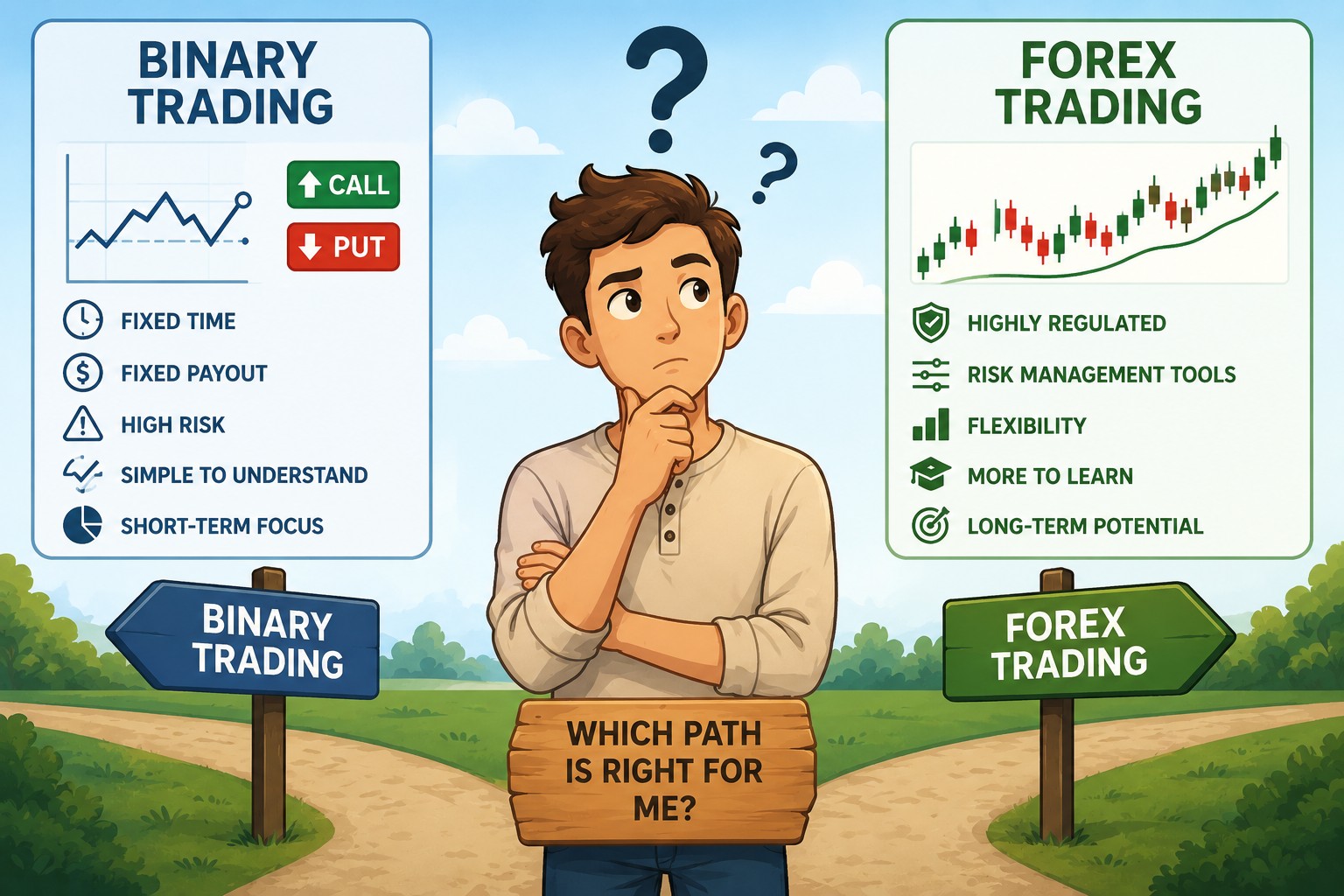
For traders comparing binary trading vs. Forex trading, Forex is generally considered the better choice for those who want to build trading skills and gain long-term market experience. Binary options may suit traders who prefer a straightforward trading format, but they typically involve higher risk and fewer tools for managing losing positions. Ultimately, the better choice depends on your experience, investment goals, and tolerance for risk.
Is binary trading more profitable than Forex?
When comparing binary options and Forex trading, both profitability and risk should be taken into account. Binary trading is generally considered riskier than Forex trading because each trade has a fixed outcome. However, successful binary options trades can generate relatively high returns over a short period, which is one of the reasons many traders are attracted to this market. Binary trading is also relatively simple to understand. Many platforms even offer trading alerts to help users identify potential opportunities.
Binary options traders can earn up to 80% in profits on a successful trade. However, the risks are equally important to consider. Because every contract has a fixed expiration time, traders must act quickly and accurately predict both the direction and timing of the price movement, which is one of the key differences between Forex and binary options.
Forex trading is generally considered less risky because traders have more flexibility to manage their positions. Unlike binary options, profits and losses are not fixed in advance but depend on the size of the market movement. This allows traders to use tools such as stop-loss and take-profit orders to better control risk, highlighting another important difference between binary option vs. Forex trading.
Binary options brokers often offer a fixed payout of around 60%; however, the payout percentage can increase to 90-95%, depending on the asset traded and the broker. In Forex trading, there is no fixed payout because returns depend entirely on market movements and position size. This gives traders greater flexibility while also requiring more active trade management.
Additionally, a Forex trader may make only two or three trades during a typical trading day, whereas a binary options trader can execute many more depending on their strategy and risk appetite. Some brokers even offer 60-second contracts, allowing traders to open positions every minute. While this creates more trading opportunities, it also increases the pace of decision-making and is generally better suited to experienced traders than beginners deciding between Forex and binary trading.
Which Forex broker should a beginner choose?
For beginners, it is generally best to choose a broker with a low minimum deposit, a demo account for risk-free practice, and strong regulatory oversight. Educational resources, responsive customer support, and a user-friendly trading platform can also make the learning process much easier.
We have compared beginner-friendly Forex brokers using our methodology, evaluating factors such as minimum deposit, spreads, available account types, regulation, and overall trading conditions. The table below highlights brokers that performed well in our analysis, helping you choose the one that best suits your trading needs after comparing binary options vs. Forex trading.
| Trading.com USA | Plus500 | OANDA | FOREX.com | IG Markets | |
|---|---|---|---|---|---|
|
Min. deposit, $ |
50 | 100 | No | 100 | 1 |
|
Tradable assets |
69 | 2800 | 129 | 5500 | 20000 |
|
Demo |
Yes | Yes | Yes | Yes | Yes |
|
Standard EUR/USD spread |
1.1 | 0.7 | 0.3 | 1.0 | 0.9 |
|
Max. leverage |
1:50 | 1:300 | 1:200 | 1:50 | 1:200 |
|
Max. Regulation Level |
Tier-1 | Tier-1 | Tier-1 | Tier-1 | Tier-1 |
|
TU overall score |
6.88 | 6.67 | 6.63 | 6.47 | 6.38 |
|
Open an account |
Go to broker Your capital is at risk. |
Go to broker 81% of retail CFD accounts lose money. |
Go to broker Your capital is at risk. |
Study review | Study review |
Best binary options brokers
Choosing a reliable broker is one of the most important decisions for anyone interested in binary options trading. The best binary options brokers typically offer transparent payout structures, fast order execution, and intuitive trading platforms that make it easier to analyze market movements and place trades efficiently.
Many leading brokers also provide demo accounts, educational resources, and trading tools that allow beginners to gain practical experience before risking real capital. When comparing platforms, it is worth considering factors such as regulation, available assets, payout rates, and customer support alongside the broker’s overall reputation.
| Foundation year | Min. deposit | Min. Payout (%) | Max. Payout (%) | Withdrawal fee | Demo | Regulation | Instruments | Open an account | |
|---|---|---|---|---|---|---|---|---|---|
| 2013 | 5 | 17 | 95 | 0-100 | Yes | No | Currency pairs, commodities, cryptocurrency, OTC (currency, commodities, stocks) | Go to broker Your capital is at risk. |
|
| 2019 | 10 | 60 | 90 | Different | Yes | IFSA | Currencies, assets of stock and commodity markets | Go to broker Your capital is at risk.
|
|
| 2009 | 250 | No | 100 | 0-25 USD | Yes | No | Currency pairs, commodities, cryptocurrencies, indices | Study review | |
| 2017 | 5 | 50 | 128 | 0-0,5 | Yes | MISA | Binary options (currency pairs, pairs of fiat and cryptocurrencies) | Go to broker Your capital is at risk. |
|
| 2019 | 10 | 20 | 98 | No | Yes | No | Binary options on currencies, cryptocurrencies, and metals, Forex, and CFDs on metals, futures indices, cryptocurrencies, and stocks | Go to broker Your capital is at risk. |
Methodology for compiling our ratings of binary options brokers
Traders Union applies a rigorous methodology to evaluate brokers using over 100 quantitative and qualitative criteria. Multiple parameters are given individual scores that feed into an overall rating.
Key aspects of the assessment include:
-
Regulation and safety. Brokers are evaluated based on the level/reputation of licenses and regulations they operate under.
-
User reviews. Client reviews and feedback are analyzed to determine customer satisfaction levels. Reviews are fact-checked and verified.
-
Trading instruments. Brokers are evaluated on the range of assets offered, as well as the breadth and depth of available markets.
-
Fees and commissions. All trading fees and commissions are analyzed comprehensively to determine overall costs for clients.
-
Trading platforms. Brokers are assessed based on the variety, quality, and features of platforms offered to clients.
-
Other factors like brand popularity, client support, and educational resources are also evaluated.
Choose the market that matches your trading style

From my experience, choosing between these markets starts with understanding how each trading model influences your decisions. Binary options often appeal to beginners because the process is straightforward: traders simply predict whether the price of an asset will rise or fall within a fixed time frame. However, when comparing the difference between Forex and binary trading, it becomes clear that this simplicity can also create pressure. Fixed expiration times and rapid decision-making may encourage emotional trading, especially when traders react to short-term market fluctuations instead of following a well-defined strategy.
Forex trading, on the other hand, requires more patience and a deeper understanding of how financial markets behave. The difference between Forex trading and binary trading becomes particularly evident in the level of control traders have over their positions. In Forex, traders can adjust position sizes, use stop-loss and take-profit orders, and adapt their strategies as market conditions change. For those wondering whether Forex or binary is the better choice, Forex offers greater flexibility and more opportunities to build sustainable trading habits. Regardless of the market you choose, long-term success depends on education, disciplined risk management, and consistent strategy execution.
Conclusion
Choosing between binary options and Forex trading ultimately comes down to your trading goals, experience level, and risk tolerance. Forex trading offers greater flexibility and robust risk management tools, making it better suited for those willing to invest time in developing skills and strategies. In contrast, binary options may attract beginners with their straightforward structure, but their fixed outcomes and rapid expiration periods can make consistent profitability elusive. Focus on building knowledge and disciplined habits no matter which market you choose, as true trading success is earned through strategy and patience rather than quick wins.
FAQs
What types of risk management strategies are available in Forex trading compared to binary options?
How does regulatory oversight differ between binary options and Forex trading?
Which market offers more flexibility for developing and testing trading strategies: binary options or Forex?
What should traders consider when choosing between binary options and Forex based on their time commitment?
Editors' Top Picks and Insights



Related Articles
Team that worked on the article
Aleksandra Chaikina has been a contributor to Traders Union since 2021. With over 15 years of experience in copywriting and more than 5 years focused on financial content, she specializes in producing detailed guides, analytics, and comparative reviews across various sectors, including cryptocurrencies, Forex, investment strategies, and financial technologies.
Dan Blystone began his trading career in 1998 as an arbitrage clerk on the floor of the Chicago Mercantile Exchange (CME). He later traded bond and Eurex futures at proprietary firms such as Altea Trading, gaining valuable experience in high-frequency trading and risk management.
Chinmay Soni is a financial analyst with more than 5 years of experience in working with stocks, Forex, derivatives, and other assets. As a founder of a boutique research firm and an active researcher, he covers various industries and fields, providing insights backed by statistical data.
Copy trading is an investing tactic where traders replicate the trading strategies of more experienced traders, automatically mirroring their trades in their own accounts to potentially achieve similar results.
Options trading is a financial derivative strategy that involves the buying and selling of options contracts, which give traders the right (but not the obligation) to buy or sell an underlying asset at a specified price, known as the strike price, before or on a predetermined expiration date. There are two main types of options: call options, which allow the holder to buy the underlying asset, and put options, which allow the holder to sell the underlying asset.
Index in trading is the measure of the performance of a group of stocks, which can include the assets and securities in it.
Trade execution is knowing how to place and close trades at the right price. This is the key to turning your trading plans into real action and has a direct impact on your profits.
Risk management is a risk management model that involves controlling potential losses while maximizing profits. The main risk management tools are stop loss, take profit, calculation of position volume taking into account leverage and pip value.

-
 Afghanistan
-
 Albania
-
 Algeria
-
 Angola
-
 Argentina
-
 Armenia
-
 Australia
-
 Austria
-
 Azerbaijan
-
 Bahamas
-
 Bahrain
-
 Bangladesh
-
 Belarus
-
 Belgium
-
 Bolivia
-
 Botswana
-
 Brazil
-
 Brunei
-
 Bulgaria
-
 Cambodia
-
 Cameroon
-
 Canada
-
 Chile
Chile
-
 China
China
-
 Colombia
-
 Congo
Congo
-
 Costa Rica
-
 Cote d'Ivoire
-
 Croatia
-
 Cuba
Cuba
-
 Cyprus
-
 Czechia
-
 DR Congo
-
 Denmark
-
 Dominican Republic
-
 Ecuador
-
 Egypt
Egypt
-
 El Salvador
-
 Estonia
-
 Eswatini
-
 Ethiopia
-
 Finland
-
 France
-
 Georgia
-
 Germany
-
 Ghana
Ghana
-
 Greece
-
 Haiti
Haiti
-
 Hong Kong
-
 Hungary
-
 India
India
-
 Indonesia
-
 Iran, Islamic republic
-
 Iraq
Iraq
-
 Ireland
-
 Israel
-
 Italy
Italy
-
 Jamaica
-
 Japan
Japan
-
 Jordan
-
 Kazakhstan
-
 Kenya
Kenya
-
 Korea
Korea
-
 Kuwait
-
 Kyrgyzstan
-
 Laos
Laos
-
 Latvia
-
 Lebanon
-
 Lesotho
-
 Libya
Libya
-
 Lithuania
-
 Luxembourg
-
 Madagascar
-
 Malaysia
-
 Malta
Malta
-
 Mauritius
-
 Mexico
-
 Moldova
-
 Mongolia
-
 Montenegro
-
 Morocco
-
 Mozambique
-
 Myanmar
-
 Namibia
-
 Nepal
Nepal
-
 Netherlands
-
 New Zealand
-
 Nigeria
-
 North Macedonia
-
 Norway
-
 Oman
Oman
-
 Pakistan
-
 Palestine
-
 Panama
-
 Papua New Guinea
-
 Paraguay
-
 Peru
Peru
-
 Philippines
-
 Poland
-
 Portugal
-
 Puerto Rico
-
 Qatar
Qatar
-
 Reunion
-
 Romania
-
 Rwanda
-
 Saudi Arabia
-
 Serbia
-
 Singapore
-
 Slovakia
-
 Slovenia
-
 Somalia
-
 South Africa
-
 Spain
Spain
-
 Sri Lanka
-
 Sweden
-
 Switzerland
-
 Syria
Syria
-
 Taiwan
-
 Tajikistan
-
 Tanzania
-
 Thailand
-
 Trinidad and Tobago
-
 Tunisia
-
 Turkey
-
 UAE
UAE
-
 Uganda
-
 Ukraine
-
 United Kingdom
-
United States
-
 Uruguay
-
 Uzbekistan
-
 Venezuela
-
 Vietnam
-
 Yemen
Yemen
-
 Zambia
-
 Zimbabwe
- Forex
- Crypto












