
Best prop firms for CFD trading


Editorial Note: While we adhere to strict Editorial Integrity, this post may contain references to products from our partners. Here's an explanation for How We Make Money. None of the data and information on this webpage constitutes investment advice according to our Disclaimer.
Best prop firms for CFD trading
- FundedNext - Beginners-friendly offers (free trial, trade copier software is allowed)
- Goat Funded Trader - A prop trading firm offering simulated capital of up to $400,000 for Forex and CFD trading
- SabioTrade - Best for those who want to work as non-staff traders with up to 90% of profit
- Funded Trading Plus - Instant funding accounts without profit target (max drawdown 6%)
- Plutus Trade Base - A proprietary trading firm, offering profit split up to 95%, and multiple evaluation models for Forex and CFD trading.
CFD prop firms allow traders to access funded accounts for trading Forex, indices, commodities, metals, and other CFD markets without committing significant personal capital. After completing an evaluation or choosing an instant funding model, successful traders receive access to firm capital and share a portion of their profits with the provider. Understanding how the best prop firms for CFD trading structure their evaluation models, trading conditions, and risk rules can help traders choose a program that supports consistent long-term performance.
Risk warning: Proprietary trading involves substantial financial risk. Using firm capital can lead to gains or losses, and failure to meet targets may result in account closure. Over 85% of prop traders do not achieve long-term profitability. Understand the risks and seek professional guidance.
Top CFD prop firms
The number of CFD prop firms has grown significantly as demand for funded trading continues to increase. While most firms follow a similar funding model, they differ in account sizes, evaluation requirements, supported markets, and risk management rules.
When comparing providers, traders should look beyond the advertised account balance. Key factors include profit splits, drawdown limits, trading platforms, available CFD markets, and payout policies. The table below compares leading CFD prop firms based on their trading conditions and funding features.
| Plutus Trade Base | Goat Funded Trader | FTMO | FundedNext | SabioTrade | Funded Trading Plus | |
|---|---|---|---|---|---|---|
|
Max. Leverage |
1:100 | 1:100 | 1:100 | 1:100 | 1:30 | 1:30 |
|
Refundable Fee |
No | No | Yes | Yes | Yes | No |
|
Funding Up To, $ |
500 000 | 2 000 000 | 2 000 000 | 4 000 000 | 1 000 000 | 200 000 |
|
Profit split up to, % |
95 | 95 | 90 | 95 | 90 | 90 |
|
Trading period |
7 | Unlimited | Unlimited | Unlimited | Unlimited | Unlimited |
|
CFDs |
Yes | Yes | Yes | Yes | Yes | Yes |
|
Open an account |
Go to broker Your capital is at risk. |
Go to broker Your capital is at risk.
|
Go to broker Your capital is at risk. |
Go to broker Your capital is at risk. |
Go to broker Your capital is at risk.
|
Go to broker Your capital is at risk. |






Why trust us
15+ years of independent market analysis
140+ evaluation criteria, reviewed by 50+ experts
Data-driven reviews of 200+ platforms, updated regularly
20+ industry awards & a wide network of global media partners
Learn more about our methodology and editorial policies.


What matters most in a CFD prop firm
Choosing the right CFD prop firm involves more than comparing account sizes or profit splits. The best providers combine transparent trading rules, reliable execution, broad market access, and a funding model that aligns with a trader's strategy and risk tolerance.
To understand what a CFD prop firm is, it's important to know how funded trading works. Most firms provide access to simulated or allocated capital after traders successfully complete an evaluation or meet predefined performance requirements. In return, traders follow the firm's risk management rules and share a portion of their profits.
When comparing providers, three factors deserve the closest attention: the evaluation model, trading conditions, and payout reliability. Differences in drawdown limits, platform support, eligible CFD markets, and withdrawal policies can have a greater impact on long-term performance than the advertised account size.
It's also important to remember that funded accounts do not eliminate market risk. CFDs are leveraged instruments, and according to the European Securities and Markets Authority (ESMA), between 74% and 89% of retail investor accounts lose money when trading CFDs. This is why reputable CFD prop firms place strict limits on drawdowns and daily losses as part of their risk management framework.
What the best CFD prop firms offer
CFD prop firms have become increasingly popular because they allow traders to access larger trading capital without risking significant personal funds. After completing an evaluation or choosing an instant funding model, traders can trade multiple CFD markets while sharing a portion of their profits with the firm.
The best CFD prop firms typically share several characteristics that support long-term success.
Broad market access. Leading firms offer CFDs on major Forex pairs, global stock indices, precious metals, energy products, and other liquid markets.
Transparent trading rules. Drawdown calculations, daily loss limits, and payout schedules should be clearly defined and consistently applied.
Reliable trading platforms. Many firms support MetaTrader, cTrader, or DXtrade, allowing traders to use familiar tools and automated strategies.
Flexible trading styles. Some providers allow overnight and swing trading, while others impose restrictions, making it important to review each firm's policies before opening an account.
Evaluation models used by CFD prop firms
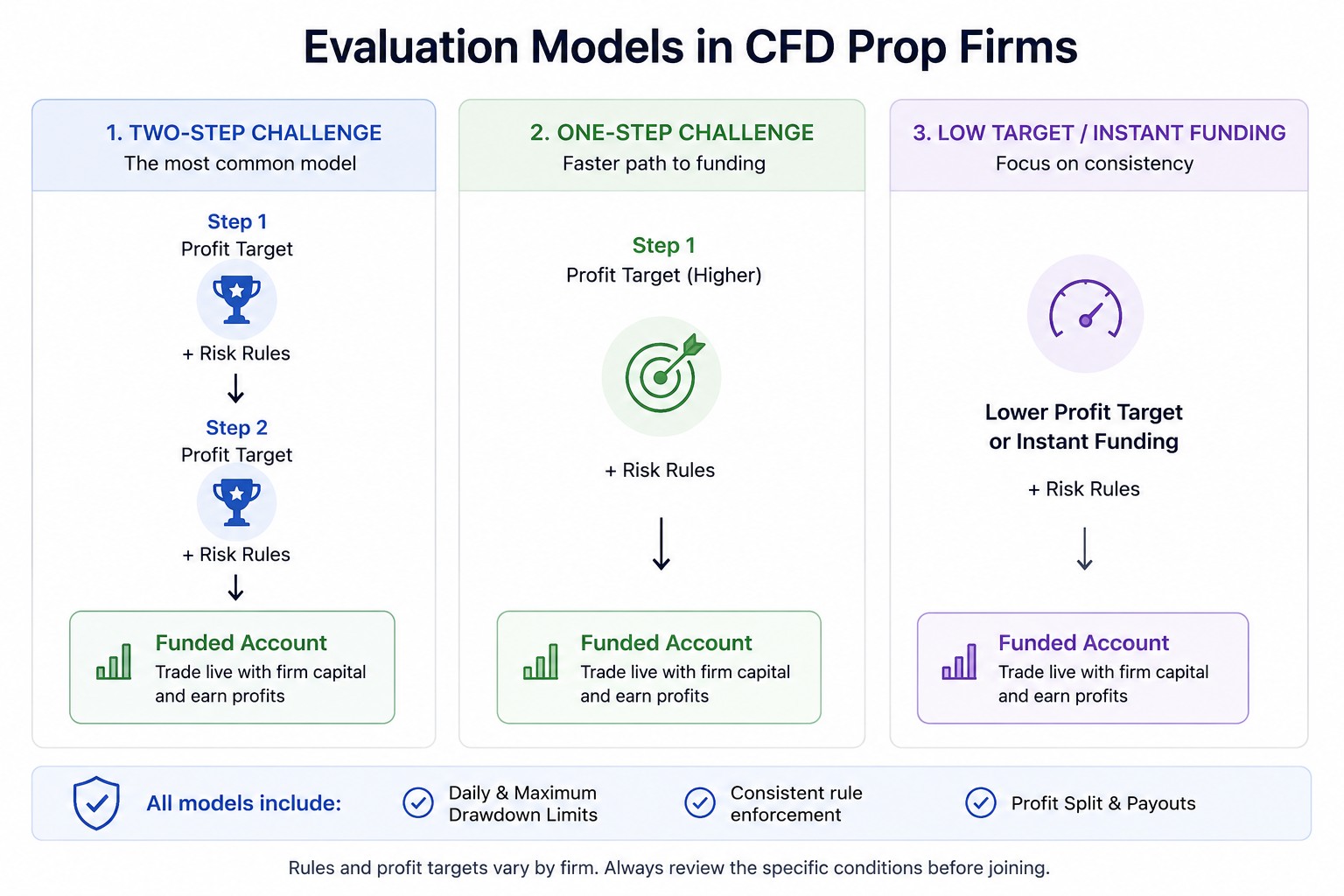
CFD prop firms use different evaluation models to determine whether traders can manage funded accounts responsibly. While the requirements vary, most firms follow one of three common approaches.
The traditional two-step evaluation remains the industry standard. Traders must meet predefined profit targets while staying within daily and overall drawdown limits before progressing to a funded account. This model is designed to assess both profitability and risk management over multiple stages.
Some firms simplify the process with one-step evaluations, allowing traders to qualify for funding after completing a single challenge. These programs generally require a higher profit target or stricter risk controls in exchange for faster access to funded capital.
A growing number of providers also offer evaluations with lower profit targets or instant funding options. Rather than rewarding aggressive short-term returns, these models are intended for traders who prioritize steady, disciplined performance and are willing to accept more conservative growth.
Trading conditions that influence real performance
Challenge fees often receive the most attention, but day-to-day trading conditions have a greater impact on long-term profitability. Execution quality, trading costs, and platform reliability can significantly affect a trader's ability to meet profit targets while staying within risk limits.
Transaction costs are especially important for active traders. Tight spreads and low commissions help reduce trading expenses, while fast execution and minimal slippage become critical during periods of high market volatility. For swing traders, overnight financing charges and position-holding rules can materially influence returns.
Platform stability is another key consideration. Leading CFD prop firms typically support platforms such as MetaTrader, cTrader, or DXtrade, providing reliable execution, advanced charting tools, and compatibility with automated trading strategies where permitted.
When evaluating a CFD prop firm, traders should also review practical details such as payout frequency, available leverage, supported markets, and trading restrictions. A firm with slightly higher evaluation fees may ultimately offer better value if it provides lower trading costs, consistent execution, and transparent operating rules.
Matching the prop firm to the trading strategy
The best CFD prop firm depends on your trading style rather than the size of the funded account. A provider that works well for a swing trader may be unsuitable for a scalper or an intraday trader because trading rules, execution quality, and market access vary across firms.
The table below highlights the key features different types of traders should prioritize when comparing CFD prop firms.
| Trading style | What to prioritize |
|---|---|
| Scalping | Tight spreads, low commissions, fast execution, and minimal slippage |
| Day trading | Reliable platform performance, flexible intraday risk limits, news trading policy, and competitive leverage |
| Swing trading | Overnight position support, reasonable financing costs, flexible holding rules, and stable execution |
| Index trading | Broad index selection, extended trading hours, competitive spreads, and consistent execution during volatile sessions |
| Commodity trading | Wide commodity coverage, competitive pricing, reliable liquidity, and transparent overnight financing |
Choosing a CFD prop firm that matches your trading strategy often has a greater impact on long-term performance than selecting the largest funded account or the highest advertised profit split.
Core rules to compare before joining a prop firm
Before opening a funded account, traders should carefully review each firm's trading rules and operating conditions. A structured comparison helps identify the best CFD prop firm for a specific trading style and reduces the risk of unexpected restrictions after funding.
Key factors to compare include:
Market coverage. Firms that offer CFDs across Forex, stock indices, commodities, metals, and other asset classes provide greater flexibility and allow traders to diversify their strategies.
Drawdown model. Static drawdowns are generally easier to manage than trailing drawdowns, which reduce the allowable loss as account equity increases.
Daily loss limits. These determine how much risk can be taken within a single trading session and directly influence position sizing.
Rule transparency. The firm's trading rules should be clearly explained and applied consistently throughout both the evaluation and funded stages to minimize the risk of accidental violations.
Execution quality. Tight spreads, reliable order execution, and minimal slippage are particularly important for active traders and can have a meaningful impact on overall profitability.
News and holding policies. Review whether trading during major economic announcements is permitted and whether positions may remain open overnight or over weekends.
Platform and automation support. If you use Expert Advisors (EAs), custom indicators, or trade management software, confirm that the firm's platform and trading rules allow them.
Payout reliability. Look for firms with transparent withdrawal policies, predictable payment schedules, and a strong reputation for processing payouts on time.
Comparing these factors together provides a more complete picture than focusing only on account size, evaluation fees, or advertised profit splits. In many cases, the overall trading environment has a greater impact on long-term results than the initial funding amount.
Risks and warnings
Legitimate CFD prop firms can provide traders with access to larger trading capital, but funded trading also comes with important limitations. Before paying an evaluation fee, traders should understand both the advantages and potential drawbacks of the prop trading model.
- Pros
- Cons
Access to larger trading capital without risking significant personal funds.
Opportunity to trade multiple CFD markets through a single funded account.
Clear risk management framework that encourages disciplined trading.
Potential to scale account size after meeting performance milestones.
Strict drawdown and daily loss limits can result in account termination after relatively small mistakes.
Evaluation fees are generally non-refundable if the challenge is not completed successfully.
Trading restrictions, such as limits on news trading or overnight positions, may not suit every strategy.
Payout policies, execution quality, and customer support vary significantly between firms.
While many CFD prop firms operate transparently, traders should review the firm's rulebook, payout history, and reputation before purchasing a challenge. Reputable providers clearly explain their trading rules, maintain consistent payout schedules, and offer reliable trading infrastructure.
It's also important to remember that CFDs are leveraged products with a high level of risk. The UK's Financial Conduct Authority (FCA) and other regulators have introduced measures to reduce excessive retail trading losses, but leverage can still amplify both gains and losses. Choosing a reputable prop firm does not eliminate the risks associated with CFD trading.
Choose trading conditions over account size

When comparing the best prop firms for CFD trading, don't focus solely on the advertised account size. Pay close attention to the evaluation model, drawdown rules, daily loss limits, payout policy, and execution quality. These factors will have a much greater impact on your long-term results than a larger funded account.
The best CFD prop firms are those that match your trading strategy. Scalpers should prioritize tight spreads and fast execution, while swing traders need firms that allow overnight positions and offer reasonable financing costs. Before purchasing a challenge, review the firm's rulebook to understand any restrictions on news trading, automation, or position holding.
Finally, remember that a funded account does not reduce market risk. Whether you trade with one of the top CFD prop firms or a smaller provider, consistent risk management, disciplined position sizing, and careful trade review remain the foundations of long-term success.
Methodology for compiling our ratings of prop firms
Traders Union applies a rigorous methodology to evaluate prop companies using over 100 quantitative and qualitative criteria. Multiple parameters are given individual scores that feed into an overall rating.
Key aspects of the assessment include:
-
Trader testimonials and reviews. Collecting and analyzing feedback from existing and past traders to understand their experiences with the firm.
-
Trading instruments. Companies are evaluated on the range of assets offered, as well as the breadth and depth of available markets.
-
Challenges and evaluation process. Analyzing the firm's challenge system, account types, evaluation criteria, and the process for granting funding.
-
Profit split. Reviewing the profit split structure and terms, scaling plans, and how the firm handles profit distributions.
-
Trading conditions. Examining leverage, execution speeds, commissions, and other trading costs associated with the firm.
-
Platform and technology. Assessing the firm's proprietary trading platform or third-party platforms it supports, including ease of use, functionality, and stability.
-
Education and support. Quality and availability of training materials, webinars, and one-on-one coaching.
Conclusion
Ultimately, the best prop firm for CFD trading is the one that strategically aligns with your trading style, risk tolerance, and long-term goals. While large funded account sizes and profit splits draw attention, factors like rule transparency, execution quality, platform reliability, and appropriate drawdown models have a far greater impact on consistent success. For example, a scalper may achieve better results with a firm offering tight spreads and minimal slippage, while a swing trader might prefer firms that allow overnight positions with reasonable financing costs. By prioritizing trading conditions and risk management over headline figures, traders set themselves up for both accountability and opportunity. Remember, in the world of prop trading, sustainable performance and disciplined risk control matter more than the size of your starting balance.
FAQs
How do drawdown models differ among the best CFD prop firms?
What trading platform features should you look for in the best prop firms for CFD trading in 2026?
What are common trading restrictions imposed by CFD prop firms?
How can a trader determine if a prop firm's payout policy is reliable?
Editors' Top Picks and Insights






Related Articles
Team that worked on the article
Aleksandra Chaikina has been a contributor to Traders Union since 2021. With over 15 years of experience in copywriting and more than 5 years focused on financial content, she specializes in producing detailed guides, analytics, and comparative reviews across various sectors, including cryptocurrencies, Forex, investment strategies, and financial technologies.
Ciaran Ryan is a veteran financial journalist based in South Africa, where he covers cryptocurrency, mining, stock markets, and governance for Moneyweb. He also hosts the weekly Moneyweb Crypto Podcast.
Chinmay Soni is a financial analyst with more than 5 years of experience in working with stocks, Forex, derivatives, and other assets. As a founder of a boutique research firm and an active researcher, he covers various industries and fields, providing insights backed by statistical data.
A bear market is a period of time in which an investment asset, such as stocks, bonds, or commodities, experiences a decline in price for an extended period of time.
A day trader is an individual who engages in buying and selling financial assets within the same trading day, seeking to profit from short-term price movements.
Risk management is a risk management model that involves controlling potential losses while maximizing profits. The main risk management tools are stop loss, take profit, calculation of position volume taking into account leverage and pip value.
Volatility refers to the degree of variation or fluctuation in the price or value of a financial asset, such as stocks, bonds, or cryptocurrencies, over a period of time. Higher volatility indicates that an asset's price is experiencing more significant and rapid price swings, while lower volatility suggests relatively stable and gradual price movements.
Scalping in trading is a strategy where traders aim to make quick, small profits by executing numerous short-term trades within seconds or minutes, capitalizing on minor price fluctuations.


