
Trading On An Uptrend: Features And Expert Advice



Editorial Note: While we adhere to strict Editorial Integrity, this post may contain references to products from our partners. Here's an explanation for How We Make Money. None of the data and information on this webpage constitutes investment advice according to our Disclaimer.
An uptrend, often referred to as a bull market or bull run, is a financial market condition characterized by steadily rising prices of stocks, bonds, commodities, or other investment instruments. Some of the easiest aspects to understand when an uptrend begins are:
- A constant increase in the price of a stock or other asset over an extended period.
- Improvement in key economic indicators such as GDP, employment and consumer spending.
- Prevalence of positive sentiment and confidence among market participants, which is reflected in high trading volumes and increased investment activity.
Trading in a bull market offers traders unique opportunities for profit. The market is showing steady growth, attracting the attention of both beginners and experienced investors. To successfully navigate this favorable environment, it is necessary not only to understand the basic principles of trading, but also to master certain strategies and risk management methods. Let's look at the key aspects of trading in a bull market, sharing useful tips and strategies to help you make the most of uptrend market opportunities.
What is an uptrend
An uptrend or bull run, is a market condition characterized by steadily rising prices of investment instruments. At the same time, the traded asset forms higher price peaks, and local corrections are relatively minor.
At this time, investors actively buy most of the traded shares or other assets, which further pushes prices up. This phenomenon is called bull run. Thus, an uptrend in the markets is accompanied by a positive market sentiment and rising asset values over an extended period of time.
An uptrend can last from a few weeks to several months or even years, depending on the cyclicality of the traded asset and other factors such as economic conditions, news and market sentiment.
Rising prices. A steady increase in asset values as seen on the charts.
Investor Confidence. Positive sentiment among market participants who are confident of further growth.
High trading volume. Active buying and selling of assets, which confirms the strength of the trend.
Economic growth. Often accompanied by improving economic indicators such as GDP, employment and corporate profits.
Decreased volatility. Prices are rising more smoothly, with less volatility.
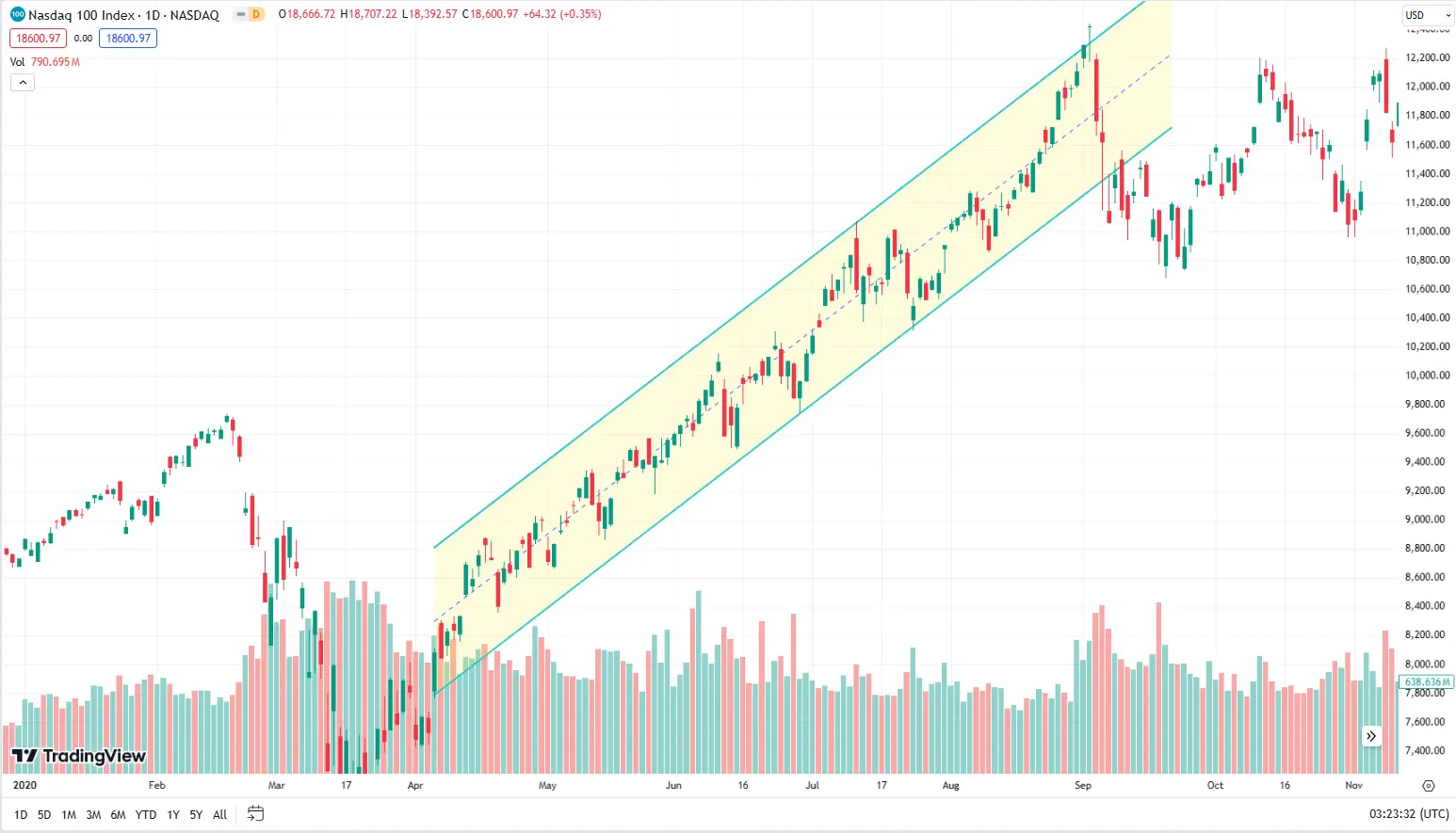 What a bull market looks like on a chart
How to spot a bull market
In the financial markets, knowing how to identify an uptrend (or bullish trend) and take advantage of it is an important skill for any trader. Trading in an uptrend provides the opportunity to make significant profits if you correctly recognize the signals indicating the beginning of a trend and apply the appropriate strategies. Let's look at some of them:
Indicators for an uptrend
Moving Averages:
Simple Moving Average (SMA): When a short-term SMA (such as the 50-day) crosses above a long-term SMA (such as the 200-day), it signals the start of an uptrend (called the "golden cross").
Exponential Moving Average (EMA): EMA reacts faster to price changes and is often used to more accurately identify trends.
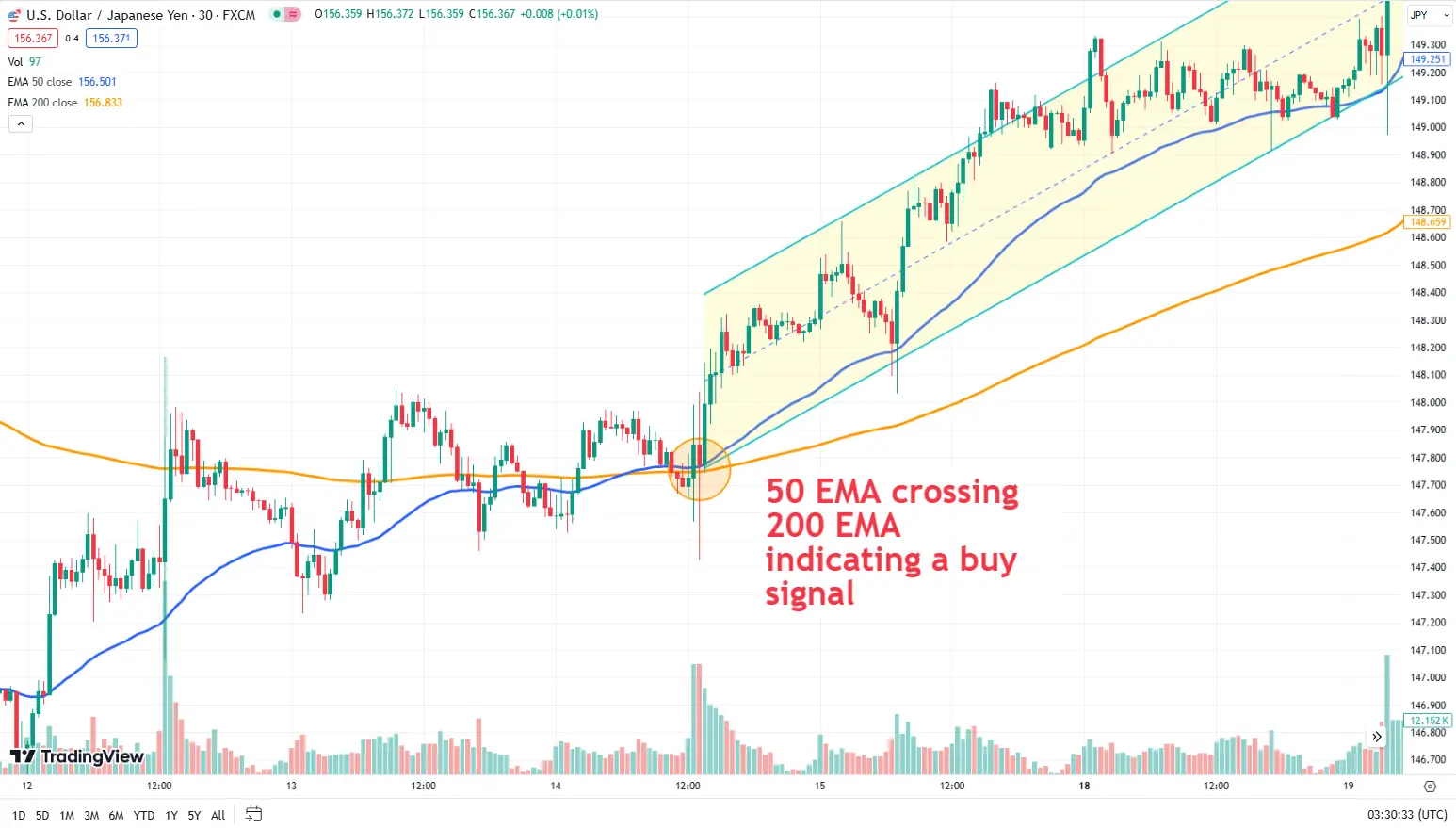 50 day MA crossing 200 day MA
Relative Strength Index (RSI). An RSI above 50 indicates an uptrend. Readings above 70 may signal overbought, which could foreshadow a correction, but in the overall context it also indicates a strong bull market.
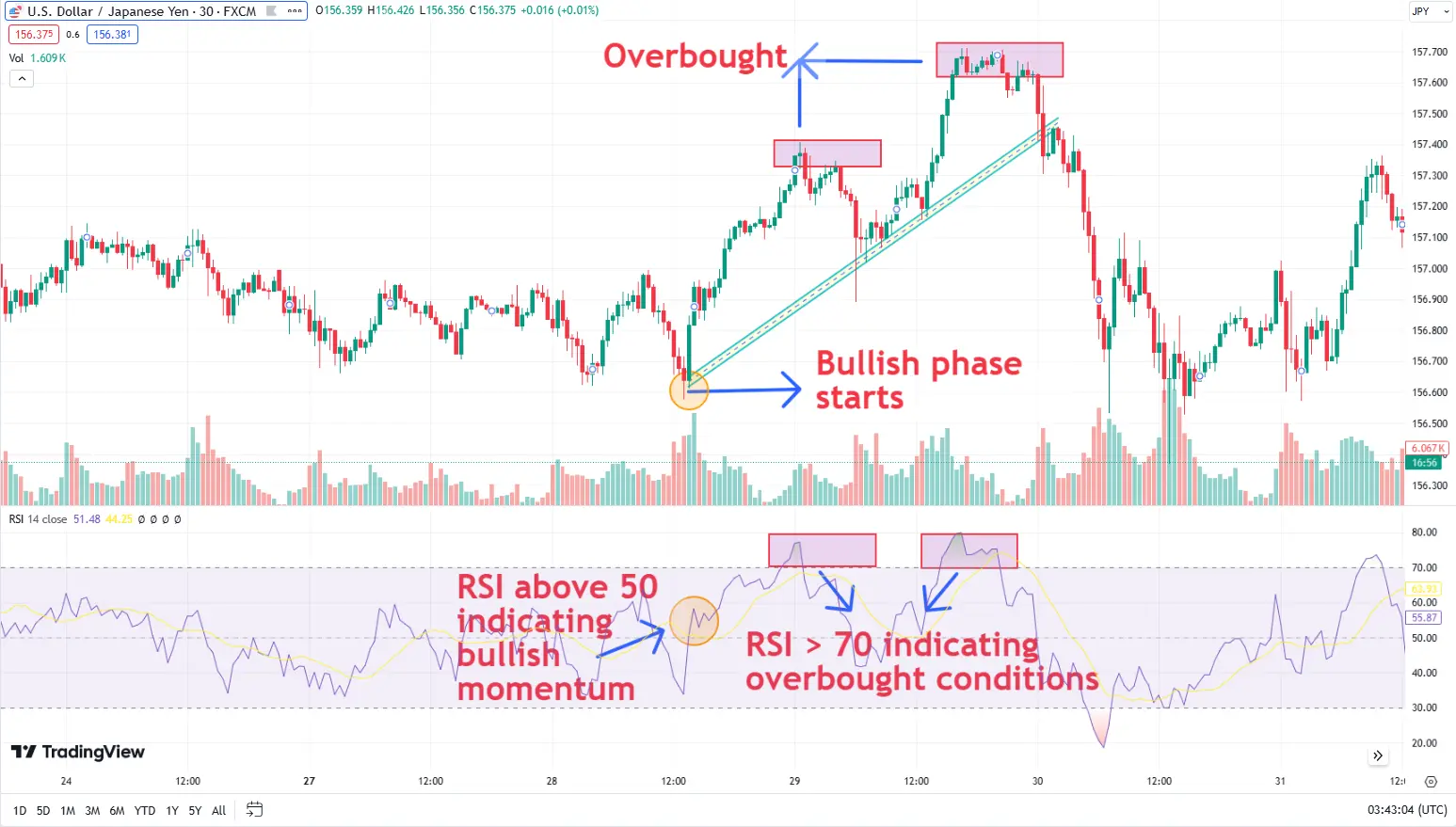 RSI strategy plotted on charts
Moving Average Convergence/Divergence (MACD) indicator. When the MACD line crosses the signal line upward, it is a bullish signal. Also, if the MACD histogram becomes positive, it indicates an uptrend.
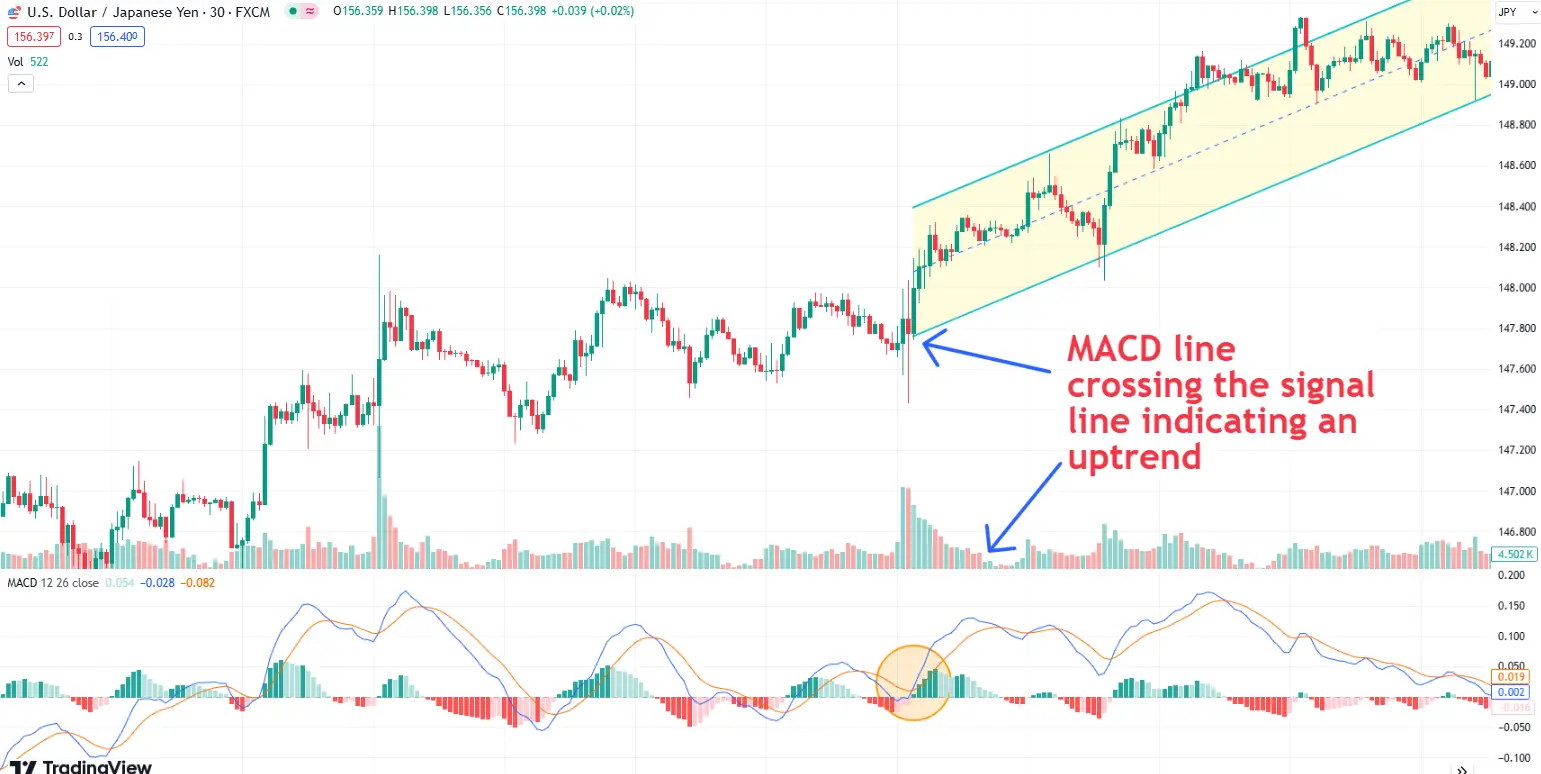 MACD line crossing the signal line
Trading figures for an uptrend
Ascending Triangle. Formed when price lows rise but highs remain at the same level. A break above the horizontal resistance level confirms the uptrend.
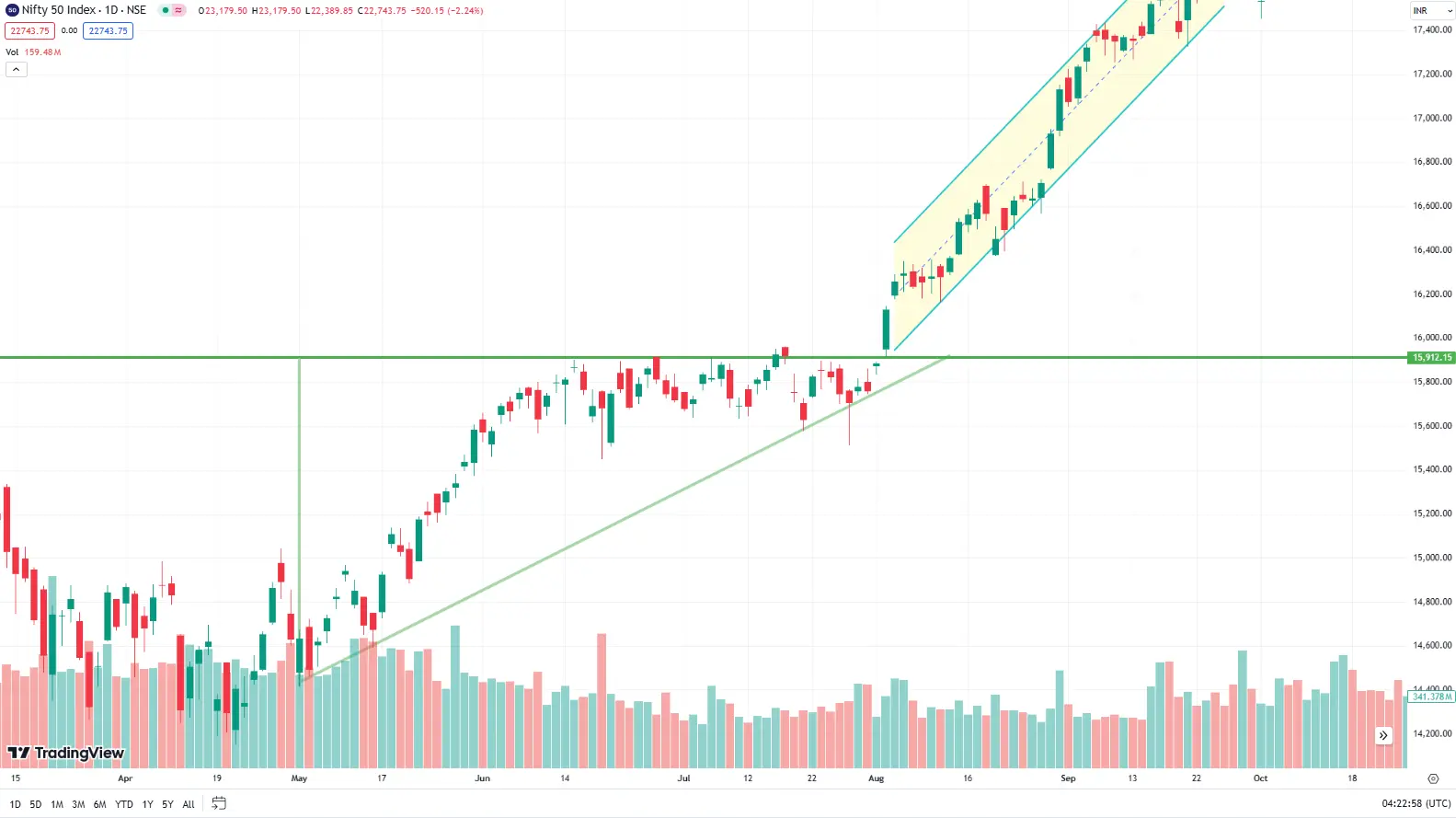 Ascending triangle plotted on charts
Flag. After a strong upward movement (flagpole), the price consolidates in a narrow range, forming a flag. An upward breakout from the flag confirms the continuation of the uptrend.
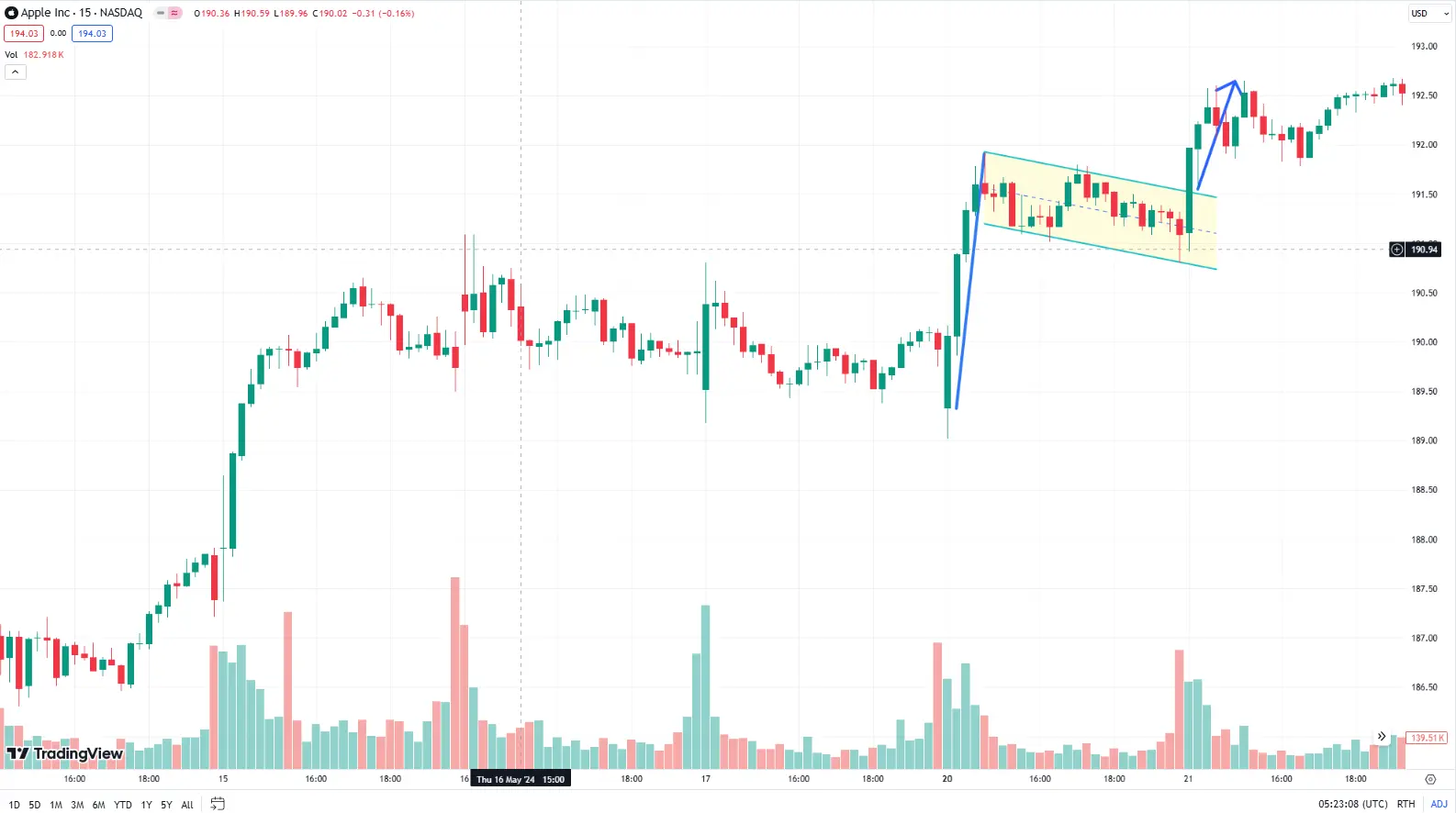 Flag pattern plotted on charts
Wedge. A rising wedge forms when price highs and lows rise, but at a steeper angle. An upward breakout from the wedge confirms the bullish trend.
An uptrend is also accompanied by a number of additional phenomena, by which one can determine the beginning of the revival of investors and enter the market in time.
Trading volume (Volume). An increase in volume when the price rises confirms the strength of the uptrend. If volume decreases on a rally, it may indicate trend weakness.
Trend Lines. Drawing a trend line through rising lows helps identify an uptrend. As long as the price is above this line, the trend is considered upward.
Support and Resistance levels. Breaking through a significant resistance level and its subsequent testing as support is a strong confirmation of the beginning or continuation of an uptrend.
How to trade in a bull market
Trading in a bull market (uptrend) provides traders with excellent opportunities for profit. To trade profitably in an uptrend, you need to understand the main features and apply uptrend trading strategies.
The main rule here is to trade with the trend, not against it. This means buying assets during corrections and holding them until new highs are reached. Moving averages, such as SMA and EMA, help determine the direction of the trend. In an uptrend, the price usually stays above its moving averages, especially the 50-day and 200-day SMA. Indicators like MACD and RSI can confirm the strength of the trend. If MACD is above zero and RSI is above 50, it usually indicates a strong uptrend.
Buying on corrections is one of the best strategies for trading in an uptrend. Instead of buying at the peaks, wait for small price pullbacks (called corrections) to buy assets at a more favorable price and reduce risks. Always set stop-losses below support levels or moving averages to limit losses in case of a sharp trend reversal. Risk management is also crucial — don’t risk more than 1-2% of your capital on a single trade and diversify your portfolio to avoid significant losses.
Trailing stops will help lock in profits as the price rises, allowing you to protect your gains and continue following the trend. Analyzing news and events is also important — positive news can strengthen the uptrend, while negative news can cause a correction. Stay disciplined and stick to your trading strategy, don’t succumb to emotions, and avoid impulsive decisions.
For trading in an uptrend, you can use the “Buy and Hold” strategy, which involves buying assets and holding them for a long time as long as the trend remains upward. You can also use continuation patterns, such as ascending triangles and flags, to enter the market on confirmed signals. Adding to existing positions upon trend confirmation allows you to increase profits as the price rises.
Follow the trend by buying assets during corrections.
Use moving averages and indicators to confirm the trend.
Set stop-losses and manage risks.
Apply trailing stops to lock in profits.
Analyze news and events affecting the market.
Stay disciplined and follow your strategy.
To trade profitably in an uptrend market, it is good to find a reliable broker. We have prepared a comparison table of Forex brokers offering a wide range of assets. They have good trading conditions, in particular the choice of currency pairs and trading commissions.
| zForex | Plus500 | OANDA | Trading.com USA | FOREX.com | |
|---|---|---|---|---|---|
|
Min. deposit, $ |
10 | 100 | No | 50 | 100 |
|
Max. leverage |
1:1000 | 1:300 | 1:200 | 1:50 | 1:50 |
|
Spread by account type Standard |
Yes | Yes | Yes | Yes | Yes |
|
Spread by account type ECN |
0.1 | No | 0.15 | No | 0.2 |
|
Spread by account type Raw |
No | No | No | No | 0.1 |
|
Scalping |
Yes | No | Yes | Yes | Yes |
|
Trading bots (EAs) |
Yes | No | Yes | Yes | Yes |
|
Open account |
Go to broker Your capital is at risk.
|
Go to broker 80% of retail CFD accounts lose money. |
Go to broker Your capital is at risk. |
Go to broker Your capital is at risk. |
Study review |
Handling emotions while trading in a bull market

Trading in a bull market requires a conscious approach and discipline. One of the key pieces of advice is to follow the trend and use proven strategies. Firstly, don't be afraid to enter trades when the market is rising. Waiting for a pullback might lead to missed opportunities, so it's important to act quickly and decisively. I also recommend using technical analysis to confirm your decisions. Indicators such as moving averages can help identify entry and exit points.
The second important aspect is risk management. Even in a bull market, corrections can occur, so always use stop-losses to protect your capital. The position size should also be reasonable: don't invest all your funds in one trade. Spread your capital across several instruments to reduce risks. Portfolio diversification remains relevant even in a growing market.
Finally, don't forget about the emotional component. Rapid market growth can lead to overconfidence and a desire to increase risks. However, it's important to stay calm and stick to your strategy. Regularly review your goals and results to adjust your plan if necessary. Always be prepared for possible changes and don't let emotions drive your decisions.
Conclusion
Trading in an uptrend—or bull market—can offer traders outstanding opportunities for profit, but long-term success hinges on disciplined strategy and robust risk management. By leveraging technical tools like moving averages, RSI, and MACD, and waiting for corrections to buy rather than chasing peaks, traders maximize their entry points while minimizing risk. For instance, setting stop-loss orders below support levels and using trailing stops can lock in gains and protect against sudden reversals. Ultimately, even as positive sentiment abounds, staying disciplined and unwavering in your approach—even in the face of rapid gains—ensures you harness the power of the trend without falling prey to emotional decision-making. Remember: riding an uptrend is about planning smart entries, protecting your capital, and letting the market's momentum work for you.
FAQs
What factors can signal the end of an uptrend in the financial markets?
How do technical indicators help minimize risks when trading an uptrend?
Why is portfolio diversification important during an uptrend?
What common mistakes should traders avoid when trading during an uptrend?
Editors' Top Picks and Insights

Dangerous but indispensable: Why the crypto market needs bridges

Markus Levin: DePIN could power the AI agent economy

Pokémon cards for $2,500: How collectibles became a new form of gambling

The privacy paradox: How the crypto mixer market has changed

Is Bitcoin right for you? Five traits shared by many cryptocurrency holders

Chasing hits: Why investors are losing interest in Netflix
Related Articles
Team that worked on the article
Parshwa is a content expert and finance professional possessing deep knowledge of stock and options trading, technical and fundamental analysis, and equity research. As a Chartered Accountant Finalist, Parshwa also has expertise in Forex, crypto trading, and personal taxation.
Dr. BJ Johnson is a PhD in English Language and an editor with over 15 years of experience. He earned his degree in English Language in the U.S and the UK.
Mirjan Hipolito is a journalist and news editor at Traders Union. She is an expert crypto writer with five years of experience in the financial markets.
A Trailing Stop Order is a type of order that automatically adjusts the stop-loss level as the market price moves in a favorable direction, helping to protect profits.
Forex leverage is a tool enabling traders to control larger positions with a relatively small amount of capital, amplifying potential profits and losses based on the chosen leverage ratio.
Diversification is an investment strategy that involves spreading investments across different asset classes, industries, and geographic regions to reduce overall risk.
Forex trading, short for foreign exchange trading, is the practice of buying and selling currencies in the global foreign exchange market with the aim of profiting from fluctuations in exchange rates. Traders speculate on whether one currency will rise or fall in value relative to another currency and make trading decisions accordingly. However, beware that trading carries risks, and you can lose your whole capital.
An ECN, or Electronic Communication Network, is a technology that connects traders directly to market participants, facilitating transparent and direct access to financial markets.

-
 Afghanistan
-
 Albania
-
 Algeria
-
 Angola
-
 Argentina
-
 Armenia
-
 Australia
-
 Austria
-
 Azerbaijan
-
 Bahamas
-
 Bahrain
-
 Bangladesh
-
 Belarus
-
 Belgium
-
 Bolivia
-
 Botswana
-
 Brazil
-
 Brunei
-
 Bulgaria
-
 Cambodia
-
 Cameroon
-
 Canada
-
 Chile
Chile
-
 China
China
-
 Colombia
-
 Congo
Congo
-
 Costa Rica
-
 Cote d'Ivoire
-
 Croatia
-
 Cuba
Cuba
-
 Cyprus
-
 Czechia
-
 DR Congo
-
 Denmark
-
 Dominican Republic
-
 Ecuador
-
 Egypt
Egypt
-
 El Salvador
-
 Estonia
-
 Eswatini
-
 Ethiopia
-
 Finland
-
 France
-
 Georgia
-
 Germany
-
 Ghana
Ghana
-
 Greece
-
 Haiti
Haiti
-
 Hong Kong
-
 Hungary
-
 India
India
-
 Indonesia
-
 Iran, Islamic republic
-
 Iraq
Iraq
-
 Ireland
-
 Israel
-
 Italy
Italy
-
 Jamaica
-
 Japan
Japan
-
 Jordan
-
 Kazakhstan
-
 Kenya
Kenya
-
 Korea
Korea
-
 Kuwait
-
 Kyrgyzstan
-
 Laos
Laos
-
 Latvia
-
 Lebanon
-
 Lesotho
-
 Libya
Libya
-
 Lithuania
-
 Luxembourg
-
 Madagascar
-
 Malaysia
-
 Malta
Malta
-
 Mauritius
-
 Mexico
-
 Moldova
-
 Mongolia
-
 Montenegro
-
 Morocco
-
 Mozambique
-
 Myanmar
-
 Namibia
-
 Nepal
Nepal
-
 Netherlands
-
 New Zealand
-
 Nigeria
-
 North Macedonia
-
 Norway
-
 Oman
Oman
-
 Pakistan
-
 Palestine
-
 Panama
-
 Papua New Guinea
-
 Paraguay
-
 Peru
Peru
-
 Philippines
-
 Poland
-
 Portugal
-
 Puerto Rico
-
 Qatar
Qatar
-
 Reunion
-
 Romania
-
 Rwanda
-
 Saudi Arabia
-
 Serbia
-
 Singapore
-
 Slovakia
-
 Slovenia
-
 Somalia
-
 South Africa
-
 Spain
Spain
-
 Sri Lanka
-
 Sweden
-
 Switzerland
-
 Syria
Syria
-
 Taiwan
-
 Tajikistan
-
 Tanzania
-
 Thailand
-
 Trinidad and Tobago
-
 Tunisia
-
 Turkey
-
 UAE
UAE
-
 Uganda
-
 Ukraine
-
 United Kingdom
-
United States
-
 Uruguay
-
 Uzbekistan
-
 Venezuela
-
 Vietnam
-
 Yemen
Yemen
-
 Zambia
-
 Zimbabwe
- Forex
- Crypto











