
Best USDT Faucets: Which One Should You Choose?


Editorial Note: While we adhere to strict Editorial Integrity, this post may contain references to products from our partners. Here's an explanation for How We Make Money. None of the data and information on this webpage constitutes investment advice according to our Disclaimer.
The best USDT faucets in 2026:
FaucetPay. Micro-wallet aggregator with a 0.1 USDT minimum withdrawal and multi-crypto support.
FireFaucet. Auto-claim platform that earns free Tether passively through an internal points system.
Cointiply. High-payout crypto faucet with surveys, games, and a 25% referral commission.
USDT Pick. Hourly faucet with bonus games.
Freecash. Task-based USDT faucet with fast payouts starting at $0.50 equivalent.
Crypto faucets are one of the simplest ways to get started with digital assets. You complete small tasks, and you earn tiny amounts of cryptocurrency in return. No investment needed.
Tether (USDT) makes this even more appealing. Unlike Bitcoin or Ethereum, USDT holds a stable value of $1 at all times, so the rewards you earn do not lose value overnight. With a circulating supply of around 184 billion tokens and a market cap of $184 billion, Tether is the largest stablecoin in the world and one of the most widely used currencies in crypto trading and payments.
This guide covers the free USDT faucets in 2026, how they work, how much you can realistically earn, and what risks to watch out for before you sign up.
Risk warning: Cryptocurrency markets are highly volatile, with sharp price swings and regulatory uncertainties. Research indicates that 75-90% of traders face losses. Only invest discretionary funds and consult an experienced financial advisor.
Best USDT faucets in 2026
The five platforms below were selected based on payout history, withdrawal flexibility, earning variety, and user feedback verified through current faucet directories and independent reviews.
FaucetPay
FaucetPay is a micro-wallet and crypto faucet aggregator that collects payouts from dozens of earning platforms into one balance. Instead of waiting to meet the high withdrawal minimums of individual faucets, users accumulate small rewards inside FaucetPay and withdraw them in one go. This saves significantly on network fees and is especially useful for anyone working across multiple platforms at once.

Beyond aggregation, FaucetPay also offers its own built-in tasks, including surveys, paid-to-click ads, and site surfing.
Claim frequency. Every 5 minutes on connected faucets.
Minimum withdrawal. 0.1 USDT.
Referral commission. 20%.
FireFaucet
FireFaucet stands out through its Auto Claim Points (ACP) system. Users earn ACP by completing shortlinks, solving captchas, watching PTC ads, and doing surveys. Those points are then used to power an auto-claim mode that earns USDT and other cryptocurrencies continuously, without needing to manually claim every few minutes. It has been operational since 2018 and has over a million users.

Withdrawals go directly to your wallet with no transaction fees, or via FaucetPay for faster access.
Claim frequency. Auto-claim, runs continuously while ACP is active.
Minimum withdrawal. 5 USDT.
Referral commission. 20%.
Cointiply
Cointiply is one of the most established crypto faucets in the space, with over 4 million registered users and more than $12 million paid out since 2018. It offers faucet claims, surveys, video ads, games, and offer walls. The platform pays out in Bitcoin, Litecoin, Dogecoin, and Dash. There is no direct USDT payout, but earnings can be converted to USDT through an exchange after withdrawal.
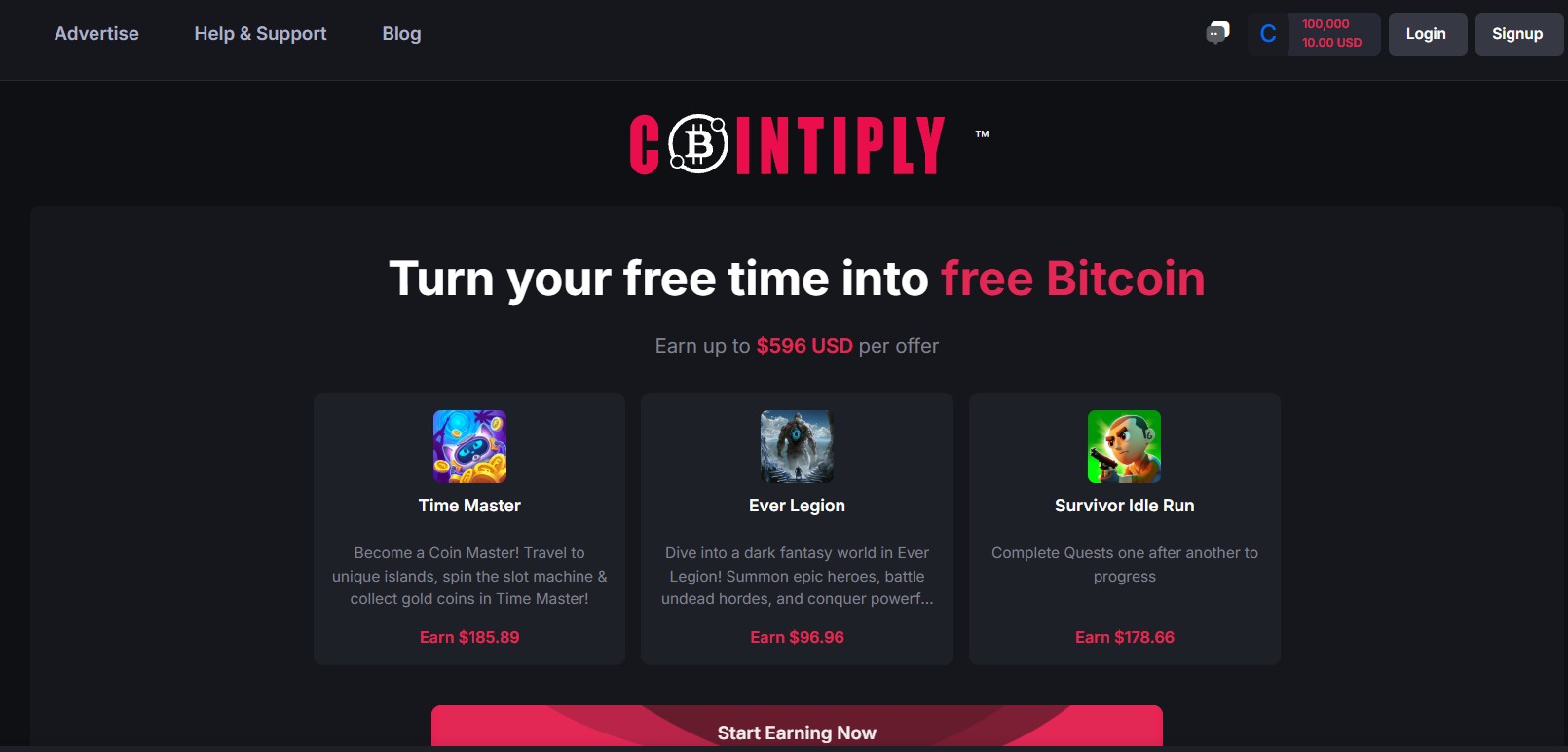
If your goal is stablecoin earnings, Cointiply works best as a stepping stone rather than a direct free USDT faucet.
Claim frequency. Every hour.
Minimum withdrawal. Equivalent of $3 in coins (~30,000 coins).
Referral commission. 25% on faucet earnings, 10% on offers and surveys.
USDT Pick
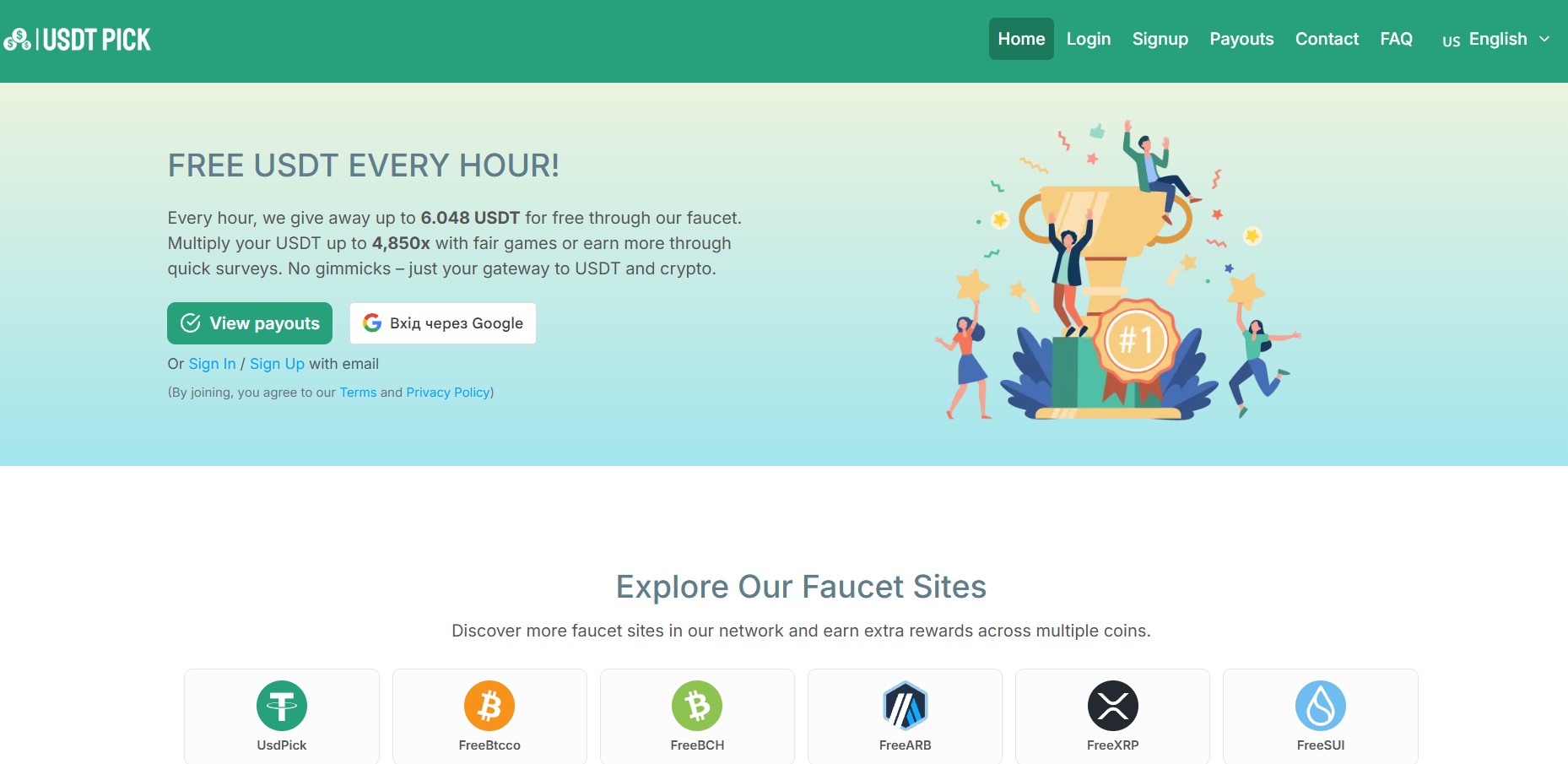
USDT Pick is one of the few faucets that allows you to claim free USDT every hour by solving captchas or taking quick surveys. In addition to standard earnings, the platform offers games with a provably fair algorithm, where you can try to multiply your USDT several thousandfold.
The platform is also known for its generous affiliate marketing: affiliates receive up to 50% of their referrals' earnings, plus an additional percentage for their in-game activities. This makes USDT Pick attractive for both new users and those looking to combine a basic income with gamified earning opportunities.
Claim frequency. Every hour.
Minimum withdrawal. 1 USDT.
Referral commission. Up to 50% of their referrals' earnings.
Freecash
Freecash is a task-based earning platform with a strong 4.8-star rating on Trustpilot from over 250,000 reviews. Users earn by testing apps, completing surveys, and reaching milestones in mobile games. Payouts are fast, often processing in under 10 minutes. USDT is one of the supported withdrawal options.
Claim frequency. Task-dependent.
Minimum withdrawal. $0.50 equivalent in USDT.
Referral commission. Up to 30%.
Note! Freecash requires full KYC identity verification before you can withdraw. This is a dealbreaker for some users but a sign of a legitimate, regulated operation.
| Platform | Direct USDT support | Claim frequency | Min. withdrawal | Referral commission | Best for |
|---|---|---|---|---|---|
| FaucetPay | Yes | Every 5 min (via faucets) | 0.1 USDT | 20% | Aggregating micro-earnings |
| Fire Faucet | Yes | Auto-claim (ACP-based) | 5 USDT | 20% | Passive auto-claiming |
| Cointiply | Indirect (BTC, convert) | Every hour | ~$3 equivalent | 25% faucet / 10% offers | High-value tasks and surveys |
| Allcoins.pw | Yes | Every 5 min | Variable | 10% | Multi-crypto flexibility |
| Freecash | Yes | Task-dependent | $0.50 equiv. | Up to 30% | Fast payouts, app testing |
Note: Minimum withdrawal limits and network options change. Always verify on the official platform before signing up.
What is a USDT faucet and how does it work?
A USDT faucet is an online platform that pays out small amounts of Tether in exchange for completing simple actions. These include solving captchas, watching ads, filling out surveys, or installing apps. The name "faucet" comes from the idea of a dripping tap. Rewards are small but steady, like drops of water.
How the earning cycle works
The basic flow of any USDT faucet is straightforward:
Register. Create an account on the platform using your email and a crypto wallet address.
Complete tasks. Solve captchas, view ads, take surveys, or use offer walls.
Accumulate balance. Each completed action adds a small amount of USDT or internal points to your account.
Reach the minimum. Once your balance hits the withdrawal threshold, you can request a payout.
Withdraw. Funds go directly to your wallet (usually via TRC20 or BEP20 networks) or to a micro-wallet like FaucetPay.
How faucets make money
Understanding the business model helps you evaluate which platforms are legitimate. Faucets earn revenue from:
Display and video ads. Advertisers pay for impressions and clicks from faucet users.
CPA offer walls. Partners pay faucets when users install apps, register for services, or complete sign-up flows.
Survey networks. Market research companies pay for completed questionnaires.
In-platform games and lotteries. Some platforms generate revenue from in-house games with a built-in house edge.
How to earn from USDT faucets?
Earning from USDT faucets is not passive income in the traditional sense. It is a micro-earning model where consistency, task selection, and fee management determine your results. The more strategic your approach, the better your returns per hour of effort.
Here are the main ways to earn on a USDT faucet platform:
Hourly and timed claims. The most basic earning method. You visit the platform, solve a captcha or click a claim button, and receive a small USDT reward.
Offer walls and app installs. The highest-paying activity on most platforms. You complete actions for partner networks, such as installing an app, registering for a service, or reaching a level in a mobile game.
Surveys. Many crypto faucet platforms connect to survey networks. A single completed survey can pay more than dozens of faucet claims. Availability depends on your region and user profile.
Shortlinks and site surfing. You visit advertiser pages or click through short URLs in exchange for small rewards. These pay less than surveys or offers but require minimal effort and fill time between larger tasks.
Referral programs. You earn a percentage of what your referred users make. On platforms like Freecash this can reach 30%, making referrals the most scalable in come stream within the free USDT faucet model if you have an active audience to share links with.
Games and bonus systems. Some platforms offer lotteries, dice games, or streak bonuses. These can boost earnings but should be approached carefully to avoid spending more time than the rewards justify.
The most effective approach is to prioritize high-value tasks like offer walls and surveys, rotate across two or three platforms, and treat claims as a background activity rather than the main event.
How much can you realistically earn from USDT faucets?
USDT faucets are a micro-earning model, not an income stream. Rewards are measured in cents per task, and even with daily effort the returns stay small. Understanding what is realistic before you start will save you time and prevent disappointment.
Here are the key factors that determine how much you earn:
Task type. Basic captcha claims and faucet buttons pay the least. Offer walls, app installs, and surveys pay significantly more. The more valuable the action is to the advertiser, the higher the reward.
Your region. Users in the US, Canada, and Western Europe get access to more offer wall tasks and higher-paying surveys. Users in other regions will see fewer high-value tasks available.
Number of platforms you use. Working with a single crypto faucet limits your income. Rotating across two to four platforms means your timers overlap and your total payout grows.
How consistent you are. Daily activity compounds over time. Irregular use produces almost nothing.
Referral activity. An active referral network is the most scalable income source within the free USDT faucet model. More active referrals means a steady passive percentage added on top of your own earnings.
Network and withdrawal timing. Frequent small withdrawals eat into earnings through network fees. Using TRC20 for USDT withdrawals keeps fees low. Withdrawing less often but in larger amounts preserves more of what you earn.
| Activity level | Time per day | Platforms used | Estimated monthly earnings |
|---|---|---|---|
| Casual | Under 30 min | 1 | $1 to $5 |
| Moderate | 30 to 60 min | 2 to 3 | $5 to $15 |
| Active | 2 to 3 hours | 3 to 5 | $15 to $40 |
| Active + referrals | 2 to 3 hours + network | 3 to 5 | $50 to $120 |
How to use USDT faucets effectively
If you have decided to work with USDT faucets, a structured approach makes a real difference:
Focus on the best time-to-reward ratio. Not all tasks are worth your time. If a survey pays 0.5 USDT and takes 5 minutes, that is far better than 20 captcha claims adding up to 0.02 USDT. Always calculate your effective hourly rate and drop tasks that do not meet your threshold.
Use two to three platforms simultaneously. Each USDT faucet platform has its own claim timers. By rotating across platforms you eliminate idle time and keep earnings flowing consistently without burning out on one site.
Choose the right withdrawal network. Always withdraw USDT over the TRC20 network where possible. It is significantly cheaper than ERC20 and widely supported. Lower fees mean you keep more of what you earn.
Withdraw less often, in larger amounts. Every withdrawal costs a network fee. Accumulating a larger balance before withdrawing reduces the fee impact as a percentage of your total payout.
Track your time and earnings. Keep a simple log of how long you spend and how much you earn per platform. This makes it easy to spot which sites are worth your time and which ones are not.
Use a separate wallet for faucet activity. Never use your main crypto wallet on a free Tether faucet site. A dedicated wallet protects your primary holdings from any risk associated with advertising scripts or unfamiliar links.
Watch for promotions and bonus periods. Many platforms temporarily double rewards or offer bonus multipliers during special events. These windows are the best time to put in more effort and stack earnings faster.
The visual below summarizes the core principles of using crypto faucets smartly:

Faucet efficiency comes from the system, not volume. Control your fees, prioritize your tasks, and track your results. Even micro-earnings become predictable when managed with discipline.
Risks and warnings
Working with a USDT faucet looks simple on the surface, but there are real risks worth understanding before you sign up anywhere:
Scams and fake platforms. Phishing sites that imitate legitimate USDT faucets are common. They copy the branding of well-known platforms to steal wallet addresses or personal data. Always verify the exact domain before registering, and never enter private keys or seed phrases on any faucet site.
Low returns for high time investment. Even the best free USDT faucet platforms pay micro-amounts. If you treat faucet activity as a serious income source, the hourly rate will almost always disappoint. Calculate earnings per hour before committing significant time to any platform.
Malware and aggressive ads. Some lesser-known crypto faucet sites rely heavily on third-party ad networks that serve pop-ups or auto-redirect scripts. These can expose your device to malware. Use an ad blocker and avoid downloading anything from faucet pages.
Withdrawal delays and rule changes. Platforms can change minimum withdrawal limits, supported networks, or payout terms without much notice. A Tether faucet that paid 0.1 USDT minimum last month may raise it to 5 USDT today. Always review current terms before invest ing time.
If you want to do more with the USDT you earn, choosing the right exchange is the next practical step. A good platform can make it easier to store, convert, or start investing without making things complicated. The table below shows some of the best crypto exchanges available in your region to help you compare your options.
| Coinbase | OKX | BTCC | Cryptohopper | Crypto.com | |
|---|---|---|---|---|---|
|
Crypto |
Yes | Yes | Yes | Yes | Yes |
|
Min. Deposit, $ |
10 | 10 | 10 | No | 1 |
|
Coins Supported |
400+ | 600+ | 399 | 1000 | 400+ |
|
Spot Taker fee, % |
0.5 | 0.1 | 0.3 | 0 | 0.5 |
|
Spot Maker Fee, % |
0.5 | 0.08 | 0.2 | 0 | 0.25 |
|
Demo account |
No | Yes | Yes | No | No |
|
TU overall score |
8.5 | 8.46 | 8.08 | 7.8 | 7.76 |
|
Open an account |
Go to broker Your capital is at risk. |
Go to broker Your capital is at risk. |
Go to broker Your capital is at risk.
|
Go to broker Your capital is at risk. |
Go to broker Your capital is at risk. |
Use faucets to learn crypto, not to earn crypto

I have tested a lot of faucet platforms over the years, and the ones that consistently deliver are the ones with transparent payout logs, clear withdrawal rules, and support for low-fee networks like TRC20. My first recommendation is always to test a withdrawal early. Do not spend weeks accumulating a balance on a platform you have never actually withdrawn from.
The second thing I always tell new users is to treat a free USDT faucet as a learning environment, not an income stream. The real value is not the cents you earn. It is the hands-on experience with wallets, network fees, transaction confirmations, and how blockchain transfers actually work in practice.
Conclusion
USDT faucets are best seen as a practical gateway for learning about cryptocurrencies rather than as a meaningful source of income. While platforms like FaucetPay and Freecash offer a variety of earning opportunities with quick withdrawals and multi-crypto support, the actual rewards remain modest and require strategic task selection to maximize returns. The major value lies in gaining real-world experience managing wallets, understanding transaction fees, and navigating crypto platforms in a hands-on way. Ultimately, treat faucet earnings as bonus pocket change and focus on the educational journey they unlock within the digital asset ecosystem.
FAQs
Can you use USDT faucets without prior experience in cryptocurrencies?
What are the typical withdrawal methods and networks supported by USDT faucets?
How often can you claim rewards from USDT faucet platforms?
Do all USDT faucet platforms require identity verification (KYC) for withdrawals?
Editors' Top Picks and Insights






Related Articles
Team that worked on the article
Aleksandra Chaikina has been a contributor to Traders Union since 2021. With over 15 years of experience in copywriting and more than 5 years focused on financial content, she specializes in producing detailed guides, analytics, and comparative reviews across various sectors, including cryptocurrencies, Forex, investment strategies, and financial technologies.
Dan Blystone began his trading career in 1998 as an arbitrage clerk on the floor of the Chicago Mercantile Exchange (CME). He later traded bond and Eurex futures at proprietary firms such as Altea Trading, gaining valuable experience in high-frequency trading and risk management.
Chinmay Soni is a financial analyst with more than 5 years of experience in working with stocks, Forex, derivatives, and other assets. As a founder of a boutique research firm and an active researcher, he covers various industries and fields, providing insights backed by statistical data.
CFD is a contract between an investor/trader and seller that demonstrates that the trader will need to pay the price difference between the current value of the asset and its value at the time of contract to the seller.
Risk management is a risk management model that involves controlling potential losses while maximizing profits. The main risk management tools are stop loss, take profit, calculation of position volume taking into account leverage and pip value.
Crypto trading involves the buying and selling of cryptocurrencies, such as Bitcoin, Ethereum, or other digital assets, with the aim of making a profit from price fluctuations.
Ethereum is a decentralized blockchain platform and cryptocurrency that was proposed by Vitalik Buterin in late 2013 and development began in early 2014. It was designed as a versatile platform for creating decentralized applications (DApps) and smart contracts.
Cryptocurrency is a type of digital or virtual currency that relies on cryptography for security. Unlike traditional currencies issued by governments (fiat currencies), cryptocurrencies operate on decentralized networks, typically based on blockchain technology.

-
 Afghanistan
-
 Albania
-
 Algeria
-
 Angola
-
 Argentina
-
 Armenia
-
 Australia
-
 Austria
-
 Azerbaijan
-
 Bahamas
-
 Bahrain
-
 Bangladesh
-
 Belarus
-
 Belgium
-
 Bolivia
-
 Botswana
-
 Brazil
-
 Brunei
-
 Bulgaria
-
 Cambodia
-
 Cameroon
-
 Canada
-
 Chile
Chile
-
 China
China
-
 Colombia
-
 Congo
Congo
-
 Costa Rica
-
 Cote d'Ivoire
-
 Croatia
-
 Cuba
Cuba
-
 Cyprus
-
 Czechia
-
 DR Congo
-
 Denmark
-
 Dominican Republic
-
 Ecuador
-
 Egypt
Egypt
-
 El Salvador
-
 Estonia
-
 Eswatini
-
 Ethiopia
-
 Finland
-
 France
-
 Georgia
-
 Germany
-
 Ghana
Ghana
-
 Greece
-
 Haiti
Haiti
-
 Hong Kong
-
 Hungary
-
 India
India
-
 Indonesia
-
 Iran, Islamic republic
-
 Iraq
Iraq
-
 Ireland
-
 Israel
-
 Italy
Italy
-
 Jamaica
-
 Japan
Japan
-
 Jordan
-
 Kazakhstan
-
 Kenya
Kenya
-
 Korea
Korea
-
 Kuwait
-
 Kyrgyzstan
-
 Laos
Laos
-
 Latvia
-
 Lebanon
-
 Lesotho
-
 Libya
Libya
-
 Lithuania
-
 Luxembourg
-
 Madagascar
-
 Malaysia
-
 Malta
Malta
-
 Mauritius
-
 Mexico
-
 Moldova
-
 Mongolia
-
 Montenegro
-
 Morocco
-
 Mozambique
-
 Myanmar
-
 Namibia
-
 Nepal
Nepal
-
 Netherlands
-
 New Zealand
-
 Nigeria
-
 North Macedonia
-
 Norway
-
 Oman
Oman
-
 Pakistan
-
 Palestine
-
 Panama
-
 Papua New Guinea
-
 Paraguay
-
 Peru
Peru
-
 Philippines
-
 Poland
-
 Portugal
-
 Puerto Rico
-
 Qatar
Qatar
-
 Reunion
-
 Romania
-
 Rwanda
-
 Saudi Arabia
-
 Serbia
-
 Singapore
-
 Slovakia
-
 Slovenia
-
 Somalia
-
 South Africa
-
 Spain
Spain
-
 Sri Lanka
-
 Sweden
-
 Switzerland
-
 Syria
Syria
-
 Taiwan
-
 Tajikistan
-
 Tanzania
-
 Thailand
-
 Trinidad and Tobago
-
 Tunisia
-
 Turkey
-
 UAE
UAE
-
 Uganda
-
 Ukraine
-
 United Kingdom
-
United States
-
 Uruguay
-
 Uzbekistan
-
 Venezuela
-
 Vietnam
-
 Yemen
Yemen
-
 Zambia
-
 Zimbabwe
- Forex
- Crypto












