
Where To Buy USDT: A Comprehensive Guide



Editorial Note: While we adhere to strict Editorial Integrity, this post may contain references to products from our partners. Here's an explanation for How We Make Money. None of the data and information on this webpage constitutes investment advice according to our Disclaimer.
Where to buy USDT:
Tether (USDT) has become an essential stablecoin for enabling cryptocurrency transactions. It is tied to the US dollar, offering a stable store of value during times of market fluctuations. The way it is structured, users get help in protecting their investments or transfer funds between platforms with less risk. This guide covers where and how to buy USDT, providing practical advice for both beginners and experienced traders.
Where to buy USDT?
Centralized cryptocurrency exchanges
Centralized exchanges are platforms where users can trade cryptocurrencies through an intermediary that manages transactions and ensures security. You can easily buy USDT on these platforms using fiat currency (e.g., USD or EUR) or other cryptocurrencies.
| CEX | Demo account | Min. Deposit, $ | Spot Maker Fee, % | Spot Taker fee, % | Deposit fee | Withdrawal fee | Open an account | |
|---|---|---|---|---|---|---|---|---|
| Yes | No | 10 | 0.5 | 0.5 | No | Fixed fee - 25 USD PayPal - 1.5% USDC - 10 USD | Go to broker Your capital is at risk. |
|
| Yes | Yes | 10 | 0.08 | 0.1 | No | 0.0004 BTC 2.6 USDT | Go to broker Your capital is at risk. |
|
| Yes | No | 1 | 0.25 | 0.5 | No | 0.0005 BTC | Go to broker Your capital is at risk. |
|
| Yes | No | 10 | 0.25 | 0.4 | No | 0.0005 BTC | Go to broker Your capital is at risk. |
|
| Yes | Yes | 10 | 0.2 | 0.3 | No | 0.0004 BTC 0.005 ETH 6%. if there was no futures trading | Go to broker Your capital is at risk.
|
Decentralized exchanges (DEXs)
DEXs operate without intermediaries, allowing users to trade cryptocurrencies directly. These platforms provide greater anonymity and control over assets but require the use of a crypto wallet.
| CEX | Demo account | Min. Deposit, $ | Spot Maker Fee, % | Spot Taker fee, % | Deposit fee | Withdrawal fee | Open an account | |
|---|---|---|---|---|---|---|---|---|
| Yes | No | 10 | 0.5 | 0.5 | No | Fixed fee - 25 USD PayPal - 1.5% USDC - 10 USD | Go to broker Your capital is at risk. |
|
| Yes | Yes | 10 | 0.08 | 0.1 | No | 0.0004 BTC 2.6 USDT | Go to broker Your capital is at risk. |
|
| Yes | No | 1 | 0.25 | 0.5 | No | 0.0005 BTC | Go to broker Your capital is at risk. |
|
| Yes | No | 10 | 0.25 | 0.4 | No | 0.0005 BTC | Go to broker Your capital is at risk. |
|
| Yes | Yes | 10 | 0.2 | 0.3 | No | 0.0004 BTC 0.005 ETH 6%. if there was no futures trading | Go to broker Your capital is at risk.
|
P2P (Peer-to-Peer) platforms
P2P (peer-to-peer) platforms allow users to buy and sell cryptocurrency directly from each other, providing flexibility in payment methods and often more favorable rates.
| P2P | Demo account | Min. Deposit, $ | P2P Maker Fee, % | P2P Taker Fee, % | Deposit fee | Withdrawal fee | Open an account | |
|---|---|---|---|---|---|---|---|---|
| Yes | No | 10 | 0 - 0.40 | 0.05 - 0.60 | No | Fixed fee - 25 USD PayPal - 1.5% USDC - 10 USD | Go to broker Your capital is at risk. |
|
| Yes | Yes | 10 | 0 | 0 | No | 0.0004 BTC 2.6 USDT | Go to broker Your capital is at risk. |
|
| Yes | No | 1 | 0,10 - 0,16 | 0,16 - 0,20 | No | 0.0005 BTC | Go to broker Your capital is at risk. |
|
| Yes | Yes | 1 | 0,1 | 0,2 | No | 0-0.1% | Go to broker Your capital is at risk. |
|
| Yes | Yes | 10 | 0 | 0 | No | Network fees | Go to broker Your capital is at risk.
|
Crypto wallet apps
Some crypto wallet apps allow users to buy cryptocurrency directly through integration with third-party payment services.
Trust Wallet: A popular wallet that supports many blockchains and has a built-in feature to buy cryptocurrencies through third-party providers.
Crypto.com App: Allows users to buy USDT and other cryptocurrencies using credit/debit cards or bank transfers. The app also offers cashback when using their prepaid card.
Payment platforms
Some mainstream payment platforms and fintech apps have integrated cryptocurrency services, including buying and selling USDT.
PayPal: In certain regions, PayPal allows users to buy, sell, and hold cryptocurrency, including USDT, which simplifies the process for existing PayPal users.
Revolut: A financial app that allows users to buy and store cryptocurrency, including USDT. It features an easy-to-use interface and quick transactions.
These platforms offer different levels of convenience, security, and accessibility, so choose the one that best suits your needs.
Step-by-step guide to buying USDT
Choose a platform. Begin by selecting a reliable platform for purchasing USDT. Focus on one with a clear fee structure and strong user reviews. If you're new to this, look for a platform that’s easy to use. More experienced users may want extra features like advanced trading options and lower transaction fees.
Sign up and verify your account. Most platforms will ask for identification documents as part of the security process. This is standard to ensure your account is secure and to prevent fraud. The verification process is usually quick and necessary to begin trading.
Deposit funds. Once your account is verified, add funds using a bank transfer, credit card, or even other cryptocurrencies if you prefer to exchange them for USDT. Make sure to check the fees associated with each option so you know what to expect.
Purchase USDT. After funding your account, find USDT in the trading section. Decide how much you want to buy and confirm the transaction. For advanced users, setting up a limit order might help you get a better deal, but if you’re just starting, a simple buy order works well.
Withdraw or hold. Once you have your USDT, you can leave it on the platform or transfer it to a secure wallet for added safety. If you’re holding it long-term or planning to use it across multiple platforms, moving it to a personal wallet ensures more control over your funds.
What beginners should consider when buying USDT
If you’re new to crypto, buying USDT may seem intimidating at first. Here's what you should keep in mind:
Prioritize fees over convenience. Don’t just go for the easiest option when buying USDT; it’s often the most expensive. Beginners tend to miss that platforms charge a variety of hidden fees. Instead, spend a little time comparing fee structures. Check if using cryptocurrency instead of your regular currency can save you from those extra charges.
Avoid buying during busy times. Even though USDT doesn’t fluctuate like other cryptos, the fees for transferring can jump if the network is overloaded. A good trick is to buy during off-hours to avoid higher transaction fees that can sneak up on you when the system is busy.
Use USDT as a buffer during market swings. If you’re already trading, use USDT to protect your funds when the market goes wild. It’s not just for transactions—you can switch to USDT if you notice a big drop coming, helping you ride out the storm without major losses.
Break up your buys. Instead of buying all your USDT at once, spread out your purchases over a few days. This can help you dodge sudden fees or platform issues, and it gives you more flexibility if the market changes.
How much can I earn with USDT?
While USDT itself is designed to be a stable asset and not one that appreciates like Bitcoin or Ethereum, there are still opportunities to earn with it.
Lending platforms. Many platforms allow you to lend out your USDT and earn interest. Interest rates typically range between 5% and 12% annually, depending on the platform and current demand for USDT lending. This option provides a relatively safe way to generate passive income without the volatility associated with other cryptocurrencies.
Yield farming. In the DeFi ecosystem, yield farming is another way to generate returns using USDT. By providing liquidity to various pools, you can earn rewards through transaction fees or governance tokens. APYs for USDT liquidity providers can reach up to 13%, but keep in mind that yield farming involves risks like impermanent loss and vulnerabilities in smart contracts.
Staking. Certain platforms allow staking USDT for interest. This requires locking your funds for a set period in exchange for predictable returns. Although returns tend to be lower than yield farming, staking can provide a steady income stream without frequent market fluctuations.
While you won’t see the dramatic gains often associated with cryptocurrencies like Bitcoin, the stability of USDT makes it an excellent tool for earning predictable, lower-risk returns through these methods.
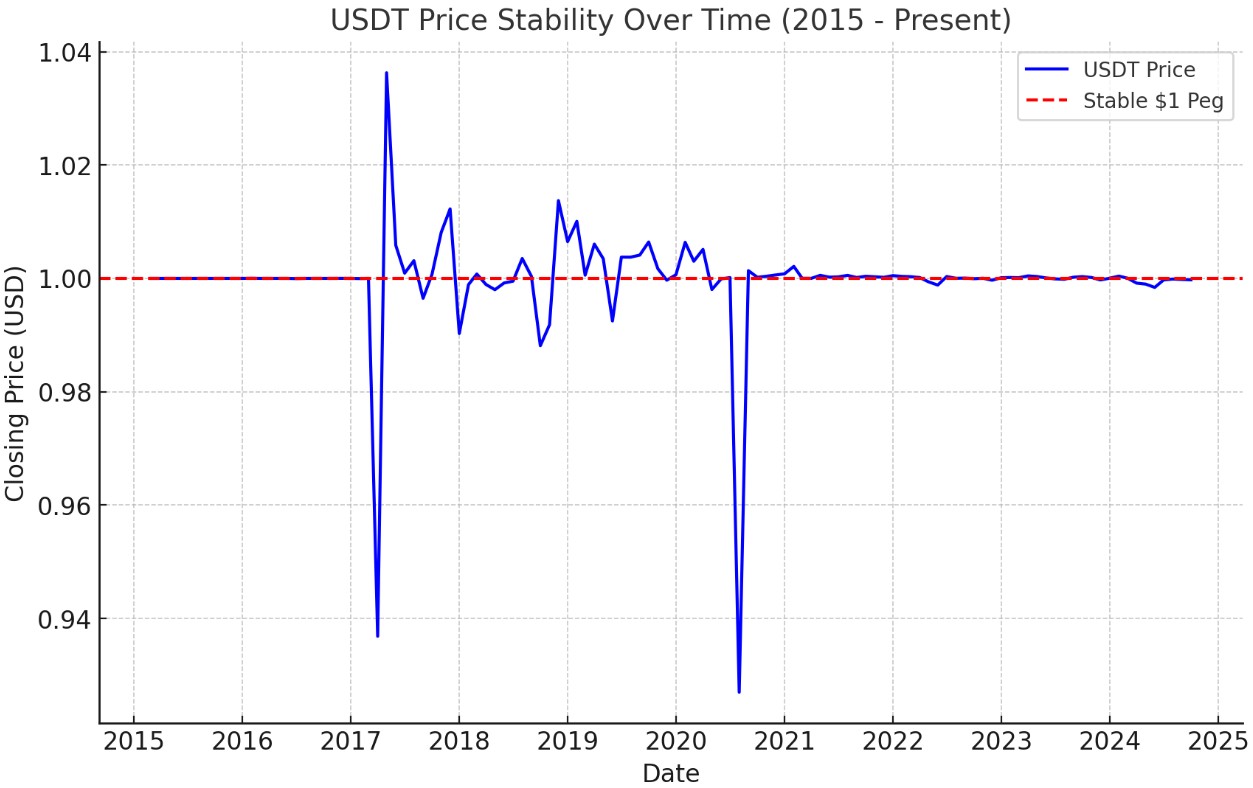
Here is a chart showing USDT's price stability over time. As you can see, the price has consistently hovered around the $1 mark, demonstrating the stability that USDT offers as a stablecoin. This reflects how effectively it maintains its peg to the US dollar.
Risks and warnings when buying USDT
While buying USDT is generally considered safe, there are some risks to keep in mind:
Platform risk. Make sure you use reputable platforms. Some unregulated exchanges or peer-to-peer (P2P) platforms could be prone to scams or fraud.
Centralization concerns. A major issue with USDT is that it's controlled by a central entity, Tether. If Tether faces legal trouble or fails to maintain enough reserves to back USDT, the coin’s value might drop. Even though USDT is linked to the US dollar, its value depends on Tether’s ability to maintain those reserves. As a beginner, it’s smart to keep an eye on any news about audits or legal cases involving Tether so you don’t get caught off guard if the value starts to fluctuate.
Regulatory pressure. Governments worldwide are paying close attention to stablecoins like USDT, and stricter regulations could be imposed. If your country tightens regulations or bans certain crypto assets, it may become hard to access or convert your USDT back to traditional money. For someone just starting in crypto, it’s important to stay updated on your country’s legal stance and think about spreading your investments to avoid relying too heavily on one coin.
Hidden fees. Always check for hidden fees, especially when withdrawing USDT from an exchange. Some platforms have high withdrawal fees, which can eat into your funds.
How to store USDT safely
Once you’ve bought USDT, storing it securely is just as important as the purchase itself. You have two main options:
Exchange wallets. Convenient, but not the safest. If you’re actively trading USDT, you may prefer to leave it on an exchange. However, exchanges can be hacked, so be cautious.
Private wallets. For long-term holding, use a private wallet. Options include:
- Hardware wallets. Devices like Ledger or Trezor provide cold storage, keeping your USDT offline and safe from hacking.
- Mobile wallets. Apps like Trust Wallet or Atomic Wallet offer easier access for daily transactions while still maintaining decent security.
It’s a good idea to choose platforms that are easy to use

When you're just starting out, it’s a good idea to choose platforms that are easy to use and open about their fees. Some services might seem simple at first, but they could hide costs that reduce your overall gains. To avoid these traps, go for platforms that show you exactly what you're paying for and how the exchange rate compares to the market. It’s also helpful to pick platforms that offer learning tools, so you can get more comfortable managing USDT from the beginning.
One more thing to watch out for is liquidity. As a beginner, you don’t want to see the price move too much while you're trying to buy. High liquidity means you can get your USDT at a stable rate without sudden price jumps. Make sure the platform accepts different ways to pay too, like credit cards, bank transfers, or even other cryptocurrencies, to give you more options.
Conclusion
Purchasing USDT has never been more accessible, thanks to a range of reputable platforms such as Binance and Coinbase that prioritize both security and user experience. The key takeaway is the importance of choosing an exchange that offers robust safety measures and transparent fees to ensure your investment remains protected. By following a step-by-step guide and opting for trustworthy platforms, you can confidently add USDT to your portfolio with minimal risk. In the ever-evolving crypto landscape, selecting the right exchange is not just a convenience—it's a crucial investment in your financial security.
FAQs
What security measures should be considered when selecting a platform to buy USDT?
Are there restrictions or regulations that could affect access to USDT in certain countries?
What is the difference between storing USDT on an exchange versus a private wallet?
How does platform liquidity impact the buying experience for USDT?
Editors' Top Picks and Insights

BitMEX is shutting down: Why Trump could not save the exchange

Do governments need crypto workers?

Brent nears $100: Why oil prices are rising

Gram Wallet launch: Can Telegram bring crypto to the masses?

AI without limits: How dangerous are neural networks?

Worldcoin on Wall Street: From iris scans to ETF
Related Articles
Team that worked on the article
Parshwa is a content expert and finance professional possessing deep knowledge of stock and options trading, technical and fundamental analysis, and equity research. As a Chartered Accountant Finalist, Parshwa also has expertise in Forex, crypto trading, and personal taxation.
Chinmay Soni is a financial analyst with more than 5 years of experience in working with stocks, Forex, derivatives, and other assets. As a founder of a boutique research firm and an active researcher, he covers various industries and fields, providing insights backed by statistical data.
Mirjan Hipolito is a journalist and news editor at Traders Union. She is an expert crypto writer with five years of experience in the financial markets.
Ethereum is a decentralized blockchain platform and cryptocurrency that was proposed by Vitalik Buterin in late 2013 and development began in early 2014. It was designed as a versatile platform for creating decentralized applications (DApps) and smart contracts.
Crypto trading involves the buying and selling of cryptocurrencies, such as Bitcoin, Ethereum, or other digital assets, with the aim of making a profit from price fluctuations.
CFD is a contract between an investor/trader and seller that demonstrates that the trader will need to pay the price difference between the current value of the asset and its value at the time of contract to the seller.
Yield refers to the earnings or income derived from an investment. It mirrors the returns generated by owning assets such as stocks, bonds, or other financial instruments.
Volatility refers to the degree of variation or fluctuation in the price or value of a financial asset, such as stocks, bonds, or cryptocurrencies, over a period of time. Higher volatility indicates that an asset's price is experiencing more significant and rapid price swings, while lower volatility suggests relatively stable and gradual price movements.

-
 Afghanistan
-
 Albania
-
 Algeria
-
 Angola
-
 Argentina
-
 Armenia
-
 Australia
-
 Austria
-
 Azerbaijan
-
 Bahamas
-
 Bahrain
-
 Bangladesh
-
 Belarus
-
 Belgium
-
 Bolivia
-
 Botswana
-
 Brazil
-
 Brunei
-
 Bulgaria
-
 Cambodia
-
 Cameroon
-
 Canada
-
 Chile
Chile
-
 China
China
-
 Colombia
-
 Congo
Congo
-
 Costa Rica
-
 Cote d'Ivoire
-
 Croatia
-
 Cuba
Cuba
-
 Cyprus
-
 Czechia
-
 DR Congo
-
 Denmark
-
 Dominican Republic
-
 Ecuador
-
 Egypt
Egypt
-
 El Salvador
-
 Estonia
-
 Eswatini
-
 Ethiopia
-
 Finland
-
 France
-
 Georgia
-
 Germany
-
 Ghana
Ghana
-
 Greece
-
 Haiti
Haiti
-
 Hong Kong
-
 Hungary
-
 India
India
-
 Indonesia
-
 Iran, Islamic republic
-
 Iraq
Iraq
-
 Ireland
-
 Israel
-
 Italy
Italy
-
 Jamaica
-
 Japan
Japan
-
 Jordan
-
 Kazakhstan
-
 Kenya
Kenya
-
 Korea
Korea
-
 Kuwait
-
 Kyrgyzstan
-
 Laos
Laos
-
 Latvia
-
 Lebanon
-
 Lesotho
-
 Libya
Libya
-
 Lithuania
-
 Luxembourg
-
 Madagascar
-
 Malaysia
-
 Malta
Malta
-
 Mauritius
-
 Mexico
-
 Moldova
-
 Mongolia
-
 Montenegro
-
 Morocco
-
 Mozambique
-
 Myanmar
-
 Namibia
-
 Nepal
Nepal
-
 Netherlands
-
 New Zealand
-
 Nigeria
-
 North Macedonia
-
 Norway
-
 Oman
Oman
-
 Pakistan
-
 Palestine
-
 Panama
-
 Papua New Guinea
-
 Paraguay
-
 Peru
Peru
-
 Philippines
-
 Poland
-
 Portugal
-
 Puerto Rico
-
 Qatar
Qatar
-
 Reunion
-
 Romania
-
 Rwanda
-
 Saudi Arabia
-
 Serbia
-
 Singapore
-
 Slovakia
-
 Slovenia
-
 Somalia
-
 South Africa
-
 Spain
Spain
-
 Sri Lanka
-
 Sweden
-
 Switzerland
-
 Syria
Syria
-
 Taiwan
-
 Tajikistan
-
 Tanzania
-
 Thailand
-
 Trinidad and Tobago
-
 Tunisia
-
 Turkey
-
 UAE
UAE
-
 Uganda
-
 Ukraine
-
 United Kingdom
-
United States
-
 Uruguay
-
 Uzbekistan
-
 Venezuela
-
 Vietnam
-
 Yemen
Yemen
-
 Zambia
-
 Zimbabwe
- Forex
- Crypto












