
Is Apple Undervalued Or Overvalued After Market Crash?


Editorial Note: While we adhere to strict Editorial Integrity, this post may contain references to products from our partners. Here's an explanation for How We Make Money. None of the data and information on this webpage constitutes investment advice according to our Disclaimer.
Apple’s stock is priced for perfection, with steady profits, brand loyalty, and strong cash flow baked in. But with iPhone growth slowing and new products like Vision Pro still unproven, the valuation may be stretched. If Apple misses even slightly on earnings or innovation, the market reaction could be sharper than expected.
Apple’s current price makes sense only if the company can continue to justify the premium the market gives it. Most major products are already mature, and new categories like Vision Pro and expanded digital services have not shown full scale potential yet. Apple looks more like a stable cash machine than a fast growth company, yet the stock still trades as if growth will stay strong. With higher expectations comes higher risk, because even small misses can change investor sentiment quickly. These dynamics shape how investors judge how much Apple is worth today.
Understanding Apple
Apple has long been viewed as a dependable tech company because of its strong brand, loyal users and deep hardware ecosystem. But recent shifts in hardware demand and more competition in services have made some investors question whether the stock still deserves a premium.
Apple continues to deliver strong profits and large buybacks, but sales in major product lines have flattened and new launches feel more like updates than major leaps. These trends have started a wider discussion about whether the market is valuing Apple for what it is today or for what it used to be. In this article we look at its financial strength, market behavior and analyst sentiment to understand Apple as a business and its valuation in the current environment.
Apple's current market position
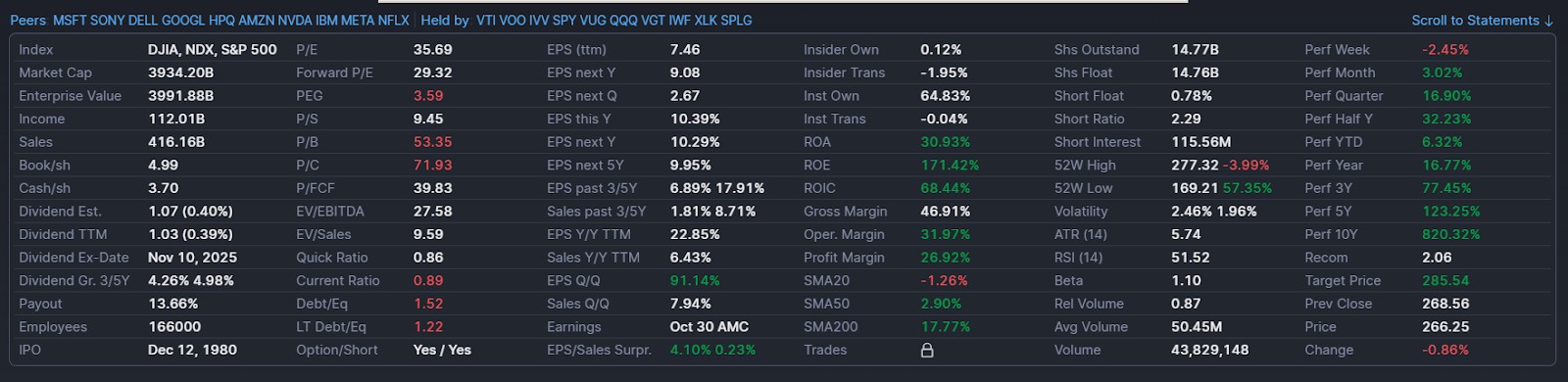
Apple remains one of the most valuable companies in the world, supported by a large hardware base and a strong services ecosystem. Its integrated approach keeps users inside the platform and drives steady profits. But to understand whether the stock deserves its current price, it helps to look at how the business is structured and how the market is valuing it based on updated numbers that shape Apple’s valuation today.
Overview of Apple Inc. and its subsidiaries
Apple is best known for the iPhone, yet the company also runs a wide mix of hardware, software and services that are tightly linked inside one ecosystem.
Key business areas:
iPhone and hardware. The iPhone remains Apple’s top revenue source, followed by iPads, Macs, and wearables like the Apple Watch and AirPods.
Services segment. This includes iCloud, Apple Music, App Store, Apple Pay, and Apple TV+. Services now make up more than 20% of total re venue and generate higher margins than hardware.
Software ecosystem. iOS, macOS, and watchOS keep users locked into the Apple environment, boosting product stickiness and repeat purchases.
Subsidiaries and ventures. While Apple has fewer subsidiaries than other tech giants, it invests heavily in supply chain control, chip development (Apple Silicon), and health tech.
Apple earns more from each user because hardware and services work together. This closed system keeps customer churn low and strengthens long-term revenue. Expansion into new areas like payments, health and mixed reality gives Apple more options for future growth, even if those areas are still small.
Recent stock performance and market capitalization
Apple’s stock has been relatively steady over the past year, with modest gains compared to some of its tech peers. Investors have rewarded its consistent profitability and capital return programs, even though top-line growth has started to slow.
Apple trades near $270 with a market cap of about $3.9 trillion. The P/E is close to 36, and the forward P/E sits near 29, which is higher than its long term average. The stock is up around 17 % over the past year and has moved within a wide range between 169 and 277 dollars.
Investor confidence is supported by steady buybacks and dividends, along with the growth of the services segment which lifts margins. New categories like Vision Pro are gaining attention, even though adoption is still developing.
Apple is viewed as a stable, cash rich business suited for long term portfolios. Growth expectations remain moderate, and the current price may reflect more trust in stability than in major upside.
Valuation of Apple
Apple’s stock has delivered solid returns over the past decade, but with slowing growth in its core hardware segments and rising valuation multiples, investors are starting to question whether the current price truly reflects its future potential. To evaluate this, we will look at Apple’s financial performance, estimated intrinsic value, and short-term price action.
Fundamental analysis of Apple
When evaluating whether Apple is overvalued, a closer look at its valuation multiples and financial strength offers helpful perspective. These numbers reflect not just how the market sees Apple today, but also how much growth and stability investors are pricing in for the future.
Price to earnings (P/E) ratio
Apple’s P/E ratio is one of the most widely followed numbers in the market, as it helps investors quickly assess whether the stock is priced for its earnings power.
Apple’s P/E remains a key metric for judging whether the stock is priced fairly for its earnings strength. Based on current data, Apple trades at a P/E of about 35.7 and a forward P/E near 29.3, both above its long term averages. These levels show that investors continue to give Apple a premium for stability and brand power. The valuation leaves little space for weak results, because even a small earnings miss could pressure the stock.
Investors are giving Apple a clear premium for steady profits and strong brand loyalty, but that premium also limits the room for weak results. With the P/E already elevated, even a small slowdown in earnings can bring the stock under pressure, which is why the ratio has become a key signal for judging AAPL’s valuation.
Apple’s current P/E reflects confidence in stability more than expectations of fast growth. The valuation is not cheap, and it assumes that Apple will keep delivering predictable results without major setbacks. Investors should consider whether earnings can stay strong enough to support the price or if slower trends could weigh on AAPL’s valuation.
Price to earnings growth (PEG) ratio
The PEG ratio adds another layer by adjusting the P/E for expected earnings growth. It’s useful for judging whether a stock’s price is fair relative to how fast profits are rising.
Apple’s PEG ratio helps show whether the price matches the company’s expected earnings growth. Based on the latest data, Apple sits at a PEG of about 3.59, which is well above the range that usually signals a fair valuation. A PEG this high suggests the market is paying a premium that assumes steady results and limited risk, rather than fast profit growth. It also shows that investors value reliability more than acceleration, which shapes how they view Apple’s fundamentals.
This PEG level shows that Apple is valued more for reliability than for fast expansion. It reflects investor trust in the company’s stability but also highlights that the stock may not offer strong upside unless earnings improve.
Apple’s PEG ratio suggests the stock is not cheap, and investors are paying for reliability, not acceleration.
Operating margins and free cash flow
Apple’s financial strength goes beyond earnings. Its ability to turn revenue into profit and cash flow is a key reason it attracts long-term investors.
Apple’s margins remain some of the strongest in the market, with an operating margin near 32% and a profit margin close to 27%. The company continues to produce large amounts of free cash flow, supported by steady demand and tight cost control. This financial strength allows Apple to maintain buybacks, pay dividends, and invest in new categories without pressure. The challenge for investors is that this stability is already reflected in the price, which limits how much benefit Apple can gain from predictable results alone.
Apple’s strong margins and large free cash flow make it one of the most stable companies in the market, and this helps support buybacks, dividends and steady investment. However, because this financial strength is widely expected, the current price already reflects most of that stability. Without a clear new growth driver, the potential upside may be slower than many investors want.
Apple intrinsic valuation
DCF models that apply steady revenue growth and stable margins often place Apple’s fair value in the $190 to $215 range. With the stock trading near $266, Apple sits roughly 25-35 % above many calculated estimates of fair value. This premium is supported by strong cash flow, a large services base and ongoing buybacks, but it pushes the price beyond what long term cash flow alone would justify.
Valuation ratios also reflect this premium, with a trailing P/E near 35.7, a forward P/E close to 29.3, and a PEG ratio of about 3.59. These levels show that the stock is priced for stability and consistency rather than strong acceleration, which is important for anyone reviewing the intrinsic value of Apple.
Apple technical analysis
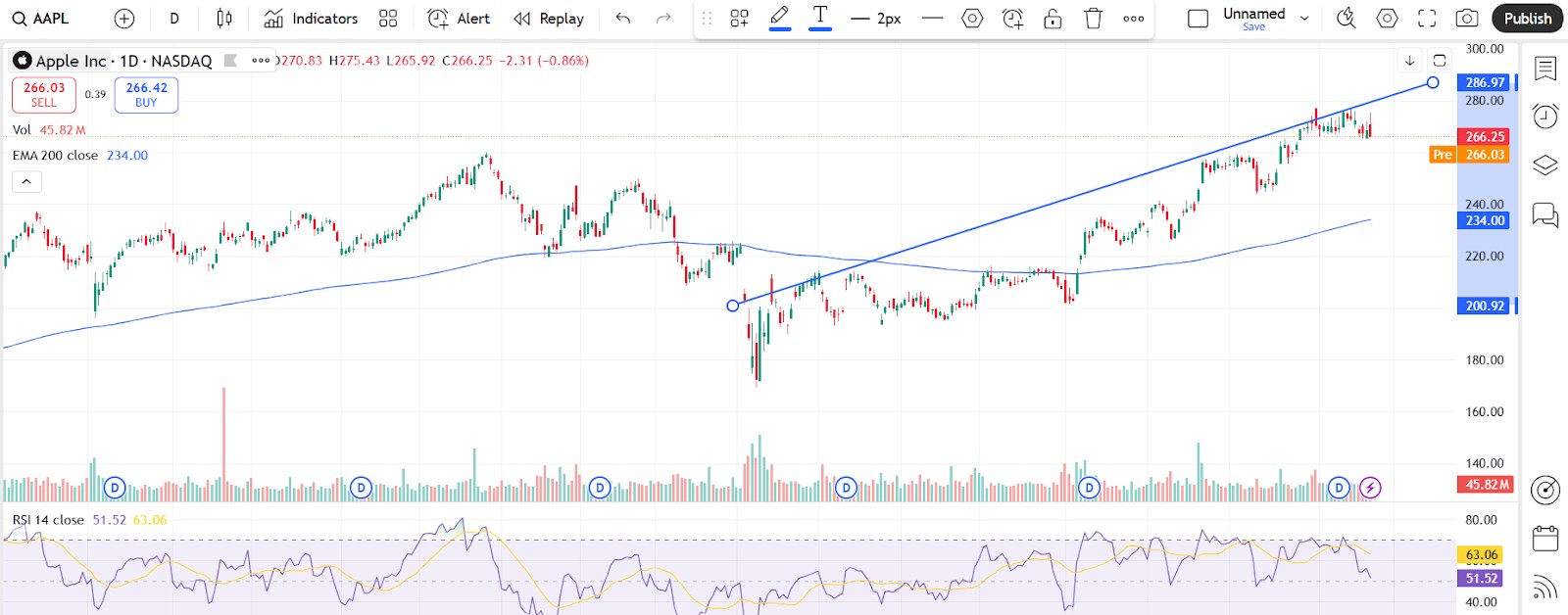
The stock continues to move within a steady uptrend, with price near $270 and trading comfortably above the 200-day EMA at $234. The rising trendline now acts as resistance near $286 to $287, while support sits around $201. RSI readings between 51 and 63 show neutral momentum with no signs of extreme moves. Volume near 46 million suggests balanced trading without unusual pressure.
The chart shows higher lows since the last major drop, and buyers have stepped in each time price approached the EMA. If the stock pulls back, the EMA near $234 is likely to be tested first, while a break above the trendline could open room for further strength. These conditions help traders frame entries when looking at AAPL’s valuation from a technical angle.
Analyst perspectives and market sentiment
Apple has long been a favorite among analysts and institutional investors. But with slower hardware growth, a maturing services business, and rising valuation multiples, views are starting to split. Some analysts still see Apple as a steady compounder, while others believe it is priced too high for a company growing this slowly.
Bullish viewpoints
Many analysts remain confident in Apple’s long-term story, pointing to its steady earnings, powerful brand, and reliable shareholder returns.
Why the bulls are still backing Apple:
Strong cash generation. Analysts at Morgan Stanley and Evercore note Apple’s free cash flow remains unmatched, giving it the power to buy back shares, invest, and pay dividends without pressure.
Brand and loyalty. The Apple ecosystem continues to pull users into iPhones, Watches, and services,creating high retention and repeat revenue.
Service segment stability. Apple’s services now generate more predictable, recurring income and are growing faster than hardware sales.
AI and new products. While not a leader in AI yet, Apple is expected to bring its own twist with privacy-first features and integration into future hardware cycles.
For bullish analysts, the appeal is stability and long lasting demand rather than fast growth, which supports their view of AAPL’s valuation in the long run.
Bearish viewpoints
Other analysts are growing cautious, not because Apple is weak, but because the stock price may be ahead of the company’s real growth potential.
Concerns raised by the bears:
Slowing iPhone growth. The smartphone market is saturated, and annual upgrades have become less exciting, limiting upside in Apple’s core business.
Valuation looks rich. With a forward P/E near 29.3x, some argue the stock is priced like a high-growth tech firm, even though revenue growth is now in the mid-single digits.
Innovation risk. Without a breakthrough product, some believe Apple risks falling behind in emerging tech like AI and AR, where competitors are more aggressive.
Geopolitical exposure. Supply chain reliance on China and regulatory pressure in Europe could create earnings headwinds in the coming years.
Apple is a solid business, but the stock may be too expensive for how slowly it is growing. If the company does not surprise with innovation, the upside may be limited.
Consensus and price targets
Despite some caution, most analysts are still positive on Apple, though the tone is less enthusiastic than it was during the earlier years of growth.
Analysts’ 12-month price targets for Apple cluster near the high two-hundreds, with averages reported between $275 and $289 and a consensus roughly around $280. Most analysts have given it buy and hold ratings rather than sells. The range of targets runs from the low $200s up to the mid $300s, so upside estimates vary by firm, but the market consensus implies only modest gains from here.
If this analysis helps you decide how you want to approach the stock, you can use the list of best stock brokers for investing in stocks to move forward. It provides a clear set of options so you can choose a platform that fits your trading style and begin investing with confidence.
| eToro USA | SpeedTrader | Plus500 | TradeZero International | eOption | |
|---|---|---|---|---|---|
|
Account min. |
50 | 2,500 | 500 | 500 | No |
|
Research and data |
Yes | Yes | Yes | Yes | Yes |
|
Basic stock/ETF fee |
No | $0.0025/$0,0009 | $0.006 | $0,005 | $0 |
|
Deposit Fee |
No | $0 | No | $0 | Not specified |
|
Withdrawal fee |
No | $30/$75 | No | ACH - $0-5, Wire - $15-50 | Not specified |
|
Regulation |
SEC, FINRA | FINRA, SIPC | CySEC, FCA, ASIC, FMA, FSCA, FSA Seychelles, EFSA, MAS, DFSA, SCB | Securities Commission of the Bahamas (Int); SEC, FINRA member, SIPC member (USA); Member firm of CIRO; member of CIPF (Canada); AFM, MiFID II (Europe) | FINRA, SIPC |
|
TU overall score |
9.3 | 9.2 | 7.7 | 7.51 | 7.5 |
|
Open an account |
Go to broker Your capital is at risk. |
Go to broker |
Go to broker 81% of retail CFD accounts lose money. |
Go to broker Your capital is at risk. |
Study review |
Apple’s biggest valuation risk is not innovation, it is predictability

When I study Apple, I focus on the difference between what the company can realistically deliver and what the stock expects. Apple is steady, but the price treats that steadiness as guaranteed. Even a small slowdown in demand or a delay in product cycles can hit the stock harder than the news deserves.
I also pay close attention to what users do, not what they say. Longer upgrade cycles or a shift toward cheaper models can show that the brand is being viewed differently. These signals appear early and help explain where the business is heading. Apple remains one of the strongest companies in the market, but the stock depends heavily on buyers staying loyal at the same pace every year. That is the part investors need to watch most closely.
Conclusion
Apple remains a powerhouse with unmatched brand loyalty and robust cash generation, but its stock price is elevated above what its current growth rate justifies. The valuation premium reflects investor faith in Apple’s stability rather than excitement for major innovation. With the core hardware business slowing and new categories yet to prove themselves, even small missteps could trigger outsized market reactions, as seen when previous incremental updates failed to excite. Investors should remember that consistency can be a double-edged sword; when predictability is fully priced in, upside is limited unless Apple surprises with breakthrough products or growth.
FAQs
How do Apple's current hardware sales trends influence its valuation outlook?
What role does innovation play in supporting Apple’s current valuation premium?
How does Apple’s integrated ecosystem affect long-term investor confidence?
Why do analysts’ price targets for Apple predict only modest upside despite strong fundamentals?
Editors' Top Picks and Insights






Related Articles
Team that worked on the article
Ashutosh Sureka is a finance professional specializing in financial research, credit assessment, and equity analysis.
Dan Blystone began his trading career in 1998 as an arbitrage clerk on the floor of the Chicago Mercantile Exchange (CME). He later traded bond and Eurex futures at proprietary firms such as Altea Trading, gaining valuable experience in high-frequency trading and risk management.
Chinmay Soni is a financial analyst with more than 5 years of experience in working with stocks, Forex, derivatives, and other assets. As a founder of a boutique research firm and an active researcher, he covers various industries and fields, providing insights backed by statistical data.
Bitcoin is a decentralized digital cryptocurrency that was created in 2009 by an anonymous individual or group using the pseudonym Satoshi Nakamoto. It operates on a technology called blockchain, which is a distributed ledger that records all transactions across a network of computers.
Risk management is a risk management model that involves controlling potential losses while maximizing profits. The main risk management tools are stop loss, take profit, calculation of position volume taking into account leverage and pip value.
Fundamental analysis is a method or tool that investors use that seeks to determine the intrinsic value of a security by examining economic and financial factors. It considers macroeconomic factors such as the state of the economy and industry conditions.
Day trading involves buying and selling financial assets within the same trading day, with the goal of profiting from short-term price fluctuations, and positions are typically not held overnight.
An investor is an individual, who invests money in an asset with the expectation that its value would appreciate in the future. The asset can be anything, including a bond, debenture, mutual fund, equity, gold, silver, exchange-traded funds (ETFs), and real-estate property.

-
 Afghanistan
-
 Albania
-
 Algeria
-
 Angola
-
 Argentina
-
 Armenia
-
 Australia
-
 Austria
-
 Azerbaijan
-
 Bahamas
-
 Bahrain
-
 Bangladesh
-
 Belarus
-
 Belgium
-
 Bolivia
-
 Botswana
-
 Brazil
-
 Brunei
-
 Bulgaria
-
 Cambodia
-
 Cameroon
-
 Canada
-
 Chile
Chile
-
 China
China
-
 Colombia
-
 Congo
Congo
-
 Costa Rica
-
 Cote d'Ivoire
-
 Croatia
-
 Cuba
Cuba
-
 Cyprus
-
 Czechia
-
 DR Congo
-
 Denmark
-
 Dominican Republic
-
 Ecuador
-
 Egypt
Egypt
-
 El Salvador
-
 Estonia
-
 Eswatini
-
 Ethiopia
-
 Finland
-
 France
-
 Georgia
-
 Germany
-
 Ghana
Ghana
-
 Greece
-
 Haiti
Haiti
-
 Hong Kong
-
 Hungary
-
 India
India
-
 Indonesia
-
 Iran, Islamic republic
-
 Iraq
Iraq
-
 Ireland
-
 Israel
-
 Italy
Italy
-
 Jamaica
-
 Japan
Japan
-
 Jordan
-
 Kazakhstan
-
 Kenya
Kenya
-
 Korea
Korea
-
 Kuwait
-
 Kyrgyzstan
-
 Laos
Laos
-
 Latvia
-
 Lebanon
-
 Lesotho
-
 Libya
Libya
-
 Lithuania
-
 Luxembourg
-
 Madagascar
-
 Malaysia
-
 Malta
Malta
-
 Mauritius
-
 Mexico
-
 Moldova
-
 Mongolia
-
 Montenegro
-
 Morocco
-
 Mozambique
-
 Myanmar
-
 Namibia
-
 Nepal
Nepal
-
 Netherlands
-
 New Zealand
-
 Nigeria
-
 North Macedonia
-
 Norway
-
 Oman
Oman
-
 Pakistan
-
 Palestine
-
 Panama
-
 Papua New Guinea
-
 Paraguay
-
 Peru
Peru
-
 Philippines
-
 Poland
-
 Portugal
-
 Puerto Rico
-
 Qatar
Qatar
-
 Reunion
-
 Romania
-
 Rwanda
-
 Saudi Arabia
-
 Serbia
-
 Singapore
-
 Slovakia
-
 Slovenia
-
 Somalia
-
 South Africa
-
 Spain
Spain
-
 Sri Lanka
-
 Sweden
-
 Switzerland
-
 Syria
Syria
-
 Taiwan
-
 Tajikistan
-
 Tanzania
-
 Thailand
-
 Trinidad and Tobago
-
 Tunisia
-
 Turkey
-
 UAE
UAE
-
 Uganda
-
 Ukraine
-
 United Kingdom
-
United States
-
 Uruguay
-
 Uzbekistan
-
 Venezuela
-
 Vietnam
-
 Yemen
Yemen
-
 Zambia
-
 Zimbabwe
- Forex
- Crypto












