
JCI Is Set To Break 10,000



Editorial Note: While we adhere to strict Editorial Integrity, this post may contain references to products from our partners. Here's an explanation for How We Make Money. None of the data and information on this webpage constitutes investment advice according to our Disclaimer.
The Jakarta Composite Index (JCI) could break the 10,000 level in 2026 due to three main catalysts: a strong rebound in domestic consumption, expansionary fiscal policy, and large-scale investments by Indonesia’s sovereign wealth fund Danantara.
Indonesia may be heading into a rare sweet spot in 2026, a cyclical upturn driven by improving domestic demand, stronger policy support, and a renewed growth narrative. High-frequency indicators already hint at momentum, manufacturing activity has stayed in expansion, consumer confidence has turned positive again, and retail/auto demand is rebounding. If this recovery broadens, it will not just lift GDP, but also can translate into better earnings visibility across banks, consumer, retailers, and other domestically oriented sectors that make up a large share of the Jakarta Composite Index (JCI).
At the same time, the market’s upside potential is no longer just about global flow. Expansionary fiscal programs are injecting purchasing power and accelerating spending, while Danantara’s investment push and the continued influence of large conglomerate-linked stocks can add an extra layer of momentum to the index.
Domestic consumption rebound sparks growth
Indonesian consumers, especially in the mid-to-low segment, have weathered a tough two years, challenged by weak government spending, white-collar job losses, and online gambling issues. However, the tide is turning favorably as Indonesian consumers are confidently spending again. Key indicators show a decisive turnaround, namely, solid money supply growth with surging M2 growth, the manufacturing PMI has stayed in the expansion mode for months, and auto and retail sales are rebounding. Higher government spending and stimulus disbursement, coupled with tighter controls on online gambling, were the main drivers for the rebound in consumer spending

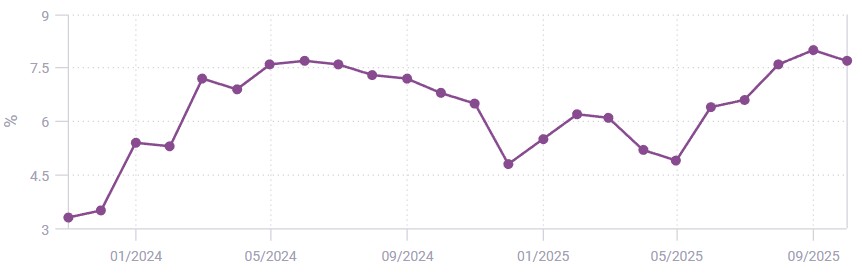
From a state budget perspective, fiscal expenditure was only up by +1% YoY for 10M25, however, social assistance and salary expenses are tracking well, up +11% and +9% YoY, respectively. Free Nutritious Meal program implementation has been rapidly accelerating too, absorbing over IDR42tr budget (equivalent to around USD2.5bn) up to 18 Nov 2025, making up 59% of the FY program budget. Additionally, the announcement of the recent USD1.8bn cash handout stimulus program in 4Q25 could provide a further material boost to mass market consumption as it would potentially double the disposable income of over 140mn individual beneficiaries.
The decline in online gambling activity is already seen with the annualized online gambling turnover falling by almost 50% in October 2025. Another leading indicator, the money deposited into platforms, declined by -35% YoY during the same period. A higher decline in turnover vs deposited money might imply that the win rate has been worsening.
Expansionary fiscal policy fuels momentum
Indonesia’s government has shifted decisively into pro-growth mode since Purbaya Yudhi Sadewa became the Indonesia’s Minister of Finance on 8 October 2025, replacing Sri Mulyani who held the post for nearly a decade. Under the new administration, the Finance Ministry is no longer fixated solely on budget discipline. Instead, they are ramping up spending and subsidies to drive a post-pandemic economic acceleration. He introduced the 5 “quick win” programs, namely 1) increase primary money supply by placing IDR276tr excess state budget balance that was previously placed in the Bank Indonesia to state owned banks (BBRI, BMRI, BBNI, BBTN), 2) collecting IDR60tr, equivalent to USD3.5bn, from about 200 tax arrears, 3) improvement in the Core Tax system, 4) tightening of illegal cigarettes, and 5) acceleration of government spending.
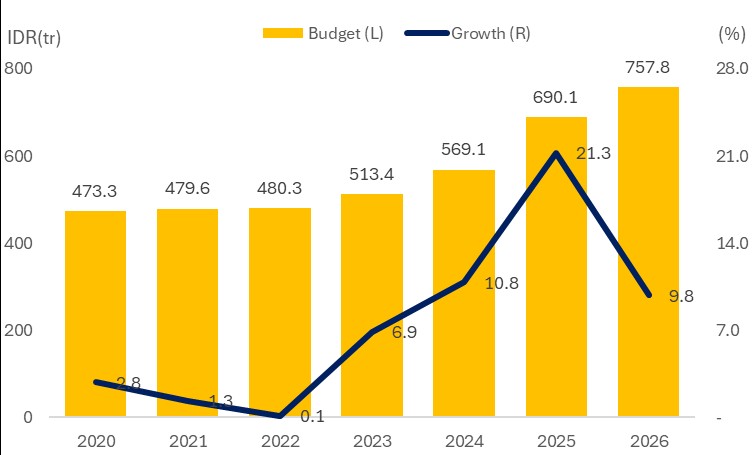
Human capital development remained the main focus of the Prabowo administration, with the Education Budget and Healthcare Budget seeing a significant 10% and 16% YoY increase, respectively, from an already high base 2025. The increase in the Education Budget was primarily driven by the IDR335tr (equivalent to USD20bn) Free Nutritious Meal program, targeting more than 82mn recipients. Budget for the program rose significantly from IDR71tr (about USD4.5bn) in 2025 along with implementation ramp-up throughout this year.
Acceleration in fiscal disbursement, rising state subsidies should lift household consumption further, benefiting consumer goods makers and retailers. Likewise, banks could see an uptick in credit demand as government support programs for SMEs and housing spur borrowing. Overall, Indonesia’s expansionary fiscal stance will provide a powerful tailwind. It not only props up short-term growth but also instills confidence in investors that the new government will do “whatever it takes” to keep the economy humming, adding more fuel to the JCI’s rally.
| Program | Budget (IDR trln) | % of FY26 Budget |
|---|---|---|
| Energy subsidies and compensation | 381 | 12% |
| Free Nutritious Meals program | 335 | 11% |
| Non-Energy subsidies | 109 | 3% |
| College Scholarships | 89 | 3% |
| Village / Urban Cooperative | 83 | 3% |
Danantara’s conglomerates power the index higher
One of the most unique catalysts for the JCI’s surge is the rise of Danantara, Indonesia’s newly empowered sovereign wealth fund, and the stock market darlings associated with it. Danantara Indonesia has been tasked with deploying massive capital into the economy, independently of the regular budget, to drive growth and investment.
In late 2025, Danantara announced plans to invest roughly USD10bn (around IDR165tr) in the near term, with about 80% earmarked for domestic projects. This includes funding for industrial down-streaming, energy infrastructure, food security, and more, exactly the kinds of big-ticket initiatives that can spur corporate earnings and market optimism. Importantly for investors, Danantara’s moves are seen as a game-changer as they could trigger a re-rating of Indonesian equities by improving profitability of the state-owned enterprises and catalyzing new industries.
For investors looking to position for a potential JCI breakout, choosing a reliable brokerage platform is a critical practical step. Access to Indonesian equities, competitive fees, robust research tools, and strong regulatory oversight can significantly influence execution quality and long-term portfolio performance.
Below is a comparison of brokers that provide convenient access to Indonesian and regional equity markets, suitable for investors seeking exposure to blue-chip stocks and long-term growth opportunities.
| eToro USA | Plus500 | eOption | Revolut | Interactive Brokers | |
|---|---|---|---|---|---|
|
Account min. |
50 | EUR500 | No | No | No |
|
Demo |
Yes | Yes | Yes | No | Yes |
|
Min. stock/ETF fee |
No | Not specified | $0 | £1.00/€1.00 | $1,00 |
|
Basic stock/ETF fee |
No | $0.006 | $0 | 0.12%-0.25% | 0-0,0035% |
|
Deposit Fee |
No | No | Not specified | No | No |
|
Withdrawal fee |
No | No | Not specified | No charge up to a limit | No |
|
Research and data |
Yes | Yes | Yes | Yes | Yes |
|
TU overall score |
8.8 | 8.48 | 7.93 | 8.6 | 8.53 |
|
Open an account |
Go to broker Your capital is at risk. |
Go to broker 80% of retail CFD accounts lose money. |
Study review | Study review | Study review |
Build solid blue-chip stocks, especially in banking, consumer goods, and telecommunication

As a market observer, I am optimistic that the JCI can breach 10,000 in 2026, but I am doing so with eyes wide open. In my experience, a rally driven by strong domestic fundamentals and supportive policy is the real deal, and Indonesia has both right now. Consumers are shopping again, the government is spending freely, and Danantara’s big push promises to create new growth engines. These are powerful tailwinds, and they make me confident that we’re building toward a historic milestone for the index.
For portfolio positioning, I advise investors to build solid blue-chip stocks, especially in banking (BBCA, BBRI, BMRI and BBNI), consumer goods (ICBP, AMRT and JPFA), and telecommunication (TLKM, EXCL). These quality names are still trading at reasonable valuations and offer generous dividends, so I’m happy to hold them through any volatility.
Conclusion
Berdasarkan uraian dalam artikel, kunci utama bagi IHSG untuk menembus level 10.000 di tahun 2026 terletak pada sinergi antara pemulihan konsumsi domestik, stimulus fiskal yang tepat sasaran, dan peranan strategis Danantara sebagai motor pertumbuhan baru. Pemulihan konsumsi akan menjadi pondasi kuat, didorong oleh belanja masyarakat yang pulih pasca-pandemi. Sementara itu, intervensi fiskal pemerintah seperti insentif pajak dan proyek infrastruktur turut mendorong optimisme investor. Danantara, dengan inovasi dan investasi di sektor digital dan energi, siap menjadi penggerak ekonomi ke depan. Apabila ketiga katalis ini berjalan harmonis, ambisi IHSG menembus 10.000 bukan lagi sekadar mimpi, melainkan target yang nyata tercapai.
FAQs
What is the significance of Danantara’s investments for the Jakarta Composite Index reaching 10,000?
How do government cash handouts and subsidies influence consumer-driven sectors in the JCI?
Which key economic indicators support the forecast for the JCI potentially breaking the 10,000 level?
Why is Indonesia’s expansionary fiscal policy viewed as a powerful catalyst for the JCI’s growth?
Editors' Top Picks and Insights

Pokémon cards for $2,500: How collectibles became a new form of gambling

The privacy paradox: How the crypto mixer market has changed

Is Bitcoin right for you? Five traits shared by many cryptocurrency holders

Chasing hits: Why investors are losing interest in Netflix

Tokenized stocks in the spotlight: How do they work and are they worth trading?

Do politicians make the best stock traders?
Related Articles
Team that worked on the article
Andreas Kristo Saragih is a seasoned equity research analyst with over a decade of experience across both buy-side and sell-side roles, focused on the Indonesian capital market. He has extensive sector coverage, including banking, consumer goods, retail, real estate, healthcare, transportation, poultry, cement, pharmaceuticals, construction, and infrastructure.
Dan Blystone began his trading career in 1998 as an arbitrage clerk on the floor of the Chicago Mercantile Exchange (CME). He later traded bond and Eurex futures at proprietary firms such as Altea Trading, gaining valuable experience in high-frequency trading and risk management.
Chinmay Soni is a financial analyst with more than 5 years of experience in working with stocks, Forex, derivatives, and other assets. As a founder of a boutique research firm and an active researcher, he covers various industries and fields, providing insights backed by statistical data.
Risk management is a risk management model that involves controlling potential losses while maximizing profits. The main risk management tools are stop loss, take profit, calculation of position volume taking into account leverage and pip value.
CFD is a contract between an investor/trader and seller that demonstrates that the trader will need to pay the price difference between the current value of the asset and its value at the time of contract to the seller.
Xetra is a German Stock Exchange trading system that the Frankfurt Stock Exchange operates. Deutsche Börse is the parent company of the Frankfurt Stock Exchange.
Index in trading is the measure of the performance of a group of stocks, which can include the assets and securities in it.
Volatility refers to the degree of variation or fluctuation in the price or value of a financial asset, such as stocks, bonds, or cryptocurrencies, over a period of time. Higher volatility indicates that an asset's price is experiencing more significant and rapid price swings, while lower volatility suggests relatively stable and gradual price movements.

-
 Afghanistan
-
 Albania
-
 Algeria
-
 Angola
-
 Argentina
-
 Armenia
-
 Australia
-
 Austria
-
 Azerbaijan
-
 Bahamas
-
 Bahrain
-
 Bangladesh
-
 Belarus
-
 Belgium
-
 Bolivia
-
 Botswana
-
 Brazil
-
 Brunei
-
 Bulgaria
-
 Cambodia
-
 Cameroon
-
 Canada
-
 Chile
Chile
-
 China
China
-
 Colombia
-
 Congo
Congo
-
 Costa Rica
-
 Cote d'Ivoire
-
 Croatia
-
 Cuba
Cuba
-
 Cyprus
-
 Czechia
-
 DR Congo
-
 Denmark
-
 Dominican Republic
-
 Ecuador
-
 Egypt
Egypt
-
 El Salvador
-
 Estonia
-
 Eswatini
-
 Ethiopia
-
 Finland
-
 France
-
 Georgia
-
 Germany
-
 Ghana
Ghana
-
 Greece
-
 Haiti
Haiti
-
 Hong Kong
-
 Hungary
-
 India
India
-
 Indonesia
-
 Iran, Islamic republic
-
 Iraq
Iraq
-
 Ireland
-
 Israel
-
 Italy
Italy
-
 Jamaica
-
 Japan
Japan
-
 Jordan
-
 Kazakhstan
-
 Kenya
Kenya
-
 Korea
Korea
-
 Kuwait
-
 Kyrgyzstan
-
 Laos
Laos
-
 Latvia
-
 Lebanon
-
 Lesotho
-
 Libya
Libya
-
 Lithuania
-
 Luxembourg
-
 Madagascar
-
 Malaysia
-
 Malta
Malta
-
 Mauritius
-
 Mexico
-
 Moldova
-
 Mongolia
-
 Montenegro
-
 Morocco
-
 Mozambique
-
 Myanmar
-
 Namibia
-
 Nepal
Nepal
-
 Netherlands
-
 New Zealand
-
 Nigeria
-
 North Macedonia
-
 Norway
-
 Oman
Oman
-
 Pakistan
-
 Palestine
-
 Panama
-
 Papua New Guinea
-
 Paraguay
-
 Peru
Peru
-
 Philippines
-
 Poland
-
 Portugal
-
 Puerto Rico
-
 Qatar
Qatar
-
 Reunion
-
 Romania
-
 Rwanda
-
 Saudi Arabia
-
 Serbia
-
 Singapore
-
 Slovakia
-
 Slovenia
-
 Somalia
-
 South Africa
-
 Spain
Spain
-
 Sri Lanka
-
 Sweden
-
 Switzerland
-
 Syria
Syria
-
 Taiwan
-
 Tajikistan
-
 Tanzania
-
 Thailand
-
 Trinidad and Tobago
-
 Tunisia
-
 Turkey
-
 UAE
UAE
-
 Uganda
-
 Ukraine
-
 United Kingdom
-
United States
-
 Uruguay
-
 Uzbekistan
-
 Venezuela
-
 Vietnam
-
 Yemen
Yemen
-
 Zambia
-
 Zimbabwe
- Forex
- Crypto











