
Full List of Stock Trading Scams 2026


Editorial Note: While we adhere to strict Editorial Integrity, this post may contain references to products from our partners. Here's an explanation for How We Make Money. None of the data and information on this webpage constitutes investment advice according to our Disclaimer.
Recent stock trading scam cases:
China Liberal Education (CLEU) (2025–2026) – Alleged pump-and-dump scheme using coordinated promotions to inflate share prices.
Ostin Technology Group (OST) (2025) – Alleged stock manipulation involving coordinated campaigns and sales at inflated prices.
Getty Images / Trillium Capital (2024) – SEC alleged a fake takeover proposal was used to boost the stock price.
Andrew Left / Citron Capital (2024) – SEC alleged misleading stock recommendations were used to profit from price movements.
Minerco (2024) – Alleged microcap stock promotion using exaggerated claims and marketing campaigns.
Alfi Inc. (2024) – SEC alleged misleading statements about the company’s business and financial performance.
Ronald Bauer Network (2024–2025) – Alleged multi-stock pump-and-dump scheme involving undisclosed promotions and coordinated trading.
Stock trading scams continue to evolve as fraudsters take advantage of growing interest in financial markets and online investing. From fake brokers and investment platforms to pump-and-dump schemes, impersonation scams, and fraudulent trading signals, investors face a wide range of risks when searching for trading opportunities online.
While technology has made stock trading more accessible than ever, it has also created new channels for scammers to target both beginner and experienced traders. Fraudulent operators often use professional-looking websites, misleading performance claims, fake testimonials, and high-pressure sales tactics to gain trust and persuade victims to deposit funds.
This guide provides a comprehensive overview of the most common stock trading scams in 2026, explains how these schemes typically operate, highlights warning signs to watch for, and outlines practical steps investors can take to protect themselves. Understanding these risks is an important part of making informed financial decisions and avoiding potentially costly mistakes.
Risk warning: All investments carry risk, including potential capital loss. Economic fluctuations and market changes affect returns, and 40-50% of investors underperform benchmarks. Diversification helps but does not eliminate risks. Invest wisely and consult professional financial advisors.
Stock trading scams 2026
The following cases highlight some of the most notable stock trading fraud investigations, enforcement actions, and market manipulation schemes reported by regulators. These examples illustrate how fraudulent actors have used tactics such as pump-and-dump campaigns, misleading stock promotions, false corporate disclosures, and coordinated trading activity to influence stock prices and target investors.
| Case | Year | Scam Type | How the Scheme Worked |
|---|---|---|---|
China Liberal Education Holdings (CLEU) | 2025–2026 | Pump-and-Dump | According to the DOJ, promoters allegedly used coordinated social media campaigns and trading activity to artificially inflate CLEU shares before selling into the price increase. Authorities later announced a victim compensation process tied to more than $200 million in seized assets. |
Ostin Technology Group (OST) | 2025 | Stock Manipulation / Pump-and-Dump | DOJ alleged that company insiders and associates manipulated stock supply and promoted OST shares through coordinated campaigns before selling at inflated prices. The alleged scheme generated more than $100 million. |
Getty Images / Trillium Capital | 2024 | Fake Buyout Offer Manipulation | SEC alleged that Trillium Capital announced a false acquisition proposal for Getty Images at nearly double the market price. The announcement boosted the stock price, after which shares were allegedly sold. |
Andrew Left / Citron Capital | 2024 | Misleading Stock Recommendations | SEC alleged that Left publicly promoted long or short positions through Citron Research and social media, then reversed positions after prices moved. Regulators described the strategy as a “bait-and-switch” scheme. |
Minerco | 2024 | Microcap Stock Promotion | SEC alleged that promoters used exaggerated claims and promotional campaigns surrounding a low-priced public company to attract retail investors and inflate trading activity. |
Alfi Inc. | 2024 | Public Company Misrepresentation | SEC alleged that the company’s former CEO made misleading public statements regarding revenue, contracts, and business operations to support investor interest and stock valuation. |
Ronald Bauer Stock Manipulation Network | 2024–2025 | Multi-Stock Pump-and-Dump | DOJ alleged that Bauer controlled shares through nominee entities, funded undisclosed promotions, coordinated trading activity, and sold stock during price increases across multiple companies. He later pleaded guilty and was sentenced in 2025. |
Scammers in Stock trading: who are they?
Stock scammers are individuals or entities that engage in fraudulent activities in the stock market. They often use deceptive tactics to manipulate stock prices or trick investors into making poor investment decisions. These scammers can include pump-and-dump schemes, insider trading, Ponzi schemes, fake or unregistered brokers, and other forms of fraud. It's important for traders to be aware of these scams and to conduct thorough research before investing to avoid falling victim to them.
Top signs you might be dealing with a Stock scam
Lack of a license. One of the most obvious signals is a lack of regulation. If the company is in no hurry to show you its licenses or boasts of being controlled by offshore public-law institutions (for example, the Financial Services Authority of St. Vincent and the Grenadines), it is a reason to consider cooperating with the holding company. Also, the broker can misappropriate other people's authorization documents, so don't be lazy and check the company's database of regulators.
Unrealistic promises. If the company promises "golden mountains" within a few months and guarantees a stable profit without any risk and effort - run away, because what you have in front of you is 99% likely to be swindlers.
Own platform. Often fraudulent brokers offer their clients to trade on their own platform, telling them about its uniqueness and unimaginable advantages. With the help of a self-written platform it is easier for fraudsters to manage your transactions and conduct the trading process in a favorable way.
Excessive aggressiveness. Rude, illiterate and aggressive managers who persistently call you on the phone with requests (more like demands) to refill your balance immediately are a clear sign of deception. Deceivers don't know what the word 'quality service' means.
Inaccurate information on the website. For example, a broker attributes 10 years of flawless work to itself, but checking the domain name shows that the site was created only a couple of months ago and there are practically no reviews on forums about the company. Swindlers also like to appeal to unknown names, pretending to be revered experts, hide contacts or slip fake phone numbers to clients, place fake photos of pseudo-employees found on stock sites, etc. on the website.
Most popular stock market fraud schemes
There are hundreds of types of stock market fraud with new ones emerging on a regular basis. Everything depends entirely on the resourcefulness of the fraudsters. Nonetheless, the old schemes continue to work and are being actively used by the criminals. Let’s review the most popular types of stock fraud schemes.
Pump and Dump is one of the most popular fraud schemes with securities. It involves artificial inflation of the quotations on stocks against the background of false news and rumors.
The fraud is structured as follows:
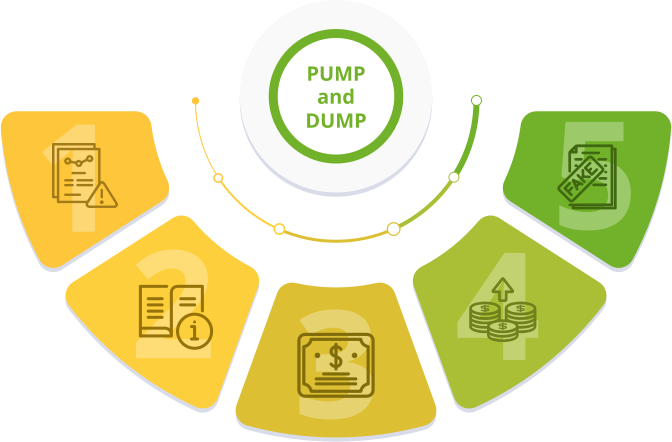
The fraudsters register a company and offer shares at the exchange. The quotations are low, as the company is unknown;
An active promo campaign is carried out, using false information, publication of positive news, and expert opinions. The quotations begin to rise;
Against the background of promo campaigns and initial growth of quotations, the investors start acquiring shares. The price increases further, attracting new players;
At that time, the organizers of the fraud sell shares at a strongly inflated price;
At some point, it becomes clear that the promo campaign was based on fake news and the number of buyers falls. The price of the stock plunges.
Profit from this type of fraud depends on the scale of the promo campaign and speculative moods in the markets. If the campaign is local, it is most likely that the fraudsters will snatch a comparatively small amount. If the information is distributed to the largest markets, the gains could reach dozens of millions of dollars.
Penny stock fraud
Penny stocks are shares with a stock price of less than $5 per share. Penny stock fraud, just like Pump and Dump, is designed to play on people’s emotions. The only difference is that there is no promo campaign. Instead, the fraudsters acquire a share package in a big lot. After the stocks are acquired, their price starts to increase. Traders and bots react, buying the securities based on the trend, thus pushing the price up even more. At a certain moment, the fraudsters ‘dump’ the shares and their price plunges, while the users, who believed in the success of the securities, suffer losses.
Pyramid scheme
Pyramid scheme is one of the most popular types of scams involving securities and shares in particular. It involves earning profit from referring new clients to the project and using their funds to finance the profits of those who already invested into the platform.
The scheme looks as follows:
A project is registered A project is registered, promising the clients high profits from investment into stocks and beneficial partnership program;
The first clients invest in the platform and start to promote it among their friends, colleagues and relatives. This forms the first level;
The clients referred by them invite new users, forming new levels. Part of the funds invested by them is used to pay the clients of a higher level and part – to the fraudsters;
The payouts continue as long as there is an inflow of new clients. As soon as it stops, the pyramid collapses and the investors lose money.
A Ponzi Scheme is a type of a pyramid scheme. The difference is that it is not the investors who attract new clients, but the project administration – promoters. The promoters are the ones who invite new clients and convince them to invest or reinvest in the platform.
Insider trading
Insider trading means trading based on the information from internal sources aka insiders. These people provide information about major events that could have an impact on the quotations of securities, for instance sale of the company, merger/acquisitions, business expansion, negative internal reports, etc. Insider trading is prohibited in the majority of countries. US SEC regularly uncovers such schemes and punishes the guilty parties.
Insider trading is a rather wide-spread phenomenon. As a rule, the fraudsters use two methods:
Providing insider information on the necessary asset with the objective of increasing its quotations. For example, an insider may report unexpected results of financial reporting, company plans on acquisition of competitors or other potentially valuable information, which will impact the stock price;
Sale of insider information, which is just what it is.
Earning a profit from alleged insider information allows the fraudsters to get money for information, which cannot be verified a priori. Due to this fact, this type of stock fraud enjoys great popularity among fraudsters.
If you have already suffered from the Stock scammers
If you have become a victim of fraud by scammers, it’s time for action. In this case, every minute counts, so act promptly and take the following steps:
Document everything! Keep records of all communications, transactions, and any other relevant information related to the scam.
Report the scam to relevant authorities, such as the Securities and Exchange Commission (SEC) in the United States or the Financial Conduct Authority (FCA) in the UK. Provide them with detailed information about the scam and your losses.
Contact your broker or financial institution. If you were working with a broker or using a financial platform, inform them of the scam and see if they can help recover your funds or provide any assistance.
Seek legal advice. Consider consulting with a lawyer who specializes in securities fraud or financial crimes. They can advise you on your legal options and help you recover your losses.
Warn others. Share your experience with others to raise awareness and prevent them from falling victim to similar scams.
Protect yourself in the future. Verify the credentials of any broker or financial institution you plan to work with.
How to avoid Stock scams? Top 5 tips
If you don't want to become a victim of a stock scam, stick to the following tips:
Before investing, research the company's background, financial health, and market reputation. Be wary of companies with little to no information available or those that promise unrealistic returns.
Ensure that the broker or financial advisor you are working with is properly licensed and regulated. Check their credentials with the relevant regulatory authorities.
Be cautious of unsolicited offers! Be skeptical of unsolicited emails, phone calls, or social media messages promoting investment opportunities. Scammers often use these methods to target victims. If you are guaranteed a high profit, it is most likely a scam. Remember that investing always involves risk, so no one can guarantee you a profit.
Avoid high-pressure sales tactics. Be wary of anyone who pressures you to make a quick investment decision or promises guaranteed returns. Legitimate investments carry risk, and there are no guarantees.
Take the time to understand the investment opportunity, including how the investment works, the risks involved, and the potential returns. If something seems too good to be true, it probably is.
Following the steps above can help reduce the risk of dealing with fraudulent firms. To make your research easier, we've compiled a list of stock brokers that operate under recognized regulatory frameworks and have established a track record in the industry.
| eToro USA | SpeedTrader | Plus500 | TradeZero International | eOption | Revolut | |
|---|---|---|---|---|---|---|
|
Account min. |
50 | 2,500 | 500 | 500 | No | No |
|
Basic stock/ETF fee |
No | $0.0025/$0,0009 | $0.006 | $0,005 | $0 | 0.12%-0.25% |
|
Basic futures fee |
Not specified | Not specified | Not specified | Not specified | Not specified | No |
|
Basic options fee |
No | $0.25-$0.35 | Not specified | $0.59 | $0.10 + $1.99 | No |
|
Max. regulation level |
Tier-1 | Tier-1 | Tier-1 | Tier-1 | Tier-1 | Tier-1 |
|
TU overall score |
9.3 | 9.2 | 7.7 | 7.51 | 7.5 | 9.61 |
|
Open an account |
Go to broker Your capital is at risk. |
Go to broker |
Go to broker 81% of retail CFD accounts lose money. |
Go to broker Your capital is at risk. |
Study review | Study review |
How to choose a trustable stock broker?
Fortunately, there are not only fraudsters, but also honest companies interested in the success of their clients. To choose a trustable stock broker you can follow such steps:

Research before you commit

Stock trading scams continue to evolve alongside financial markets, becoming more sophisticated and more difficult to identify. Fraudsters increasingly rely on professional branding, social media marketing, cloned websites, and fabricated performance records to create the appearance of legitimacy.
In my view, investors should approach every investment opportunity with a healthy level of skepticism, especially when dealing with unfamiliar brokers, trading platforms, or unsolicited offers. Taking the time to verify regulatory status, review independent information sources, and understand how a service operates can significantly reduce the risk of becoming a victim of fraud. Careful due diligence remains one of the most effective tools for protecting your capital in today's investment environment.
Conclusion
Stock trading scams are becoming increasingly sophisticated, making vigilance and due diligence more essential than ever for investors. Scams like the recent China Liberal Education pump-and-dump and Ostin Technology Group manipulations demonstrate how coordinated campaigns can inflict significant losses on unsuspecting individuals. The central lesson is that promises of guaranteed returns, unlicensed brokers, and aggressive sales tactics are red flags not to be ignored. Ultimately, protecting your assets starts with skepticism and verifying every opportunity before committing your hard-earned money.
FAQs
What are the most common types of stock broker fraud schemes?
How can investors distinguish between a legitimate stock broker and a fraudulent one?
What risks are associated with using self-written or proprietary trading platforms?
Which practical steps can help investors minimize exposure to stock broker scams?
Editors' Top Picks and Insights





Related Articles
Team that worked on the article
Oleg Tkachenko is an economic analyst and risk manager having more than 14 years of experience in working with systemically important banks, investment companies, and analytical platforms. He has been a Traders Union analyst since 2018.
Dan Blystone began his trading career in 1998 as an arbitrage clerk on the floor of the Chicago Mercantile Exchange (CME). He later traded bond and Eurex futures at proprietary firms such as Altea Trading, gaining valuable experience in high-frequency trading and risk management.
Chinmay Soni is a financial analyst with more than 5 years of experience in working with stocks, Forex, derivatives, and other assets. As a founder of a boutique research firm and an active researcher, he covers various industries and fields, providing insights backed by statistical data.
Pump and dump" is a fraudulent scheme commonly seen in financial markets, especially in the context of stocks or cryptocurrencies. In a pump and dump scheme, manipulative individuals or groups artificially inflate the price of an asset, often through spreading false or misleading information to attract unsuspecting investors.
Stock fraud, also known as securities fraud, refers to a range of illegal activities or deceptive practices related to stocks and securities markets. These fraudulent activities can harm investors, undermine market integrity, and are often subject to legal penalties.
A bear market is a period of time in which an investment asset, such as stocks, bonds, or commodities, experiences a decline in price for an extended period of time.
CFD is a contract between an investor/trader and seller that demonstrates that the trader will need to pay the price difference between the current value of the asset and its value at the time of contract to the seller.
Bitcoin is a decentralized digital cryptocurrency that was created in 2009 by an anonymous individual or group using the pseudonym Satoshi Nakamoto. It operates on a technology called blockchain, which is a distributed ledger that records all transactions across a network of computers.

-
 Afghanistan
-
 Albania
-
 Algeria
-
 Angola
-
 Argentina
-
 Armenia
-
 Australia
-
 Austria
-
 Azerbaijan
-
 Bahamas
-
 Bahrain
-
 Bangladesh
-
 Belarus
-
 Belgium
-
 Bolivia
-
 Botswana
-
 Brazil
-
 Brunei
-
 Bulgaria
-
 Cambodia
-
 Cameroon
-
 Canada
-
 Chile
Chile
-
 China
China
-
 Colombia
-
 Congo
Congo
-
 Costa Rica
-
 Cote d'Ivoire
-
 Croatia
-
 Cuba
Cuba
-
 Cyprus
-
 Czechia
-
 DR Congo
-
 Denmark
-
 Dominican Republic
-
 Ecuador
-
 Egypt
Egypt
-
 El Salvador
-
 Estonia
-
 Eswatini
-
 Ethiopia
-
 Finland
-
 France
-
 Georgia
-
 Germany
-
 Ghana
Ghana
-
 Greece
-
 Haiti
Haiti
-
 Hong Kong
-
 Hungary
-
 India
India
-
 Indonesia
-
 Iran, Islamic republic
-
 Iraq
Iraq
-
 Ireland
-
 Israel
-
 Italy
Italy
-
 Jamaica
-
 Japan
Japan
-
 Jordan
-
 Kazakhstan
-
 Kenya
Kenya
-
 Korea
Korea
-
 Kuwait
-
 Kyrgyzstan
-
 Laos
Laos
-
 Latvia
-
 Lebanon
-
 Lesotho
-
 Libya
Libya
-
 Lithuania
-
 Luxembourg
-
 Madagascar
-
 Malaysia
-
 Malta
Malta
-
 Mauritius
-
 Mexico
-
 Moldova
-
 Mongolia
-
 Montenegro
-
 Morocco
-
 Mozambique
-
 Myanmar
-
 Namibia
-
 Nepal
Nepal
-
 Netherlands
-
 New Zealand
-
 Nigeria
-
 North Macedonia
-
 Norway
-
 Oman
Oman
-
 Pakistan
-
 Palestine
-
 Panama
-
 Papua New Guinea
-
 Paraguay
-
 Peru
Peru
-
 Philippines
-
 Poland
-
 Portugal
-
 Puerto Rico
-
 Qatar
Qatar
-
 Reunion
-
 Romania
-
 Rwanda
-
 Saudi Arabia
-
 Serbia
-
 Singapore
-
 Slovakia
-
 Slovenia
-
 Somalia
-
 South Africa
-
 Spain
Spain
-
 Sri Lanka
-
 Sweden
-
 Switzerland
-
 Syria
Syria
-
 Taiwan
-
 Tajikistan
-
 Tanzania
-
 Thailand
-
 Trinidad and Tobago
-
 Tunisia
-
 Turkey
-
 UAE
UAE
-
 Uganda
-
 Ukraine
-
 United Kingdom
-
United States
-
 Uruguay
-
 Uzbekistan
-
 Venezuela
-
 Vietnam
-
 Yemen
Yemen
-
 Zambia
-
 Zimbabwe
- Forex
- Crypto












