
How To Use The Moving Average Strategy For Binary Options Trading


Editorial Note: While we adhere to strict Editorial Integrity, this post may contain references to products from our partners. Here's an explanation for How We Make Money. None of the data and information on this webpage constitutes investment advice according to our Disclaimer.
The best way to use moving averages in binary options is not by blindly following every crossover but by reading how price behaves around them. A sharp candle breaking through a flat line often traps traders, while the real setup appears on the retest. For short expiries, focus on EMA angles, candle body strength, and whether momentum confirms the signal. Moving averages work as a map of crowd behavior. The edge comes from spotting hesitation or traps, not from chasing every cross.
Traders often think moving averages are just basic tools for slow trend signals. But in binary options, where trades can shift in seconds, these lines show where people get stuck, where the price turns sharp, and where fake moves begin. When you learn to read how price reacts during a moving average cross with strong candles, that is when the setup becomes real. It is not about following the average. It is about spotting the moment traders get caught off guard.
Risk warning: Binary options trading is highly risky and may result in a total loss of funds. These speculative instruments often lack strong regulation, with over 80% of traders losing their capital. Invest only what you can afford to lose and seek professional advice.
Understanding moving averages in binary options
Moving average analysis is one of the most widely used methods for analyzing price trends. Moving averages (MA)smooth out fluctuations and highlight the underlying market direction, making them ideal for short-term trading setups. Many traders use the moving average strategy for binary options trading in order to identify signals, confirm trends, and time entries with precision.

What are moving averages and how do they work?
A moving average is a calculation that takes the average price of an asset over a set number of periods. Instead of reacting to every small fluctuation, it produces a smoother line that reflects the overall direction.
When the price is above the moving average, the trend is generally bullish.
When the price is below it, the trend is often bearish.
Crossovers between shorter and longer MAs often generate signals for entry and exit.
This makes the moving average strategy one of the most practical tools for binary options beginners and advanced traders alike.
Why traders use moving averages for binary signals
Traders use moving averages because they simplify the decision-making process. A single glance at the slope of the average or a crossover can highlight whether to take a call or a put option.
Here’s why the EMA binary options strategy and other MA-based systems are popular:
| Benefit | Why it matters in binary trading |
|---|---|
| Trend clarity | Removes noise and shows true direction |
| Entry signals | Crossovers offer structured entry and exit points |
| Versatility | Works on all timeframes and assets |
| Simplicity | Easy to understand for beginners |
The best moving average time frame for binary options is often chosen based on the trader’s style, whether they prefer short-term EMAs for speed or longer MAs for stability.
Types of moving averages used in binary strategies
There are different types of moving averages, each offering unique advantages.
Simple Moving Average (SMA). The most basic type, averaging prices over a set period. Useful for general trend observation in binary options setups involving moving average.
Exponential Moving Average (EMA). Places more weight on recent prices, making it faster and better for short-term trades. The EMA strategy for binary options is a favorite for traders using 5-minute and 15-minute charts.
Hull Moving Average (HMA). Reduces lag while maintaining smoothness. Many traders test the hull moving average method for binary options to capture faster moves with fewer false signals.
By choosing between SMA, EMA, and HMA, traders can build the best moving average strategy for binary options that fits their style.
Core strategies using moving averages
A moving average strategy for binary options can be applied in many ways, from simple crossovers to advanced confirmation systems. Traders adapt methods like the EMA binary options strategy, the Hull Moving Average binary options approach, and even the 3 moving averages strategy for binary options to fit different market conditions. Below are some of the most effective setups.
EMA crossover strategy for binary options
The moving average crossover strategy for binary options uses two exponential moving averages (EMAs), one short-term and one long-term.

When the short EMA crosses above the long EMA, it generates a bullish signal for call trades.
When the short EMA crosses below the long EMA, it creates a bearish signal for put trades.
This strategy works best on trending markets and is often used with 5-minute or 15-minute expiry times.
SMA pullback and bounce setup
Traders can also use the simple moving average (SMA) as a dynamic support and resistance level.
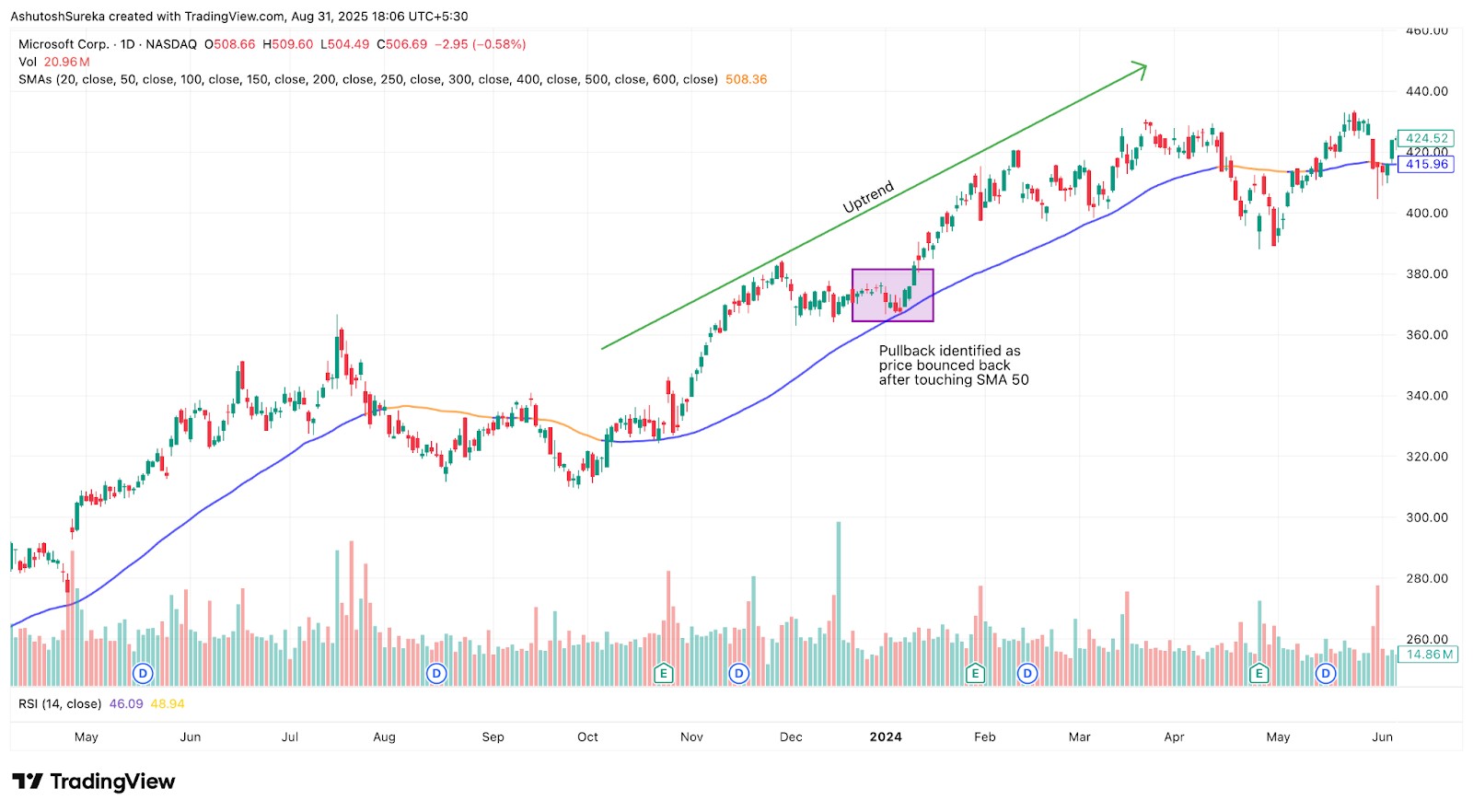
For example, in an uptrend, traders wait for the price to pull back toward the SMA, then enter a call trade once the price bounces off it. In a downtrend, price testing the SMA and rejecting it offers a put trade setup.
This approach gives a structured way to catch continuation moves without relying only on crossovers.
3 moving average confirmation method
The 3 moving averages strategy for binary options adds more filtering by using three averages: fast, medium, and slow.

| Signal condition | Trade implication |
|---|---|
| Fast > Medium > Slow | Uptrend confirmed, call setups favored |
| Fast < Medium < Slow | Downtrend confirmed, put setups favored |
This layered structure helps avoid false signals by ensuring alignment across short, medium, and long timeframes before taking a trade.
Hull moving average strategy for fast entries
The Hull Moving Average method for binary options is popular because it reduces lag and provides smoother signals.

Traders use it to catch faster trend changes without the whipsaws often seen in EMAs or SMAs. For short expiry trades, the HMA can act as both a trend filter and a signal generator, making it a top contender for the best moving average strategy for binary options.
Timeframes and asset selection for moving average setups
The success of a moving average strategy for binary options trading depends not just on the indicator itself but also on choosing the right expiry durations and assets.
Best expiry durations for MA-based signals
Moving averages smooth out price movement, but different strategies require different expiries.
For short-term signals, 5-minute or 15-minute expiries are common because EMAs react quickly.
For slower strategies like SMA pullbacks, traders often prefer 15-minute or even 30-minute expiries.
The hull moving average strategy approach allows faster entries, making it suitable for very short expiries such as 1–5 minutes.
Choosing the right expiry ensures the moving average signal has time to play out.
Which assets suit moving average strategies
Some assets respond better to moving averages than others. High-liquidity instruments with steady price action tend to respect MA signals more than volatile or thinly traded markets.
| Asset type | Why it suits MA strategies |
|---|---|
| Major forex pairs (EURUSD, GBPUSD, USDJPY) | Strong liquidity, smooth trends, reliable MA reactions |
| Commodities (Gold, Crude Oil) | Clear trending phases, good for EMA and HMA setups |
| Indices (S&P 500, DAX) | Consistent patterns align well with crossover systems |
Traders often find that the best moving average strategies for binary options perform better on majors and indices than on exotic or highly volatile pairs.
Avoiding sideways markets and false setups
A major limitation of the moving average crossover method is its weakness in sideways conditions. When markets lack clear direction, moving averages flatten and cross repeatedly, generating false signals.
To avoid this, traders add filters such as RSI or Bollinger Bands to confirm whether a genuine trend exists. By avoiding sideways markets, the moving average strategy becomes more reliable and reduces unnecessary losses.
Enhancing the strategy with other tools
The moving average strategy becomes far more effective when combined with other indicators. Pairing EMAs, SMAs, or HMAs with tools like RSI, MACD, or Bollinger Bands helps filter false entries and refine timing.
Moving average with RSI for trend filtering
RSI is a momentum indicator that works well alongside the EMA strategy for binary options trading. While moving averages highlight direction, RSI confirms whether momentum supports the move.
If the price is above the EMA and the RSI is above 50, call setups are stronger.
If the price is below the EMA and the RSI is under 50, put setups are more reliable.
This blend reduces the number of false moving average crossover signals during weak market conditions.
MACD and moving average synergy setup
MACD adds another layer of confirmation to any moving average strategy used for a binary options setup. The moving average crossover provides the initial signal, while MACD validates whether the momentum is strong enough to continue.
| Condition | Moving average role | MACD role | Trade implication |
|---|---|---|---|
| Bullish setup | Fast EMA crosses above slow EMA | MACD histogram above zero | Strong call entry |
| Bearish setup | Fast EMA crosses below slow EMA | MACD histogram below zero | Strong put entry |
Entry and exit rules for high-accuracy trades
A successful moving average strategy depends not only on spotting signals but also on applying strict entry and exit rules. By defining how to enter, when to set expiry, and what confirmations to wait for, traders can improve accuracy and consistency.
Setting entry points based on crossover triggers
Crossovers remain the most common entry rule in any moving average strategy.
A bullish entry occurs when the short EMA crosses above the long EMA, signaling upward momentum.
A bearish entry occurs when the short EMA crosses below the long EMA, signaling downward momentum.
The key is to wait until the crossover is confirmed rather than reacting mid-candle, reducing the chance of false triggers.
Defining expiry time based on market speed
Expiry choice is one of the most important factors in a moving average strategy setup. Market speed, or volatility, determines how quickly a signal plays out.
| Market speed | Suggested expiry | Why it works |
|---|---|---|
| Fast-moving market | 1–5 minutes | Quick signals resolve faster |
| Moderate trend | 5–15 minutes | Gives trades time to develop |
| Slow-moving market | 15–30 minutes | Allows crossovers to unfold without whipsaws |
This adjustment ensures that signals from the strategy deployed align with realistic trade durations.
Using candle close or breakout for confirmation
One common mistake in the moving average method is entering too early. Waiting for a candle to close after the crossover reduces noise. In some cases, traders also wait for a breakout of a recent high or low to confirm momentum before entering.
This extra step avoids false crossovers in sideways markets and ensures that entries are backed by genuine market movement. By applying this rule consistently, traders can significantly raise their win rate.
Applying a moving average strategy calls for brokers that provide smooth charting and dependable indicator access. Below is a list of platforms that supply the technical features needed to trade with moving averages effectively.
| Pepperstone | Fusion Markets | IC.com | Deriv | IC Trading | |
|---|---|---|---|---|---|
|
Tradable assets |
1200 | 250 | 2250 | 190 | 2250 |
|
Min. deposit, $ |
No | 1 | 200 | 5 | 200 |
|
Max. leverage |
1:500 | 1:500 | 1:5000 | 1:30 | 1:500 |
|
TradingView |
Yes | Yes | Yes | Yes | Yes |
|
MT5 |
Yes | Yes | Yes | Yes | Yes |
|
cTrader |
Yes | Yes | Yes | Yes | Yes |
|
TU overall score |
9.3 | 9.25 | 8.55 | 7.89 | 7.54 |
|
Open an account |
Go to broker Your capital is at risk.
|
Go to broker Your capital is at risk. |
Go to broker Your capital is at risk. |
Go to broker Your capital is at risk. |
Go to broker Your capital is at risk.
|
The one signal MA traders miss in fast binary setups

Most beginners use a moving average crossover like a traffic light. Green for go, red for stop. But in binary options, that logic breaks down. What matters more is the candle behavior right before and right after the crossover. A flat moving average with sudden volume and a wick-heavy candle often means price is about to fake one side and snap back. That is where professionals strike. So if you are watching an EMA cross on a 1-minute chart, pay more attention to the angle of the lines and the candle body strength than the crossover itself.
Another trick very few talk about is the concept of MA traps. When a fast MA crosses a slower one and the price stays flat afterward, it is a warning. That is not confirmation. That is a trap setting up. The real move happens not when the average crosses but when it fails and pulls back to retest. Watch those fake crosses. They happen all the time. The cleanest entries come from waiting, not reacting. Let the crowd chase the cross. You get in on the retest when their stops trigger.
Conclusion
The key insight from leveraging moving averages in binary options trading is that success hinges less on blindly following crossover signals and more on reading how price and momentum react around these levels. For instance, traders who wait for retests after a crossover or confirm moves with RSI or MACD significantly reduce false entries and improve accuracy. Whether using fast EMAs for 5-minute trades or applying the Hull Moving Average for quick breakout detection, the real edge comes from patience and interpreting crowd behavior, not from chasing every technical cross. Ultimately, mastering moving average strategies means focusing on market psychology and waiting for true confirmation, transforming these simple tools into powerful vehicles for consistent wins.
FAQs
What role does market volatility play in the effectiveness of a Moving Average Strategy for binary options trading?
How can entry and exit rules be refined to improve the win rate when using moving averages in binary options?
What are the main differences between SMA, EMA, and HMA when applying a moving average strategy to binary options trading?
Why is it important to avoid trading moving average signals during sideways or range-bound markets in binary options?
Editors' Top Picks and Insights






Related Articles
Team that worked on the article
Anton Kharitonov is an active trader and analyst. He employs both short- and long-term trading strategies, primarily based on fundamental factors, supported by technical indicators and intermarket analysis.
Dan Blystone began his trading career in 1998 as an arbitrage clerk on the floor of the Chicago Mercantile Exchange (CME). He later traded bond and Eurex futures at proprietary firms such as Altea Trading, gaining valuable experience in high-frequency trading and risk management.
Chinmay Soni is a financial analyst with more than 5 years of experience in working with stocks, Forex, derivatives, and other assets. As a founder of a boutique research firm and an active researcher, he covers various industries and fields, providing insights backed by statistical data.
Forex leverage is a tool enabling traders to control larger positions with a relatively small amount of capital, amplifying potential profits and losses based on the chosen leverage ratio.
Volatility refers to the degree of variation or fluctuation in the price or value of a financial asset, such as stocks, bonds, or cryptocurrencies, over a period of time. Higher volatility indicates that an asset's price is experiencing more significant and rapid price swings, while lower volatility suggests relatively stable and gradual price movements.
Risk management is a risk management model that involves controlling potential losses while maximizing profits. The main risk management tools are stop loss, take profit, calculation of position volume taking into account leverage and pip value.
CFD is a contract between an investor/trader and seller that demonstrates that the trader will need to pay the price difference between the current value of the asset and its value at the time of contract to the seller.
Day trading involves buying and selling financial assets within the same trading day, with the goal of profiting from short-term price fluctuations, and positions are typically not held overnight.

-
 Afghanistan
-
 Albania
-
 Algeria
-
 Angola
-
 Argentina
-
 Armenia
-
 Australia
-
 Austria
-
 Azerbaijan
-
 Bahamas
-
 Bahrain
-
 Bangladesh
-
 Belarus
-
 Belgium
-
 Bolivia
-
 Botswana
-
 Brazil
-
 Brunei
-
 Bulgaria
-
 Cambodia
-
 Cameroon
-
 Canada
-
 Chile
Chile
-
 China
China
-
 Colombia
-
 Congo
Congo
-
 Costa Rica
-
 Cote d'Ivoire
-
 Croatia
-
 Cuba
Cuba
-
 Cyprus
-
 Czechia
-
 DR Congo
-
 Denmark
-
 Dominican Republic
-
 Ecuador
-
 Egypt
Egypt
-
 El Salvador
-
 Estonia
-
 Eswatini
-
 Ethiopia
-
 Finland
-
 France
-
 Georgia
-
 Germany
-
 Ghana
Ghana
-
 Greece
-
 Haiti
Haiti
-
 Hong Kong
-
 Hungary
-
 India
India
-
 Indonesia
-
 Iran, Islamic republic
-
 Iraq
Iraq
-
 Ireland
-
 Israel
-
 Italy
Italy
-
 Jamaica
-
 Japan
Japan
-
 Jordan
-
 Kazakhstan
-
 Kenya
Kenya
-
 Korea
Korea
-
 Kuwait
-
 Kyrgyzstan
-
 Laos
Laos
-
 Latvia
-
 Lebanon
-
 Lesotho
-
 Libya
Libya
-
 Lithuania
-
 Luxembourg
-
 Madagascar
-
 Malaysia
-
 Malta
Malta
-
 Mauritius
-
 Mexico
-
 Moldova
-
 Mongolia
-
 Montenegro
-
 Morocco
-
 Mozambique
-
 Myanmar
-
 Namibia
-
 Nepal
Nepal
-
 Netherlands
-
 New Zealand
-
 Nigeria
-
 North Macedonia
-
 Norway
-
 Oman
Oman
-
 Pakistan
-
 Palestine
-
 Panama
-
 Papua New Guinea
-
 Paraguay
-
 Peru
Peru
-
 Philippines
-
 Poland
-
 Portugal
-
 Puerto Rico
-
 Qatar
Qatar
-
 Reunion
-
 Romania
-
 Rwanda
-
 Saudi Arabia
-
 Serbia
-
 Singapore
-
 Slovakia
-
 Slovenia
-
 Somalia
-
 South Africa
-
 Spain
Spain
-
 Sri Lanka
-
 Sweden
-
 Switzerland
-
 Syria
Syria
-
 Taiwan
-
 Tajikistan
-
 Tanzania
-
 Thailand
-
 Trinidad and Tobago
-
 Tunisia
-
 Turkey
-
 UAE
UAE
-
 Uganda
-
 Ukraine
-
 United Kingdom
-
United States
-
 Uruguay
-
 Uzbekistan
-
 Venezuela
-
 Vietnam
-
 Yemen
Yemen
-
 Zambia
-
 Zimbabwe
- Forex
- Crypto












