
Top DeFi Exchanges In 2026


Editorial Note: While we adhere to strict Editorial Integrity, this post may contain references to products from our partners. Here's an explanation for How We Make Money. None of the data and information on this webpage constitutes investment advice according to our Disclaimer.
Top-performing DeFi exchanges:
- BitcoinTry - A hybrid crypto exchange (CEX and DEX) with a Web3 wallet. Offers no-KYC trading and supports both spot and futures trading for 70+ cryptocurrencies.
- OpenOcean - Fast and efficient decentralized trading with seamless execution and deep liquidity
- Uniswap V3 - Best for decentralized trading (no central authority, peer-to-peer transactions)
- Camelot - A decentralized exchange built on the Arbitrum blockchain, offering spot trading and liquidity pools with a primary focus on assets within the Ethereum ecosystem.
- Balancer - A decentralized protocol on Ethereum with customizable liquidity pools and automatic portfolio rebalancing.
- Deepcoin - Provides advanced trading tools with real-time market data and intuitive charts
Decentralized finance (DeFi) has completely changed how people interact with financial tools. Instead of relying on banks or middlemen, DeFi platforms let users make transactions directly through smart contracts on blockchains like Ethereum. This shift means better security, full transparency, and easier access for anyone with an internet connection.
With DeFi growing fast, picking the right exchange really matters. These platforms aren’t just for trading – they open the door to a wide range of financial tools and services. As we head through 2026, there are more DeFi exchanges than ever, so choosing the right one is key to keeping your crypto safe and trading effectively.
This guide breaks down what makes top DeFi platforms stand out and helps you find the one that fits your goals best.
Risk warning: Cryptocurrency markets are highly volatile, with sharp price swings and regulatory uncertainties. Research indicates that 75-90% of traders face losses. Only invest discretionary funds and consult an experienced financial advisor.
Best DeFi exchanges
In 2026, several DeFi exchanges will have distinguished themselves by offering exceptional services and innovative features. Here’s a detailed look at some of the leading platforms:
| DEX | Demo account | Min. Deposit, $ | Coins Supported | Alerts | Copy trading | Trading bot | Open an account | |
|---|---|---|---|---|---|---|---|---|
| Yes | No | No | 59 | No | No | No | Go to broker Your capital is at risk.
|
|
| Yes | No | 1 | 1000 | No | No | No | Study review | |
| Yes | No | 1 | 282 | No | No | No | Study review | |
| Yes | No | No | 137 | No | No | No | Study review | |
| Yes | No | No | - | No | No | No | Study review | |
| Yes | Yes | 10 | 153 | No | Yes | No | Go to broker Your capital is at risk.
|






Why trust us
15+ years of independent market analysis
140+ evaluation criteria, reviewed by 50+ experts
Data-driven reviews of 200+ platforms, updated regularly
20+ industry awards & a wide network of global media partners
Learn more about our methodology and editorial policies.


What makes a DeFi exchange stand out?
Most DeFi exchanges look the same on the surface, but a few key traits separate the best from the rest – especially if you're just getting started.
Smart routing matters more than UI. A clean interface is nice, but a DEX that routes your trade through multiple pools to get the best price can quietly save you serious money.
Token whitelisting builds real trust. Platforms that review and vet tokens before listing help you avoid scams – don’t underestimate the power of curated listings.
Deep liquidity isn’t just about volume. What matters is how that liquidity is distributed – concentrated pools can mean less slippage, even with lower volume.
Watch what whales use. If high-net-worth wallets are consistently using one DEX, there’s usually a reason – whale behavior often reveals where the real efficiency is.
Audit history is a dealbreaker. Don't just check if a platform is audited – look for how often and by whom. Regular, high-quality audits are a better signal than flashy partnerships.
Gas optimization is underrated. A good DEX will bundle transactions or minimize on-chain steps to cut gas fees – small savings that add up fast over time.
Decentralized vs centralized exchanges
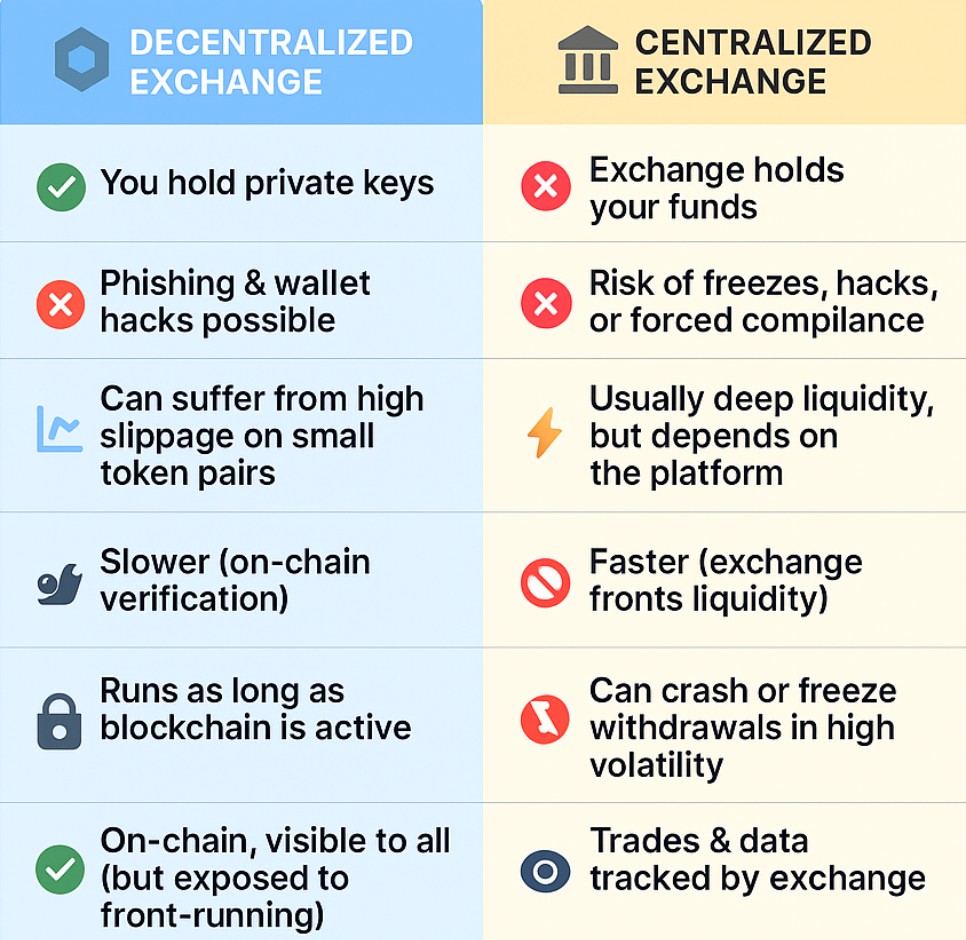
Most traders compare decentralized and centralized exchanges based on fees and ease of use, but the real differences lie much deeper. Here’s what you actually need to understand:
Your funds are safer – until they’re not. On decentralized exchanges (DEXs), you control your private keys, which is great – until you forget that even one accidental wallet connection or phishing scam can drain your funds with no one to help.
Centralized exchanges watch your every move. If you're using a CEX, remember that your trades, logins, withdrawals – even IP addresses – are being tracked. This can lead to unexpected freezes or compliance requests if your behavior triggers risk flags.
Liquidity looks good – but check the slippage. DEXs can show high liquidity but still suffer from huge slippage when trading certain token pairs. Always check the actual execution impact, especially with low-cap or volatile assets.
Speed isn't just about tech – it's about trust. Centralized exchanges are fast because they front the liquidity, but you're trusting them with every step. DEXs are slower because every action is verified on-chain, but that delay comes with transparency.
CEX downtime can ruin everything. During high volatility, centralized platforms often freeze withdrawals or crash completely. DEXs can keep running if the blockchain does, making them more reliable when the market gets crazy.
Hidden front-running is real. While DEXs offer transparency, they also expose your trade intentions to bots that can front-run your transactions. Tools like MEV protection or private relays can reduce this, but most beginners don’t use them.
Getting started with a DeFi exchange
Starting on a DeFi exchange isn’t just about clicking "connect wallet" – there’s a lot going on under the hood that traders miss. Here’s how to truly get ahead:
Check gas fee timing before any trade. Many first-timers lose money by swapping during peak network hours; always check current gas prices on tools like Etherscan or TXStreet and plan trades during low-traffic windows to save big.
Know how slippage settings affect your outcome. Most users leave slippage tolerance at default, but even 0.5% can make or break a trade on low-liquidity pairs – understand how to manually adjust slippage and why it matters during high volatility.
Always verify the contract address. Scammers often clone popular tokens with similar names – don’t just search for a token on the exchange UI; get the official contract from CoinGecko or the project’s verified site to avoid fake tokens.
Understand liquidity pool depth before trading. Just because a token is listed doesn’t mean it has meaningful liquidity – if the pool is too shallow, even a small trade can lead to wild price impact or failed transactions.
Watch token approval permissions. When you approve a token to be spent by a DEX, you may unknowingly grant unlimited access – always review and limit allowances using tools like Revoke.cash after your transaction.
Use Layer 2 networks when possible. Don’t jump into Ethereum mainnet trades without checking if the same pair is available on a Layer 2 like Arbitrum or Optimism – fees are lower, and settlement is faster.
Track real-time pool activity before entering. Some advanced traders use bots to monitor liquidity adds and removals – if a whale pulls out liquidity mid-trade, you’re left exposed. Use tools like DEXTools or DeBank to watch live changes.

Future trends in DeFi exchanges
DeFi exchanges in 2026 and beyond won’t just evolve – they’ll completely reshape how users interact with crypto markets. Here are powerful insights you should not miss:
Real yield will replace inflationary rewards. Instead of relying on unsustainable token emissions, DeFi platforms will focus on generating real revenue – through fees or partnerships – and distributing that to users, meaning your returns won’t evaporate with token inflation.
Account abstraction will simplify onboarding. Smart contract wallets will allow users to skip seed phrases and gas tokens, meaning you'll log in with biometrics or social accounts while the tech quietly handles everything in the background.
DEXs will integrate intent-based trading. Rather than placing orders manually, users will submit "what they want" (like best price or lowest slippage), and protocols will route it through MEV-resistant paths to get optimal execution automatically.
Modular liquidity layers will dominate. Instead of liquidity locked in separate pools on every DEX, future exchanges will tap into shared, modular liquidity across chains and platforms, making slippage and fragmentation much less of a problem.
AI-driven risk engines will protect users. Future DeFi platforms will use AI models to detect unusual wallet behavior, flag scams, and auto-disable risky contracts – giving retail users a layer of defense without needing expert knowledge.
DEX aggregators will evolve into trade strategists. They won't just find the best price – they’ll simulate different outcomes, assess gas costs, volatility, and execution time, then recommend the smartest way to execute a trade.
Cross-chain UX will feel chainless. As cross-chain bridges and interoperability improve, users won’t even need to know what chain they’re using – DeFi platforms will abstract it away, letting them trade any token from anywhere with one click.
Routing and fake liquidity can distort top DeFi exchange choices in 2026

Most beginners jump into DeFi by picking the exchange with the biggest brand name – but they often overlook how fee structures, routing logic, and LP incentives impact real trade results. For example, Uniswap V3 might seem like the obvious choice for ERC-20 tokens, but if you're not using a front-end that optimizes for concentrated liquidity zones, you might be paying more than necessary in slippage and gas. Meanwhile, newer platforms like CowSwap use intent-based trading and MEV protection to route your trades differently – sometimes giving you better prices even if the base protocol isn’t as popular. The secret? It’s not just about where you trade – it’s how the trade gets executed under the hood.
Another thing few beginners realize is how rewards and tokenomics can distort liquidity incentives. A DEX may offer huge APYs to liquidity providers, but that often signals low organic trading volume and potential price manipulation. Look at depth, not hype – a good exchange has real, sticky liquidity without constant incentives. Tools like DeFiLlama’s DEX tracker can show volume-to-incentive ratios, helping you separate real market demand from short-term farming games. If you're serious about staying in DeFi long-term, train your eye to read behind the numbers – not just chase whatever’s trending on crypto Twitter.
Methodology for compiling our ratings of crypto exchanges
Traders Union applies a rigorous methodology to evaluate crypto exchanges using over 100 quantitative and qualitative criteria. Multiple parameters are given individual scores that feed into an overall rating.
Key aspects of the assessment include:
-
User reviews. Client reviews and feedback are analyzed to determine customer satisfaction levels. Reviews are fact-checked and verified.
-
Trading instruments. Exchanges are evaluated on the range of assets offered, as well as the breadth and depth of available markets.
-
Fees and commissions. All trading fees and commissions are analyzed comprehensively to determine overall costs for clients.
-
Trading platforms. Exchanges are assessed based on the variety, quality, and features of platforms offered to clients.
-
Extra services. Unique value propositions and useful features that provide traders with more options for yield generation.
-
Other factors like brand popularity, client support, and educational resources are also evaluated.
Conclusion
The top DeFi exchanges of 2026 are redefining how users trade digital assets, offering enhanced security, lower fees, and a broader selection of cryptocurrencies. These platforms continue to push innovation, each catering to different trading needs. Whether you prioritize liquidity, advanced trading tools, or a user-friendly experience, choosing the right exchange is crucial for securing assets and optimizing trading strategies.
As decentralized finance evolves, staying informed about new features and security measures is essential. By selecting a trusted DeFi exchange, traders can navigate the future of finance with confidence, flexibility, and full control over their assets.
FAQs
What is a DeFi exchange?
A DeFi (Decentralized Finance) exchange is a platform that allows users to trade cryptocurrencies directly from their wallets without needing an intermediary or custodian. Transactions are automated by smart contracts on a blockchain.
How safe are DeFi exchanges?
DeFi exchanges are generally safe if they use robust security measures like smart contract audits and multi-factor authentication. However, users must manage their own security, such as safeguarding private keys.
Can I trade any cryptocurrency on a DeFi exchange?
Most DeFi exchanges support a broad range of cryptocurrencies, especially those built on Ethereum. The availability of specific assets can vary, so check each platform for its supported tokens.
Do I need to provide personal information to use a DeFi exchange?
No, most DeFi exchanges do not require personal information for trading. They offer privacy and anonymity by allowing you to trade directly from your wallet without identity verification.
Editors' Top Picks and Insights




Related Articles
Team that worked on the article
Peter Emmanuel Chijioke is a professional personal finance, Forex, crypto, blockchain, NFT, and Web3 writer and a contributor to the Traders Union website. As a computer science graduate with a robust background in programming, machine learning, and blockchain technology, he possesses a comprehensive understanding of software, technologies, cryptocurrency, and Forex trading.
Dan Blystone began his trading career in 1998 as an arbitrage clerk on the floor of the Chicago Mercantile Exchange (CME). He later traded bond and Eurex futures at proprietary firms such as Altea Trading, gaining valuable experience in high-frequency trading and risk management.
Chinmay Soni is a financial analyst with more than 5 years of experience in working with stocks, Forex, derivatives, and other assets. As a founder of a boutique research firm and an active researcher, he covers various industries and fields, providing insights backed by statistical data.
Yield refers to the earnings or income derived from an investment. It mirrors the returns generated by owning assets such as stocks, bonds, or other financial instruments.
Volatility refers to the degree of variation or fluctuation in the price or value of a financial asset, such as stocks, bonds, or cryptocurrencies, over a period of time. Higher volatility indicates that an asset's price is experiencing more significant and rapid price swings, while lower volatility suggests relatively stable and gradual price movements.
CFD is a contract between an investor/trader and seller that demonstrates that the trader will need to pay the price difference between the current value of the asset and its value at the time of contract to the seller.
Risk management is a risk management model that involves controlling potential losses while maximizing profits. The main risk management tools are stop loss, take profit, calculation of position volume taking into account leverage and pip value.
Index in trading is the measure of the performance of a group of stocks, which can include the assets and securities in it.

-
 Afghanistan
-
 Albania
-
 Algeria
-
 Angola
-
 Argentina
-
 Armenia
-
 Australia
-
 Austria
-
 Azerbaijan
-
 Bahamas
-
 Bahrain
-
 Bangladesh
-
 Belarus
-
 Belgium
-
 Bolivia
-
 Botswana
-
 Brazil
-
 Brunei
-
 Bulgaria
-
 Cambodia
-
 Cameroon
-
 Canada
-
 Chile
Chile
-
 China
China
-
 Colombia
-
 Congo
Congo
-
 Costa Rica
-
 Cote d'Ivoire
-
 Croatia
-
 Cuba
Cuba
-
 Cyprus
-
 Czechia
-
 DR Congo
-
 Denmark
-
 Dominican Republic
-
 Ecuador
-
 Egypt
Egypt
-
 El Salvador
-
 Estonia
-
 Eswatini
-
 Ethiopia
-
 Finland
-
 France
-
 Georgia
-
 Germany
-
 Ghana
Ghana
-
 Greece
-
 Haiti
Haiti
-
 Hong Kong
-
 Hungary
-
 India
India
-
 Indonesia
-
 Iran, Islamic republic
-
 Iraq
Iraq
-
 Ireland
-
 Israel
-
 Italy
Italy
-
 Jamaica
-
 Japan
Japan
-
 Jordan
-
 Kazakhstan
-
 Kenya
Kenya
-
 Korea
Korea
-
 Kuwait
-
 Kyrgyzstan
-
 Laos
Laos
-
 Latvia
-
 Lebanon
-
 Lesotho
-
 Libya
Libya
-
 Lithuania
-
 Luxembourg
-
 Madagascar
-
 Malaysia
-
 Malta
Malta
-
 Mauritius
-
 Mexico
-
 Moldova
-
 Mongolia
-
 Montenegro
-
 Morocco
-
 Mozambique
-
 Myanmar
-
 Namibia
-
 Nepal
Nepal
-
 Netherlands
-
 New Zealand
-
 Nigeria
-
 North Macedonia
-
 Norway
-
 Oman
Oman
-
 Pakistan
-
 Palestine
-
 Panama
-
 Papua New Guinea
-
 Paraguay
-
 Peru
Peru
-
 Philippines
-
 Poland
-
 Portugal
-
 Puerto Rico
-
 Qatar
Qatar
-
 Reunion
-
 Romania
-
 Rwanda
-
 Saudi Arabia
-
 Serbia
-
 Singapore
-
 Slovakia
-
 Slovenia
-
 Somalia
-
 South Africa
-
 Spain
Spain
-
 Sri Lanka
-
 Sweden
-
 Switzerland
-
 Syria
Syria
-
 Taiwan
-
 Tajikistan
-
 Tanzania
-
 Thailand
-
 Trinidad and Tobago
-
 Tunisia
-
 Turkey
-
 UAE
UAE
-
 Uganda
-
 Ukraine
-
 United Kingdom
-
United States
-
 Uruguay
-
 Uzbekistan
-
 Venezuela
-
 Vietnam
-
 Yemen
Yemen
-
 Zambia
-
 Zimbabwe
- Forex
- Crypto












